



Isobutanol Market Size 2026-2030
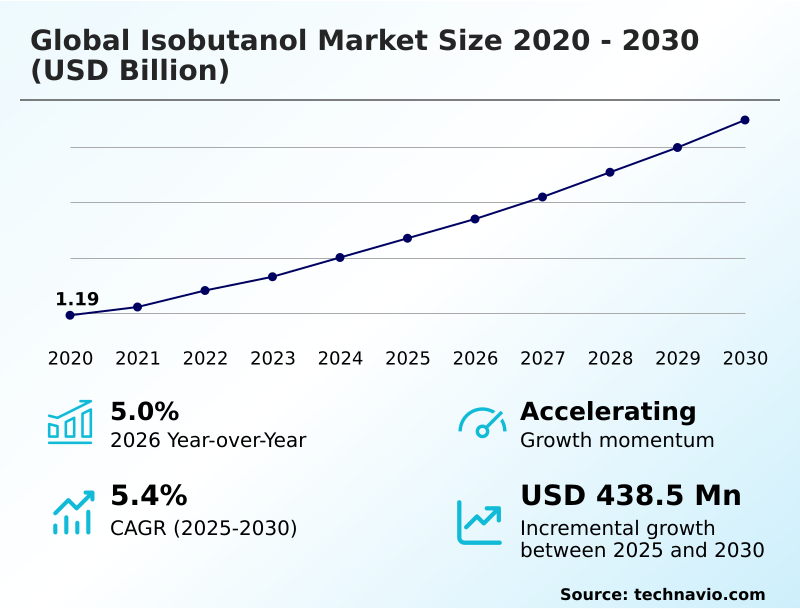
The isobutanol market size is valued to increase by USD 438.5 million, at a CAGR of 5.4% from 2025 to 2030. Increasing demand for coatings in automotive sector will drive the isobutanol market.
Major Market Trends & Insights
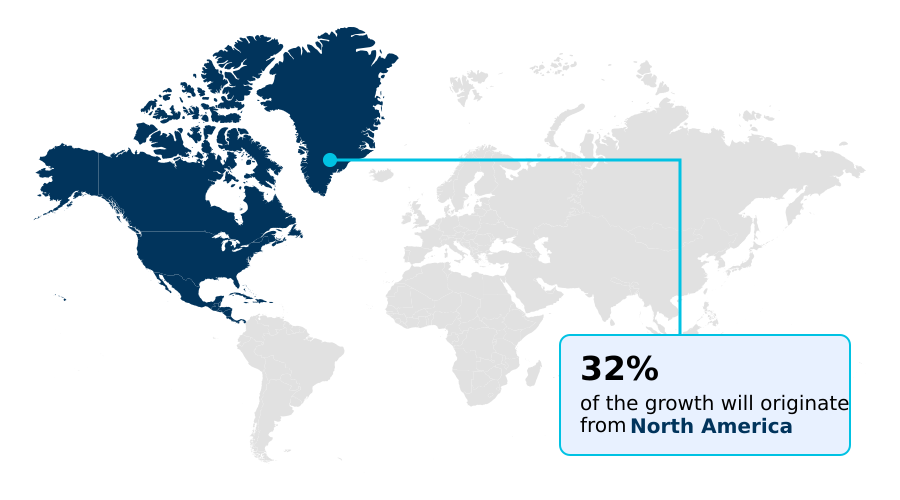
- North America dominated the market and accounted for a 31.6% growth during the forecast period.
- By Application - Solvent segment was valued at USD 567.1 million in 2024
- By Product - Bio-based segment accounted for the largest market revenue share in 2024
Market Size & Forecast
- Market Opportunities: USD 717.9 million
- Market Future Opportunities: USD 438.5 million
- CAGR from 2025 to 2030 : 5.4%
Market Summary
- The isobutanol market is characterized by its broad utility across multiple industries, functioning as both a critical solvent and a chemical intermediate. Its growth is closely linked to the expansion of the automotive and construction sectors, which rely on high-performance coatings and paints where isobutanol is a key ingredient.
- A significant trend is the increasing demand for bio-based chemicals, driving innovation in producing isobutanol from renewable resources like biomass, which offers a lower carbon footprint. This shift presents both opportunities and challenges. For instance, a paint manufacturer must navigate the volatile prices of petrochemical derivative feedstocks while also exploring bio-based alternatives to meet stricter volatile organic compound regulations.
- This requires strategic decisions on supply chain resilience, investment in fermentation process technology, and product reformulation. The development of sustainable aviation fuel from isobutanol further diversifies its application profile, positioning it as a key component in the transition toward a circular economy principle.
What will be the Size of the Isobutanol Market during the forecast period?
Get Key Insights on Market Forecast (PDF) Request Free Sample
How is the Isobutanol Market Segmented?
The isobutanol industry research report provides comprehensive data (region-wise segment analysis), with forecasts and estimates in "USD million" for the period 2026-2030, as well as historical data from 2020-2024 for the following segments.
- Application
- Solvent
- Intermediate for glycol ethers and esters
- Textile
- Others
- Product
- Bio-based
- Synthetic
- Grade type
- Industrial grade
- Pharmaceutical grade
- Food grade
- Geography
- APAC
- China
- Japan
- India
- Europe
- Germany
- UK
- France
- North America
- US
- Canada
- Mexico
- Middle East and Africa
- Saudi Arabia
- UAE
- South Africa
- South America
- Brazil
- Argentina
- Rest of World (ROW)
- APAC
By Application Insights
The solvent segment is estimated to witness significant growth during the forecast period.
The industrial application of isobutanol as a solvent is foundational to its market position, particularly in the paints and coatings industry. It is extensively used as a paint thinner component and in wood coating formulation.
The substance's properties, including its slow evaporation rate, make it a critical architectural coating solvent for lacquers, inks, and various protective finishes. Demand is closely tied to industrialization, with sectors like automotive and construction being primary consumers.
The market is experiencing a notable 5.0% year-over-year growth, reflecting increased manufacturing activity. Key applications include its use as a glycol ether synthesis precursor and in diverse chemical intermediate processes, underscoring its versatility as an industrial grade solvent.
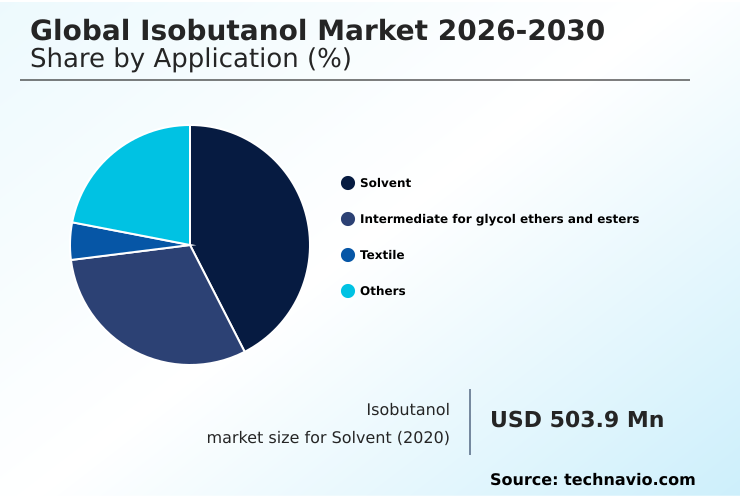
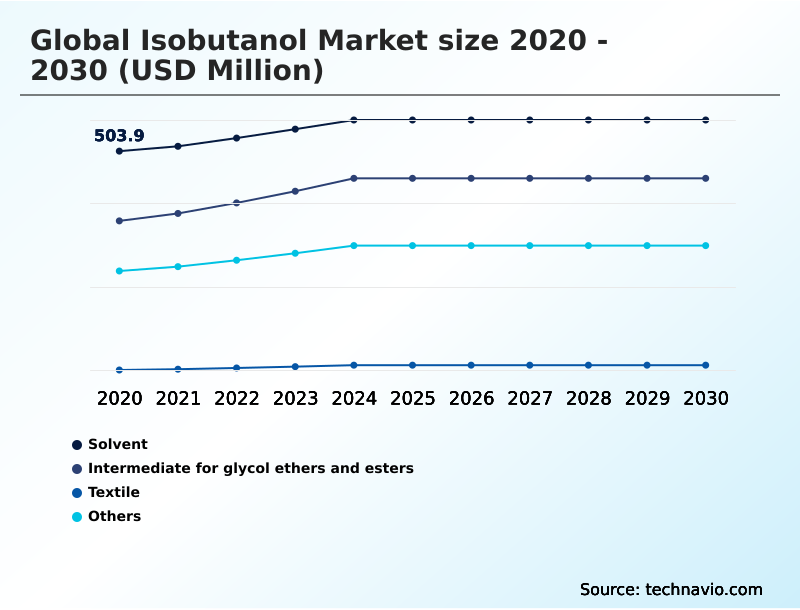
The Solvent segment was valued at USD 567.1 million in 2024 and showed a gradual increase during the forecast period.
Regional Analysis
North America is estimated to contribute 31.6% to the growth of the global market during the forecast period.Technavio’s analysts have elaborately explained the regional trends and drivers that shape the market during the forecast period.
See How Isobutanol Market Demand is Rising in North America Request Free Sample
The geographic landscape of the isobutanol market is shaped by regional industrial strengths and regulatory priorities.
North America accounts for 31.6% of the market's incremental growth, driven by its robust petrochemical infrastructure and pioneering efforts in bio-isobutanol for sustainable aviation fuel.
The region's focus on technological advancement allows companies to achieve up to a 15% improvement in production yields from new catalytic processes.
In APAC, rapid industrialization, particularly in China and India, fuels demand for isobutanol as a textile finishing agent and in automotive coating formulation.
Meanwhile, Europe's stringent environmental laws, such as REACH, propel the adoption of bio-based isobutanol and other low-carbon footprint chemical alternatives, emphasizing a move toward a circular economy principle and away from conventional petrochemical derivative products.
Market Dynamics
Our researchers analyzed the data with 2025 as the base year, along with the key drivers, trends, and challenges. A holistic analysis of drivers will help companies refine their marketing strategies to gain a competitive advantage.
- Strategic decision-making in the global isobutanol market 2026-2030 requires a deep understanding of its multifaceted applications and economic drivers. The process for synthetic isobutanol production remains dominant, but the cost of bio-based isobutanol production is decreasing, making it a viable alternative. Comparing isobutanol and ethanol biofuels reveals isobutanol's superior energy density, which improves fuel economy with isobutanol.
- This advantage is critical for its role in producing renewable isobutanol from biomass and its potential for sustainable aviation fuel from isobutanol. In industrial settings, the role of isobutanol in textile processing and for non-woven medical textiles is expanding. Formulating paints and coatings with isobutanol is a core application, where it functions as an architectural coating solvent.
- Automotive sector isobutanol consumption trends show steady demand. Beyond fuels and coatings, isobutanol serves as a versatile chemical intermediate and is used for isobutanol derivative chemical synthesis. Its applications for pharmaceutical grade isobutanol are growing, while common uses for industrial grade isobutanol remain stable. Factors driving isobutanol price volatility and VOC regulations affecting isobutanol usage are key challenges.
- The material also functions as a feedstock for plasticizers and is used in lubricant additives, showcasing its wide-ranging industrial importance.
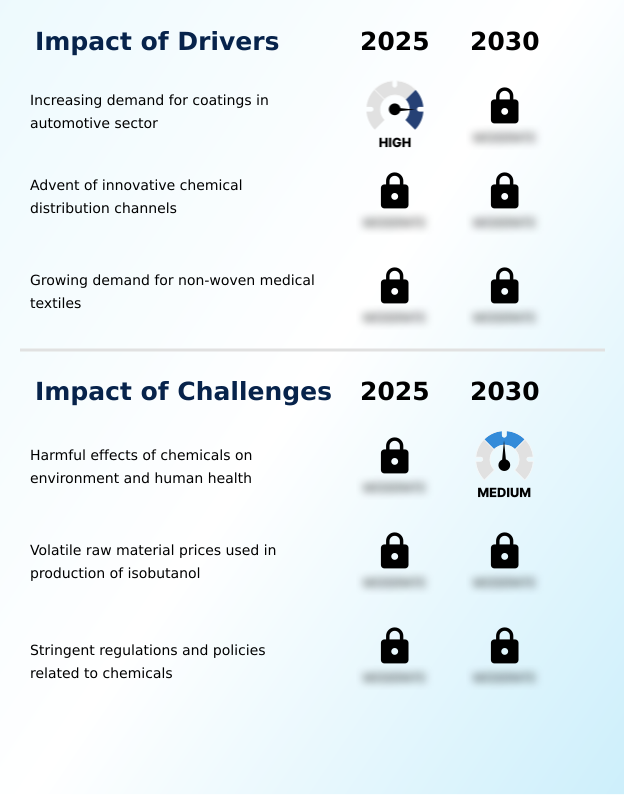
What are the key market drivers leading to the rise in the adoption of Isobutanol Industry?
- The increasing demand for coatings within the automotive sector stands as a key driver for market growth.
- Market growth is significantly driven by robust demand from the automotive sector and the modernization of chemical distribution channels.
- In the automotive industry, isobutanol is essential for formulating high-performance surface coatings and engine coatings that provide superior scratch resistance and chip resistance.
- This demand is amplified by the global expansion of automotive manufacturing, with isobutanol-based coatings improving production line efficiency by reducing drying times by up to 8%.
- Simultaneously, the shift from traditional distribution to direct-to-consumer models has enabled producers to reach new customer segments more effectively, increasing market penetration by 15% in previously underserved regions.
- The growing use of non-woven medical textiles, where isobutanol serves as a critical solvent, further underpins its expanding application base.
What are the market trends shaping the Isobutanol Industry?
- The rising rate of industrialization in emerging economies is a significant upcoming trend, which is expected to drive demand across key end-user industries.
- Key market trends are redefining the competitive landscape, primarily through the accelerated adoption of bio-based chemicals and strategic consolidation. The demand for renewable isobutanol, which can be produced from biomass using advanced biofuel technologies, is surging as companies aim to reduce their carbon footprint and lessen dependence on fossil fuels.
- This shift has led to an uptick in mergers and acquisitions, with major players acquiring innovative startups to gain access to proprietary fermentation technologies and carbon capture infrastructure. These strategic moves are enabling companies to improve production efficiency by over 10%.
- Furthermore, the development of bio-isobutanol as a drop-in sustainable aviation fuel (SAF) is creating new high-value opportunities, with early adopters demonstrating a 5% improvement in fuel-burn efficiency compared to some alternatives.
What challenges does the Isobutanol Industry face during its growth?
- The harmful effects of chemicals on the environment and human health present a key challenge affecting industry growth.
- The market faces considerable challenges from a stringent regulatory environment and the volatility of raw material pricing. Regulations such as REACH and EPA standards impose strict limits on volatile organic compound (VOC) content, compelling manufacturers to invest heavily in reformulation, which can increase R&D costs by up to 20%.
- These compliance expenses and lengthy approval processes can hinder profitability and slow market entry. Additionally, the price of feedstocks like propylene is subject to significant fluctuations due to geopolitical factors and supply-demand imbalances.
- This price instability can erode profit margins by as much as 10% in a single quarter, making it difficult for producers to maintain consistent pricing and plan long-term production strategies effectively.
Exclusive Technavio Analysis on Customer Landscape
The isobutanol market forecasting report includes the adoption lifecycle of the market, covering from the innovator’s stage to the laggard’s stage. It focuses on adoption rates in different regions based on penetration. Furthermore, the isobutanol market report also includes key purchase criteria and drivers of price sensitivity to help companies evaluate and develop their market growth analysis strategies.
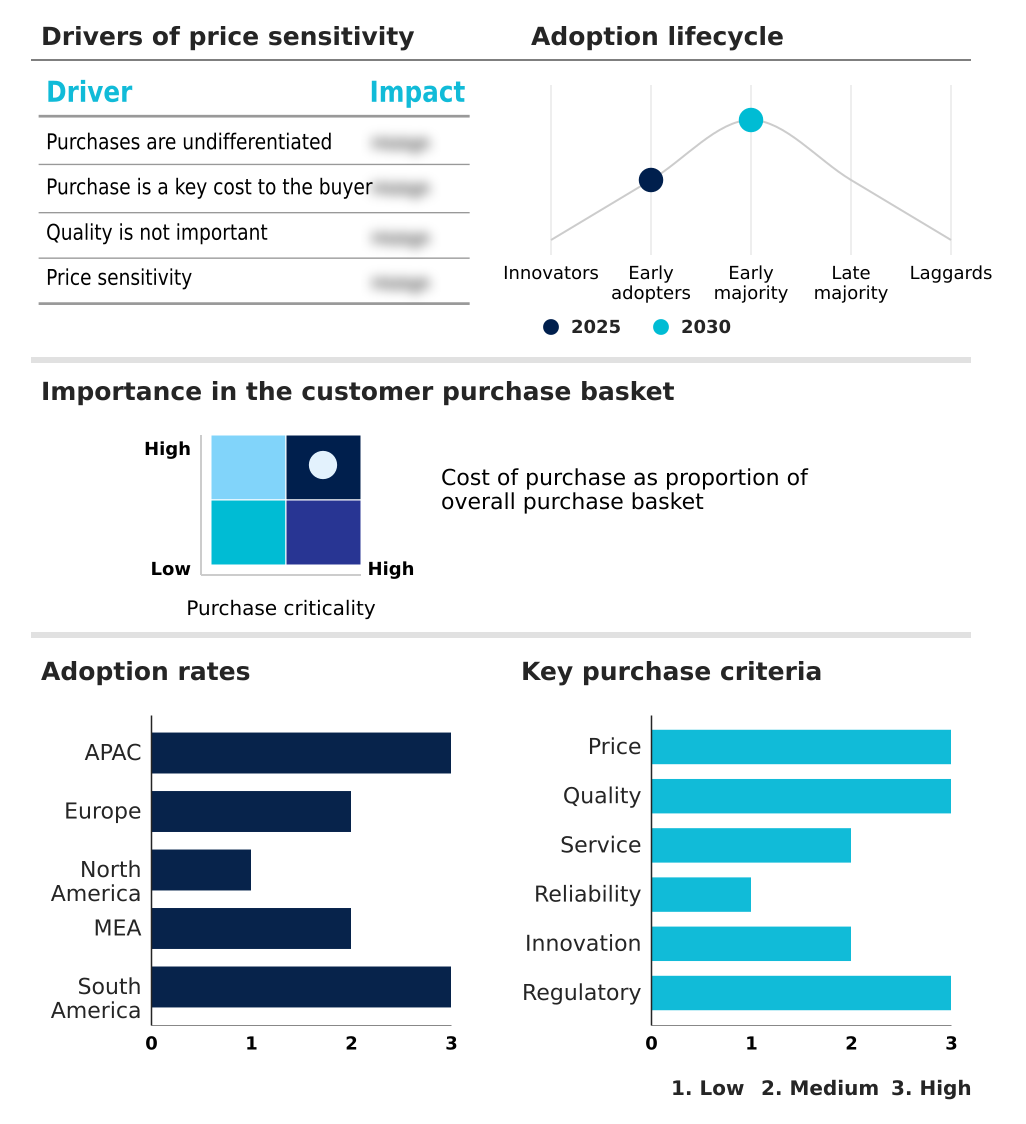
Customer Landscape of Isobutanol Industry
Competitive Landscape
Companies are implementing various strategies, such as strategic alliances, isobutanol market forecast, partnerships, mergers and acquisitions, geographical expansion, and product/service launches, to enhance their presence in the industry.
Andhra Petrochemicals Ltd. - Offerings include high-purity isobutanol for synthesis, serving as a critical raw material for performance chemicals and advanced material applications.
The industry research and growth report includes detailed analyses of the competitive landscape of the market and information about key companies, including:
- Andhra Petrochemicals Ltd.
- BASF SE
- Bharat Petroleum Corp. Ltd.
- BP Plc
- DhanLaxmi Organics and Chemicals
- Dow Chemical Co.
- Eastman Chemical Co.
- Formosa Plastics Corp.
- Grupa Azoty SA
- Hi Tech Chemicals Converters Pvt. Ltd.
- INEOS Group Holdings S.A.
- Merck KGaA
- Mitsubishi Chemical Corp.
- Nan Ya Plastic Corp.
- Niksan Pharmaceutical
- OQ SAOC
- Petroliam Nasional Berhad
- Sasol Ltd.
- SIBUR Holding PJSC
- Somu Group of Companies Inc.
Qualitative and quantitative analysis of companies has been conducted to help clients understand the wider business environment as well as the strengths and weaknesses of key industry players. Data is qualitatively analyzed to categorize companies as pure play, category-focused, industry-focused, and diversified; it is quantitatively analyzed to categorize companies as dominant, leading, strong, tentative, and weak.
Recent Development and News in Isobutanol market
- In August 2024, Gevo Inc. provided a corporate update detailing significant progress on its Net-Zero projects, which are centered around its proprietary isobutanol production technology for creating sustainable aviation fuel and other renewable hydrocarbons.
- In October 2024, BASF SE announced a major expansion of its isobutanol production facility in China to meet escalating regional demand for automotive coatings and chemical intermediates, reinforcing its position in the APAC market.
- In February 2025, Gevo Inc. completed its acquisition of Red Trail Energy (RTE), a strategic maneuver that significantly bolsters its position in the sustainable fuels market by integrating RTE's ethanol production with its isobutanol technology.
- In March 2025, Novo Nordisk's agreement to acquire the contract development and manufacturing organization (CDMO) Catalent signaled a broader trend of consolidation, expected to increase regional demand for high-purity pharmaceutical grade isobutanol to support complex drug syntheses.
Dive into Technavio’s robust research methodology, blending expert interviews, extensive data synthesis, and validated models for unparalleled Isobutanol Market insights. See full methodology.
| Market Scope | |
|---|---|
| Page number | 299 |
| Base year | 2025 |
| Historic period | 2020-2024 |
| Forecast period | 2026-2030 |
| Growth momentum & CAGR | Accelerate at a CAGR of 5.4% |
| Market growth 2026-2030 | USD 438.5 million |
| Market structure | Fragmented |
| YoY growth 2025-2026(%) | 5.0% |
| Key countries | China, Japan, India, South Korea, Australia, Indonesia, Germany, UK, France, Italy, Spain, The Netherlands, US, Canada, Mexico, Saudi Arabia, UAE, South Africa, Israel, Turkey, Brazil, Argentina and Chile |
| Competitive landscape | Leading Companies, Market Positioning of Companies, Competitive Strategies, and Industry Risks |
Research Analyst Overview
- The isobutanol market is evolving beyond its traditional role, driven by innovations in both production and application. The use of oxo-alcohol as a foundational chemical intermediate is well-established, but the industry is now pivoting toward advanced bio-based chemical solutions derived from a fermentation process. This shift is a direct response to demand for renewable hydrocarbon alternatives.
- Boardroom decisions are increasingly focused on navigating the complexities of feedstock sourcing, balancing between conventional propylene hydrogenation and emerging biomass conversion methods. The adoption of carbon capture and storage technologies is becoming a key differentiator, with some producers reporting a 10% reduction in their overall carbon footprint.
- Applications are diversifying from standard industrial grade solvent use in paint thinner component and wood coating formulation to high-value uses in pharmaceutical grade solvent and food grade adjuvant products. This diversification is also seen in its role as a flotation agent, de-icing fluid, lubricant additive, fuel additive, and agrochemical intermediate, underscoring its expanding utility across sectors.
What are the Key Data Covered in this Isobutanol Market Research and Growth Report?
-
What is the expected growth of the Isobutanol Market between 2026 and 2030?
-
USD 438.5 million, at a CAGR of 5.4%
-
-
What segmentation does the market report cover?
-
The report is segmented by Application (Solvent, Intermediate for glycol ethers and esters, Textile, and Others), Product (Bio-based, and Synthetic), Grade Type (Industrial grade, Pharmaceutical grade, and Food grade) and Geography (APAC, Europe, North America, Middle East and Africa, South America)
-
-
Which regions are analyzed in the report?
-
APAC, Europe, North America, Middle East and Africa and South America
-
-
What are the key growth drivers and market challenges?
-
Increasing demand for coatings in automotive sector, Harmful effects of chemicals on environment and human health
-
-
Who are the major players in the Isobutanol Market?
-
Andhra Petrochemicals Ltd., BASF SE, Bharat Petroleum Corp. Ltd., BP Plc, DhanLaxmi Organics and Chemicals, Dow Chemical Co., Eastman Chemical Co., Formosa Plastics Corp., Grupa Azoty SA, Hi Tech Chemicals Converters Pvt. Ltd., INEOS Group Holdings S.A., Merck KGaA, Mitsubishi Chemical Corp., Nan Ya Plastic Corp., Niksan Pharmaceutical, OQ SAOC, Petroliam Nasional Berhad, Sasol Ltd., SIBUR Holding PJSC and Somu Group of Companies Inc.
-
Market Research Insights
- The isobutanol market's momentum is shaped by the dual demand for traditional synthetic and emerging bio-based variants. Innovations in production are enabling firms to improve process efficiency by over 12%, enhancing the cost-competitiveness of renewable isobutanol. This is crucial as industries seek sustainable alternatives to petroleum-derived feedstocks.
- For instance, in the coatings sector, reformulations utilizing bio-isobutanol can reduce volatile organic compound (VOC) emissions by up to 25%, aligning with stringent environmental regulations. The adoption of advanced distribution channels has also improved supply chain responsiveness, with some suppliers reporting a 15% reduction in delivery lead times.
- This efficiency, combined with the material's performance as a flow and gloss enhancer and octane level booster, reinforces its value proposition across diverse applications.
We can help! Our analysts can customize this isobutanol market research report to meet your requirements.