

Japan Testosterone Replacement Therapy Market Analysis, Size, and Forecast 2026-2030

Japan Testosterone Replacement Therapy Market Analysis, Size, and Forecast 2026-2030

Published: May 2026 206 Pages SKU: IRTNTR81293

Market Overview at a Glance

$19.42 Mn
Market Opportunity
5.7%
CAGR 2025 - 2030
5.6%
YoY growth 2025-2026(%)
$29.27 Mn
Hospitals pharmacies segment 2024

Japan Testosterone Replacement Therapy Market Size and Growth Forecast 2026-2030

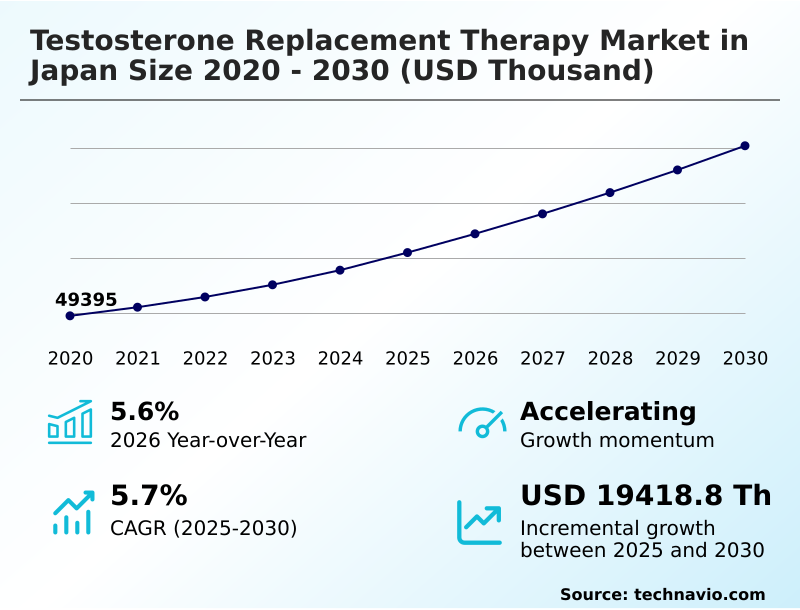
The Japan Testosterone Replacement Therapy Market size was valued at USD 60.90 million in 2025 growing at a CAGR of 5.7% during the forecast period 2026-2030.

The Hospitals pharmacies segment by Distribution Channel was valued at USD 29.27 million in 2024, while the Injectables segment holds the largest revenue share by Product.

The market is projected to grow by from 2020 to 2030, with USD 19.42 million of the growth expected during the forecast period of 2025 to 2030.
Get Key Insights on Market Forecast (PDF) Request Free Sample

Japan Testosterone Replacement Therapy Market Overview

The testosterone replacement therapy market in Japan is defined by the clinical necessity to manage conditions like late-onset hypogonadism within its rapidly aging population, a dynamic driving year-over-year growth of 5.6%. This has catalyzed a shift towards patient-centric delivery and non-invasive treatments, including transdermal gels and advanced oral formulations. A specialized men's health clinic in Tokyo, for instance, leverages digital health platforms to offer telemedicine consultations and home testing kits. This approach enhances patient adherence to therapeutic regimens by enabling remote dosage adjustments based on real-time serum testosterone levels, improving outcomes for androgen deficiency and associated sarcopenia. The integration of such technologies, governed by clinical guidelines, is crucial for effective comorbidity management and addresses the psychological barriers to treatment. This model exemplifies the market's move toward combining clinical efficacy with patient convenience, directly influencing the adoption of different testosterone esters and delivery systems.

Drivers, Trends, and Challenges in the Japan Testosterone Replacement Therapy Market

The economic burden of untreated hypogonadism is a significant factor shaping investment in the testosterone replacement therapy market in Japan. Navigating the regulatory hurdles for new androgenic products, as stipulated by the Pharmaceutical and Medical Devices Act, remains a primary challenge, alongside achieving diagnostic accuracy for testosterone deficiency.

The cultural shifts in male hormonal health are driving demand for services that address long-term safety concerns of androgen therapy, with a notable preference for non-invasive testosterone delivery. A key operational consideration for providers is managing comorbidities with testosterone therapy, which requires specialized training for hormone providers.

The role of telemedicine in male hormonal health is expanding, offering discreet access and improving patient adherence to self-administered gels. Clinically, the debate over injectable versus topical testosterone efficacy continues, with injectables still holding nearly double the market share of topicals.

In practice, a urology clinic managing testosterone therapy for late-onset hypogonadism must now integrate digital platforms to monitor patient outcomes, reflecting the broader impact of digital health on TRT access. The comparative profiles of testosterone undecanoate vs enanthate are central to prescribing decisions, balancing half-life with patient lifestyle.

Concurrently, R&D efforts focus on improving bioavailability in oral testosterone while also mitigating the risk of secondary transfer from topicals and standardizing TRT clinical guidelines.
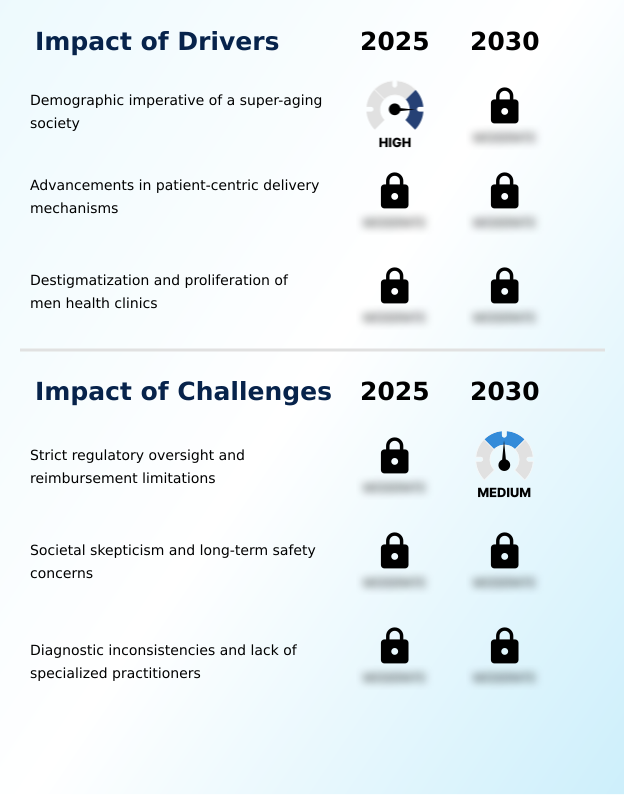
Primary Growth Driver: The demographic imperative of a super-aging society is a key driver for the market.

The primary market driver is Japan's super-aging demographic, with over 30% of its population aged 65 or older as of 2025, creating an urgent clinical necessity for managing age-related conditions.

This has intensified the focus on late-onset hypogonadism, male menopause, and associated health issues like sarcopenia and metabolic syndrome.

A cultural shift toward the destigmatization of men's health has lowered psychological barriers to treatment, increasing demand for diagnostic screenings and therapies that promote anti-aging and vitality.

The emphasis on maintaining the health of an aging workforce has led to the integration of testosterone therapy into standard geriatric care protocols and preventative hormonal treatments, supported by a growing number of specialized men's health clinics and more open public discourse.

Emerging Market Trend: A key market trend is the transition toward non-invasive delivery systems. This shift addresses patient preferences for convenience and reduced clinical visits.

A significant trend is the move toward digital health platforms and telemedicine consultations to manage androgen deficiency. This digitalization supports remote monitoring and convenient dosage adjustments, enhancing patient adherence to self-administered topical solutions and oral formulations. The development of user-friendly delivery mechanisms, including long-acting formulations and subcutaneous implants, reflects a strong market preference for non-invasive treatments over traditional injectable formulations.

This evolution in drug delivery systems aims to improve the pharmacokinetic profile of treatments, ensuring more stable serum testosterone levels. The focus on patient convenience is also driving innovation in home testing kits, which empower individuals to take a more active role in managing their hormonal balance and supports a more holistic approach to hormone therapy.

Key Industry Challenge: Strict regulatory oversight and reimbursement limitations are key challenges affecting industry growth.

A significant market challenge stems from Japan's rigorous regulatory framework under the Pharmaceutical and Medical Devices Act, which imposes strict controls and complex reimbursement pathways. This creates a bifurcated market where access often depends on out-of-pocket payments at private clinics.

Persistent societal skepticism and concerns over the long-term safety of androgen therapy, coupled with a lack of standardized diagnostic protocols, further restrain growth. The shortage of specialized hormone therapy providers, particularly outside of major urban areas, leads to diagnostic inconsistencies and undertreatment of androgen deficiency.

These factors collectively hinder the adoption of even clinically effective treatments and create barriers for new market entrants seeking to introduce innovative long-acting formulations or other advanced drug delivery systems.

Explore Full Market Dynamics Analysis Request Free Sample

Japan Testosterone Replacement Therapy Market Segmentation

The japan testosterone replacement therapy industry research report provides comprehensive data including region-wise segment analysis, with forecasts and analysis for the period 2026-2030, as well as historical data from 2020-2024 for the following segments.

Market Segment by Distribution channel
  • Hospitals pharmacies
  • Retail pharmacies
  • Online pharmacies
Market Segment by Product
  • Injectables
  • Topicals
  • Oral
  • Implants and pellets
  • Others
Market Segment by Material
  • Testosterone enanthate
  • Testosterone
  • Testosterone undecanoate
  • Testosterone cypionate
  • Others
Market Segment by End-user
  • Hospitals
  • Clinics
  • Homecare
  • Others
Market Segment by Geography
Asia
Japan

Distribution Channel Segment Analysis

The hospitals pharmacies segment is estimated to witness significant growth during the forecast period.

Hospital pharmacies are the principal distribution channel, shaped by strict physician-led supervision and regulatory frameworks like the Pharmaceutical and Medical Devices Act.

These settings are integral for initial endocrine evaluations and managing complex cases of androgen deficiency, which often involve comorbidities requiring integrated care models. Hospitals facilitate hypogonadism treatment through injectable formulations and provide the medical supervision necessary for safe self-administration protocols.

This channel's dominance, accounting for over 50% of the market in 2024, is reinforced by national insurance reimbursement structures that favor hospital-based dispensing for specialized therapeutic regimens.

The need for precise dosage adjustments and monitoring of serum testosterone levels further entrenches the hospital pharmacy's role, particularly for patients with severe late-onset hypogonadism requiring comprehensive care and long-acting formulations.
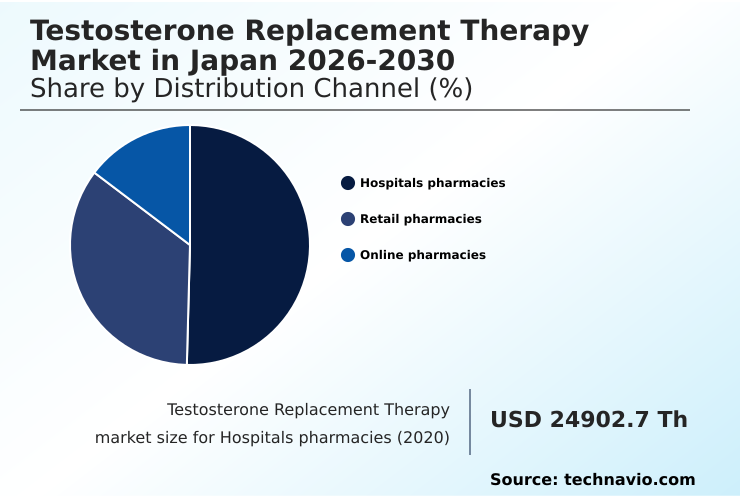
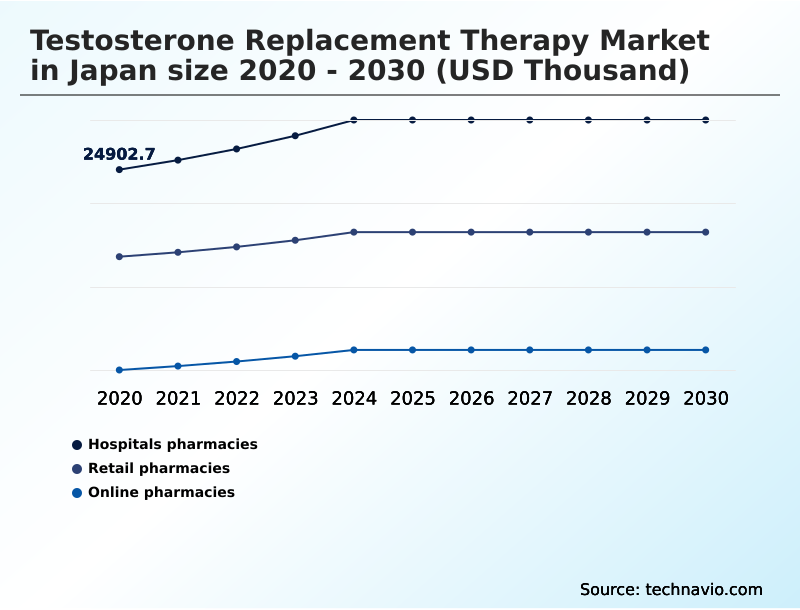
The Hospitals pharmacies segment was valued at USD 29.27 million in 2024 and showed a gradual increase during the forecast period.
Customer Landscape Analysis for the Japan Testosterone Replacement Therapy Market

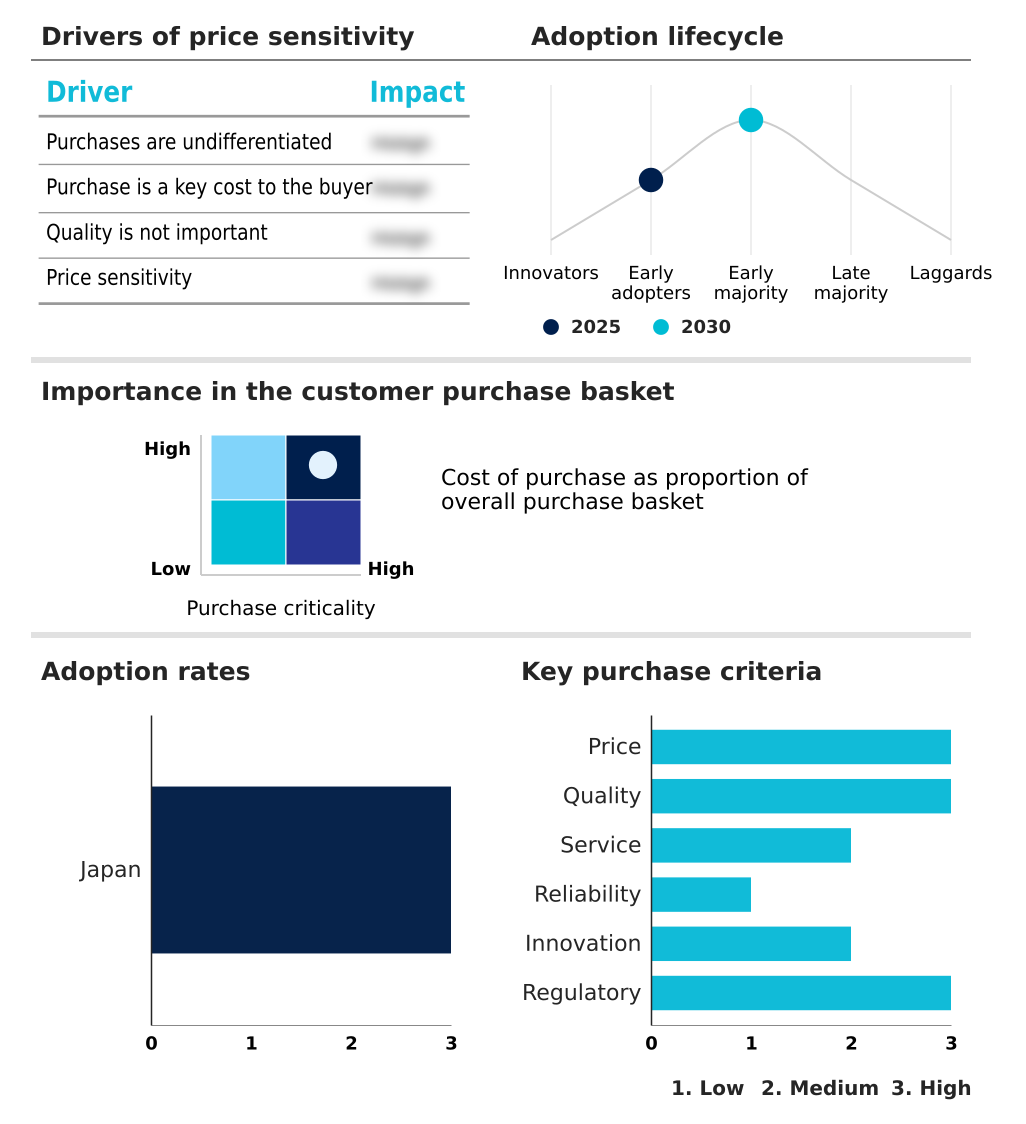
The japan testosterone replacement therapy market forecasting report includes the adoption lifecycle of the market, covering from the innovator’s stage to the laggard’s stage. It focuses on adoption rates in different regions based on penetration. Furthermore, the japan testosterone replacement therapy market report also includes key purchase criteria and drivers of price sensitivity to help companies evaluate and develop their market growth analysis strategies.
Competitive Landscape of the Japan Testosterone Replacement Therapy Market

Companies are implementing various strategies, such as strategic alliances, partnerships, mergers and acquisitions, geographical expansion, and product/service launches, to enhance their presence in the japan testosterone replacement therapy market industry.

AbbVie Inc. - Offerings include a comprehensive portfolio of androgen therapies, providing diverse drug delivery systems to address a range of clinical needs and patient-centric delivery preferences.

The industry research and growth report includes detailed analyses of the competitive landscape of the market and information about key companies, including:

  • AbbVie Inc.
  • ASKA Pharmaceutical Co., Ltd
  • Bayer AG
  • Daito Pharmaceutical Co., Ltd
  • Fuji Pharma Co., Ltd.
  • Kyowa Kirin Co. Ltd.
  • Lupin Ltd.
  • Merck and Co. Inc.
  • Organon and Co.
  • Sun Pharmaceutical Industries
  • TOWA PHARMACEUTICAL CO.,LTD

Qualitative and quantitative analysis of companies has been conducted to help clients understand the wider business environment as well as the strengths and weaknesses of key industry players. Data is qualitatively analyzed to categorize companies as pure play, category-focused, industry-focused, and diversified; it is quantitatively analyzed to categorize companies as dominant, leading, strong, tentative, and weak.

Recent Developments in the Japan Testosterone Replacement Therapy Market

  • In May 2025, the Japanese Pharmaceuticals and Medical Devices Agency implemented a revised safety monitoring protocol for all new androgenic products, requiring additional three-year longitudinal studies to enhance long-term safety data collection and protect public health.
  • In February 2025, the Japan Health Research Consortium initiated a nationwide data collection project to evaluate the long-term impact of various testosterone delivery methods on the metabolic health of the aging workforce, aiming to inform data-driven healthcare policy.
  • In January 2025, AbbVie Inc. announced a strategic partnership with a leading telemedicine provider to enhance patient access to AndroGel consultations through digital health platforms across Japan, integrating remote monitoring and prescription services.
  • In September 2024, Sun Pharmaceutical Industries received approval from the Ministry of Health, Labour and Welfare for its generic testosterone cypionate injection, increasing market competition and providing a lower-cost alternative for hypogonadism treatment.

Research Analyst Overview: Japan Testosterone Replacement Therapy Market

Operational focus is shifting from traditional injectable formulations to patient-centric delivery, compelling a strategic pivot in R&D and supply chain investments. The adoption of non-invasive treatments, including transdermal gels and novel oral formulations, is driven by demands for self-administration and improved bioavailability.

This trend directly impacts boardroom decisions regarding resource allocation, prioritizing digital health platforms and home testing kits over legacy distribution models. Compliance with evolving clinical guidelines from bodies like the Japan Society of Men’s Health for managing late-onset hypogonadism is non-negotiable.

With a year-over-year growth of 5.6%, companies must balance innovation in transdermal delivery systems and subcutaneous implants with the stringent medical supervision required for all hypogonadism treatment.

Success hinges on mastering the logistics of new drug delivery systems while navigating diagnostic protocols and ensuring the safe management of androgenic effects and testosterone esters for an aging demographic increasingly seeking hormonal balance.

Dive into Technavio’s robust research methodology, blending expert interviews, extensive data synthesis, and validated models for unparalleled Japan Testosterone Replacement Therapy Market insights. See full methodology.

Request Free Sample

Market Scope
Page number 206
Base year 2025
Historic period 2020-2024
Forecast period 2026-2030
Growth momentum & CAGR Accelerate at a CAGR of 5.7%
Market growth 2026-2030 USD 19418.8 thousand
Market structure Concentrated
YoY growth 2025-2026(%) 5.6%
Key countries Japan
Competitive landscape Leading Companies, Market Positioning of Companies, Competitive Strategies, and Industry Risks

Japan Testosterone Replacement Therapy Market: Key Questions Answered in This Report

  • What is the expected growth of the Japan Testosterone Replacement Therapy Market between 2026 and 2030?

    • The Japan Testosterone Replacement Therapy Market is expected to grow by USD 19.42 million during 2026-2030, registering a CAGR of 5.7%. Year-over-year growth in 2026 is estimated at 5.6%%. This acceleration is shaped by demographic imperative of a super-aging society, which is intensifying demand across multiple end-use verticals covered in the report.

  • What segmentation does the market report cover?

    • The report is segmented by Distribution Channel (Hospitals pharmacies, Retail pharmacies, and Online pharmacies), Product (Injectables, Topicals, Oral, Implants and pellets, and Others), Material (Testosterone enanthate, Testosterone, Testosterone undecanoate, Testosterone cypionate, and Others), End-user (Hospitals, Clinics, Homecare, and Others) and Geography (Asia). Among these, the Hospitals pharmacies segment is estimated to witness significant growth during the forecast period, driven by rising adoption across key application areas. Each segment includes detailed qualitative and quantitative analysis, along with historical data from 2020-2024 and forecasts through 2030 with year-over-year growth rates.

  • Which regions are analyzed in the report?

    • The report covers Asia. Country-level analysis includes Japan, with dedicated market size tables and year-over-year growth for each.

  • What are the key growth drivers and market challenges?

    • The primary driver is demographic imperative of a super-aging society, which is accelerating investment and industry demand. The main challenge is strict regulatory oversight and reimbursement limitations, creating operational barriers for key market participants. The report quantifies the impact of each driver and challenge across 2026 and 2030 with comparative analysis.

  • Who are the major players in the Japan Testosterone Replacement Therapy Market?

    • Key vendors include AbbVie Inc., ASKA Pharmaceutical Co., Ltd, Bayer AG, Daito Pharmaceutical Co., Ltd, Fuji Pharma Co., Ltd., Kyowa Kirin Co. Ltd., Lupin Ltd., Merck and Co. Inc., Organon and Co., Sun Pharmaceutical Industries and TOWA PHARMACEUTICAL CO.,LTD. The report provides qualitative and quantitative analysis categorizing companies as dominant, leading, strong, tentative, and weak based on their market positioning. Company profiles include business segment analysis, SWOT assessment, key offerings, and recent strategic developments.

Japan Testosterone Replacement Therapy Market Research Insights

Market dynamics are heavily influenced by a cultural shift toward the destigmatization of men's health and a clinical focus on the benefits of hormonal balance. The regulatory framework, governed by the Pharmaceutical and Medical Devices Act, favors physician-led supervision, solidifying the role of hospital pharmacies, which command a larger market share than retail and online channels combined.

This structure creates challenges for patient autonomy but is being counteracted by the rise of specialized men's health clinics offering discreet, home-based treatment options and out-of-pocket payments. These clinics focus on preventative hormonal treatments and integrated care models, leveraging remote hormone monitoring to improve patient convenience.

This bifurcated system reflects a tension between traditional medical oversight and modern demands for accessible, user-friendly delivery mechanisms and holistic hormone therapy.

We can help! Our analysts can customize this japan testosterone replacement therapy market research report to meet your requirements.

Get in touch

1. Executive Summary

1.1 Market overview

Executive Summary - Chart on Market Overview
Executive Summary - Data Table on Market Overview
Executive Summary - Chart on Country Market Characteristics
Executive Summary - Chart on Market Segmentation by Distribution Channel
Executive Summary - Chart on Market Segmentation by Product
Executive Summary - Chart on Market Segmentation by Material
Executive Summary - Chart on Market Segmentation by End-user
Executive Summary - Chart on Company Market Positioning

2. Technavio Analysis

2.1 Analysis of price sensitivity, lifecycle, customer purchase basket, adoption rates, and purchase criteria

2.2 Criticality of inputs and Factors of differentiation

Overview on criticality of inputs and factors of differentiation

2.3 Factors of disruption

Overview on factors of disruption

2.4 Impact of drivers and challenges

Impact of drivers and challenges in 2025 and 2030

3. Market Landscape

3.1 Market ecosystem

Chart on Parent Market
Data Table on - Parent Market

3.2 Market characteristics

Chart on Market characteristics analysis

3.3 Value chain analysis

Chart on Value chain analysis

4. Market Sizing

4.1 Market definition

Data Table on Offerings of companies included in the market definition

4.2 Market segment analysis

Market segments

4.3 Market size 2025

4.4 Market outlook: Forecast for 2025-2030

Chart on Japan - Market size and forecast 2025-2030 ($ thousand)
Data Table on Japan - Market size and forecast 2025-2030 ($ thousand)
Chart on Japan: Year-over-year growth 2025-2030 (%)
Data Table on Japan: Year-over-year growth 2025-2030 (%)

5. Historic Market Size

5.1 Testosterone Replacement Therapy Market in Japan 2020 - 2024

Historic Market Size - Data Table on Testosterone Replacement Therapy Market in Japan 2020 - 2024 ($ thousand)

5.2 Distribution Channel segment analysis 2020 - 2024

Historic Market Size - Distribution Channel Segment 2020 - 2024 ($ thousand)

5.3 Product segment analysis 2020 - 2024

Historic Market Size - Product Segment 2020 - 2024 ($ thousand)

5.4 Material segment analysis 2020 - 2024

Historic Market Size - Material Segment 2020 - 2024 ($ thousand)

5.5 End-user segment analysis 2020 - 2024

Historic Market Size - End-user Segment 2020 - 2024 ($ thousand)

6. Qualitative Analysis

6.1 Impact of AI on the Testosterone Replacement Therapy Market in Japan

7. Five Forces Analysis

7.1 Five forces summary

Five forces analysis - Comparison between 2025 and 2030

7.2 Bargaining power of buyers

Bargaining power of buyers - Impact of key factors 2025 and 2030

7.3 Bargaining power of suppliers

Bargaining power of suppliers - Impact of key factors in 2025 and 2030

7.4 Threat of new entrants

Threat of new entrants - Impact of key factors in 2025 and 2030

7.5 Threat of substitutes

Threat of substitutes - Impact of key factors in 2025 and 2030

7.6 Threat of rivalry

Threat of rivalry - Impact of key factors in 2025 and 2030

7.7 Market condition

Chart on Market condition - Five forces 2025 and 2030

8. Market Segmentation by Distribution Channel

8.1 Market segments

Chart on Distribution Channel - Market share 2025-2030 (%)
Data Table on Distribution Channel - Market share 2025-2030 (%)

8.2 Comparison by Distribution Channel

Chart on Comparison by Distribution Channel
Data Table on Comparison by Distribution Channel

8.3 Hospitals pharmacies - Market size and forecast 2025-2030

Chart on Hospitals pharmacies - Market size and forecast 2025-2030 ($ thousand)
Data Table on Hospitals pharmacies - Market size and forecast 2025-2030 ($ thousand)
Chart on Hospitals pharmacies - Year-over-year growth 2025-2030 (%)
Data Table on Hospitals pharmacies - Year-over-year growth 2025-2030 (%)

8.4 Retail pharmacies - Market size and forecast 2025-2030

Chart on Retail pharmacies - Market size and forecast 2025-2030 ($ thousand)
Data Table on Retail pharmacies - Market size and forecast 2025-2030 ($ thousand)
Chart on Retail pharmacies - Year-over-year growth 2025-2030 (%)
Data Table on Retail pharmacies - Year-over-year growth 2025-2030 (%)

8.5 Online pharmacies - Market size and forecast 2025-2030

Chart on Online pharmacies - Market size and forecast 2025-2030 ($ thousand)
Data Table on Online pharmacies - Market size and forecast 2025-2030 ($ thousand)
Chart on Online pharmacies - Year-over-year growth 2025-2030 (%)
Data Table on Online pharmacies - Year-over-year growth 2025-2030 (%)

8.6 Market opportunity by Distribution Channel

Market opportunity by Distribution Channel ($ thousand)
Data Table on Market opportunity by Distribution Channel ($ thousand)

9. Market Segmentation by Product

9.1 Market segments

Chart on Product - Market share 2025-2030 (%)
Data Table on Product - Market share 2025-2030 (%)

9.2 Comparison by Product

Chart on Comparison by Product
Data Table on Comparison by Product

9.3 Injectables - Market size and forecast 2025-2030

Chart on Injectables - Market size and forecast 2025-2030 ($ thousand)
Data Table on Injectables - Market size and forecast 2025-2030 ($ thousand)
Chart on Injectables - Year-over-year growth 2025-2030 (%)
Data Table on Injectables - Year-over-year growth 2025-2030 (%)

9.4 Topicals - Market size and forecast 2025-2030

Chart on Topicals - Market size and forecast 2025-2030 ($ thousand)
Data Table on Topicals - Market size and forecast 2025-2030 ($ thousand)
Chart on Topicals - Year-over-year growth 2025-2030 (%)
Data Table on Topicals - Year-over-year growth 2025-2030 (%)

9.5 Oral - Market size and forecast 2025-2030

Chart on Oral - Market size and forecast 2025-2030 ($ thousand)
Data Table on Oral - Market size and forecast 2025-2030 ($ thousand)
Chart on Oral - Year-over-year growth 2025-2030 (%)
Data Table on Oral - Year-over-year growth 2025-2030 (%)

9.6 Implants and pellets - Market size and forecast 2025-2030

Chart on Implants and pellets - Market size and forecast 2025-2030 ($ thousand)
Data Table on Implants and pellets - Market size and forecast 2025-2030 ($ thousand)
Chart on Implants and pellets - Year-over-year growth 2025-2030 (%)
Data Table on Implants and pellets - Year-over-year growth 2025-2030 (%)

9.7 Others - Market size and forecast 2025-2030

Chart on Others - Market size and forecast 2025-2030 ($ thousand)
Data Table on Others - Market size and forecast 2025-2030 ($ thousand)
Chart on Others - Year-over-year growth 2025-2030 (%)
Data Table on Others - Year-over-year growth 2025-2030 (%)

9.8 Market opportunity by Product

Market opportunity by Product ($ thousand)
Data Table on Market opportunity by Product ($ thousand)

10. Market Segmentation by Material

10.1 Market segments

Chart on Material - Market share 2025-2030 (%)
Data Table on Material - Market share 2025-2030 (%)

10.2 Comparison by Material

Chart on Comparison by Material
Data Table on Comparison by Material

10.3 Testosterone enanthate - Market size and forecast 2025-2030

Chart on Testosterone enanthate - Market size and forecast 2025-2030 ($ thousand)
Data Table on Testosterone enanthate - Market size and forecast 2025-2030 ($ thousand)
Chart on Testosterone enanthate - Year-over-year growth 2025-2030 (%)
Data Table on Testosterone enanthate - Year-over-year growth 2025-2030 (%)

10.4 Testosterone - Market size and forecast 2025-2030

Chart on Testosterone - Market size and forecast 2025-2030 ($ thousand)
Data Table on Testosterone - Market size and forecast 2025-2030 ($ thousand)
Chart on Testosterone - Year-over-year growth 2025-2030 (%)
Data Table on Testosterone - Year-over-year growth 2025-2030 (%)

10.5 Testosterone undecanoate - Market size and forecast 2025-2030

Chart on Testosterone undecanoate - Market size and forecast 2025-2030 ($ thousand)
Data Table on Testosterone undecanoate - Market size and forecast 2025-2030 ($ thousand)
Chart on Testosterone undecanoate - Year-over-year growth 2025-2030 (%)
Data Table on Testosterone undecanoate - Year-over-year growth 2025-2030 (%)

10.6 Testosterone cypionate - Market size and forecast 2025-2030

Chart on Testosterone cypionate - Market size and forecast 2025-2030 ($ thousand)
Data Table on Testosterone cypionate - Market size and forecast 2025-2030 ($ thousand)
Chart on Testosterone cypionate - Year-over-year growth 2025-2030 (%)
Data Table on Testosterone cypionate - Year-over-year growth 2025-2030 (%)

10.7 Others - Market size and forecast 2025-2030

Chart on Others - Market size and forecast 2025-2030 ($ thousand)
Data Table on Others - Market size and forecast 2025-2030 ($ thousand)
Chart on Others - Year-over-year growth 2025-2030 (%)
Data Table on Others - Year-over-year growth 2025-2030 (%)

10.8 Market opportunity by Material

Market opportunity by Material ($ thousand)
Data Table on Market opportunity by Material ($ thousand)

11. Market Segmentation by End-user

11.1 Market segments

Chart on End-user - Market share 2025-2030 (%)
Data Table on End-user - Market share 2025-2030 (%)

11.2 Comparison by End-user

Chart on Comparison by End-user
Data Table on Comparison by End-user

11.3 Hospitals - Market size and forecast 2025-2030

Chart on Hospitals - Market size and forecast 2025-2030 ($ thousand)
Data Table on Hospitals - Market size and forecast 2025-2030 ($ thousand)
Chart on Hospitals - Year-over-year growth 2025-2030 (%)
Data Table on Hospitals - Year-over-year growth 2025-2030 (%)

11.4 Clinics - Market size and forecast 2025-2030

Chart on Clinics - Market size and forecast 2025-2030 ($ thousand)
Data Table on Clinics - Market size and forecast 2025-2030 ($ thousand)
Chart on Clinics - Year-over-year growth 2025-2030 (%)
Data Table on Clinics - Year-over-year growth 2025-2030 (%)

11.5 Homecare - Market size and forecast 2025-2030

Chart on Homecare - Market size and forecast 2025-2030 ($ thousand)
Data Table on Homecare - Market size and forecast 2025-2030 ($ thousand)
Chart on Homecare - Year-over-year growth 2025-2030 (%)
Data Table on Homecare - Year-over-year growth 2025-2030 (%)

11.6 Others - Market size and forecast 2025-2030

Chart on Others - Market size and forecast 2025-2030 ($ thousand)
Data Table on Others - Market size and forecast 2025-2030 ($ thousand)
Chart on Others - Year-over-year growth 2025-2030 (%)
Data Table on Others - Year-over-year growth 2025-2030 (%)

11.7 Market opportunity by End-user

Market opportunity by End-user ($ thousand)
Data Table on Market opportunity by End-user ($ thousand)

12. Customer Landscape

12.1 Customer landscape overview

Analysis of price sensitivity, lifecycle, customer purchase basket, adoption rates, and purchase criteria

13. Drivers, Challenges, and Opportunity

13.1 Market drivers

Demographic imperative of a super-aging society
Advancements in patient-centric delivery mechanisms
Destigmatization and proliferation of men health clinics

13.2 Market challenges

Strict regulatory oversight and reimbursement limitations
Societal skepticism and long-term safety concerns
Diagnostic inconsistencies and lack of specialized practitioners

13.3 Impact of drivers and challenges

Impact of drivers and challenges in 2025 and 2030

13.4 Market opportunities

Transition toward non-invasive delivery systems
Integration of digital health and specialized health telemedicine
Expanding clinical focus on late-onset hypogonadism

14. Competitive Landscape

14.1 Overview

14.2

Overview on criticality of inputs and factors of differentiation

14.3 Landscape disruption

Overview on factors of disruption

14.4 Industry risks

Impact of key risks on business

15. Competitive Analysis

15.1 Companies profiled

Companies covered

15.2 Company ranking index

15.3 Market positioning of companies

Matrix on companies position and classification

15.4 AbbVie Inc.

AbbVie Inc. - Overview
AbbVie Inc. - Business segments
AbbVie Inc. - Key news
AbbVie Inc. - Key offerings
AbbVie Inc. - Segment focus
SWOT

15.5 ASKA Pharmaceutical Co., Ltd

ASKA Pharmaceutical Co., Ltd - Overview
ASKA Pharmaceutical Co., Ltd - Product / Service
ASKA Pharmaceutical Co., Ltd - Key offerings
SWOT

15.6 Bayer AG

Bayer AG - Overview
Bayer AG - Business segments
Bayer AG - Key news
Bayer AG - Key offerings
Bayer AG - Segment focus
SWOT

15.7 Daito Pharmaceutical Co., Ltd

Daito Pharmaceutical Co., Ltd - Overview
Daito Pharmaceutical Co., Ltd - Product / Service
Daito Pharmaceutical Co., Ltd - Key offerings
SWOT

15.8 Fuji Pharma Co., Ltd.

Fuji Pharma Co., Ltd. - Overview
Fuji Pharma Co., Ltd. - Product / Service
Fuji Pharma Co., Ltd. - Key offerings
SWOT

15.9 Kyowa Kirin Co. Ltd.

Kyowa Kirin Co. Ltd. - Overview
Kyowa Kirin Co. Ltd. - Business segments
Kyowa Kirin Co. Ltd. - Key offerings
Kyowa Kirin Co. Ltd. - Segment focus
SWOT

15.10 Lupin Ltd.

Lupin Ltd. - Overview
Lupin Ltd. - Business segments
Lupin Ltd. - Key news
Lupin Ltd. - Key offerings
Lupin Ltd. - Segment focus
SWOT

15.11 Merck and Co. Inc.

Merck and Co. Inc. - Overview
Merck and Co. Inc. - Business segments
Merck and Co. Inc. - Key news
Merck and Co. Inc. - Key offerings
Merck and Co. Inc. - Segment focus
SWOT

15.12 Organon and Co.

Organon and Co. - Overview
Organon and Co. - Product / Service
Organon and Co. - Key offerings
SWOT

15.13 Sun Pharmaceutical Industries

Sun Pharmaceutical Industries - Overview
Sun Pharmaceutical Industries - Product / Service
Sun Pharmaceutical Industries - Key news
Sun Pharmaceutical Industries - Key offerings
SWOT

15.14 TOWA PHARMACEUTICAL CO.,LTD

TOWA PHARMACEUTICAL CO.,LTD - Overview
TOWA PHARMACEUTICAL CO.,LTD - Product / Service
TOWA PHARMACEUTICAL CO.,LTD - Key offerings
SWOT

16. Appendix

16.1 Scope of the report

Market definition
Objectives
Notes and caveats

16.2 Inclusions and exclusions checklist

Inclusions checklist
Exclusions checklist

16.3 Currency conversion rates for US$

16.4 Research methodology

16.5 Data procurement

Information sources

16.6 Data validation

16.7 Validation techniques employed for market sizing

16.8 Data synthesis

16.9 360 degree market analysis

16.10 List of abbreviations

Research Methodology

Technavio presents a detailed picture of the market by way of study, synthesis, and summation of data from multiple sources. The analysts have presented the various facets of the market with a particular focus on identifying the key industry influencers. The data thus presented is comprehensive, reliable, and the result of extensive research, both primary and secondary.

INFORMATION SOURCES

Primary sources

  • Manufacturers and suppliers
  • Channel partners
  • Industry experts
  • Strategic decision makers

Secondary sources

  • Industry journals and periodicals
  • Government data
  • Financial reports of key industry players
  • Historical data
  • Press releases

DATA ANALYSIS

Data Synthesis

  • Collation of data
  • Estimation of key figures
  • Analysis of derived insights

Data Validation

  • Triangulation with data models
  • Reference against proprietary databases
  • Corroboration with industry experts

REPORT WRITING

Qualitative

  • Market drivers
  • Market challenges
  • Market trends
  • Five forces analysis

Quantitative

  • Market size and forecast
  • Market segmentation
  • Geographical insights
  • Competitive landscape

Interested in this report?

Get your sample now to see our research methodology and insights!

Download Now

Frequently Asked Questions

Japan Testosterone Replacement Therapy market growth will increase by USD 19418.8 thousand thousand during 2026-2030.

The Japan Testosterone Replacement Therapy market is expected to grow at a CAGR of 5.7% during 2026-2030.

Japan Testosterone Replacement Therapy market is segmented by Distribution channel (Hospitals pharmacies, Retail pharmacies, Online pharmacies) Product (Injectables, Topicals, Oral, Implants and pellets, Others) Material (Testosterone enanthate, Testosterone, Testosterone undecanoate, Testosterone cypionate, Others) End-user (Hospitals, Clinics, Homecare, Others)

AbbVie Inc., ASKA Pharmaceutical Co., Ltd, Bayer AG, Daito Pharmaceutical Co., Ltd, Fuji Pharma Co., Ltd., Kyowa Kirin Co. Ltd., Lupin Ltd., Merck and Co. Inc., Organon and Co., Sun Pharmaceutical Industries, TOWA PHARMACEUTICAL CO.,LTD are a few of the key vendors in the Japan Testosterone Replacement Therapy market.

Asia will register the highest growth rate of 100% among the other regions. Therefore, the Japan Testosterone Replacement Therapy market in Asia is expected to garner significant business opportunities for the vendors during the forecast period.

Japan

  • Demographic imperative of a super-aging society is the driving factor this market.

The Japan Testosterone Replacement Therapy market vendors should focus on grabbing business opportunities from the Distribution channel segment as it accounted for the largest market share in the base year.
RIA - Research AI Assistant
Ask RIA