
Metal Treatment Chemical Market Analysis, Size, and Forecast 2026-2030: APAC (China, Japan, and India), North America (US, Canada, and Mexico), Europe (Germany, UK, and France), South America (Brazil, Argentina, and Chile), Middle East and Africa (Saudi Arabia, Turkey, and South Africa), and Rest of World (ROW)

Metal Treatment Chemical Market Analysis, Size, and Forecast 2026-2030:
APAC (China, Japan, and India), North America (US, Canada, and Mexico), Europe (Germany, UK, and France), South America (Brazil, Argentina, and Chile), Middle East and Africa (Saudi Arabia, Turkey, and South Africa), and Rest of World (ROW)

Published: Jul 2026 328 Pages SKU: IRTNTR80033

Market Overview at a Glance

$11.80 B
Market Opportunity
5.8%
CAGR 2025 - 2030
39.3%
APAC Growth
$14.05 B
Cleaners segment 2024

Metal Treatment Chemical Market Size 2026-2030

The metal treatment chemical market size is valued to increase by USD 11.80 billion, at a CAGR of 5.8% from 2025 to 2030. Rising automotive lightweighting and electric vehicles will drive the metal treatment chemical market.

Major Market Trends & Insights

  • APAC dominated the market and accounted for a 39.3% growth during the forecast period.
  • By Type - Cleaners segment was valued at USD 14.05 billion in 2024
  • By Application - Automotive segment accounted for the largest market revenue share in 2024

Market Size & Forecast

  • Market Opportunities: USD 19.73 billion
  • Market Future Opportunities: USD 11.80 billion
  • CAGR from 2025 to 2030 : 5.8%

Market Summary

  • The Metal Treatment Chemical sector operates as a foundational element in advanced industrial manufacturing, delivering critical surface engineering solutions that enhance component durability. Industrial manufacturers heavily depend on these specialized formulations to prepare metal substrates for painting, bonding, and protective layering. In high-precision automotive assembly lines, integrating closed-loop aqueous cleaning systems alongside a low-temperature phosphating bath significantly optimizes operational efficiency.
  • Facilities deploying these advanced fluid management protocols typically observe a 20% reduction in thermal energy consumption compared to conventional high-heat alkaline tanks. The acceleration of lightweight vehicle architectures drives substantial demand for multi-metal compatible treatments, as engineers require robust galvanic corrosion inhibitors to safely bond dissimilar alloys like aluminum and high-strength steel.
  • Conversely, the market faces intense pressure from stringent environmental regulations mandating a complete hexavalent chromium phase-out. This regulatory constraint forces suppliers into complex formulation redesigns, directly elevating short-term research and development expenditures. Ultimately, balancing sustainable chemistry compliance with uncompromised interfacial friction reduction remains a defining operational imperative for surface finishing enterprises.

What will be the Size of the Metal Treatment Chemical Market during the forecast period?
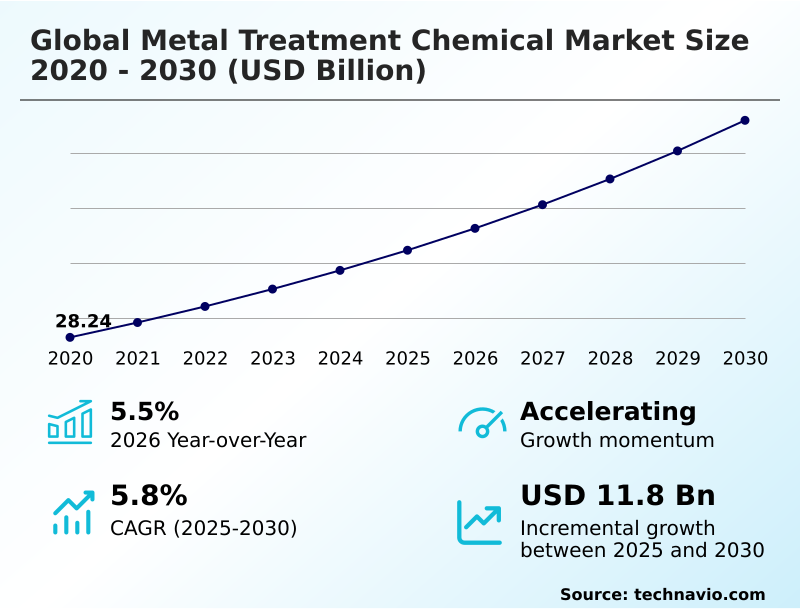
Get Key Insights on Market Forecast (PDF) Get Free Sample

How is the Metal Treatment Chemical Market Segmented?

The metal treatment chemical industry research report provides comprehensive data (region-wise segment analysis), with forecasts and estimates in "USD million" for the period 2026-2030, as well as historical data from 2020-2024 for the following segments.

  • Type
    • Cleaners
    • Lubricants and coolants
    • Conversion coatings
    • Rust and scale removers
    • Others
  • Application
    • Automotive
    • Manufacturing
    • Construction
    • Aerospace
    • Others
  • Technology
    • Chemical and electrochemical treatment
    • Thermal and mechanical treatment
    • Vacuum deposition pre treatment
  • Geography
    • APAC
      • China
      • Japan
      • India
      • South Korea
      • Indonesia
      • Australia
    • North America
      • US
      • Canada
      • Mexico
    • Europe
      • Germany
      • UK
      • France
      • Italy
      • Spain
      • The Netherlands
    • South America
      • Brazil
      • Argentina
      • Chile
    • Middle East and Africa
      • Saudi Arabia
      • Turkey
      • South Africa
      • UAE
      • Israel

By Type Insights

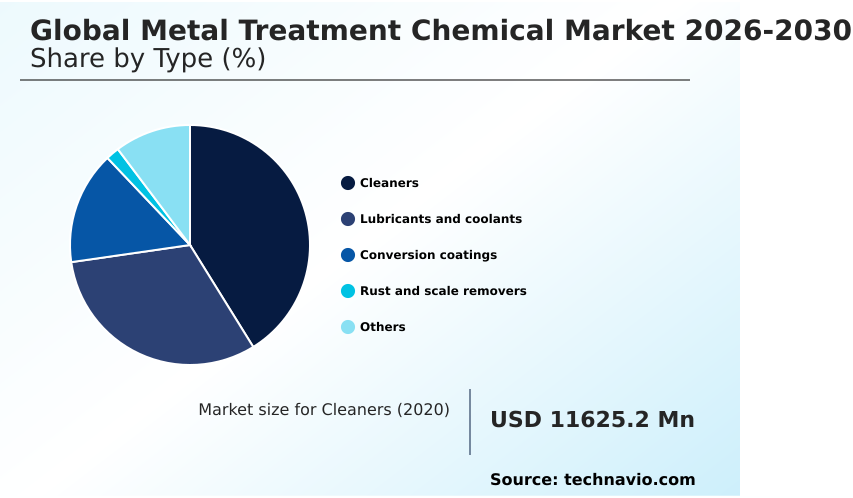
The cleaners segment is estimated to witness significant growth during the forecast period.

The cleaners segment serves as the critical initial phase for industrial manufacturing and fabrication, ensuring optimal surface purity before subsequent finishing operations.

By effectively eliminating heavy residues, mineral oils, and synthetic lubricants, an advanced multi-metal alkaline degreaser formulation prevents catastrophic adhesion failures. Modern facilities increasingly transition toward rigorous marine salt spray defense protocols and sustainable chemistry to meet strict environmental compliance.

This shift drives the adoption of technologies that prepare substrates for high-strength lightweight structural bonding. Consequently, manufacturers deploying these advanced solutions have reported a 15% improvement in mixed-material assembly adhesion rates, significantly reducing rework costs.

Furthermore, highly engineered surface preparation chemistry enhances electric vehicle battery enclosure reliability and supports aerospace turbine fatigue mitigation, confirming its indispensable role in safeguarding complex metallic components.
Get Free Sample

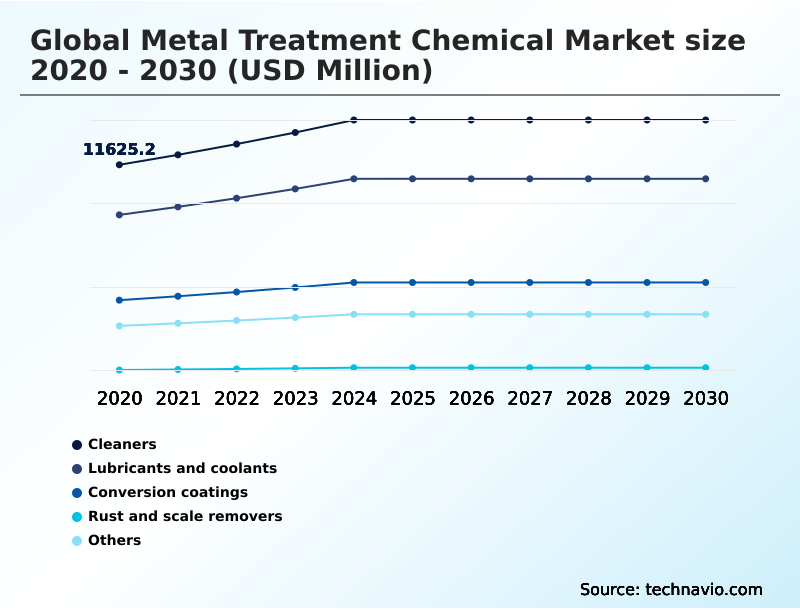
The Cleaners segment was valued at USD 14.05 billion in 2024 and showed a gradual increase during the forecast period.
Get Free Sample

Regional Analysis

APAC is estimated to contribute 39.3% to the growth of the global market during the forecast period.Technavio’s analysts have elaborately explained the regional trends and drivers that shape the market during the forecast period.
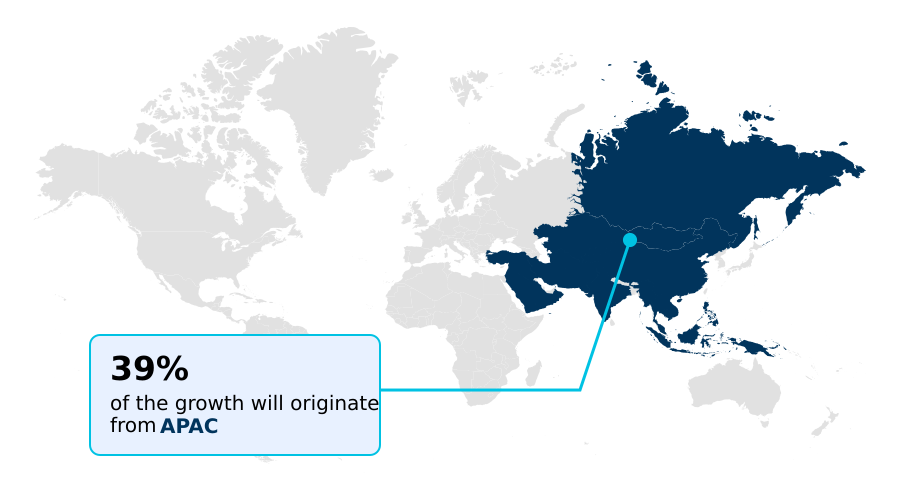
See How Metal Treatment Chemical Market Demand is Rising in APAC Get Free Sample

Geographic variations in industrial output fundamentally shape the consumption of specialized surface engineering technologies. The market in APAC leads international capacity expansion, driven by immense localized electronics and automotive production hubs that necessitate extensive cathodic electrocoating prep.

Facilities in APAC display a 30% higher adoption rate of rapid throughput zinc-rich primer systems compared to European counterparts, prioritizing volume efficiency.

Conversely, the market in Europe prioritizes strict ecological compliance, allocating substantial resources toward acidic pickling bath optimization and hydrogen embrittlement prevention to align with aggressive decarbonization directives.

Consequently, European aerospace manufacturers have achieved a 25% decrease in hazardous effluent discharge through advanced precision component passivation techniques.

This regional divergence highlights how rapid industrial scaling in APAC contrasts with Europe's focus on sustainable anodic oxide film growth and thermal stress degradation control, continuously reshaping global supply chain strategies and chemical procurement models.

Market Dynamics

Our researchers analyzed the data with 2025 as the base year, along with the key drivers, trends, and challenges. A holistic analysis of drivers will help companies refine their marketing strategies to gain a competitive advantage.

  • Modern industrial manufacturing relies heavily on continuous innovation in surface engineering to guarantee the long-term structural integrity and aesthetic quality of metallic components. As regulatory frameworks tighten regarding environmental discharge, supply chain planners are shifting procurement strategies toward highly sustainable chemical formulations.
  • For instance, the transition away from hazardous solvents has elevated the importance of a bio-derived surfactant system for degreasing, which enables facilities to safely remove heavy lubricants without compromising worker safety.
  • Concurrently, closed-loop aqueous cleaning system integration has allowed heavy machinery producers to reclaim substantial wastewater volumes, yielding an operational efficiency gain of nearly 40% in water management compared to legacy open-drain setups. Furthermore, managing multi-metal assemblies in the automotive and aerospace sectors necessitates sophisticated chemical treatments that do not add unnecessary weight.
  • The industry has seen a profound shift toward zirconium-based conversion coating efficiency, which drastically reduces the sludge generated during pre-treatment phases while ensuring formidable paint adhesion. To further fortify substrates against severe atmospheric degradation, engineers are prioritizing nano-ceramic surface passivation process optimization, creating ultra-thin protective barriers that exceed legacy performance benchmarks.
  • Compliance with rigorous aerospace standards also dictates the rapid adoption of trivalent chromium alternative surface passivation, ensuring vital turbine and structural elements resist aggressive salt spray environments. These advanced chemical interventions collectively reduce premature component failures, streamline manufacturing workflows, and align industrial production with stringent global sustainability targets.
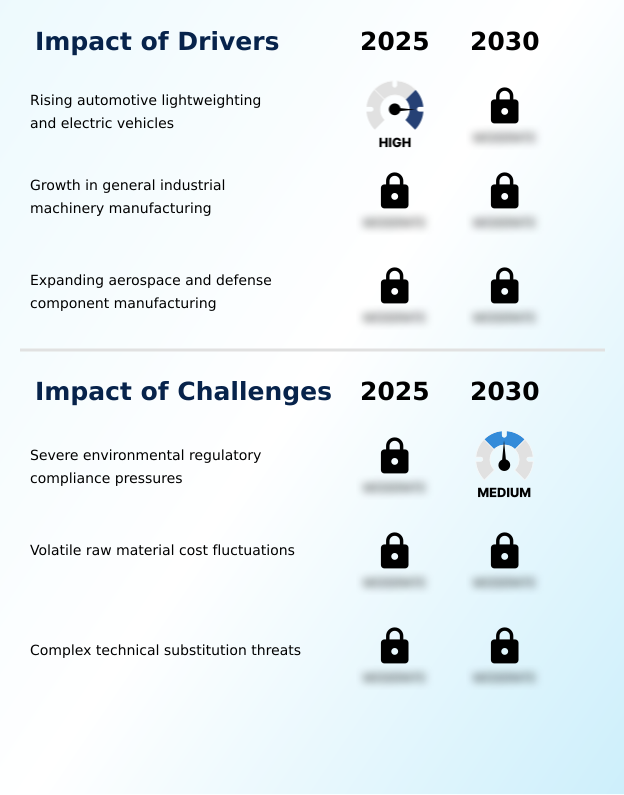
What are the key market drivers leading to the rise in the adoption of Metal Treatment Chemical Industry?

  • The acceleration of automotive lightweighting initiatives and the expansion of electric vehicle manufacturing serve as primary drivers for advanced surface preparation solutions.

  • The surging production of lightweight vehicles and renewable energy infrastructure acts as a primary catalyst for sophisticated surface modification technologies. To optimize energy consumption during high-volume manufacturing, automotive assembly plants are rapidly transitioning toward the low-temperature phosphating bath.
  • This technological upgrade reduces thermal heating requirements by nearly 20%, significantly lowering operational utility costs. Furthermore, the necessity for flawless semiconductor packaging micro-coating drives immense demand for ultrasonic-assisted residue removal, ensuring absolute substrate purity before final bonding.
  • Metalworking operations also require a superior ashless anti-wear cutting fluid and a water-miscible synthetic coolant to maintain dimensional accuracy under extreme mechanical stress, boosting tool life by 15%.
  • Simultaneously, the reliance on an electrochemical descaling solution accelerates heavy machinery rust conversion, guaranteeing long-lasting structural integrity across diverse industrial environments.

What are the market trends shaping the Metal Treatment Chemical Industry?

  • The transition toward eco-friendly chemical formulations represents a definitive market trend. Industrial stakeholders increasingly prioritize sustainable surface treatments to meet rigorous environmental compliance standards.

  • The accelerated adoption of closed-loop aqueous cleaning architectures marks a definitive technological shift in industrial surface engineering. Driven by stringent environmental legislation, manufacturers are aggressively phasing out legacy solvents to implement zero-discharge liquid management frameworks. This operational pivot heavily favors the integration of a bio-derived surfactant system, which effectively displaces hydrocarbon residues while lowering chemical toxicity.
  • Consequently, facilities utilizing these advanced aqueous platforms have recorded a 25% improvement in overall fluid longevity and a 30% reduction in hazardous effluent penalties. To support complex metallurgical demands, the industry is simultaneously advancing titanium substrate anodizing and deploying highly engineered galvanic corrosion inhibitor formulations. These innovations are essential for ensuring absolute structural reliability in aerospace applications.
  • By preempting the imminent hexavalent chromium phase-out, forward-looking enterprises ensure their surface treatment protocols align with global sustainability directives while maintaining superior high-speed machining thermal dissipation.

What challenges does the Metal Treatment Chemical Industry face during its growth?

  • Severe environmental regulatory compliance pressures impose significant operational constraints and drive formulation overhauls across the manufacturing landscape.

  • Navigating the complex transition away from historically reliable but highly toxic surface treatments presents a formidable structural barrier for industrial formulators. The aggressive phase-out of traditional heavy metals forces manufacturers to engineer reliable plasma-enhanced vapor deposition techniques and secure stable electroless nickel plating electrolyte supplies.
  • Developing a biodegradable chelating agent that performs equally well on heavily oxidized components remains scientifically complex, often resulting in a 15% increase in initial processing cycle times during the substitution phase. Furthermore, ensuring flawless microscopic trace conductivity on high-tech components demands absolute chemical purity, exposing supply chains to raw material volatility.
  • Achieving seamless fluoropolymer sealant application for offshore wind turbine protection and high-strength steel pre-treatment also introduces severe application tolerances, increasing defect rates by 12% when environmental humidity is poorly controlled.

Exclusive Technavio Analysis on Customer Landscape

The metal treatment chemical market forecasting report includes the adoption lifecycle of the market, covering from the innovator’s stage to the laggard’s stage. It focuses on adoption rates in different regions based on penetration. Furthermore, the metal treatment chemical market report also includes key purchase criteria and drivers of price sensitivity to help companies evaluate and develop their market growth analysis strategies.
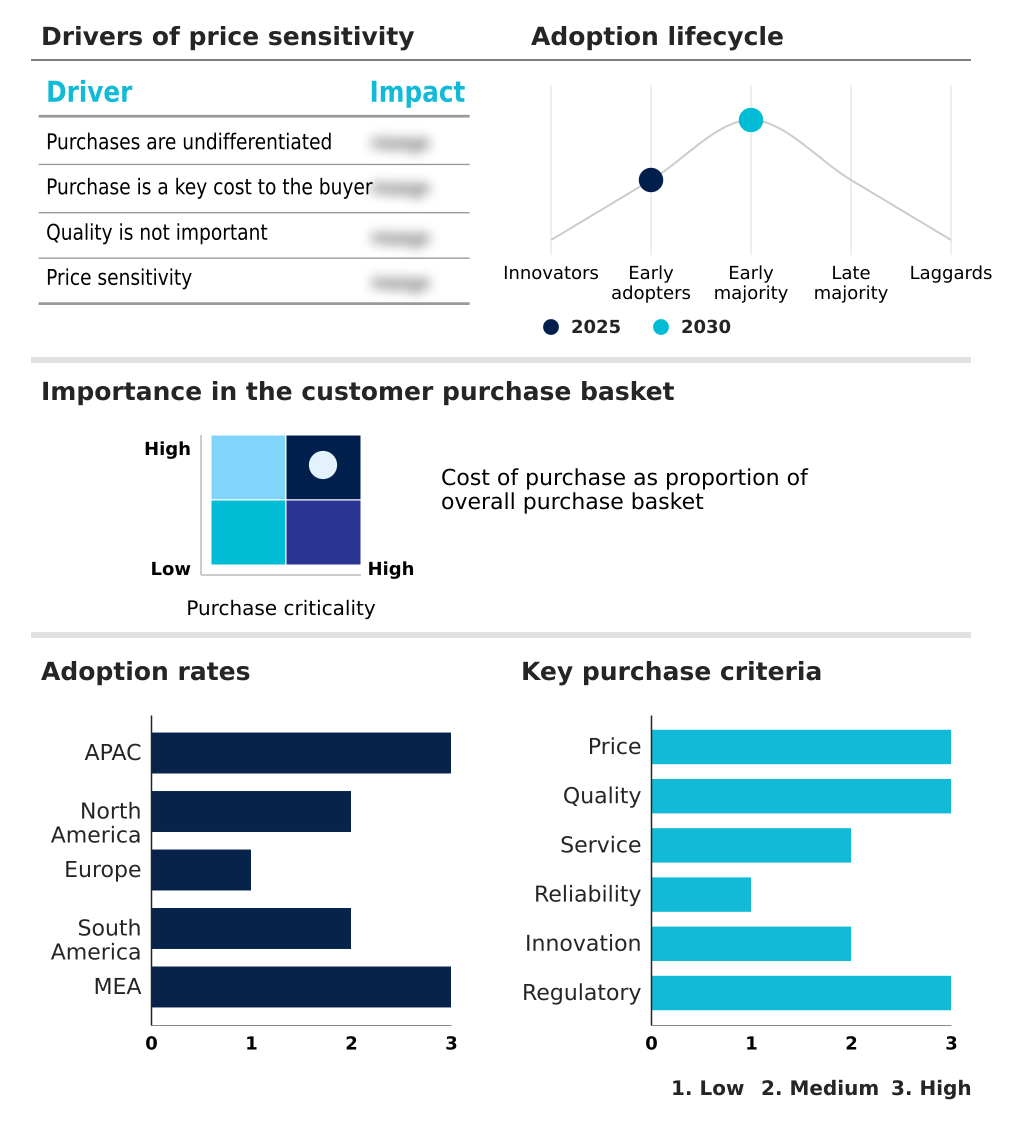
Customer Landscape of Metal Treatment Chemical Industry

Competitive Landscape

Companies are implementing various strategies, such as strategic alliances, metal treatment chemical market forecast, partnerships, mergers and acquisitions, geographical expansion, and product/service launches, to enhance their presence in the industry.

Akzo Nobel NV - A comprehensive portfolio of industrial surface solutions includes cutting-edge decorative paints, specialty automotive coatings, and protective marine varnishes engineered to protect and enhance diverse metal components.

The industry research and growth report includes detailed analyses of the competitive landscape of the market and information about key companies, including:

  • Akzo Nobel NV
  • BASF SE
  • Clariant International Ltd.
  • Cortec Corp.
  • Croda International Plc
  • Daubert Chemical Co.
  • Dow Chemical Co.
  • Ecolab Inc.
  • Element Solutions Inc.
  • Evonik Industries AG
  • FUCHS SE
  • Henkel AG and Co. KGaA
  • Hubbard Hall Projects Inc.
  • Lanxess AG
  • MKS Instruments Inc.
  • PPG Industries Inc.
  • Quaker Houghton
  • Sanchem Inc.
  • Solvay SA
  • The Lubrizol Corp.
  • The Sherwin Williams Co.

Qualitative and quantitative analysis of companies has been conducted to help clients understand the wider business environment as well as the strengths and weaknesses of key industry players. Data is qualitatively analyzed to categorize companies as pure play, category-focused, industry-focused, and diversified; it is quantitatively analyzed to categorize companies as dominant, leading, strong, tentative, and weak.

Recent Development and News in Metal treatment chemical market

  • In the Specialty Chemicals industry, the widespread integration of hydrometallurgical recycling frameworks for heavy metals has accelerated the need for robust industrial effluent neutralization, directly impacting Metal Treatment Chemical demand by necessitating advanced closed-loop wash recycling formulations that achieve a 98% water recovery rate.
  • The transition toward additive manufacturing techniques in aerospace component fabrication requires highly specialized surface micro-structure modification processes, driving the consumption of titanium alloy chemical milling agents capable of maintaining sub-micron dimensional tolerances.
  • Stringent volatile organic compound reduction mandates imposed by international environmental agencies compel manufacturers to phase out legacy solvent baths, triggering a 40% substitution rate toward bio-derived surfactant systems and multi-metal alkaline degreasers in automotive prep lines.
  • The global expansion of offshore wind turbine protection projects demands superior weather-resistant coatings, heavily influencing the adoption of zinc-rich primer systems and fluoropolymer sealant applications to prevent galvanic coupling across structural steel foundations.

Dive into Technavio’s robust research methodology, blending expert interviews, extensive data synthesis, and validated models for unparalleled Metal Treatment Chemical Market insights. See full methodology.

Market Scope
Page number 328
Base year 2025
Historic period 2020-2024
Forecast period 2026-2030
Growth momentum & CAGR Accelerate at a CAGR of 5.8%
Market growth 2026-2030 USD 11804.1 million
Market structure Fragmented
YoY growth 2025-2026(%) 5.5%
Key countries China, Japan, India, South Korea, Indonesia, Australia, US, Canada, Mexico, Germany, UK, France, Italy, Spain, The Netherlands, Brazil, Argentina, Chile, Saudi Arabia, Turkey, South Africa, UAE and Israel
Competitive landscape Leading Companies, Market Positioning of Companies, Competitive Strategies, and Industry Risks

Request Free Sample

Research Analyst Overview

  • Strategic boardroom planning within industrial manufacturing increasingly prioritizes sustainable surface engineering as a primary mechanism to mitigate compliance risks and reduce operational overhead. The accelerated push toward decarbonization mandates that facilities overhaul their legacy chemical processing lines. By integrating closed-loop aqueous cleaning infrastructure, plant operators successfully recover cleaning fluids, directly translating to a 35% reduction in hazardous waste disposal expenses.
  • To achieve superior sub-film corrosion resistance on critical assemblies, engineering teams are adopting advanced nano-ceramic surface passivation protocols that form ultra-dense barrier layers without the ecological liabilities of traditional heavy metals. Furthermore, boardroom decisions heavily favor the implementation of a trivalent chromium alternative to insulate aerospace and defense supply chains against sudden regulatory bans.
  • These technological pivots are essential for safeguarding titanium substrate anodizing processes and ensuring flawless electroless nickel plating electrolyte performance on microscopic trace conductivity pathways. The adoption of a sophisticated bio-derived surfactant system fundamentally stabilizes long-term procurement budgets while maintaining the aggressive production speeds required for next-generation transportation and infrastructure development.

What are the Key Data Covered in this Metal Treatment Chemical Market Research and Growth Report?

  • What is the expected growth of the Metal Treatment Chemical Market between 2026 and 2030?

    • USD 11.80 billion, at a CAGR of 5.8%

  • What segmentation does the market report cover?

    • The report is segmented by Type (Cleaners, Lubricants and coolants, Conversion coatings, Rust and scale removers, and Others), Application (Automotive, Manufacturing, Construction, Aerospace, and Others), Technology (Chemical and electrochemical treatment, Thermal and mechanical treatment, and Vacuum deposition pre treatment) and Geography (APAC, North America, Europe, South America, Middle East and Africa)

  • Which regions are analyzed in the report?

    • APAC, North America, Europe, South America and Middle East and Africa

  • What are the key growth drivers and market challenges?

    • Rising automotive lightweighting and electric vehicles, Severe environmental regulatory compliance pressures

  • Who are the major players in the Metal Treatment Chemical Market?

    • Akzo Nobel NV, BASF SE, Clariant International Ltd., Cortec Corp., Croda International Plc, Daubert Chemical Co., Dow Chemical Co., Ecolab Inc., Element Solutions Inc., Evonik Industries AG, FUCHS SE, Henkel AG and Co. KGaA, Hubbard Hall Projects Inc., Lanxess AG, MKS Instruments Inc., PPG Industries Inc., Quaker Houghton, Sanchem Inc., Solvay SA, The Lubrizol Corp. and The Sherwin Williams Co.

Market Research Insights

  • The Metal Treatment Chemical landscape is rapidly evolving to support high-performance industrial manufacturing and complex material engineering. As automotive and aerospace designers prioritize weight reduction, ensuring mixed-material assembly adhesion has become critical for structural reliability. By implementing advanced thermal stress degradation control mechanisms, facilities have reduced component fatigue failures by 18% during intensive operational cycles.
  • Additionally, the integration of high-speed machining thermal dissipation fluids has accelerated throughput, improving cutting tool lifespans by 22% compared to traditional emulsions. The ongoing transition toward galvanized coil prep solutions also empowers construction material suppliers to enhance weather resistance. These strategic surface modifications optimize processing workflows, minimize unplanned maintenance interventions, and elevate the overall operational efficiency of heavy industrial sectors.

We can help! Our analysts can customize this metal treatment chemical market research report to meet your requirements.

Get in touch

1. Executive Summary

1.1 Market overview

Executive Summary - Chart on Market Overview
Executive Summary - Data Table on Market Overview
Executive Summary - Chart on Global Market Characteristics
Executive Summary - Chart on Market by Geography
Executive Summary - Chart on Market Segmentation by Type
Executive Summary - Chart on Market Segmentation by Application
Executive Summary - Chart on Market Segmentation by Technology
Executive Summary - Chart on Incremental Growth
Executive Summary - Data Table on Incremental Growth
Executive Summary - Chart on Company Market Positioning

2. Technavio Analysis

2.1 Analysis of price sensitivity, lifecycle, customer purchase basket, adoption rates, and purchase criteria

2.2 Criticality of inputs and Factors of differentiation

Chart on Overview on criticality of inputs and factors of differentiation

2.3 Factors of disruption

Chart on Overview on factors of disruption

2.4 Impact of drivers and challenges

Chart on Impact of drivers and challenges in 2025 and 2030

3. Market Landscape

3.1 Market ecosystem

Chart on Parent Market
Data Table on - Parent Market

3.2 Market characteristics

Chart on Market characteristics analysis

3.3 Value chain analysis

Chart on Value chain analysis

4. Market Sizing

4.1 Market definition

Data Table on Offerings of companies included in the market definition

4.2 Market segment analysis

Market segments

4.3 Market size 2025

4.4 Market outlook: Forecast for 2025-2030

Chart on Global - Market size and forecast 2025-2030 ($ million)
Data Table on Global - Market size and forecast 2025-2030 ($ million)
Chart on Global Market: Year-over-year growth 2025-2030 (%)
Data Table on Global Market: Year-over-year growth 2025-2030 (%)

5. Historic Market Size

5.1 Global Metal Treatment Chemical Market 2020 - 2024

Historic Market Size - Data Table on Global Metal Treatment Chemical Market 2020 - 2024 ($ million)

5.2 Type segment analysis 2020 - 2024

Historic Market Size - Type Segment 2020 - 2024 ($ million)

5.3 Application segment analysis 2020 - 2024

Historic Market Size - Application Segment 2020 - 2024 ($ million)

5.4 Technology segment analysis 2020 - 2024

Historic Market Size - Technology Segment 2020 - 2024 ($ million)

5.5 Geography segment analysis 2020 - 2024

Historic Market Size - Geography Segment 2020 - 2024 ($ million)

5.6 Country segment analysis 2020 - 2024

Historic Market Size - Country Segment 2020 - 2024 ($ million)

6. Qualitative Analysis

6.1 Impact of AI on Global Metal Treatment Chemical Market

6.2 Impact of geopolitical conflicts on Global Metal Treatment Chemical Market

7. Five Forces Analysis

7.1 Five forces summary

Five forces analysis - Comparison between 2025 and 2030

7.2 Bargaining power of buyers

Bargaining power of buyers - Impact of key factors 2025 and 2030

7.3 Bargaining power of suppliers

Bargaining power of suppliers - Impact of key factors in 2025 and 2030

7.4 Threat of new entrants

Threat of new entrants - Impact of key factors in 2025 and 2030

7.5 Threat of substitutes

Threat of substitutes - Impact of key factors in 2025 and 2030

7.6 Threat of rivalry

Threat of rivalry - Impact of key factors in 2025 and 2030

7.7 Market condition

Chart on Market condition - Five forces 2025 and 2030

8. Market Segmentation by Type

8.1 Market segments

Chart on Type - Market share 2025-2030 (%)
Data Table on Type - Market share 2025-2030 (%)

8.2 Comparison by Type

Chart on Comparison by Type
Data Table on Comparison by Type

8.3 Cleaners - Market size and forecast 2025-2030

Chart on Cleaners - Market size and forecast 2025-2030 ($ million)
Data Table on Cleaners - Market size and forecast 2025-2030 ($ million)
Chart on Cleaners - Year-over-year growth 2025-2030 (%)
Data Table on Cleaners - Year-over-year growth 2025-2030 (%)

8.4 Lubricants and coolants - Market size and forecast 2025-2030

Chart on Lubricants and coolants - Market size and forecast 2025-2030 ($ million)
Data Table on Lubricants and coolants - Market size and forecast 2025-2030 ($ million)
Chart on Lubricants and coolants - Year-over-year growth 2025-2030 (%)
Data Table on Lubricants and coolants - Year-over-year growth 2025-2030 (%)

8.5 Conversion coatings - Market size and forecast 2025-2030

Chart on Conversion coatings - Market size and forecast 2025-2030 ($ million)
Data Table on Conversion coatings - Market size and forecast 2025-2030 ($ million)
Chart on Conversion coatings - Year-over-year growth 2025-2030 (%)
Data Table on Conversion coatings - Year-over-year growth 2025-2030 (%)

8.6 Rust and scale removers - Market size and forecast 2025-2030

Chart on Rust and scale removers - Market size and forecast 2025-2030 ($ million)
Data Table on Rust and scale removers - Market size and forecast 2025-2030 ($ million)
Chart on Rust and scale removers - Year-over-year growth 2025-2030 (%)
Data Table on Rust and scale removers - Year-over-year growth 2025-2030 (%)

8.7 Others - Market size and forecast 2025-2030

Chart on Others - Market size and forecast 2025-2030 ($ million)
Data Table on Others - Market size and forecast 2025-2030 ($ million)
Chart on Others - Year-over-year growth 2025-2030 (%)
Data Table on Others - Year-over-year growth 2025-2030 (%)

8.8 Market opportunity by Type

Market opportunity by Type ($ million)
Data Table on Market opportunity by Type ($ million)

9. Market Segmentation by Application

9.1 Market segments

Chart on Application - Market share 2025-2030 (%)
Data Table on Application - Market share 2025-2030 (%)

9.2 Comparison by Application

Chart on Comparison by Application
Data Table on Comparison by Application

9.3 Automotive - Market size and forecast 2025-2030

Chart on Automotive - Market size and forecast 2025-2030 ($ million)
Data Table on Automotive - Market size and forecast 2025-2030 ($ million)
Chart on Automotive - Year-over-year growth 2025-2030 (%)
Data Table on Automotive - Year-over-year growth 2025-2030 (%)

9.4 Manufacturing - Market size and forecast 2025-2030

Chart on Manufacturing - Market size and forecast 2025-2030 ($ million)
Data Table on Manufacturing - Market size and forecast 2025-2030 ($ million)
Chart on Manufacturing - Year-over-year growth 2025-2030 (%)
Data Table on Manufacturing - Year-over-year growth 2025-2030 (%)

9.5 Construction - Market size and forecast 2025-2030

Chart on Construction - Market size and forecast 2025-2030 ($ million)
Data Table on Construction - Market size and forecast 2025-2030 ($ million)
Chart on Construction - Year-over-year growth 2025-2030 (%)
Data Table on Construction - Year-over-year growth 2025-2030 (%)

9.6 Aerospace - Market size and forecast 2025-2030

Chart on Aerospace - Market size and forecast 2025-2030 ($ million)
Data Table on Aerospace - Market size and forecast 2025-2030 ($ million)
Chart on Aerospace - Year-over-year growth 2025-2030 (%)
Data Table on Aerospace - Year-over-year growth 2025-2030 (%)

9.7 Others - Market size and forecast 2025-2030

Chart on Others - Market size and forecast 2025-2030 ($ million)
Data Table on Others - Market size and forecast 2025-2030 ($ million)
Chart on Others - Year-over-year growth 2025-2030 (%)
Data Table on Others - Year-over-year growth 2025-2030 (%)

9.8 Market opportunity by Application

Market opportunity by Application ($ million)
Data Table on Market opportunity by Application ($ million)

10. Market Segmentation by Technology

10.1 Market segments

Chart on Technology - Market share 2025-2030 (%)
Data Table on Technology - Market share 2025-2030 (%)

10.2 Comparison by Technology

Chart on Comparison by Technology
Data Table on Comparison by Technology

10.3 Chemical and electrochemical treatment - Market size and forecast 2025-2030

Chart on Chemical and electrochemical treatment - Market size and forecast 2025-2030 ($ million)
Data Table on Chemical and electrochemical treatment - Market size and forecast 2025-2030 ($ million)
Chart on Chemical and electrochemical treatment - Year-over-year growth 2025-2030 (%)
Data Table on Chemical and electrochemical treatment - Year-over-year growth 2025-2030 (%)

10.4 Thermal and mechanical treatment - Market size and forecast 2025-2030

Chart on Thermal and mechanical treatment - Market size and forecast 2025-2030 ($ million)
Data Table on Thermal and mechanical treatment - Market size and forecast 2025-2030 ($ million)
Chart on Thermal and mechanical treatment - Year-over-year growth 2025-2030 (%)
Data Table on Thermal and mechanical treatment - Year-over-year growth 2025-2030 (%)

10.5 Vacuum deposition pre treatment - Market size and forecast 2025-2030

Chart on Vacuum deposition pre treatment - Market size and forecast 2025-2030 ($ million)
Data Table on Vacuum deposition pre treatment - Market size and forecast 2025-2030 ($ million)
Chart on Vacuum deposition pre treatment - Year-over-year growth 2025-2030 (%)
Data Table on Vacuum deposition pre treatment - Year-over-year growth 2025-2030 (%)

10.6 Market opportunity by Technology

Market opportunity by Technology ($ million)
Data Table on Market opportunity by Technology ($ million)

11. Customer Landscape

11.1 Customer landscape overview

Analysis of price sensitivity, lifecycle, customer purchase basket, adoption rates, and purchase criteria

12. Geographic Landscape

12.1 Geographic segmentation

Chart on Market share by geography 2025-2030 (%)
Data Table on Market share by geography 2025-2030 (%)

12.2 Geographic comparison

Chart on Geographic comparison
Data Table on Geographic comparison

12.3 APAC - Market size and forecast 2025-2030

Chart on APAC - Market size and forecast 2025-2030 ($ million)
Data Table on APAC - Market size and forecast 2025-2030 ($ million)
Chart on APAC - Year-over-year growth 2025-2030 (%)
Data Table on APAC - Year-over-year growth 2025-2030 (%)
Chart on Regional Comparison - APAC
Data Table on Regional Comparison - APAC

12.3.1 China - Market size and forecast 2025-2030

Chart on China - Market size and forecast 2025-2030 ($ million)
Data Table on China - Market size and forecast 2025-2030 ($ million)
Chart on China - Year-over-year growth 2025-2030 (%)
Data Table on China - Year-over-year growth 2025-2030 (%)

12.3.2 Japan - Market size and forecast 2025-2030

Chart on Japan - Market size and forecast 2025-2030 ($ million)
Data Table on Japan - Market size and forecast 2025-2030 ($ million)
Chart on Japan - Year-over-year growth 2025-2030 (%)
Data Table on Japan - Year-over-year growth 2025-2030 (%)

12.3.3 India - Market size and forecast 2025-2030

Chart on India - Market size and forecast 2025-2030 ($ million)
Data Table on India - Market size and forecast 2025-2030 ($ million)
Chart on India - Year-over-year growth 2025-2030 (%)
Data Table on India - Year-over-year growth 2025-2030 (%)

12.3.4 South Korea - Market size and forecast 2025-2030

Chart on South Korea - Market size and forecast 2025-2030 ($ million)
Data Table on South Korea - Market size and forecast 2025-2030 ($ million)
Chart on South Korea - Year-over-year growth 2025-2030 (%)
Data Table on South Korea - Year-over-year growth 2025-2030 (%)

12.3.5 Indonesia - Market size and forecast 2025-2030

Chart on Indonesia - Market size and forecast 2025-2030 ($ million)
Data Table on Indonesia - Market size and forecast 2025-2030 ($ million)
Chart on Indonesia - Year-over-year growth 2025-2030 (%)
Data Table on Indonesia - Year-over-year growth 2025-2030 (%)

12.3.6 Australia - Market size and forecast 2025-2030

Chart on Australia - Market size and forecast 2025-2030 ($ million)
Data Table on Australia - Market size and forecast 2025-2030 ($ million)
Chart on Australia - Year-over-year growth 2025-2030 (%)
Data Table on Australia - Year-over-year growth 2025-2030 (%)

12.4 North America - Market size and forecast 2025-2030

Chart on North America - Market size and forecast 2025-2030 ($ million)
Data Table on North America - Market size and forecast 2025-2030 ($ million)
Chart on North America - Year-over-year growth 2025-2030 (%)
Data Table on North America - Year-over-year growth 2025-2030 (%)
Chart on Regional Comparison - North America
Data Table on Regional Comparison - North America

12.4.1 US - Market size and forecast 2025-2030

Chart on US - Market size and forecast 2025-2030 ($ million)
Data Table on US - Market size and forecast 2025-2030 ($ million)
Chart on US - Year-over-year growth 2025-2030 (%)
Data Table on US - Year-over-year growth 2025-2030 (%)

12.4.2 Canada - Market size and forecast 2025-2030

Chart on Canada - Market size and forecast 2025-2030 ($ million)
Data Table on Canada - Market size and forecast 2025-2030 ($ million)
Chart on Canada - Year-over-year growth 2025-2030 (%)
Data Table on Canada - Year-over-year growth 2025-2030 (%)

12.4.3 Mexico - Market size and forecast 2025-2030

Chart on Mexico - Market size and forecast 2025-2030 ($ million)
Data Table on Mexico - Market size and forecast 2025-2030 ($ million)
Chart on Mexico - Year-over-year growth 2025-2030 (%)
Data Table on Mexico - Year-over-year growth 2025-2030 (%)

12.5 Europe - Market size and forecast 2025-2030

Chart on Europe - Market size and forecast 2025-2030 ($ million)
Data Table on Europe - Market size and forecast 2025-2030 ($ million)
Chart on Europe - Year-over-year growth 2025-2030 (%)
Data Table on Europe - Year-over-year growth 2025-2030 (%)
Chart on Regional Comparison - Europe
Data Table on Regional Comparison - Europe

12.5.1 Germany - Market size and forecast 2025-2030

Chart on Germany - Market size and forecast 2025-2030 ($ million)
Data Table on Germany - Market size and forecast 2025-2030 ($ million)
Chart on Germany - Year-over-year growth 2025-2030 (%)
Data Table on Germany - Year-over-year growth 2025-2030 (%)

12.5.2 UK - Market size and forecast 2025-2030

Chart on UK - Market size and forecast 2025-2030 ($ million)
Data Table on UK - Market size and forecast 2025-2030 ($ million)
Chart on UK - Year-over-year growth 2025-2030 (%)
Data Table on UK - Year-over-year growth 2025-2030 (%)

12.5.3 France - Market size and forecast 2025-2030

Chart on France - Market size and forecast 2025-2030 ($ million)
Data Table on France - Market size and forecast 2025-2030 ($ million)
Chart on France - Year-over-year growth 2025-2030 (%)
Data Table on France - Year-over-year growth 2025-2030 (%)

12.5.4 Italy - Market size and forecast 2025-2030

Chart on Italy - Market size and forecast 2025-2030 ($ million)
Data Table on Italy - Market size and forecast 2025-2030 ($ million)
Chart on Italy - Year-over-year growth 2025-2030 (%)
Data Table on Italy - Year-over-year growth 2025-2030 (%)

12.5.5 Spain - Market size and forecast 2025-2030

Chart on Spain - Market size and forecast 2025-2030 ($ million)
Data Table on Spain - Market size and forecast 2025-2030 ($ million)
Chart on Spain - Year-over-year growth 2025-2030 (%)
Data Table on Spain - Year-over-year growth 2025-2030 (%)

12.5.6 The Netherlands - Market size and forecast 2025-2030

Chart on The Netherlands - Market size and forecast 2025-2030 ($ million)
Data Table on The Netherlands - Market size and forecast 2025-2030 ($ million)
Chart on The Netherlands - Year-over-year growth 2025-2030 (%)
Data Table on The Netherlands - Year-over-year growth 2025-2030 (%)

12.6 South America - Market size and forecast 2025-2030

Chart on South America - Market size and forecast 2025-2030 ($ million)
Data Table on South America - Market size and forecast 2025-2030 ($ million)
Chart on South America - Year-over-year growth 2025-2030 (%)
Data Table on South America - Year-over-year growth 2025-2030 (%)
Chart on Regional Comparison - South America
Data Table on Regional Comparison - South America

12.6.1 Brazil - Market size and forecast 2025-2030

Chart on Brazil - Market size and forecast 2025-2030 ($ million)
Data Table on Brazil - Market size and forecast 2025-2030 ($ million)
Chart on Brazil - Year-over-year growth 2025-2030 (%)
Data Table on Brazil - Year-over-year growth 2025-2030 (%)

12.6.2 Argentina - Market size and forecast 2025-2030

Chart on Argentina - Market size and forecast 2025-2030 ($ million)
Data Table on Argentina - Market size and forecast 2025-2030 ($ million)
Chart on Argentina - Year-over-year growth 2025-2030 (%)
Data Table on Argentina - Year-over-year growth 2025-2030 (%)

12.6.3 Chile - Market size and forecast 2025-2030

Chart on Chile - Market size and forecast 2025-2030 ($ million)
Data Table on Chile - Market size and forecast 2025-2030 ($ million)
Chart on Chile - Year-over-year growth 2025-2030 (%)
Data Table on Chile - Year-over-year growth 2025-2030 (%)

12.7 Middle East and Africa - Market size and forecast 2025-2030

Chart on Middle East and Africa - Market size and forecast 2025-2030 ($ million)
Data Table on Middle East and Africa - Market size and forecast 2025-2030 ($ million)
Chart on Middle East and Africa - Year-over-year growth 2025-2030 (%)
Data Table on Middle East and Africa - Year-over-year growth 2025-2030 (%)
Chart on Regional Comparison - Middle East and Africa
Data Table on Regional Comparison - Middle East and Africa

12.7.1 Saudi Arabia - Market size and forecast 2025-2030

Chart on Saudi Arabia - Market size and forecast 2025-2030 ($ million)
Data Table on Saudi Arabia - Market size and forecast 2025-2030 ($ million)
Chart on Saudi Arabia - Year-over-year growth 2025-2030 (%)
Data Table on Saudi Arabia - Year-over-year growth 2025-2030 (%)

12.7.2 Turkey - Market size and forecast 2025-2030

Chart on Turkey - Market size and forecast 2025-2030 ($ million)
Data Table on Turkey - Market size and forecast 2025-2030 ($ million)
Chart on Turkey - Year-over-year growth 2025-2030 (%)
Data Table on Turkey - Year-over-year growth 2025-2030 (%)

12.7.3 South Africa - Market size and forecast 2025-2030

Chart on South Africa - Market size and forecast 2025-2030 ($ million)
Data Table on South Africa - Market size and forecast 2025-2030 ($ million)
Chart on South Africa - Year-over-year growth 2025-2030 (%)
Data Table on South Africa - Year-over-year growth 2025-2030 (%)

12.7.4 UAE - Market size and forecast 2025-2030

Chart on UAE - Market size and forecast 2025-2030 ($ million)
Data Table on UAE - Market size and forecast 2025-2030 ($ million)
Chart on UAE - Year-over-year growth 2025-2030 (%)
Data Table on UAE - Year-over-year growth 2025-2030 (%)

12.7.5 Israel - Market size and forecast 2025-2030

Chart on Israel - Market size and forecast 2025-2030 ($ million)
Data Table on Israel - Market size and forecast 2025-2030 ($ million)
Chart on Israel - Year-over-year growth 2025-2030 (%)
Data Table on Israel - Year-over-year growth 2025-2030 (%)

12.8 Market opportunity by geography

Market opportunity by geography ($ million)
Data Tables on Market opportunity by geography ($ million)

13. Drivers, Challenges, and Opportunity

13.1 Market drivers

Rising automotive lightweighting and electric vehicles
Growth in general industrial machinery manufacturing
Expanding aerospace and defense component manufacturing

13.2 Market challenges

Severe environmental regulatory compliance pressures
Volatile raw material cost fluctuations
Complex technical substitution threats

13.3 Impact of drivers and challenges

Impact of drivers and challenges in 2025 and 2030

13.4 Market opportunities

Transition toward eco-friendly chemical formulations
Adoption of advanced nanotechnology treatments
Proliferation of renewable energy infrastructure

14. Competitive Landscape

14.1 Overview

14.2

Overview on criticality of inputs and factors of differentiation

14.3 Landscape disruption

Overview on factors of disruption

14.4 Industry risks

Impact of key risks on business

15. Competitive Analysis

15.1 Companies profiled

Companies covered

15.2 Company ranking index

15.3 Market positioning of companies

Matrix on companies position and classification

15.4 Akzo Nobel NV

Akzo Nobel NV - Overview
Akzo Nobel NV - Business segments
Akzo Nobel NV - Key offerings
Akzo Nobel NV - Segment focus
SWOT

15.5 BASF SE

BASF SE - Overview
BASF SE - Business segments
BASF SE - Key news
BASF SE - Key offerings
BASF SE - Segment focus
SWOT

15.6 Clariant International Ltd.

Clariant International Ltd. - Overview
Clariant International Ltd. - Business segments
Clariant International Ltd. - Key offerings
Clariant International Ltd. - Segment focus
SWOT

15.7 Croda International Plc

Croda International Plc - Overview
Croda International Plc - Business segments
Croda International Plc - Key offerings
Croda International Plc - Segment focus
SWOT

15.8 Dow Chemical Co.

Dow Chemical Co. - Overview
Dow Chemical Co. - Business segments
Dow Chemical Co. - Key news
Dow Chemical Co. - Key offerings
Dow Chemical Co. - Segment focus
SWOT

15.9 Ecolab Inc.

Ecolab Inc. - Overview
Ecolab Inc. - Business segments
Ecolab Inc. - Key news
Ecolab Inc. - Key offerings
Ecolab Inc. - Segment focus
SWOT

15.10 Evonik Industries AG

Evonik Industries AG - Overview
Evonik Industries AG - Business segments
Evonik Industries AG - Key news
Evonik Industries AG - Key offerings
Evonik Industries AG - Segment focus
SWOT

15.11 FUCHS SE

FUCHS SE - Overview
FUCHS SE - Business segments
FUCHS SE - Key news
FUCHS SE - Key offerings
FUCHS SE - Segment focus
SWOT

15.12 Henkel AG and Co. KGaA

Henkel AG and Co. KGaA - Overview
Henkel AG and Co. KGaA - Business segments
Henkel AG and Co. KGaA - Key offerings
Henkel AG and Co. KGaA - Segment focus
SWOT

15.13 Lanxess AG

Lanxess AG - Overview
Lanxess AG - Business segments
Lanxess AG - Key offerings
Lanxess AG - Segment focus
SWOT

15.14 MKS Instruments Inc.

MKS Instruments Inc. - Overview
MKS Instruments Inc. - Business segments
MKS Instruments Inc. - Key offerings
MKS Instruments Inc. - Segment focus
SWOT

15.15 PPG Industries Inc.

PPG Industries Inc. - Overview
PPG Industries Inc. - Business segments
PPG Industries Inc. - Key offerings
PPG Industries Inc. - Segment focus
SWOT

15.16 Quaker Houghton

Quaker Houghton - Overview
Quaker Houghton - Business segments
Quaker Houghton - Key offerings
Quaker Houghton - Segment focus
SWOT

15.17 Solvay SA

Solvay SA - Overview
Solvay SA - Business segments
Solvay SA - Key offerings
Solvay SA - Segment focus
SWOT

15.18 The Sherwin Williams Co.

The Sherwin Williams Co. - Overview
The Sherwin Williams Co. - Business segments
The Sherwin Williams Co. - Key offerings
The Sherwin Williams Co. - Segment focus
SWOT

16. Appendix

16.1 Scope of the report

Market definition
Objectives
Notes and caveats

16.2 Inclusions and exclusions checklist

Inclusions checklist
Exclusions checklist

16.3 Currency conversion rates for US$

16.4 Research methodology

16.5 Data procurement

Information sources

16.6 Data validation

16.7 Validation techniques employed for market sizing

16.8 Data synthesis

16.9 360 degree market analysis

16.10 List of abbreviations

Research Methodology

Technavio presents a detailed picture of the market by way of study, synthesis, and summation of data from multiple sources. The analysts have presented the various facets of the market with a particular focus on identifying the key industry influencers. The data thus presented is comprehensive, reliable, and the result of extensive research, both primary and secondary.

INFORMATION SOURCES

Primary sources

  • Manufacturers and suppliers
  • Channel partners
  • Industry experts
  • Strategic decision makers

Secondary sources

  • Industry journals and periodicals
  • Government data
  • Financial reports of key industry players
  • Historical data
  • Press releases

DATA ANALYSIS

Data Synthesis

  • Collation of data
  • Estimation of key figures
  • Analysis of derived insights

Data Validation

  • Triangulation with data models
  • Reference against proprietary databases
  • Corroboration with industry experts

REPORT WRITING

Qualitative

  • Market drivers
  • Market challenges
  • Market trends
  • Five forces analysis

Quantitative

  • Market size and forecast
  • Market segmentation
  • Geographical insights
  • Competitive landscape

Interested in this report?

Get your sample now to see our research methodology and insights!

Download Now

Frequently Asked Questions

Metal Treatment Chemical market growth will increase by USD 11804.1 million during 2026-2030.

The Metal Treatment Chemical market is expected to grow at a CAGR of 5.8% during 2026-2030.

Metal Treatment Chemical market is segmented by Type (Cleaners, Lubricants and coolants, Conversion coatings, Rust and scale removers, Others) Application (Automotive, Manufacturing, Construction, Aerospace, Others) Technology (Chemical and electrochemical treatment, Thermal and mechanical treatment, Vacuum deposition pre treatment)

Akzo Nobel NV, BASF SE, Clariant International Ltd., Cortec Corp., Croda International Plc, Daubert Chemical Co., Dow Chemical Co., Ecolab Inc., Element Solutions Inc., Evonik Industries AG, FUCHS SE, Henkel AG and Co. KGaA, Hubbard Hall Projects Inc., Lanxess AG, MKS Instruments Inc., PPG Industries Inc., Quaker Houghton, Sanchem Inc., Solvay SA, The Lubrizol Corp., The Sherwin Williams Co. are a few of the key vendors in the Metal Treatment Chemical market.

APAC will register the highest growth rate of 39.3% among the other regions. Therefore, the Metal Treatment Chemical market in APAC is expected to garner significant business opportunities for the vendors during the forecast period.

China, Japan, India, South Korea, Indonesia, Australia, US, Canada, Mexico, Germany, UK, France, Italy, Spain, The Netherlands, Brazil, Argentina, Chile, Saudi Arabia, Turkey, South Africa, UAE, Israel

  • Rising automotive lightweighting and electric vehicles is the driving factor this market.

The Metal Treatment Chemical market vendors should focus on grabbing business opportunities from the Type segment as it accounted for the largest market share in the base year.
RIA - Research AI Assistant
Ask RIA