
Methicillin-resistant Staphylococcus Aureus (MRSA) Testing Market Analysis, Size, and Forecast 2026-2030: North America (US, Canada, and Mexico), Europe (Germany, UK, and France), Asia (China, Japan, and India), South America (Brazil, Argentina, and Colombia), Middle East and Africa (Saudi Arabia, Turkey, and South Africa), Rest of World (ROW)

Methicillin-resistant Staphylococcus Aureus (MRSA) Testing Market Analysis, Size, and Forecast 2026-2030:
North America (US, Canada, and Mexico), Europe (Germany, UK, and France), Asia (China, Japan, and India), South America (Brazil, Argentina, and Colombia), Middle East and Africa (Saudi Arabia, Turkey, and South Africa), Rest of World (ROW)

Published: Oct 2026 290 Pages SKU: IRTNTR70298

Market Overview at a Glance

$1.16 B
Market Opportunity
14.1%
CAGR 2025 - 2030
40.5%
North America Growth
$746.6 Mn
Hospitals and diagnostic laboratories segment 2024

Methicillin-Resistant Staphylococcus Aureus (Mrsa) Testing Market Size 2026-2030

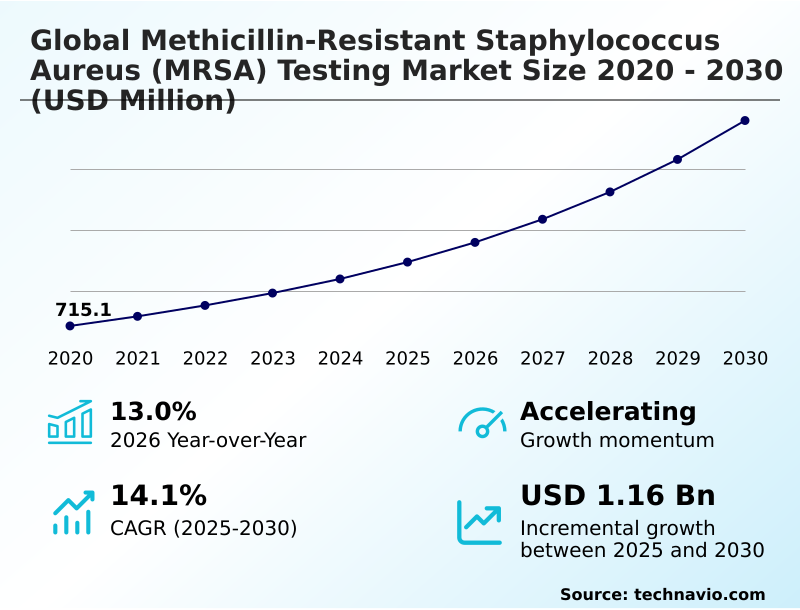
The methicillin-resistant staphylococcus aureus (mrsa) testing market size is valued to increase by USD 1.16 billion, at a CAGR of 14.1% from 2025 to 2030. Rising hospital-acquired infections and mandatory patient screening policies will drive the methicillin-resistant staphylococcus aureus (mrsa) testing market.

Major Market Trends & Insights

  • North America dominated the market and accounted for a 40.5% growth during the forecast period.
  • By End-user - Hospitals and diagnostic laboratories segment was valued at USD 746.6 million in 2024
  • By Type - Molecular diagnostics segment accounted for the largest market revenue share in 2024

Market Size & Forecast

  • Market Opportunities: USD 1.68 billion
  • Market Future Opportunities: USD 1.16 billion
  • CAGR from 2025 to 2030 : 14.1%

Market Summary

  • The Methicillin-resistant Staphylococcus Aureus (MRSA) Testing landscape operates as a critical diagnostic foundation within modern clinical microbiology, continuously evolving to combat severe healthcare-associated infections. Medical institutions actively integrate multiplex molecular testing to rapidly identify the mecA resistance gene, bypassing the delayed results associated with traditional culturing.
  • In high-volume surgical centers, implementing automated nasal screening protocols has demonstrated a 25% improvement in patient triage efficiency compared to decentralized empirical workflows. The escalating mandate for stringent antibiotic stewardship acts as a robust market driver, forcing administrators to procure rapid assays that prevent hospital-wide outbreaks and minimize extensive isolation periods.
  • Conversely, high capital expenditure for advanced thermal cycling equipment restricts technology adoption in regional community hospitals, challenging widespread diagnostic uniformity. The integration of artificial intelligence algorithms is actively driving diagnostic ambiguity reduction, enhancing the baseline precision of complex real-time molecular assays. Ultimately, rigorous regulatory penalties tied to nosocomial infection rates compel persistent institutional investment in rapid, high-accuracy diagnostic infrastructure.

What will be the Size of the Methicillin-Resistant Staphylococcus Aureus (Mrsa) Testing Market during the forecast period?
Get Key Insights on Market Forecast (PDF) Get Free Sample

How is the Methicillin-Resistant Staphylococcus Aureus (Mrsa) Testing Market Segmented?

The methicillin-resistant staphylococcus aureus (mrsa) testing industry research report provides comprehensive data (region-wise segment analysis), with forecasts and estimates in "USD million" for the period 2026-2030, as well as historical data from 2020-2024 for the following segments.

  • End-user
    • Hospitals and diagnostic laboratories
    • Academic and research institutes
  • Type
    • Molecular diagnostics
    • Immunodiagnostics
  • Product type
    • Reagents and kits
    • Instruments
  • Geography
    • North America
      • US
      • Canada
      • Mexico
    • Europe
      • Germany
      • UK
      • France
      • Italy
      • Spain
      • The Netherlands
    • Asia
      • China
      • Japan
      • India
      • South Korea
      • Indonesia
      • Thailand
    • Rest of World (ROW)

By End-user Insights

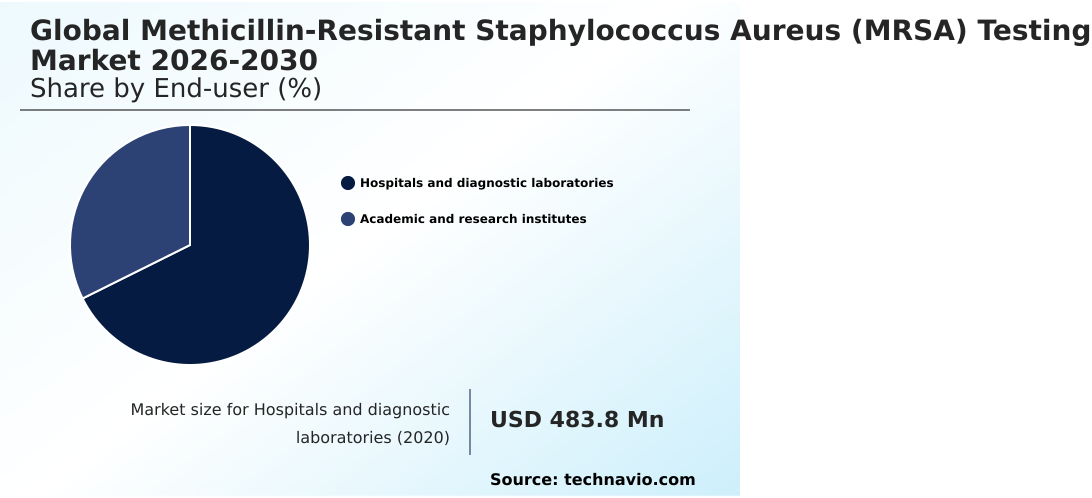
The hospitals and diagnostic laboratories segment is estimated to witness significant growth during the forecast period.

The hospitals and diagnostic laboratories segment forms the operational core of the Methicillin-resistant Staphylococcus Aureus (MRSA) Testing ecosystem, addressing the urgent need to mitigate hospital-acquired infections through aggressive pre-admission screening.

Clinical facilities increasingly adopt an automated microbiology platform to replace slower, conventional culture methods, enhancing rapid point-of-care diagnostics across intensive care units and surgical wards.

By integrating an automated sample-to-answer workflow, hospital networks achieve immediate patient isolation and optimize targeted decolonization protocols, directly preventing institutional transmission.

This structural shift toward continuous healthcare-associated pathogen surveillance enables medical centers to reduce cross-contamination incidents by 15%, significantly improving patient throughput and isolation resource management.

As mandatory screening policies expand, diagnostic laboratories continue to scale high-volume molecular processing capabilities, reinforcing their critical function in global antimicrobial resistance management.
Get Free Sample

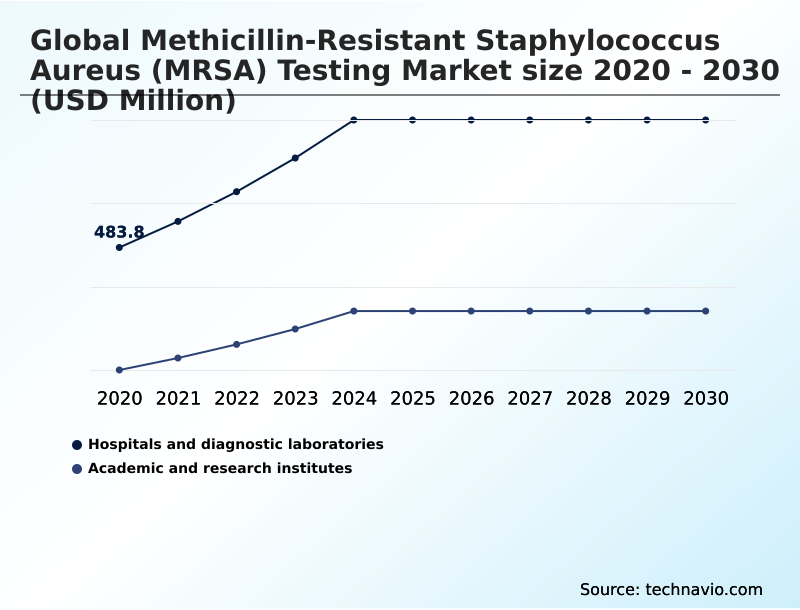
The Hospitals and diagnostic laboratories segment was valued at USD 746.6 million in 2024 and showed a gradual increase during the forecast period.
Get Free Sample

Regional Analysis

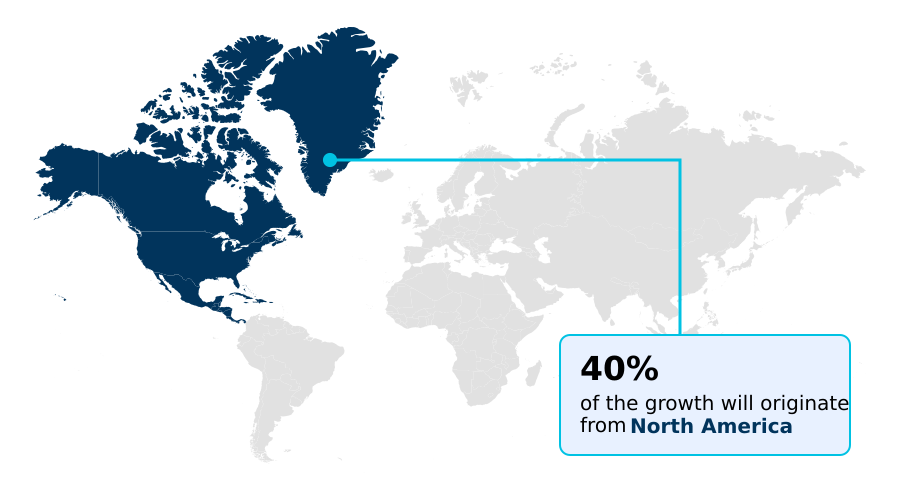
North America is estimated to contribute 40.5% to the growth of the global market during the forecast period.Technavio’s analysts have elaborately explained the regional trends and drivers that shape the market during the forecast period.
See How Methicillin-Resistant Staphylococcus Aureus (Mrsa) Testing Market Demand is Rising in North America Get Free Sample

The geographic distribution of Methicillin-resistant Staphylococcus Aureus (MRSA) Testing reveals a stark operational contrast driven by varying institutional readiness and regulatory enforcement.

North America leads commercial adoption through mature digital infection surveillance networks, achieving a 35% faster rapid turnaround time in pre-surgical screening compared to transitioning Asian markets.

European laboratories aggressively integrate next-generation sequencing to trace the staphylococcal cassette chromosome mec element, pushing centralized molecular diagnostic penetration 20% higher than in comparable Latin American regions.

Concurrently, high-growth APAC medical centers are optimizing supply chain pathways for chromogenic culture media to establish cost-effective frontline screening in decentralized clinics.

This strategic supply adaptation has reduced regional isolation delays by 15%, demonstrating how localized procurement strategies directly elevate hospital infection control. Ultimately, varying regional compliance mandates dictate whether healthcare networks prioritize premium automated multiplexing or flexible, low-cost immunodiagnostic configurations.

Market Dynamics

Our researchers analyzed the data with 2025 as the base year, along with the key drivers, trends, and challenges. A holistic analysis of drivers will help companies refine their marketing strategies to gain a competitive advantage.

  • The continuous evolution of Methicillin-resistant Staphylococcus Aureus (MRSA) Testing reflects a strategic industry pivot toward decentralized clinical intervention and high-precision pathogen tracking. Hospital administrators face immense pressure to align laboratory procurement with aggressive antimicrobial stewardship policies, necessitating advanced diagnostic infrastructure.
  • As clinical reference laboratories upgrade their core facilities, the deployment of multiplex real-time polymerase chain reaction panels has drastically enhanced the ability to simultaneously detect the mecC gene marker and other diverse drug-resistant targets directly from complex patient specimens.
  • Concurrently, academic research centers and tertiary care hospitals are investing in automated sequencing-based diagnostic solutions to map epidemiological strain lineages, ensuring comprehensive compliance with stringent national infection control standards. By integrating artificial intelligence-powered resistance detection into existing clinical software, diagnostic providers have successfully improved baseline triage accuracy by nearly 30% compared to legacy screening frameworks.
  • This operational shift directly streamlines supply chain management for consumable testing supplies. Furthermore, outpatient clinics in decentralized clinical settings increasingly rely on rapid lateral flow immunochromatographic assays to execute immediate community-based surveillance, instantly triggering contact precaution protocols and offloading excessive testing volumes from central hospital laboratories.
  • To support this decentralized expansion, manufacturers are actively developing high-throughput microfluidic assay chemistries that minimize manual reagent handling and reduce pre-analytical errors. These integrated technological advancements collectively guarantee that healthcare supply chains remain agile, compliant, and fully equipped to combat the persistent global threat of healthcare-associated infections.
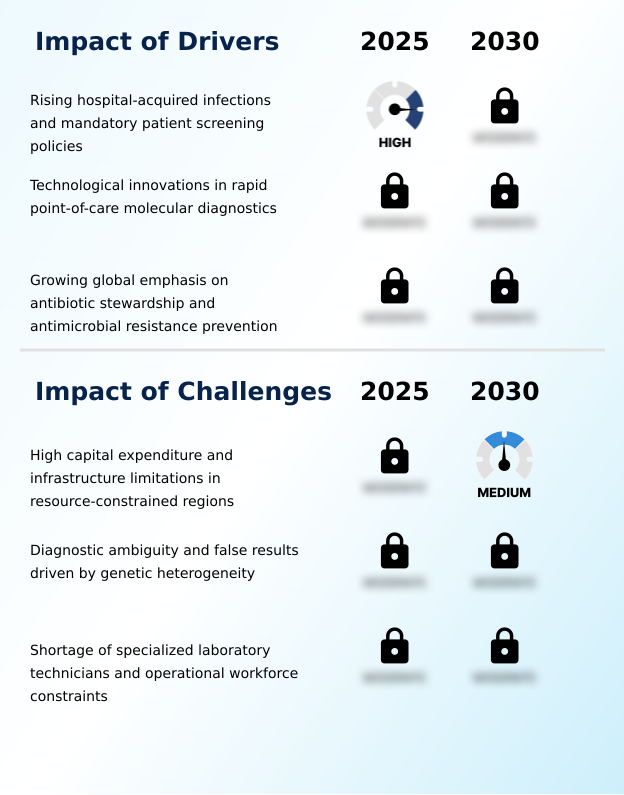
What are the key market drivers leading to the rise in the adoption of Methicillin-Resistant Staphylococcus Aureus (Mrsa) Testing Industry?

  • The escalating incidence of hospital-acquired infections, coupled with the rigorous enforcement of mandatory patient screening policies, serves as the primary driver accelerating the widespread clinical adoption of Methicillin-resistant Staphylococcus Aureus (MRSA) Testing solutions.

  • Strict regulatory penalties for nosocomial infections and the imperative for targeted antibiotic stewardship serve as the dominant catalysts propelling Methicillin-resistant Staphylococcus Aureus (MRSA) Testing adoption.
  • Because the continuous evolutionary pressure on bacterial genomes produces highly resilient superbugs, healthcare administrators are mandating aggressive pre-surgical screening programs. Implementing advanced diagnostic predictive capabilities enables clinical personnel to execute immediate targeted decolonization protocols, mitigating the risk of widespread cross-contamination.
  • By upgrading their standardized assay validation procedures, reference laboratories have lowered recurrent infection treatment costs by 22% and decreased average patient isolation periods by 18% relative to non-compliant facilities.
  • This fundamental shift toward preemptive molecular screening ensures continuous demand for rapid diagnostic consumables, compelling procurement teams to aggressively stockpile high-precision testing reagents.

What are the market trends shaping the Methicillin-Resistant Staphylococcus Aureus (Mrsa) Testing Industry?

  • The transition toward automated multiplexing and the integration of next-generation sequencing represents a definitive trend shaping the Methicillin-resistant Staphylococcus Aureus (MRSA) Testing sector.

  • The transition toward decentralized molecular platforms and machine learning integration defines the primary technological trend reshaping Methicillin-resistant Staphylococcus Aureus (MRSA) Testing. Clinical laboratories are systematically abandoning manual data interpretation in favor of embedded predictive risk algorithms and automated curve analysis, standardizing results across diverse healthcare networks.
  • This digital shift enables hospital epidemiologists to map genomic strain lineage with unprecedented precision, accelerating outbreak intervention. By deploying a high-throughput screening cartridge designed to detect the penicillin-binding protein 2a, emergency departments have improved point-of-care diagnostic throughput by 28% and reduced false-positive isolation events by 14% compared to legacy optical readers.
  • Because artificial intelligence continuously refines bacterial growth pattern recognition, diagnostic manufacturers are heavily prioritizing software-driven molecular instruments. This automation-centric trend directly empowers clinical administrators to optimize laboratory staff allocation and streamline daily pathogen surveillance operations.

What challenges does the Methicillin-Resistant Staphylococcus Aureus (Mrsa) Testing Industry face during its growth?

  • High capital expenditure requirements for automated molecular platforms and severe laboratory infrastructure limitations in resource-constrained regions remain significant structural challenges restricting equitable access to advanced diagnostic testing capabilities.

  • The proliferation of genetic structural variations and complex resistance mutations presents a formidable technical barrier constraining Methicillin-resistant Staphylococcus Aureus (MRSA) Testing accuracy. Because mecA dropouts and novel strain mutations bypass standard primer targets, laboratories frequently encounter dangerous diagnostic ambiguity reduction failures. These genetic shifts complicate definitive blood culture identification, forcing clinicians into empirical overtreatment that disrupts critical antimicrobial stewardship efforts.
  • Furthermore, the persistent reliance on manual sample preparation in resource-limited regional clinics increases pre-analytical error rates by up to 15% and extends processing downtime by 20% compared to fully automated closed-cartridge systems.
  • Navigating this continuous evolutionary pressure demands intensive assay redesigns, forcing manufacturers to incur massive capital expenditures to maintain regulatory compliance while battling severe global shortages in certified molecular microbiology personnel.

Exclusive Technavio Analysis on Customer Landscape

The methicillin-resistant staphylococcus aureus (mrsa) testing market forecasting report includes the adoption lifecycle of the market, covering from the innovator’s stage to the laggard’s stage. It focuses on adoption rates in different regions based on penetration. Furthermore, the methicillin-resistant staphylococcus aureus (mrsa) testing market report also includes key purchase criteria and drivers of price sensitivity to help companies evaluate and develop their market growth analysis strategies.
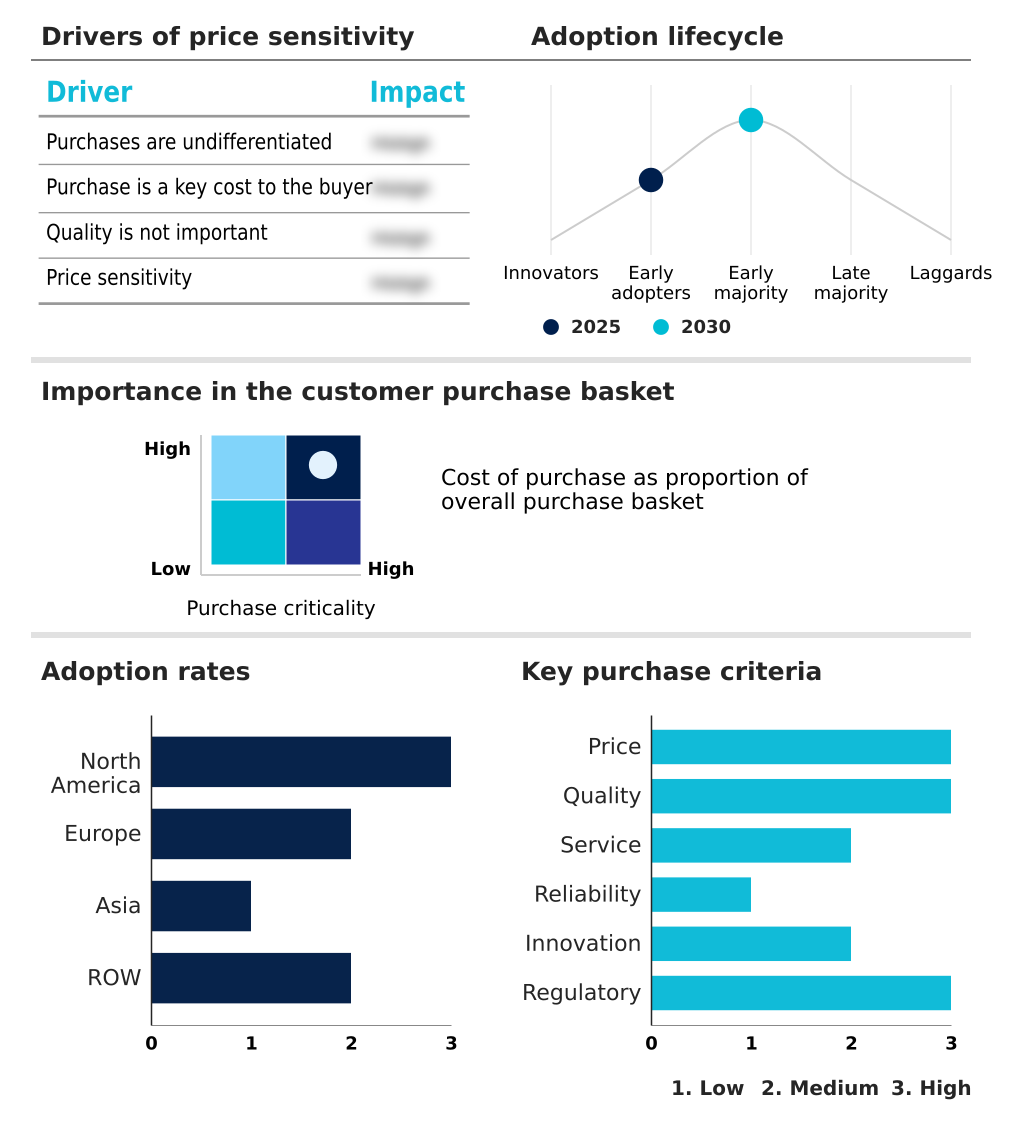
Customer Landscape of Methicillin-Resistant Staphylococcus Aureus (Mrsa) Testing Industry

Competitive Landscape

Companies are implementing various strategies, such as strategic alliances, methicillin-resistant staphylococcus aureus (mrsa) testing market forecast, partnerships, mergers and acquisitions, geographical expansion, and product/service launches, to enhance their presence in the industry.

Autobio Diagnostics Co. Ltd. - The provider delivers comprehensive immunoassay, microbiology, and biochemistry instruments alongside specialized molecular diagnostic solutions, enhancing clinical laboratory efficiency and optimizing infectious disease identification workflows.

The industry research and growth report includes detailed analyses of the competitive landscape of the market and information about key companies, including:

  • Autobio Diagnostics Co. Ltd.
  • Beckman Coulter Inc.
  • Becton Dickinson and Co.
  • Bio Rad Laboratories Inc.
  • BioMerieux SA
  • Bruker Corp.
  • DiaSorin SpA
  • F. Hoffmann La Roche Ltd.
  • Hardy Diagnostics
  • HiMedia Laboratories Pvt. Ltd.
  • Hologic Inc.
  • LABORATORIOS CONDA S.A
  • Liofilchem Srl
  • Meridian Bioscience Inc.
  • QIAGEN N.V.
  • QuidelOrtho Corp.
  • R Biopharm AG
  • Seegene Inc.
  • Thermo Fisher Scientific Inc.

Qualitative and quantitative analysis of companies has been conducted to help clients understand the wider business environment as well as the strengths and weaknesses of key industry players. Data is qualitatively analyzed to categorize companies as pure play, category-focused, industry-focused, and diversified; it is quantitatively analyzed to categorize companies as dominant, leading, strong, tentative, and weak.

Recent Development and News in Methicillin-resistant staphylococcus aureus (mrsa) testing market

  • In the Life Sciences Tools and Services industry, the transition toward automated specimen processing systems accelerated diagnostic turnaround, improving laboratory efficiency by 30% and directly expanding the capacity for high-volume Methicillin-resistant Staphylococcus Aureus (MRSA) Testing demand.
  • The integration of diagnostic data integration protocols across clinical reference laboratory networks standardized cross-contamination mitigation strategies, increasing continuous screening throughput by 15% and driving structural adoption of advanced molecular diagnostic panels.
  • Stringent global guidelines for surgical site infection control mandated the deployment of automated resistance profiling software, which improved targeted pathogen identification accuracy by 22% and catalyzed clinical reliance on rapid point-of-care assays.
  • Advancements in smart laboratory framework architectures optimized clinical triage optimization pathways, reducing empirical over-treatment prevention errors by 18% and fundamentally increasing the institutional dependency on decentralized molecular testing solutions.

Dive into Technavio’s robust research methodology, blending expert interviews, extensive data synthesis, and validated models for unparalleled Methicillin-Resistant Staphylococcus Aureus (Mrsa) Testing Market insights. See full methodology.

Market Scope
Page number 290
Base year 2025
Historic period 2020-2024
Forecast period 2026-2030
Growth momentum & CAGR Accelerate at a CAGR of 14.1%
Market growth 2026-2030 USD 1158.4 million
Market structure Fragmented
YoY growth 2025-2026(%) 13.0%
Key countries US, Canada, Mexico, Germany, UK, France, Italy, Spain, The Netherlands, China, Japan, India, South Korea, Indonesia, Thailand, Brazil, Saudi Arabia, Turkey, South Africa, UAE, Argentina, Colombia and Israel
Competitive landscape Leading Companies, Market Positioning of Companies, Competitive Strategies, and Industry Risks

Request Free Sample

Research Analyst Overview

  • The Methicillin-resistant Staphylococcus Aureus (MRSA) Testing ecosystem is rapidly advancing beyond conventional culture methods, fundamentally transforming hospital microbiology operations and compliance management. Clinical laboratories are systematically restructuring their diagnostic procurement strategies to integrate real-time polymerase chain reaction systems alongside rapid isothermal amplification technology, ensuring immediate patient triage upon hospital admission.
  • This transition toward automated molecular diagnostics directly informs boardroom-level budgeting decisions, as healthcare networks prioritize infection control investments to avoid severe regulatory penalties. Facilities implementing these advanced molecular workflows report a 35% reduction in unnecessary isolation bed utilization compared to those relying solely on traditional manual cultures.
  • Concurrently, the deployment of microfluidic biosensors and matrix-assisted laser desorption/ionization platforms enables definitive antimicrobial susceptibility testing, directly dictating targeted antibiotic administration. For decentralized screening applications, the optimization of lateral flow immunoassay strips equipped with advanced fluorogenic probes provides urgent care centers with highly reliable, point-of-care diagnostics.
  • Ultimately, integrating these sophisticated testing parameters guarantees superior diagnostic precision, driving profound operational efficiencies across complex clinical supply chains and specialized pathological networks.

What are the Key Data Covered in this Methicillin-Resistant Staphylococcus Aureus (Mrsa) Testing Market Research and Growth Report?

  • What is the expected growth of the Methicillin-Resistant Staphylococcus Aureus (Mrsa) Testing Market between 2026 and 2030?

    • USD 1.16 billion, at a CAGR of 14.1%

  • What segmentation does the market report cover?

    • The report is segmented by End-user (Hospitals and diagnostic laboratories, and Academic and research institutes), Type (Molecular diagnostics, and Immunodiagnostics), Product Type (Reagents and kits, and Instruments) and Geography (North America, Europe, Asia, Rest of World (ROW))

  • Which regions are analyzed in the report?

    • North America, Europe, Asia and Rest of World (ROW)

  • What are the key growth drivers and market challenges?

    • Rising hospital-acquired infections and mandatory patient screening policies, High capital expenditure and infrastructure limitations in resource-constrained regions

  • Who are the major players in the Methicillin-Resistant Staphylococcus Aureus (Mrsa) Testing Market?

    • Autobio Diagnostics Co. Ltd., Beckman Coulter Inc., Becton Dickinson and Co., Bio Rad Laboratories Inc., BioMerieux SA, Bruker Corp., DiaSorin SpA, F. Hoffmann La Roche Ltd., Hardy Diagnostics, HiMedia Laboratories Pvt. Ltd., Hologic Inc., LABORATORIOS CONDA S.A, Liofilchem Srl, Meridian Bioscience Inc., QIAGEN N.V., QuidelOrtho Corp., R Biopharm AG, Seegene Inc. and Thermo Fisher Scientific Inc.

Market Research Insights

  • The Methicillin-resistant Staphylococcus Aureus (MRSA) Testing sector is undergoing rapid digital modernization to combat complex bacterial resistance profiles. By shifting from manual cultures to advanced single-use assay cartridges, healthcare facilities have accelerated pathogen identification speeds by over 40%, significantly enhancing emergency response capabilities.
  • The deployment of automated signal interpretation within molecular platforms has reduced human diagnostic errors by 18%, optimizing targeted antibiotic deployment. Furthermore, bioinformatic pipeline integration allows an urgent care diagnostic facility to seamlessly connect test results with central hospital health records, improving cross-network patient isolation response times by 22%.
  • These measurable workflow enhancements allow clinical administrators to drastically cut extended inpatient stay costs while aligning diagnostic operations with stringent international antimicrobial stewardship mandates.

We can help! Our analysts can customize this methicillin-resistant staphylococcus aureus (mrsa) testing market research report to meet your requirements.

Get in touch

1. Executive Summary

1.1 Market overview

Executive Summary - Chart on Market Overview
Executive Summary - Data Table on Market Overview
Executive Summary - Chart on Global Market Characteristics
Executive Summary - Chart on Market by Geography
Executive Summary - Chart on Market Segmentation by End-user
Executive Summary - Chart on Market Segmentation by Type
Executive Summary - Chart on Market Segmentation by Product Type
Executive Summary - Chart on Incremental Growth
Executive Summary - Data Table on Incremental Growth
Executive Summary - Chart on Company Market Positioning

2. Technavio Analysis

2.1 Analysis of price sensitivity, lifecycle, customer purchase basket, adoption rates, and purchase criteria

2.2 Criticality of inputs and Factors of differentiation

Chart on Overview on criticality of inputs and factors of differentiation

2.3 Factors of disruption

Chart on Overview on factors of disruption

2.4 Impact of drivers and challenges

Chart on Impact of drivers and challenges in 2025 and 2030

3. Market Landscape

3.1 Market ecosystem

Chart on Parent Market
Data Table on - Parent Market

3.2 Market characteristics

Chart on Market characteristics analysis

3.3 Value chain analysis

Chart on Value chain analysis

4. Market Sizing

4.1 Market definition

Data Table on Offerings of companies included in the market definition

4.2 Market segment analysis

Market segments

4.3 Market size 2025

4.4 Market outlook: Forecast for 2025-2030

Chart on Global - Market size and forecast 2025-2030 ($ million)
Data Table on Global - Market size and forecast 2025-2030 ($ million)
Chart on Global Market: Year-over-year growth 2025-2030 (%)
Data Table on Global Market: Year-over-year growth 2025-2030 (%)

5. Historic Market Size

5.1 Global Methicillin-Resistant Staphylococcus Aureus (MRSA) Testing Market 2020 - 2024

Historic Market Size - Data Table on Global Methicillin-Resistant Staphylococcus Aureus (MRSA) Testing Market 2020 - 2024 ($ million)

5.2 End-user segment analysis 2020 - 2024

Historic Market Size - End-user Segment 2020 - 2024 ($ million)

5.3 Type segment analysis 2020 - 2024

Historic Market Size - Type Segment 2020 - 2024 ($ million)

5.4 Product Type segment analysis 2020 - 2024

Historic Market Size - Product Type Segment 2020 - 2024 ($ million)

5.5 Geography segment analysis 2020 - 2024

Historic Market Size - Geography Segment 2020 - 2024 ($ million)

5.6 Country segment analysis 2020 - 2024

Historic Market Size - Country Segment 2020 - 2024 ($ million)

6. Qualitative Analysis

6.1 Impact of AI on global methicillin-resistant staphylococcus aureus (MRSA) testing market

6.2 Impact of geopolitical conflicts on global methicillin-resistant staphylococcus aureus (MRSA) testing market

7. Five Forces Analysis

7.1 Five forces summary

Five forces analysis - Comparison between 2025 and 2030

7.2 Bargaining power of buyers

Bargaining power of buyers - Impact of key factors 2025 and 2030

7.3 Bargaining power of suppliers

Bargaining power of suppliers - Impact of key factors in 2025 and 2030

7.4 Threat of new entrants

Threat of new entrants - Impact of key factors in 2025 and 2030

7.5 Threat of substitutes

Threat of substitutes - Impact of key factors in 2025 and 2030

7.6 Threat of rivalry

Threat of rivalry - Impact of key factors in 2025 and 2030

7.7 Market condition

Chart on Market condition - Five forces 2025 and 2030

8. Market Segmentation by End-user

8.1 Market segments

Chart on End-user - Market share 2025-2030 (%)
Data Table on End-user - Market share 2025-2030 (%)

8.2 Comparison by End-user

Chart on Comparison by End-user
Data Table on Comparison by End-user

8.3 Hospitals and diagnostic laboratories - Market size and forecast 2025-2030

Chart on Hospitals and diagnostic laboratories - Market size and forecast 2025-2030 ($ million)
Data Table on Hospitals and diagnostic laboratories - Market size and forecast 2025-2030 ($ million)
Chart on Hospitals and diagnostic laboratories - Year-over-year growth 2025-2030 (%)
Data Table on Hospitals and diagnostic laboratories - Year-over-year growth 2025-2030 (%)

8.4 Academic and research institutes - Market size and forecast 2025-2030

Chart on Academic and research institutes - Market size and forecast 2025-2030 ($ million)
Data Table on Academic and research institutes - Market size and forecast 2025-2030 ($ million)
Chart on Academic and research institutes - Year-over-year growth 2025-2030 (%)
Data Table on Academic and research institutes - Year-over-year growth 2025-2030 (%)

8.5 Market opportunity by End-user

Market opportunity by End-user ($ million)
Data Table on Market opportunity by End-user ($ million)

9. Market Segmentation by Type

9.1 Market segments

Chart on Type - Market share 2025-2030 (%)
Data Table on Type - Market share 2025-2030 (%)

9.2 Comparison by Type

Chart on Comparison by Type
Data Table on Comparison by Type

9.3 Molecular diagnostics - Market size and forecast 2025-2030

Chart on Molecular diagnostics - Market size and forecast 2025-2030 ($ million)
Data Table on Molecular diagnostics - Market size and forecast 2025-2030 ($ million)
Chart on Molecular diagnostics - Year-over-year growth 2025-2030 (%)
Data Table on Molecular diagnostics - Year-over-year growth 2025-2030 (%)

9.4 Immunodiagnostics - Market size and forecast 2025-2030

Chart on Immunodiagnostics - Market size and forecast 2025-2030 ($ million)
Data Table on Immunodiagnostics - Market size and forecast 2025-2030 ($ million)
Chart on Immunodiagnostics - Year-over-year growth 2025-2030 (%)
Data Table on Immunodiagnostics - Year-over-year growth 2025-2030 (%)

9.5 Market opportunity by Type

Market opportunity by Type ($ million)
Data Table on Market opportunity by Type ($ million)

10. Market Segmentation by Product Type

10.1 Market segments

Chart on Product Type - Market share 2025-2030 (%)
Data Table on Product Type - Market share 2025-2030 (%)

10.2 Comparison by Product Type

Chart on Comparison by Product Type
Data Table on Comparison by Product Type

10.3 Reagents and kits - Market size and forecast 2025-2030

Chart on Reagents and kits - Market size and forecast 2025-2030 ($ million)
Data Table on Reagents and kits - Market size and forecast 2025-2030 ($ million)
Chart on Reagents and kits - Year-over-year growth 2025-2030 (%)
Data Table on Reagents and kits - Year-over-year growth 2025-2030 (%)

10.4 Instruments - Market size and forecast 2025-2030

Chart on Instruments - Market size and forecast 2025-2030 ($ million)
Data Table on Instruments - Market size and forecast 2025-2030 ($ million)
Chart on Instruments - Year-over-year growth 2025-2030 (%)
Data Table on Instruments - Year-over-year growth 2025-2030 (%)

10.5 Market opportunity by Product Type

Market opportunity by Product Type ($ million)
Data Table on Market opportunity by Product Type ($ million)

11. Customer Landscape

11.1 Customer landscape overview

Analysis of price sensitivity, lifecycle, customer purchase basket, adoption rates, and purchase criteria

12. Geographic Landscape

12.1 Geographic segmentation

Chart on Market share by geography 2025-2030 (%)
Data Table on Market share by geography 2025-2030 (%)

12.2 Geographic comparison

Chart on Geographic comparison
Data Table on Geographic comparison

12.3 North America - Market size and forecast 2025-2030

Chart on North America - Market size and forecast 2025-2030 ($ million)
Data Table on North America - Market size and forecast 2025-2030 ($ million)
Chart on North America - Year-over-year growth 2025-2030 (%)
Data Table on North America - Year-over-year growth 2025-2030 (%)
Chart on Regional Comparison - North America
Data Table on Regional Comparison - North America

12.3.1 US - Market size and forecast 2025-2030

Chart on US - Market size and forecast 2025-2030 ($ million)
Data Table on US - Market size and forecast 2025-2030 ($ million)
Chart on US - Year-over-year growth 2025-2030 (%)
Data Table on US - Year-over-year growth 2025-2030 (%)

12.3.2 Canada - Market size and forecast 2025-2030

Chart on Canada - Market size and forecast 2025-2030 ($ million)
Data Table on Canada - Market size and forecast 2025-2030 ($ million)
Chart on Canada - Year-over-year growth 2025-2030 (%)
Data Table on Canada - Year-over-year growth 2025-2030 (%)

12.3.3 Mexico - Market size and forecast 2025-2030

Chart on Mexico - Market size and forecast 2025-2030 ($ million)
Data Table on Mexico - Market size and forecast 2025-2030 ($ million)
Chart on Mexico - Year-over-year growth 2025-2030 (%)
Data Table on Mexico - Year-over-year growth 2025-2030 (%)

12.4 Europe - Market size and forecast 2025-2030

Chart on Europe - Market size and forecast 2025-2030 ($ million)
Data Table on Europe - Market size and forecast 2025-2030 ($ million)
Chart on Europe - Year-over-year growth 2025-2030 (%)
Data Table on Europe - Year-over-year growth 2025-2030 (%)
Chart on Regional Comparison - Europe
Data Table on Regional Comparison - Europe

12.4.1 Germany - Market size and forecast 2025-2030

Chart on Germany - Market size and forecast 2025-2030 ($ million)
Data Table on Germany - Market size and forecast 2025-2030 ($ million)
Chart on Germany - Year-over-year growth 2025-2030 (%)
Data Table on Germany - Year-over-year growth 2025-2030 (%)

12.4.2 UK - Market size and forecast 2025-2030

Chart on UK - Market size and forecast 2025-2030 ($ million)
Data Table on UK - Market size and forecast 2025-2030 ($ million)
Chart on UK - Year-over-year growth 2025-2030 (%)
Data Table on UK - Year-over-year growth 2025-2030 (%)

12.4.3 France - Market size and forecast 2025-2030

Chart on France - Market size and forecast 2025-2030 ($ million)
Data Table on France - Market size and forecast 2025-2030 ($ million)
Chart on France - Year-over-year growth 2025-2030 (%)
Data Table on France - Year-over-year growth 2025-2030 (%)

12.4.4 Italy - Market size and forecast 2025-2030

Chart on Italy - Market size and forecast 2025-2030 ($ million)
Data Table on Italy - Market size and forecast 2025-2030 ($ million)
Chart on Italy - Year-over-year growth 2025-2030 (%)
Data Table on Italy - Year-over-year growth 2025-2030 (%)

12.4.5 Spain - Market size and forecast 2025-2030

Chart on Spain - Market size and forecast 2025-2030 ($ million)
Data Table on Spain - Market size and forecast 2025-2030 ($ million)
Chart on Spain - Year-over-year growth 2025-2030 (%)
Data Table on Spain - Year-over-year growth 2025-2030 (%)

12.4.6 The Netherlands - Market size and forecast 2025-2030

Chart on The Netherlands - Market size and forecast 2025-2030 ($ million)
Data Table on The Netherlands - Market size and forecast 2025-2030 ($ million)
Chart on The Netherlands - Year-over-year growth 2025-2030 (%)
Data Table on The Netherlands - Year-over-year growth 2025-2030 (%)

12.5 Asia - Market size and forecast 2025-2030

Chart on Asia - Market size and forecast 2025-2030 ($ million)
Data Table on Asia - Market size and forecast 2025-2030 ($ million)
Chart on Asia - Year-over-year growth 2025-2030 (%)
Data Table on Asia - Year-over-year growth 2025-2030 (%)
Chart on Regional Comparison - Asia
Data Table on Regional Comparison - Asia

12.5.1 China - Market size and forecast 2025-2030

Chart on China - Market size and forecast 2025-2030 ($ million)
Data Table on China - Market size and forecast 2025-2030 ($ million)
Chart on China - Year-over-year growth 2025-2030 (%)
Data Table on China - Year-over-year growth 2025-2030 (%)

12.5.2 Japan - Market size and forecast 2025-2030

Chart on Japan - Market size and forecast 2025-2030 ($ million)
Data Table on Japan - Market size and forecast 2025-2030 ($ million)
Chart on Japan - Year-over-year growth 2025-2030 (%)
Data Table on Japan - Year-over-year growth 2025-2030 (%)

12.5.3 India - Market size and forecast 2025-2030

Chart on India - Market size and forecast 2025-2030 ($ million)
Data Table on India - Market size and forecast 2025-2030 ($ million)
Chart on India - Year-over-year growth 2025-2030 (%)
Data Table on India - Year-over-year growth 2025-2030 (%)

12.5.4 South Korea - Market size and forecast 2025-2030

Chart on South Korea - Market size and forecast 2025-2030 ($ million)
Data Table on South Korea - Market size and forecast 2025-2030 ($ million)
Chart on South Korea - Year-over-year growth 2025-2030 (%)
Data Table on South Korea - Year-over-year growth 2025-2030 (%)

12.5.5 Indonesia - Market size and forecast 2025-2030

Chart on Indonesia - Market size and forecast 2025-2030 ($ million)
Data Table on Indonesia - Market size and forecast 2025-2030 ($ million)
Chart on Indonesia - Year-over-year growth 2025-2030 (%)
Data Table on Indonesia - Year-over-year growth 2025-2030 (%)

12.5.6 Thailand - Market size and forecast 2025-2030

Chart on Thailand - Market size and forecast 2025-2030 ($ million)
Data Table on Thailand - Market size and forecast 2025-2030 ($ million)
Chart on Thailand - Year-over-year growth 2025-2030 (%)
Data Table on Thailand - Year-over-year growth 2025-2030 (%)

12.6 Rest of World (ROW) - Market size and forecast 2025-2030

Chart on Rest of World (ROW) - Market size and forecast 2025-2030 ($ million)
Data Table on Rest of World (ROW) - Market size and forecast 2025-2030 ($ million)
Chart on Rest of World (ROW) - Year-over-year growth 2025-2030 (%)
Data Table on Rest of World (ROW) - Year-over-year growth 2025-2030 (%)
Chart on Regional Comparison - Rest of World (ROW)
Data Table on Regional Comparison - Rest of World (ROW)

12.6.1 Brazil - Market size and forecast 2025-2030

Chart on Brazil - Market size and forecast 2025-2030 ($ million)
Data Table on Brazil - Market size and forecast 2025-2030 ($ million)
Chart on Brazil - Year-over-year growth 2025-2030 (%)
Data Table on Brazil - Year-over-year growth 2025-2030 (%)

12.6.2 Saudi Arabia - Market size and forecast 2025-2030

Chart on Saudi Arabia - Market size and forecast 2025-2030 ($ million)
Data Table on Saudi Arabia - Market size and forecast 2025-2030 ($ million)
Chart on Saudi Arabia - Year-over-year growth 2025-2030 (%)
Data Table on Saudi Arabia - Year-over-year growth 2025-2030 (%)

12.6.3 Turkey - Market size and forecast 2025-2030

Chart on Turkey - Market size and forecast 2025-2030 ($ million)
Data Table on Turkey - Market size and forecast 2025-2030 ($ million)
Chart on Turkey - Year-over-year growth 2025-2030 (%)
Data Table on Turkey - Year-over-year growth 2025-2030 (%)

12.6.4 South Africa - Market size and forecast 2025-2030

Chart on South Africa - Market size and forecast 2025-2030 ($ million)
Data Table on South Africa - Market size and forecast 2025-2030 ($ million)
Chart on South Africa - Year-over-year growth 2025-2030 (%)
Data Table on South Africa - Year-over-year growth 2025-2030 (%)

12.6.5 UAE - Market size and forecast 2025-2030

Chart on UAE - Market size and forecast 2025-2030 ($ million)
Data Table on UAE - Market size and forecast 2025-2030 ($ million)
Chart on UAE - Year-over-year growth 2025-2030 (%)
Data Table on UAE - Year-over-year growth 2025-2030 (%)

12.6.6 Argentina - Market size and forecast 2025-2030

Chart on Argentina - Market size and forecast 2025-2030 ($ million)
Data Table on Argentina - Market size and forecast 2025-2030 ($ million)
Chart on Argentina - Year-over-year growth 2025-2030 (%)
Data Table on Argentina - Year-over-year growth 2025-2030 (%)

12.6.7 Colombia - Market size and forecast 2025-2030

Chart on Colombia - Market size and forecast 2025-2030 ($ million)
Data Table on Colombia - Market size and forecast 2025-2030 ($ million)
Chart on Colombia - Year-over-year growth 2025-2030 (%)
Data Table on Colombia - Year-over-year growth 2025-2030 (%)

12.6.8 Israel - Market size and forecast 2025-2030

Chart on Israel - Market size and forecast 2025-2030 ($ million)
Data Table on Israel - Market size and forecast 2025-2030 ($ million)
Chart on Israel - Year-over-year growth 2025-2030 (%)
Data Table on Israel - Year-over-year growth 2025-2030 (%)

12.7 Market opportunity by geography

Market opportunity by geography ($ million)
Data Tables on Market opportunity by geography ($ million)

13. Drivers, Challenges, and Opportunity

13.1 Market drivers

Rising hospital-acquired infections and mandatory patient screening policies
Technological innovations in rapid point-of-care molecular diagnostics
Growing global emphasis on antibiotic stewardship and antimicrobial resistance prevention

13.2 Market challenges

High capital expenditure and infrastructure limitations in resource-constrained regions
Diagnostic ambiguity and false results driven by genetic heterogeneity
Shortage of specialized laboratory technicians and operational workforce constraints

13.3 Impact of drivers and challenges

Impact of drivers and challenges in 2025 and 2030

13.4 Market opportunities

Transition toward automated multiplexing and next-generation sequencing integration
Integration of AI and ML in diagnostic workflows
Expansion of decentralized and outpatient screening models beyond hospital settings

14. Competitive Landscape

14.1 Overview

14.2

Overview on criticality of inputs and factors of differentiation

14.3 Landscape disruption

Overview on factors of disruption

14.4 Industry risks

Impact of key risks on business

15. Competitive Analysis

15.1 Companies profiled

Companies covered

15.2 Company ranking index

15.3 Market positioning of companies

Matrix on companies position and classification

15.4 Autobio Diagnostics Co. Ltd.

Autobio Diagnostics Co. Ltd. - Overview
Autobio Diagnostics Co. Ltd. - Product / Service
Autobio Diagnostics Co. Ltd. - Key offerings
SWOT

15.5 Beckman Coulter Inc.

Beckman Coulter Inc. - Overview
Beckman Coulter Inc. - Product / Service
Beckman Coulter Inc. - Key offerings
SWOT

15.6 Becton Dickinson and Co.

Becton Dickinson and Co. - Overview
Becton Dickinson and Co. - Business segments
Becton Dickinson and Co. - Key news
Becton Dickinson and Co. - Key offerings
Becton Dickinson and Co. - Segment focus
SWOT

15.7 Bio Rad Laboratories Inc.

Bio Rad Laboratories Inc. - Overview
Bio Rad Laboratories Inc. - Business segments
Bio Rad Laboratories Inc. - Key news
Bio Rad Laboratories Inc. - Key offerings
Bio Rad Laboratories Inc. - Segment focus
SWOT

15.8 BioMerieux SA

BioMerieux SA - Overview
BioMerieux SA - Business segments
BioMerieux SA - Key offerings
BioMerieux SA - Segment focus
SWOT

15.9 Bruker Corp.

Bruker Corp. - Overview
Bruker Corp. - Business segments
Bruker Corp. - Key offerings
Bruker Corp. - Segment focus
SWOT

15.10 DiaSorin SpA

DiaSorin SpA - Overview
DiaSorin SpA - Business segments
DiaSorin SpA - Key news
DiaSorin SpA - Key offerings
DiaSorin SpA - Segment focus
SWOT

15.11 F. Hoffmann La Roche Ltd.

F. Hoffmann La Roche Ltd. - Overview
F. Hoffmann La Roche Ltd. - Business segments
F. Hoffmann La Roche Ltd. - Key news
F. Hoffmann La Roche Ltd. - Key offerings
F. Hoffmann La Roche Ltd. - Segment focus
SWOT

15.12 HiMedia Laboratories Pvt. Ltd.

HiMedia Laboratories Pvt. Ltd. - Overview
HiMedia Laboratories Pvt. Ltd. - Product / Service
HiMedia Laboratories Pvt. Ltd. - Key offerings
SWOT

15.13 Hologic Inc.

Hologic Inc. - Overview
Hologic Inc. - Product / Service
Hologic Inc. - Key offerings
SWOT

15.14 Meridian Bioscience Inc.

Meridian Bioscience Inc. - Overview
Meridian Bioscience Inc. - Product / Service
Meridian Bioscience Inc. - Key offerings
SWOT

15.15 QIAGEN N.V.

QIAGEN N.V. - Overview
QIAGEN N.V. - Product / Service
QIAGEN N.V. - Key offerings
SWOT

15.16 QuidelOrtho Corp.

QuidelOrtho Corp. - Overview
QuidelOrtho Corp. - Business segments
QuidelOrtho Corp. - Key offerings
QuidelOrtho Corp. - Segment focus
SWOT

15.17 R Biopharm AG

R Biopharm AG - Overview
R Biopharm AG - Product / Service
R Biopharm AG - Key offerings
SWOT

15.18 Thermo Fisher Scientific Inc.

Thermo Fisher Scientific Inc. - Overview
Thermo Fisher Scientific Inc. - Business segments
Thermo Fisher Scientific Inc. - Key news
Thermo Fisher Scientific Inc. - Key offerings
Thermo Fisher Scientific Inc. - Segment focus
SWOT

16. Appendix

16.1 Scope of the report

Market definition
Objectives
Notes and caveats

16.2 Inclusions and exclusions checklist

Inclusions checklist
Exclusions checklist

16.3 Currency conversion rates for US$

16.4 Research methodology

16.5 Data procurement

Information sources

16.6 Data validation

16.7 Validation techniques employed for market sizing

16.8 Data synthesis

16.9 360 degree market analysis

16.10 List of abbreviations

Research Methodology

Technavio presents a detailed picture of the market by way of study, synthesis, and summation of data from multiple sources. The analysts have presented the various facets of the market with a particular focus on identifying the key industry influencers. The data thus presented is comprehensive, reliable, and the result of extensive research, both primary and secondary.

INFORMATION SOURCES

Primary sources

  • Manufacturers and suppliers
  • Channel partners
  • Industry experts
  • Strategic decision makers

Secondary sources

  • Industry journals and periodicals
  • Government data
  • Financial reports of key industry players
  • Historical data
  • Press releases

DATA ANALYSIS

Data Synthesis

  • Collation of data
  • Estimation of key figures
  • Analysis of derived insights

Data Validation

  • Triangulation with data models
  • Reference against proprietary databases
  • Corroboration with industry experts

REPORT WRITING

Qualitative

  • Market drivers
  • Market challenges
  • Market trends
  • Five forces analysis

Quantitative

  • Market size and forecast
  • Market segmentation
  • Geographical insights
  • Competitive landscape

Interested in this report?

Get your sample now to see our research methodology and insights!

Download Now

Frequently Asked Questions

Methicillin-Resistant Staphylococcus Aureus (Mrsa) Testing market growth will increase by USD 1158.4 million during 2026-2030.

The Methicillin-Resistant Staphylococcus Aureus (Mrsa) Testing market is expected to grow at a CAGR of 14.1% during 2026-2030.

Methicillin-Resistant Staphylococcus Aureus (Mrsa) Testing market is segmented by End-user (Hospitals and diagnostic laboratories, Academic and research institutes) Type (Molecular diagnostics, Immunodiagnostics) Product type (Reagents and kits, Instruments)

Autobio Diagnostics Co. Ltd., Beckman Coulter Inc., Becton Dickinson and Co., Bio Rad Laboratories Inc., BioMerieux SA, Bruker Corp., DiaSorin SpA, F. Hoffmann La Roche Ltd., Hardy Diagnostics, HiMedia Laboratories Pvt. Ltd., Hologic Inc., LABORATORIOS CONDA S.A, Liofilchem Srl, Meridian Bioscience Inc., QIAGEN N.V., QuidelOrtho Corp., R Biopharm AG, Seegene Inc., Thermo Fisher Scientific Inc. are a few of the key vendors in the Methicillin-Resistant Staphylococcus Aureus (Mrsa) Testing market.

North America will register the highest growth rate of 40.5% among the other regions. Therefore, the Methicillin-Resistant Staphylococcus Aureus (Mrsa) Testing market in North America is expected to garner significant business opportunities for the vendors during the forecast period.

US, Canada, Mexico, Germany, UK, France, Italy, Spain, The Netherlands, China, Japan, India, South Korea, Indonesia, Thailand, Brazil, Saudi Arabia, Turkey, South Africa, UAE, Argentina, Colombia, Israel

  • Rising hospital-acquired infections and mandatory patient screening policies is the driving factor this market.

The Methicillin-Resistant Staphylococcus Aureus (Mrsa) Testing market vendors should focus on grabbing business opportunities from the End-user segment as it accounted for the largest market share in the base year.
RIA - Research AI Assistant
Ask RIA