


Multefire Market Size 2024-2028
The multefire market size is forecast to increase by USD 5.33 billion, at a CAGR of 55.91% between 2023 and 2028.
- The market is experiencing significant growth, driven primarily by the increasing digitalization trend across various industries. The industrial sector, in particular, is witnessing a surge in demand for MulteFire technology due to its ability to provide reliable, high-speed wireless connectivity in areas where traditional cellular networks may be unavailable or inadequate. However, the market's growth is not without challenges. The lack of MulteFire devices is a major obstacle hindering widespread adoption. As industries continue to digitalize and demand for reliable, high-speed wireless connectivity increases, companies must navigate this challenge to capitalize on the market's potential.
- To succeed, organizations must focus on developing and deploying MulteFire devices at an accelerated pace to meet the growing demand. By doing so, they can effectively address the challenges posed by the current device scarcity and position themselves as leaders in the evolving the market.
What will be the Size of the Multefire Market during the forecast period?

Explore in-depth regional segment analysis with market size data - historical 2018-2022 and forecasts 2024-2028 - in the full report.
Request Free Sample
The market continues to evolve, driven by the integration of various technologies and applications. RF front-end modules and Massive MIMO enhance signal strength, enabling better coverage and capacity for cellular networks. Industrial IoT and Service Level Agreements require open standards and software-defined networking for seamless integration and efficient communication. Power amplifiers and coverage expansion ensure reliable connectivity in public safety and critical infrastructure sectors. Performance monitoring and capacity enhancement through network slicing and carrier aggregation cater to the growing demands of connected vehicles and smart cities. Interference mitigation and network security are essential components of dynamic spectrum allocation and spectrum sharing, ensuring access control and configuration management.
Network management, antenna design, and fault management are crucial for maintaining optimal data rates and minimizing packet loss. Edge computing and cloud RAN enable real-time processing and analysis, while radio frequency identification and software-defined radio offer new possibilities for IoT devices and network function virtualization. The market's continuous dynamism extends to the integration of emerging technologies such as network slicing, small cells, and emergency response systems. These advancements underscore the market's potential to transform various industries and applications, redefining the landscape of wireless communications.
How is this Multefire Industry segmented?
The multefire industry research report provides comprehensive data (region-wise segment analysis), with forecasts and estimates in "USD million" for the period 2024-2028, as well as historical data from 2018-2022 for the following segments.
- Type
- Small cells
- Switches
- Controllers
- Geography
- North America
- US
- Canada
- Europe
- Germany
- UK
- APAC
- China
- Rest of World (ROW)
- North America
By Type Insights
The small cells segment is estimated to witness significant growth during the forecast period.
The small cells segment dominates The market in 2023, driven by the increasing demand for dependable and private networks. This trend is further fueled by the continuous growth in the need for private networks utilizing unlicensed and shared frequencies. Small cells offer a cost-effective solution for enterprise applications, eliminating the need for costly rooftop installations. Additionally, small cells significantly enhance network performance, making them an essential component of the market. Massive MIMO technology and signal strength play crucial roles in expanding coverage in this market. Industrial IoT applications require high-performance networks, leading to a growing demand for multefire technology.
Service level agreements and open standards ensure reliable and secure network connections, attracting more businesses to adopt this technology. Software-defined networking, power amplifiers, and network slicing enable efficient capacity enhancement and dynamic spectrum allocation. Public safety networks benefit from multefire technology's ability to provide reliable and high-speed connectivity during emergencies. Connected vehicles and smart cities require robust networks for seamless communication, further driving the market's growth. Interference mitigation and network security features ensure uninterrupted and secure data transmission, making multefire an attractive option for businesses. Network management, antenna design, fault management, edge computing, cloud RAN, radio frequency identification, software-defined radio, and IoT devices are integral components of the multefire ecosystem.
Overall, the market is evolving to meet the growing demand for high-performance, flexible, and cost-effective network solutions.
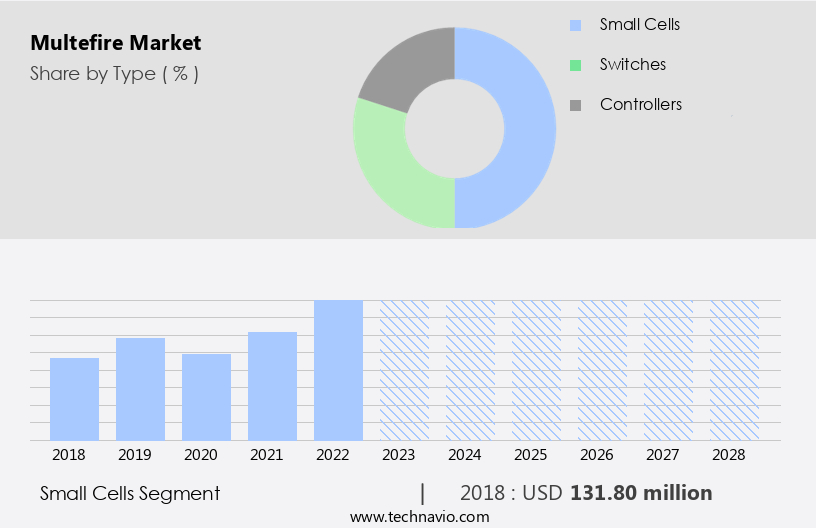
The Small cells segment was valued at USD 131.80 billion in 2018 and showed a gradual increase during the forecast period.
Regional Analysis
North America is estimated to contribute 36% to the growth of the global market during the forecast period.Technavio’s analysts have elaborately explained the regional trends and drivers that shape the market during the forecast period.

The market is experiencing significant growth, driven by the adoption of MulteFire technology-based networks in various industries. In 2023, North America held the largest market share due to its leadership in this area. The region's growth can be attributed to initiatives like the MulteFire Alliance, which explores opportunities for LTE technologies in the unlicensed band for applications such as industrial IoT, healthcare, mining, and commercial use. Key players in the region, including Qualcomm, Intel, Wave Wireless, SpiderCloud Wireless, T-Mobile, and Verizon, are members of the Alliance and are driving innovation in this space. Massive MIMO and signal strength are crucial factors enhancing network performance and capacity.
Open standards and software-defined networking enable flexibility and interoperability. Power amplifiers and coverage expansion ensure reliable connectivity, while public safety applications prioritize network security and interference mitigation. Dynamic spectrum allocation and spectrum sharing facilitate efficient use of available resources. Access control, configuration management, and network management optimize network operations. Edge computing and cloud RAN enable real-time data processing and reduce latency. Antenna design and fault management ensure network reliability. Connected vehicles and smart cities are emerging applications for MulteFire technology. Network slicing and carrier aggregation improve network efficiency and data rates. RF engineering and packet loss optimization ensure high-quality communication.
The market's evolution is marked by the integration of various technologies, including radio frequency identification, software-defined radio, IoT devices, and network function virtualization, to create harmonious, immersive, and harmonious networks that prioritize performance and reliability.
Market Dynamics
Our researchers analyzed the data with 2023 as the base year, along with the key drivers, trends, and challenges. A holistic analysis of drivers will help companies refine their marketing strategies to gain a competitive advantage.
What are the key market drivers leading to the rise in the adoption of Multefire Industry?
- The industrial sector's increasing demand serves as the primary driver for market growth.
- The market experienced notable growth in 2021, driven by the increasing demand for advanced connectivity solutions in industrial applications. Industrial infrastructure, which includes robotics, drones, augmented reality (AR), automated guided vehicles (AGVs), and virtual reality (VR) technology-based devices, necessitates high-speed and low-latency data transmission for optimal performance. The emergence of Industry 4.0 and the growing requirement for secure, dependable, and high-capacity networks for IoT devices have significantly fueled the market's expansion. Moreover, the implementation of edge computing, cloud-ran, network function virtualization (NFV), radio frequency identification (RFID), software-defined radio (SDR), and smart city projects further boosts the market's potential.
- In addition, MulteFire's ability to provide fault management and emergency response capabilities makes it an attractive option for industries, particularly in critical infrastructure and public safety applications. The market's future looks promising as the technology continues to evolve and address the unique connectivity challenges of various industries.
What are the market trends shaping the Multefire Industry?
- The trend toward increasing digitalization is a mandatory development in today's market. Professionals must keep abreast of this knowledge-intensive and formal shift in business practices.
- The global market for MulteFire is experiencing significant growth due to the increasing demand for high-speed networks across various sectors, including banking, financial services and insurance (BFSI), information and communications technology (ICT), utilities, manufacturing, and healthcare. In the BFSI sector, digital transformations are enhancing overall efficiency by simplifying the management of complex tasks and performance systems through advanced analytics, IoT, and enterprise resource planning (ERP).
- Furthermore, the adoption of advanced technologies such as IoT, cloud computing, big data, and analytics is facilitating the structural integration of organizations with IT developments. These trends are propelling the market forward, offering immersive and harmonious network solutions that prioritize high performance and reliability.
What challenges does the Multefire Industry face during its growth?
- The absence of MulteFire devices poses a significant challenge to the industry's growth trajectory. This technology gap hinders advancements and expansion in various sectors, potentially limiting market potential and innovation.
- The MulteFire Alliance (MFA) is driving the global adoption of private cellular networks using MulteFire specifications for Long-Term Evolution (LTE) technology. Enterprises can leverage this solution to establish their own optimized, dependable, and secure networks in unlicensed, shared, or locally licensed spectrum. The MFA Certification Program ensures MulteFire-certified devices have undergone interoperability testing and conform to the specifications, offering end-users confidence in their network performance. In June 2021, Nokia introduced an industry-first MulteFire Alliance certified 4.9G/LTE private wireless networking solution, the MulteFire field router 700. This innovative offering can be deployed with the certified Nokia MulteFire radio access point and Nokia Digital Automation Cloud (DAC) application platform, providing enterprises with massive MIMO capabilities, improved signal strength, and software-defined networking for industrial IoT applications.
- Service level agreements are essential for businesses, and MulteFire's open standards enable customization to meet specific business requirements. Power amplifiers and coverage expansion are also supported, making MulteFire a versatile choice for organizations seeking a reliable and secure private network solution.
Exclusive Customer Landscape
The multefire market forecasting report includes the adoption lifecycle of the market, covering from the innovator’s stage to the laggard’s stage. It focuses on adoption rates in different regions based on penetration. Furthermore, the multefire market report also includes key purchase criteria and drivers of price sensitivity to help companies evaluate and develop their market growth analysis strategies.

Customer Landscape
Key Companies & Market Insights
Companies are implementing various strategies, such as strategic alliances, multefire market forecast, partnerships, mergers and acquisitions, geographical expansion, and product/service launches, to enhance their presence in the industry.
Aviat Networks Inc. - The company specializes in MulteFire technology, an innovative solution that operates exclusively in unlicensed spectrum. This technology enables seamless connectivity by utilizing underutilized frequency bands, enhancing network capacity and efficiency. MulteFire operates independently of traditional cellular networks, providing flexibility and cost savings for businesses and organizations. By leveraging unlicensed spectrum, the technology offers a scalable and adaptable alternative to traditional wireless communication systems.
The industry research and growth report includes detailed analyses of the competitive landscape of the market and information about key companies, including:
- Aviat Networks Inc.
- Casa Systems Inc.
- Huawei Technologies Co. Ltd.
- Intel Corp.
- InterDigital Inc.
- Nokia Corp.
- Qualcomm Inc.
- Qucell Inc.
- Samsung Electronics Co. Ltd.
- Sony Group Corp.
- Telefonaktiebolaget LM Ericsson
Qualitative and quantitative analysis of companies has been conducted to help clients understand the wider business environment as well as the strengths and weaknesses of key industry players. Data is qualitatively analyzed to categorize companies as pure play, category-focused, industry-focused, and diversified; it is quantitatively analyzed to categorize companies as dominant, leading, strong, tentative, and weak.
Recent Development and News in Multefire Market
- In March 2024, the MulteFire Alliance, an industry consortium promoting MulteFire technology, announced the successful completion of the MulteFire Release 1.1 standard, enabling seamless integration of MulteFire networks with 4G LTE and 5G networks (MulteFire Alliance Press Release, 2024). This significant technological advancement paves the way for improved network flexibility and interoperability.
- In July 2024, Nokia and Intel collaborated to integrate MulteFire technology into Nokia's 4G and 5G private wireless solutions, expanding the potential market reach and enhancing the appeal of MulteFire technology to enterprise customers (Intel Newsroom, 2024).
- In January 2025, the MulteFire Alliance reported a 50% increase in member companies, with notable additions like Samsung and Deutsche Telekom, strengthening the alliance's position and driving industry-wide adoption of MulteFire technology (MulteFire Alliance Press Release, 2025).
- In April 2025, the European Union Intellectual Property Office granted a patent to Qualcomm for MulteFire technology, providing the company with exclusive rights to the technology in Europe and further solidifying MulteFire's position in the wireless communications market (Qualcomm Press Release, 2025).
Research Analyst Overview
- The market, centered around non-terrestrial networks using Satellite Communication, is gaining momentum as businesses seek cost optimization and network flexibility. Data analytics plays a crucial role in the market's ecosystem development, enabling machine-to-machine and device-to-device communication for efficient resource management. Artificial Intelligence and Machine Learning are integral to network optimization and handover management, ensuring seamless connectivity. Cost optimization is a significant driver for commercial deployment, with infrastructure cost reduction a key focus. Big data processing is essential for network performance and ROI, while interoperability testing and mobility management ensure seamless integration with existing systems. UAV communication and machine-to-machine communication are emerging trends, offering new opportunities for businesses.
- Field trials are ongoing to address deployment cost concerns and ensure energy efficiency. Network optimization and radio resource management are critical for market adoption, with handover management and infrastructure cost reduction key considerations for operational cost savings. The market's potential is vast, offering businesses a cost-effective and flexible alternative to traditional communication networks.
Dive into Technavio’s robust research methodology, blending expert interviews, extensive data synthesis, and validated models for unparalleled Multefire Market insights. See full methodology.
|
Market Scope |
|
|
Report Coverage |
Details |
|
Page number |
144 |
|
Base year |
2023 |
|
Historic period |
2018-2022 |
|
Forecast period |
2024-2028 |
|
Growth momentum & CAGR |
Accelerate at a CAGR of 55.91% |
|
Market growth 2024-2028 |
USD 5329 million |
|
Market structure |
Concentrated |
|
YoY growth 2023-2024(%) |
37.62 |
|
Key countries |
US, UK, Germany, China, and Canada |
|
Competitive landscape |
Leading Companies, Market Positioning of Companies, Competitive Strategies, and Industry Risks |
What are the Key Data Covered in this Multefire Market Research and Growth Report?
- CAGR of the Multefire industry during the forecast period
- Detailed information on factors that will drive the growth and forecasting between 2024 and 2028
- Precise estimation of the size of the market and its contribution of the industry in focus to the parent market
- Accurate predictions about upcoming growth and trends and changes in consumer behaviour
- Growth of the market across North America, Europe, APAC, South America, and Middle East and Africa
- Thorough analysis of the market’s competitive landscape and detailed information about companies
- Comprehensive analysis of factors that will challenge the multefire market growth of industry companies
We can help! Our analysts can customize this multefire market research report to meet your requirements.
 RIA -
RIA -