
Offshore Supply Vessel Market Analysis, Size, and Forecast 2026-2030: APAC (China, Australia, and India), Europe (UK, Germany, and France), North America (US, Canada, and Mexico), Middle East and Africa (Saudi Arabia, UAE, and South Africa), South America (Brazil and Argentina), and Rest of World (ROW)

Offshore Supply Vessel Market Analysis, Size, and Forecast 2026-2030:
APAC (China, Australia, and India), Europe (UK, Germany, and France), North America (US, Canada, and Mexico), Middle East and Africa (Saudi Arabia, UAE, and South Africa), South America (Brazil and Argentina), and Rest of World (ROW)

Published: May 2026 303 Pages SKU: IRTNTR44908

Market Overview at a Glance

$6.83 B
Market Opportunity
4.6%
CAGR 2025 - 2030
26.6%
APAC Growth
$10.65 B
AHTS segment 2024

Offshore Supply Vessel Market Size 2026-2030

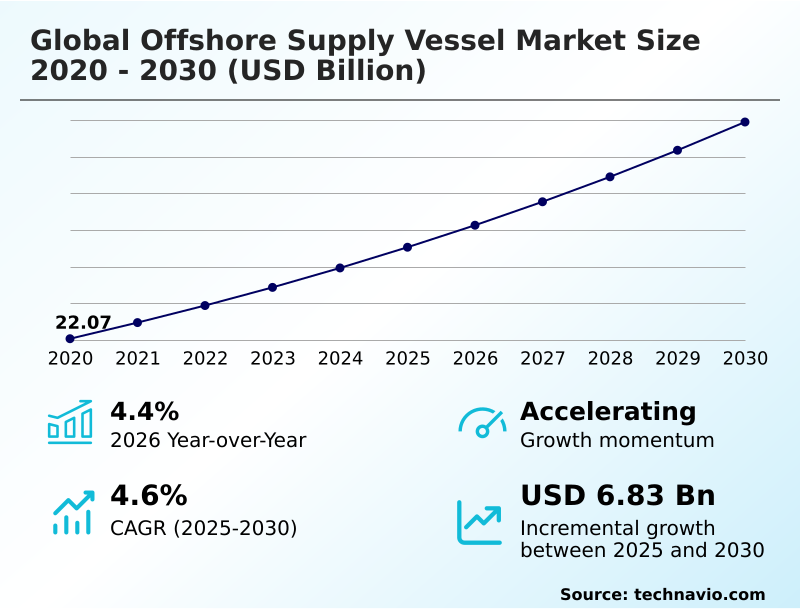
The offshore supply vessel market size is valued to increase by USD 6.83 billion, at a CAGR of 4.6% from 2025 to 2030. Resurgence of deepwater oil and gas exploration and production activities will drive the offshore supply vessel market.

Major Market Trends & Insights

  • APAC dominated the market and accounted for a 26.6% growth during the forecast period.
  • By Type - AHTS segment was valued at USD 10.65 billion in 2024
  • By End-user - Offshore oil and gas segment accounted for the largest market revenue share in 2024

Market Size & Forecast

  • Market Opportunities: USD 11.82 billion
  • Market Future Opportunities: USD 6.83 billion
  • CAGR from 2025 to 2030 : 4.6%

Market Summary

  • The Offshore Supply Vessel Market is undergoing a significant transformation, driven by renewed investment in offshore energy projects and the rapid expansion of renewable infrastructure. This evolution necessitates a focus on fleet modernization, with operators prioritizing vessels equipped with dynamic positioning systems and advanced automation to handle complex deepwater operations.
  • A key trend is the adoption of hybrid propulsion systems and low-emission energy storage solutions to meet stringent environmental regulations and reduce operational costs. For instance, a vessel operator can optimize fuel consumption during standby operations by leveraging battery power, leading to significant emission reductions and enhanced efficiency.
  • Simultaneously, the market is influenced by the need for specialized assets like commissioning service operation vessels to support the growing offshore wind sector. These dynamics are reshaping the competitive landscape, where technological sophistication, environmental compliance, and operational excellence in subsea construction support are paramount for sustaining growth and profitability.
  • This shift requires a strategic approach to both fleet management and service delivery.

What will be the Size of the Offshore Supply Vessel Market during the forecast period?
Get Key Insights on Market Forecast (PDF) Get Free Sample

How is the Offshore Supply Vessel Market Segmented?

The offshore supply vessel industry research report provides comprehensive data (region-wise segment analysis), with forecasts and estimates in "USD million" for the period 2026-2030, as well as historical data from 2020-2024 for the following segments.

  • Type
    • AHTS
    • PSV
    • FSIV
    • MPSV
    • Others
  • End-user
    • Offshore oil and gas
    • Offshore wind
  • Propulsion
    • Conventional diesel-powered
    • LNG-powered
    • Hybrid or electric
  • Geography
    • APAC
      • China
      • Australia
      • India
    • Europe
      • UK
      • Germany
      • France
    • North America
      • US
      • Canada
      • Mexico
    • Middle East and Africa
      • Saudi Arabia
      • UAE
      • South Africa
    • South America
      • Brazil
      • Argentina
    • Rest of World (ROW)

By Type Insights

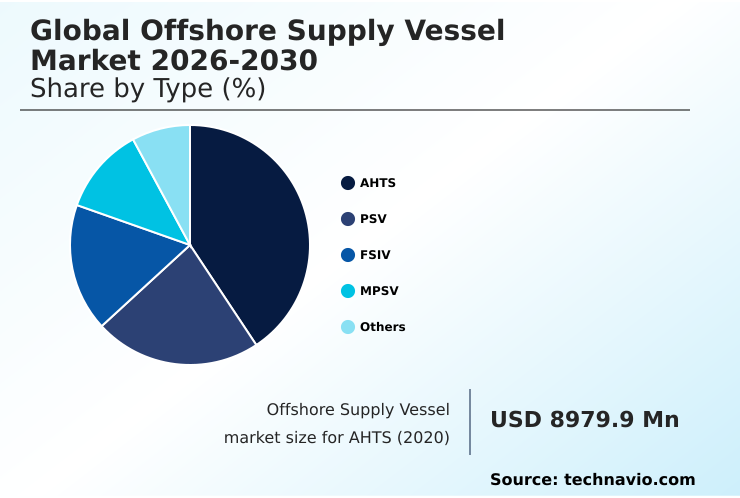
The ahts segment is estimated to witness significant growth during the forecast period.

The Anchor Handling Tug Supply (AHTS) segment represents a critical vertical, defined by high-volume capacity and technical versatility essential for subsea construction support. These vessels are engineered for complex tasks like rig moves and towing operations.

Demand is propelled by a resurgence in deepwater exploration support, requiring high-bollard-pull anchor handling capabilities. Modernization is driving the adoption of advanced telematics and exhaust gas recirculation technologies to meet sustainability mandates.

As the market tightens, marketed utilization for the AHTS fleet is strengthening to 77 percent, supported by a renewed wave of offshore engineering procurement and installation investment.

This necessitates a strategic focus on asset life-extension programs and upgrades to maintain fleet operational efficiency in a competitive landscape.
Get Free Sample

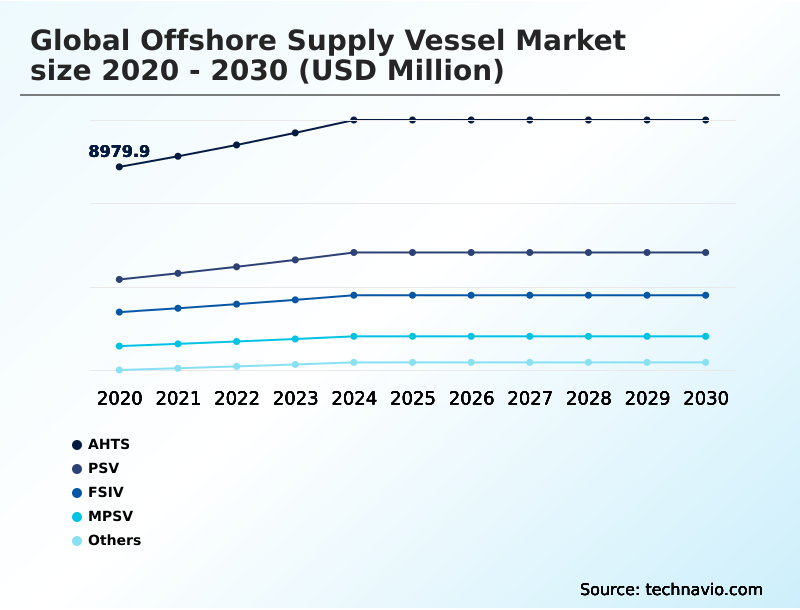
The AHTS segment was valued at USD 10.65 billion in 2024 and showed a gradual increase during the forecast period.
Get Free Sample

Regional Analysis

APAC is estimated to contribute 26.6% to the growth of the global market during the forecast period.Technavio’s analysts have elaborately explained the regional trends and drivers that shape the market during the forecast period.
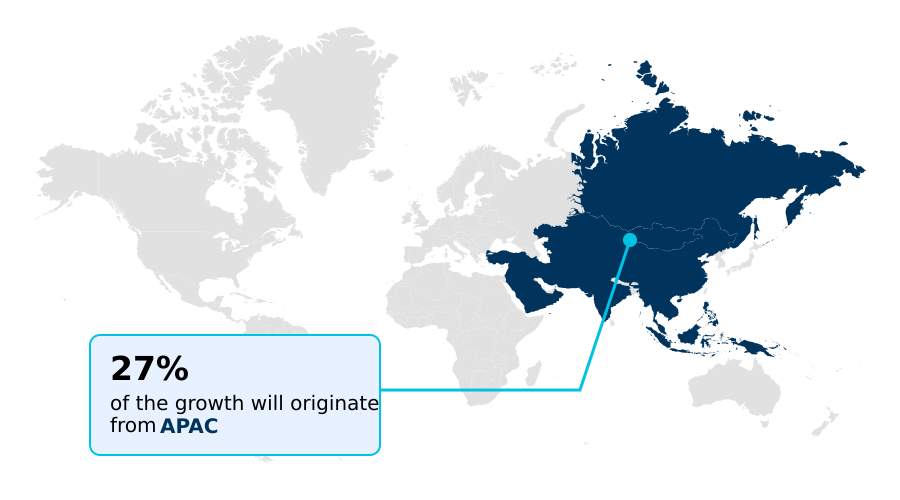
See How Offshore Supply Vessel Market Demand is Rising in APAC Get Free Sample

The geographic landscape is evolving, with APAC emerging as the fastest-growing region, accounting for 26.6% of the market's incremental growth, slightly ahead of the Middle East and Africa's 23.4%.

This expansion is fueled by massive investments in offshore engineering procurement and deepwater exploration support. In this region, a focus on local content requirements is driving investment in maritime logistics infrastructure and specialized training centers.

The need for subsea robotics and advanced subsea production systems is particularly high, supporting complex marine supply operations.

This surge has created a shortage of high-specification vessels, prompting operators to prioritize fleet rejuvenation and upgrades and invest in marine transportation services to meet the technical demands of modern projects and secure a competitive edge.

Market Dynamics

Our researchers analyzed the data with 2025 as the base year, along with the key drivers, trends, and challenges. A holistic analysis of drivers will help companies refine their marketing strategies to gain a competitive advantage.

  • The Offshore Supply Vessel Market's trajectory is increasingly defined by a sophisticated cost-benefit analysis of walk-to-work systems and other advanced technologies. Strategic fleet consolidation for market share is a dominant theme, as operators grapple with managing fleet obsolescence with retrofitting programs.
  • The role of OSVs in decommissioning old infrastructure is creating a new, stable revenue stream, while OSV support for carbon capture infrastructure represents a significant future growth area. A detailed analysis comparing AHTS and PSV operational costs reveals nuanced trade-offs based on project-specific requirements.
  • The market drivers for Jones Act-compliant vessels continue to shape the domestic landscape, particularly with the rise of offshore wind projects. Key challenges of hybrid propulsion system integration are being addressed, as the ROI of battery energy storage on supply vessels becomes more favorable; early adopters report efficiency gains more than 15% higher than conventional vessels.
  • The impact of digital twin technology on fleet management is profound, enabling operators to optimize fuel consumption with predictive maintenance. Moreover, improving safety with autonomous navigation technology is a top priority, mitigating geopolitical risk impact on charter rates. The role of MPSVs in subsea telecommunications support is expanding, alongside subsea inspection using remotely operated vehicles.
  • Efficiency gains from digital operational excellence are critical for compliance with IMO Tier III emission standards, as modernizing fleets for deepwater exploration becomes a necessity. Specialized vessel requirements for floating offshore wind and the benefits of LNG propulsion in emission control areas are also shaping future investment decisions.
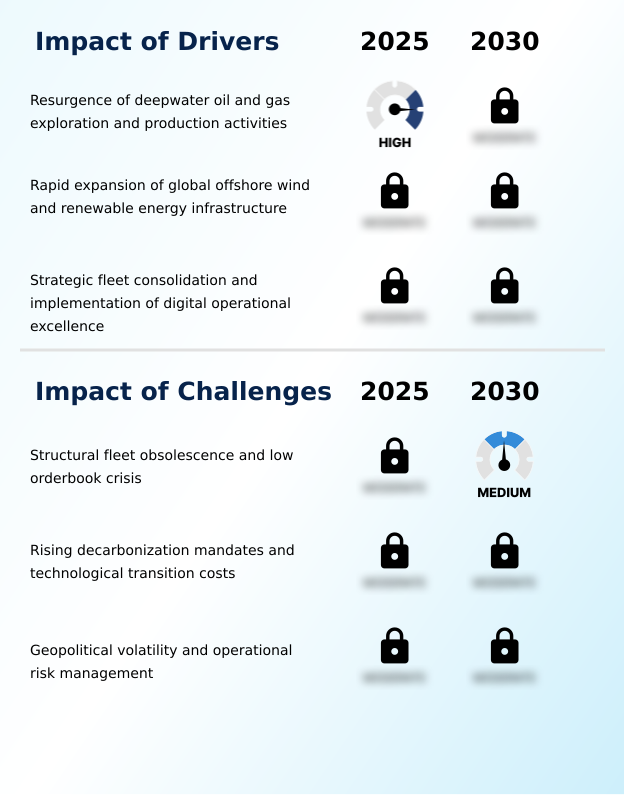
What are the key market drivers leading to the rise in the adoption of Offshore Supply Vessel Industry?

  • A key driver for the market is the resurgence of deepwater oil and gas exploration and production activities, which is increasing the demand for high-specification support vessels.

  • Renewed focus on deepwater hydrocarbon exploration is a primary driver, increasing demand for high-specification platform supply vessels and anchor handling tug supply vessels. These projects require advanced dynamic positioning systems and substantial deck capacities, tightening the supply of modern assets.
  • Charterers are prioritizing fuel-efficient vessels, with modern fleets showing up to 15% better fuel economy than older counterparts.
  • Simultaneously, unprecedented growth in the offshore wind sector diversifies the demand base, requiring specialized offshore energy support vessels for wind farm installation support. The development of floating offshore wind technology creates a new market for high-bollard-pull anchor handling.
  • This dual-demand environment is fueling strategic fleet consolidation and digital operational excellence to maximize vessel utilization and profitability across both energy sectors.

What are the market trends shaping the Offshore Supply Vessel Industry?

  • A primary market trend is the integration of hybrid propulsion and low-emission energy storage systems. This shift is driven by stricter regulations and demands for decarbonization from major energy producers.

  • The market is undergoing a structural shift toward decarbonization, driven by the adoption of hybrid propulsion systems and advanced battery energy storage. These green shipping incentives allow for optimized engine loads, reducing emissions and fuel consumption by up to 35% during standby operations.
  • This move toward electrification, supported by shore-power capabilities and maturing marine-grade batteries, is becoming a prerequisite for securing long-term charters. Furthermore, the strategic pivot to the offshore wind sector is creating demand for specialized commissioning service operation vessels with walk-to-work capabilities.
  • This diversification provides predictable revenue streams, as longevity of wind projects often surpasses traditional oil and gas contracts by over a decade. The adoption of advanced motion-compensated gangways and heavy-lift cranes is essential for this segment.

What challenges does the Offshore Supply Vessel Industry face during its growth?

  • The industry faces a significant challenge from structural fleet obsolescence and a low orderbook, creating a supply bottleneck for modern, high-specification vessels.

  • The market faces a critical challenge from structural fleet obsolescence, with a significant portion of the global fleet now exceeding 15 years of age. These older vessels often lack the fuel-efficient propulsion and dynamic positioning systems required for modern deep-water projects, creating a bottleneck as charterers demand higher-specification tonnage.
  • Compounding this, rising decarbonization mandates necessitate costly investments in hybrid propulsion systems and battery energy storage, with retrofitting costs sometimes approaching 40% of a vessel's market value. This creates a two-tiered market where eco-friendly vessels command premium rates, marginalizing conventional tonnage.
  • Geopolitical volatility further complicates operations, increasing insurance premiums and security expenditures, which can elevate operating expenses by over 10% in high-risk regions.

Exclusive Technavio Analysis on Customer Landscape

The offshore supply vessel market forecasting report includes the adoption lifecycle of the market, covering from the innovator’s stage to the laggard’s stage. It focuses on adoption rates in different regions based on penetration. Furthermore, the offshore supply vessel market report also includes key purchase criteria and drivers of price sensitivity to help companies evaluate and develop their market growth analysis strategies.
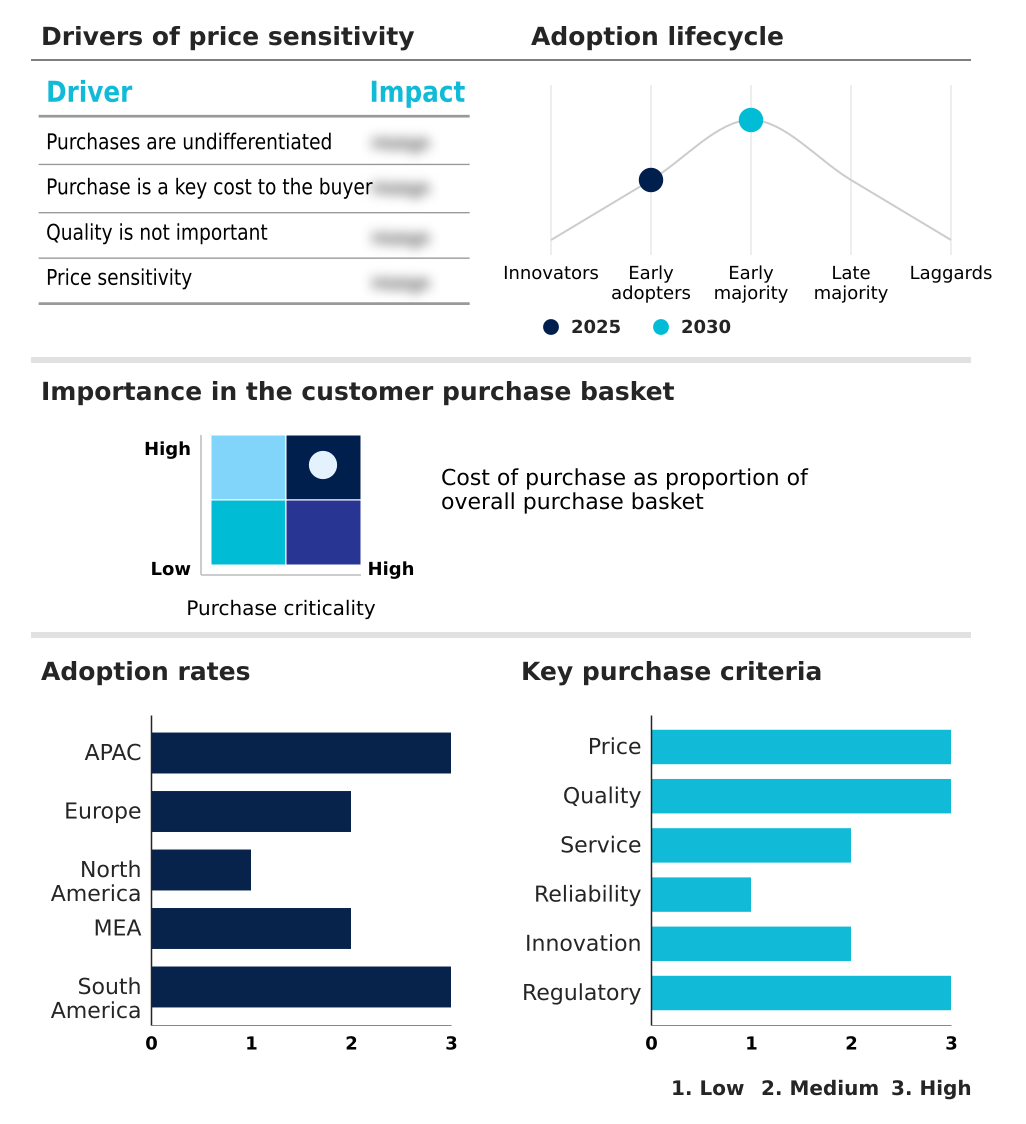
Customer Landscape of Offshore Supply Vessel Industry

Competitive Landscape

Companies are implementing various strategies, such as strategic alliances, offshore supply vessel market forecast, partnerships, mergers and acquisitions, geographical expansion, and product/service launches, to enhance their presence in the industry.

AP Moller Maersk AS - Key offerings center on providing specialized offshore logistics support and integrated marine supply operations for global energy projects.

The industry research and growth report includes detailed analyses of the competitive landscape of the market and information about key companies, including:

  • AP Moller Maersk AS
  • Bass Marine Pty Ltd.
  • Bourbon Maritime
  • Damen Shipyards Group
  • DP World
  • Eastern Shipbuilding Inc.
  • Edison Chouest Offshore Co.
  • Harren Group
  • Harvey Gulf Intl. Marine
  • Havila Shipping ASA
  • Hornbeck Offshore Services
  • Island Offshore Management AS
  • SEACOR Marine Holdings Inc.
  • Siem Offshore Inc.
  • Solstad Offshore ASA
  • Tidewater Inc.
  • Van Aalst Group B.V.
  • Vroon BV
  • Wartsila Corp.

Qualitative and quantitative analysis of companies has been conducted to help clients understand the wider business environment as well as the strengths and weaknesses of key industry players. Data is qualitatively analyzed to categorize companies as pure play, category-focused, industry-focused, and diversified; it is quantitatively analyzed to categorize companies as dominant, leading, strong, tentative, and weak.

Recent Development and News in Offshore supply vessel market

  • In May, 2025, Tidewater Inc. reported strong first-quarter financial performance, attributing its success to investments in fleet uptime and the integration of advanced digital tracking across its global platform.
  • In April, 2025, Bourbon Corporation announced a major fleet expansion, acquiring thirteen high-specification offshore support vessels, including several diesel-electric platform supply vessels, to capitalize on rising deepwater demand.
  • In March, 2025, Tidewater Inc. announced the successful acquisition of the 22-vessel fleet of Wilson Sons Ultratug, significantly strengthening its operational presence and integrated logistical solutions in the Brazilian offshore market.
  • In January, 2025, Acta Marine took delivery of the Acta Pegasus, the first in a new series of advanced offshore energy support vessels featuring a methanol-ready propulsion system and designed for the offshore wind sector.

Dive into Technavio’s robust research methodology, blending expert interviews, extensive data synthesis, and validated models for unparalleled Offshore Supply Vessel Market insights. See full methodology.

Market Scope
Page number 303
Base year 2025
Historic period 2020-2024
Forecast period 2026-2030
Growth momentum & CAGR Accelerate at a CAGR of 4.6%
Market growth 2026-2030 USD 6832.8 million
Market structure Fragmented
YoY growth 2025-2026(%) 4.4%
Key countries China, Australia, India, South Korea, Japan, Indonesia, UK, Germany, France, Italy, Spain, The Netherlands, US, Canada, Mexico, Saudi Arabia, UAE, South Africa, Turkey, Israel, Brazil, Argentina and Chile
Competitive landscape Leading Companies, Market Positioning of Companies, Competitive Strategies, and Industry Risks

Request Free Sample

Research Analyst Overview

  • The Offshore Supply Vessel Market is defined by a push toward technological sophistication and operational efficiency. The integration of dynamic positioning systems, advanced telematics, and autonomous marine systems is now standard for supporting subsea production systems and deepwater exploration support.
  • Fleet modernization is paramount, with a clear trend toward LNG-powered propulsion, hybrid propulsion systems, and battery energy storage to meet green shipping incentives and carbon pricing mechanisms. Specialized assets such as anchor handling tug supply vessels, platform supply vessels, and commissioning service operation vessels with walk-to-work systems and motion-compensated gangways are in high demand.
  • These vessels are crucial for subsea construction support, subsea inspection maintenance and repair, and floating offshore wind technology projects. Boardroom decisions are heavily influenced by the need to invest in digital twin technology and predictive maintenance to enhance fleet operational efficiency, with some operators reporting a 30% reduction in unplanned downtime.
  • The deployment of remotely operated vehicle deployment systems, heavy-lift cranes, and integrated marine systems is becoming a key differentiator. The industry's evolution is also shaped by the need for Jones Act-compliant vessels, the adoption of selective catalytic reduction and exhaust gas recirculation for emissions control, and investment in maritime logistics infrastructure and specialized training centers.
  • Dual-fuel engines and vessel automation technologies further underscore the focus on high-bollard-pull anchor handling, low-emission energy storage, and marine propulsion systems.

What are the Key Data Covered in this Offshore Supply Vessel Market Research and Growth Report?

  • What is the expected growth of the Offshore Supply Vessel Market between 2026 and 2030?

    • USD 6.83 billion, at a CAGR of 4.6%

  • What segmentation does the market report cover?

    • The report is segmented by Type (AHTS, PSV, FSIV, MPSV, and Others), End-user (Offshore oil and gas, and Offshore wind), Propulsion (Conventional diesel-powered, LNG-powered, and Hybrid or electric) and Geography (APAC, Europe, North America, Middle East and Africa, South America)

  • Which regions are analyzed in the report?

    • APAC, Europe, North America, Middle East and Africa and South America

  • What are the key growth drivers and market challenges?

    • Resurgence of deepwater oil and gas exploration and production activities , Structural fleet obsolescence and low orderbook crisis

  • Who are the major players in the Offshore Supply Vessel Market?

    • AP Moller Maersk AS, Bass Marine Pty Ltd., Bourbon Maritime, Damen Shipyards Group, DP World, Eastern Shipbuilding Inc., Edison Chouest Offshore Co., Harren Group, Harvey Gulf Intl. Marine, Havila Shipping ASA, Hornbeck Offshore Services, Island Offshore Management AS, SEACOR Marine Holdings Inc., Siem Offshore Inc., Solstad Offshore ASA, Tidewater Inc., Van Aalst Group B.V., Vroon BV and Wartsila Corp.

Market Research Insights

  • The market's dynamics are shaped by a strategic pivot toward operational efficiency and diversification. Key marine transportation services are being enhanced through fleet rejuvenation and upgrades, with operators achieving up to 35% improvement in fuel efficiency by adopting hybrid power.
  • This focus on fleet uptime and operational excellence is critical as charterers prioritize assets that can perform complex well intervention tasks and subsea construction and maintenance with minimal downtime. The expansion into wind farm installation support and subsea cable laying provides a counter-cyclical revenue stream, with utilization rates for specialized vessels reaching 77% in key regions.
  • Furthermore, the emphasis on local content requirements and integrated logistical solutions is compelling vessel owners to invest in specialized training centers and local partnerships to secure long-term contracts.

We can help! Our analysts can customize this offshore supply vessel market research report to meet your requirements.

Get in touch

1. Executive Summary

1.1 Market overview

Executive Summary - Chart on Market Overview
Executive Summary - Data Table on Market Overview
Executive Summary - Chart on Global Market Characteristics
Executive Summary - Chart on Market by Geography
Executive Summary - Chart on Market Segmentation by Type
Executive Summary - Chart on Market Segmentation by End-user
Executive Summary - Chart on Market Segmentation by Propulsion
Executive Summary - Chart on Incremental Growth
Executive Summary - Data Table on Incremental Growth
Executive Summary - Chart on Company Market Positioning

2. Technavio Analysis

2.1 Analysis of price sensitivity, lifecycle, customer purchase basket, adoption rates, and purchase criteria

2.2 Criticality of inputs and Factors of differentiation

Chart on Overview on criticality of inputs and factors of differentiation

2.3 Factors of disruption

Chart on Overview on factors of disruption

2.4 Impact of drivers and challenges

Chart on Impact of drivers and challenges in 2025 and 2030

3. Market Landscape

3.1 Market ecosystem

Chart on Parent Market
Data Table on - Parent Market

3.2 Market characteristics

Chart on Market characteristics analysis

3.3 Value chain analysis

Chart on Value chain analysis

4. Market Sizing

4.1 Market definition

Data Table on Offerings of companies included in the market definition

4.2 Market segment analysis

Market segments

4.3 Market size 2025

4.4 Market outlook: Forecast for 2025-2030

Chart on Global - Market size and forecast 2025-2030 ($ million)
Data Table on Global - Market size and forecast 2025-2030 ($ million)
Chart on Global Market: Year-over-year growth 2025-2030 (%)
Data Table on Global Market: Year-over-year growth 2025-2030 (%)

5. Historic Market Size

5.1 Global Offshore Supply Vessel Market 2020 - 2024

Historic Market Size - Data Table on Global Offshore Supply Vessel Market 2020 - 2024 ($ million)

5.2 Type segment analysis 2020 - 2024

Historic Market Size - Type Segment 2020 - 2024 ($ million)

5.3 End-user segment analysis 2020 - 2024

Historic Market Size - End-user Segment 2020 - 2024 ($ million)

5.4 Propulsion segment analysis 2020 - 2024

Historic Market Size - Propulsion Segment 2020 - 2024 ($ million)

5.5 Geography segment analysis 2020 - 2024

Historic Market Size - Geography Segment 2020 - 2024 ($ million)

5.6 Country segment analysis 2020 - 2024

Historic Market Size - Country Segment 2020 - 2024 ($ million)

6. Qualitative Analysis

6.1 Impact of AI on global offshore supply vessel market

6.2 Impact of geopolitical conflict on global offshore supply vessel market

7. Five Forces Analysis

7.1 Five forces summary

Five forces analysis - Comparison between 2025 and 2030

7.2 Bargaining power of buyers

Bargaining power of buyers - Impact of key factors 2025 and 2030

7.3 Bargaining power of suppliers

Bargaining power of suppliers - Impact of key factors in 2025 and 2030

7.4 Threat of new entrants

Threat of new entrants - Impact of key factors in 2025 and 2030

7.5 Threat of substitutes

Threat of substitutes - Impact of key factors in 2025 and 2030

7.6 Threat of rivalry

Threat of rivalry - Impact of key factors in 2025 and 2030

7.7 Market condition

Chart on Market condition - Five forces 2025 and 2030

8. Market Segmentation by Type

8.1 Market segments

Chart on Type - Market share 2025-2030 (%)
Data Table on Type - Market share 2025-2030 (%)

8.2 Comparison by Type

Chart on Comparison by Type
Data Table on Comparison by Type

8.3 AHTS - Market size and forecast 2025-2030

Chart on AHTS - Market size and forecast 2025-2030 ($ million)
Data Table on AHTS - Market size and forecast 2025-2030 ($ million)
Chart on AHTS - Year-over-year growth 2025-2030 (%)
Data Table on AHTS - Year-over-year growth 2025-2030 (%)

8.4 PSV - Market size and forecast 2025-2030

Chart on PSV - Market size and forecast 2025-2030 ($ million)
Data Table on PSV - Market size and forecast 2025-2030 ($ million)
Chart on PSV - Year-over-year growth 2025-2030 (%)
Data Table on PSV - Year-over-year growth 2025-2030 (%)

8.5 FSIV - Market size and forecast 2025-2030

Chart on FSIV - Market size and forecast 2025-2030 ($ million)
Data Table on FSIV - Market size and forecast 2025-2030 ($ million)
Chart on FSIV - Year-over-year growth 2025-2030 (%)
Data Table on FSIV - Year-over-year growth 2025-2030 (%)

8.6 MPSV - Market size and forecast 2025-2030

Chart on MPSV - Market size and forecast 2025-2030 ($ million)
Data Table on MPSV - Market size and forecast 2025-2030 ($ million)
Chart on MPSV - Year-over-year growth 2025-2030 (%)
Data Table on MPSV - Year-over-year growth 2025-2030 (%)

8.7 Others - Market size and forecast 2025-2030

Chart on Others - Market size and forecast 2025-2030 ($ million)
Data Table on Others - Market size and forecast 2025-2030 ($ million)
Chart on Others - Year-over-year growth 2025-2030 (%)
Data Table on Others - Year-over-year growth 2025-2030 (%)

8.8 Market opportunity by Type

Market opportunity by Type ($ million)
Data Table on Market opportunity by Type ($ million)

9. Market Segmentation by End-user

9.1 Market segments

Chart on End-user - Market share 2025-2030 (%)
Data Table on End-user - Market share 2025-2030 (%)

9.2 Comparison by End-user

Chart on Comparison by End-user
Data Table on Comparison by End-user

9.3 Offshore oil and gas - Market size and forecast 2025-2030

Chart on Offshore oil and gas - Market size and forecast 2025-2030 ($ million)
Data Table on Offshore oil and gas - Market size and forecast 2025-2030 ($ million)
Chart on Offshore oil and gas - Year-over-year growth 2025-2030 (%)
Data Table on Offshore oil and gas - Year-over-year growth 2025-2030 (%)

9.4 Offshore wind - Market size and forecast 2025-2030

Chart on Offshore wind - Market size and forecast 2025-2030 ($ million)
Data Table on Offshore wind - Market size and forecast 2025-2030 ($ million)
Chart on Offshore wind - Year-over-year growth 2025-2030 (%)
Data Table on Offshore wind - Year-over-year growth 2025-2030 (%)

9.5 Market opportunity by End-user

Market opportunity by End-user ($ million)
Data Table on Market opportunity by End-user ($ million)

10. Market Segmentation by Propulsion

10.1 Market segments

Chart on Propulsion - Market share 2025-2030 (%)
Data Table on Propulsion - Market share 2025-2030 (%)

10.2 Comparison by Propulsion

Chart on Comparison by Propulsion
Data Table on Comparison by Propulsion

10.3 Conventional diesel-powered - Market size and forecast 2025-2030

Chart on Conventional diesel-powered - Market size and forecast 2025-2030 ($ million)
Data Table on Conventional diesel-powered - Market size and forecast 2025-2030 ($ million)
Chart on Conventional diesel-powered - Year-over-year growth 2025-2030 (%)
Data Table on Conventional diesel-powered - Year-over-year growth 2025-2030 (%)

10.4 LNG-powered - Market size and forecast 2025-2030

Chart on LNG-powered - Market size and forecast 2025-2030 ($ million)
Data Table on LNG-powered - Market size and forecast 2025-2030 ($ million)
Chart on LNG-powered - Year-over-year growth 2025-2030 (%)
Data Table on LNG-powered - Year-over-year growth 2025-2030 (%)

10.5 Hybrid or electric - Market size and forecast 2025-2030

Chart on Hybrid or electric - Market size and forecast 2025-2030 ($ million)
Data Table on Hybrid or electric - Market size and forecast 2025-2030 ($ million)
Chart on Hybrid or electric - Year-over-year growth 2025-2030 (%)
Data Table on Hybrid or electric - Year-over-year growth 2025-2030 (%)

10.6 Market opportunity by Propulsion

Market opportunity by Propulsion ($ million)
Data Table on Market opportunity by Propulsion ($ million)

11. Customer Landscape

11.1 Customer landscape overview

Analysis of price sensitivity, lifecycle, customer purchase basket, adoption rates, and purchase criteria

12. Geographic Landscape

12.1 Geographic segmentation

Chart on Market share by geography 2025-2030 (%)
Data Table on Market share by geography 2025-2030 (%)

12.2 Geographic comparison

Chart on Geographic comparison
Data Table on Geographic comparison

12.3 APAC - Market size and forecast 2025-2030

Chart on APAC - Market size and forecast 2025-2030 ($ million)
Data Table on APAC - Market size and forecast 2025-2030 ($ million)
Chart on APAC - Year-over-year growth 2025-2030 (%)
Data Table on APAC - Year-over-year growth 2025-2030 (%)
Chart on Regional Comparison - APAC
Data Table on Regional Comparison - APAC

12.3.1 China - Market size and forecast 2025-2030

Chart on China - Market size and forecast 2025-2030 ($ million)
Data Table on China - Market size and forecast 2025-2030 ($ million)
Chart on China - Year-over-year growth 2025-2030 (%)
Data Table on China - Year-over-year growth 2025-2030 (%)

12.3.2 Australia - Market size and forecast 2025-2030

Chart on Australia - Market size and forecast 2025-2030 ($ million)
Data Table on Australia - Market size and forecast 2025-2030 ($ million)
Chart on Australia - Year-over-year growth 2025-2030 (%)
Data Table on Australia - Year-over-year growth 2025-2030 (%)

12.3.3 India - Market size and forecast 2025-2030

Chart on India - Market size and forecast 2025-2030 ($ million)
Data Table on India - Market size and forecast 2025-2030 ($ million)
Chart on India - Year-over-year growth 2025-2030 (%)
Data Table on India - Year-over-year growth 2025-2030 (%)

12.3.4 South Korea - Market size and forecast 2025-2030

Chart on South Korea - Market size and forecast 2025-2030 ($ million)
Data Table on South Korea - Market size and forecast 2025-2030 ($ million)
Chart on South Korea - Year-over-year growth 2025-2030 (%)
Data Table on South Korea - Year-over-year growth 2025-2030 (%)

12.3.5 Japan - Market size and forecast 2025-2030

Chart on Japan - Market size and forecast 2025-2030 ($ million)
Data Table on Japan - Market size and forecast 2025-2030 ($ million)
Chart on Japan - Year-over-year growth 2025-2030 (%)
Data Table on Japan - Year-over-year growth 2025-2030 (%)

12.3.6 Indonesia - Market size and forecast 2025-2030

Chart on Indonesia - Market size and forecast 2025-2030 ($ million)
Data Table on Indonesia - Market size and forecast 2025-2030 ($ million)
Chart on Indonesia - Year-over-year growth 2025-2030 (%)
Data Table on Indonesia - Year-over-year growth 2025-2030 (%)

12.4 Europe - Market size and forecast 2025-2030

Chart on Europe - Market size and forecast 2025-2030 ($ million)
Data Table on Europe - Market size and forecast 2025-2030 ($ million)
Chart on Europe - Year-over-year growth 2025-2030 (%)
Data Table on Europe - Year-over-year growth 2025-2030 (%)
Chart on Regional Comparison - Europe
Data Table on Regional Comparison - Europe

12.4.1 UK - Market size and forecast 2025-2030

Chart on UK - Market size and forecast 2025-2030 ($ million)
Data Table on UK - Market size and forecast 2025-2030 ($ million)
Chart on UK - Year-over-year growth 2025-2030 (%)
Data Table on UK - Year-over-year growth 2025-2030 (%)

12.4.2 Germany - Market size and forecast 2025-2030

Chart on Germany - Market size and forecast 2025-2030 ($ million)
Data Table on Germany - Market size and forecast 2025-2030 ($ million)
Chart on Germany - Year-over-year growth 2025-2030 (%)
Data Table on Germany - Year-over-year growth 2025-2030 (%)

12.4.3 France - Market size and forecast 2025-2030

Chart on France - Market size and forecast 2025-2030 ($ million)
Data Table on France - Market size and forecast 2025-2030 ($ million)
Chart on France - Year-over-year growth 2025-2030 (%)
Data Table on France - Year-over-year growth 2025-2030 (%)

12.4.4 Italy - Market size and forecast 2025-2030

Chart on Italy - Market size and forecast 2025-2030 ($ million)
Data Table on Italy - Market size and forecast 2025-2030 ($ million)
Chart on Italy - Year-over-year growth 2025-2030 (%)
Data Table on Italy - Year-over-year growth 2025-2030 (%)

12.4.5 Spain - Market size and forecast 2025-2030

Chart on Spain - Market size and forecast 2025-2030 ($ million)
Data Table on Spain - Market size and forecast 2025-2030 ($ million)
Chart on Spain - Year-over-year growth 2025-2030 (%)
Data Table on Spain - Year-over-year growth 2025-2030 (%)

12.4.6 The Netherlands - Market size and forecast 2025-2030

Chart on The Netherlands - Market size and forecast 2025-2030 ($ million)
Data Table on The Netherlands - Market size and forecast 2025-2030 ($ million)
Chart on The Netherlands - Year-over-year growth 2025-2030 (%)
Data Table on The Netherlands - Year-over-year growth 2025-2030 (%)

12.5 North America - Market size and forecast 2025-2030

Chart on North America - Market size and forecast 2025-2030 ($ million)
Data Table on North America - Market size and forecast 2025-2030 ($ million)
Chart on North America - Year-over-year growth 2025-2030 (%)
Data Table on North America - Year-over-year growth 2025-2030 (%)
Chart on Regional Comparison - North America
Data Table on Regional Comparison - North America

12.5.1 US - Market size and forecast 2025-2030

Chart on US - Market size and forecast 2025-2030 ($ million)
Data Table on US - Market size and forecast 2025-2030 ($ million)
Chart on US - Year-over-year growth 2025-2030 (%)
Data Table on US - Year-over-year growth 2025-2030 (%)

12.5.2 Canada - Market size and forecast 2025-2030

Chart on Canada - Market size and forecast 2025-2030 ($ million)
Data Table on Canada - Market size and forecast 2025-2030 ($ million)
Chart on Canada - Year-over-year growth 2025-2030 (%)
Data Table on Canada - Year-over-year growth 2025-2030 (%)

12.5.3 Mexico - Market size and forecast 2025-2030

Chart on Mexico - Market size and forecast 2025-2030 ($ million)
Data Table on Mexico - Market size and forecast 2025-2030 ($ million)
Chart on Mexico - Year-over-year growth 2025-2030 (%)
Data Table on Mexico - Year-over-year growth 2025-2030 (%)

12.6 Middle East and Africa - Market size and forecast 2025-2030

Chart on Middle East and Africa - Market size and forecast 2025-2030 ($ million)
Data Table on Middle East and Africa - Market size and forecast 2025-2030 ($ million)
Chart on Middle East and Africa - Year-over-year growth 2025-2030 (%)
Data Table on Middle East and Africa - Year-over-year growth 2025-2030 (%)
Chart on Regional Comparison - Middle East and Africa
Data Table on Regional Comparison - Middle East and Africa

12.6.1 Saudi Arabia - Market size and forecast 2025-2030

Chart on Saudi Arabia - Market size and forecast 2025-2030 ($ million)
Data Table on Saudi Arabia - Market size and forecast 2025-2030 ($ million)
Chart on Saudi Arabia - Year-over-year growth 2025-2030 (%)
Data Table on Saudi Arabia - Year-over-year growth 2025-2030 (%)

12.6.2 UAE - Market size and forecast 2025-2030

Chart on UAE - Market size and forecast 2025-2030 ($ million)
Data Table on UAE - Market size and forecast 2025-2030 ($ million)
Chart on UAE - Year-over-year growth 2025-2030 (%)
Data Table on UAE - Year-over-year growth 2025-2030 (%)

12.6.3 South Africa - Market size and forecast 2025-2030

Chart on South Africa - Market size and forecast 2025-2030 ($ million)
Data Table on South Africa - Market size and forecast 2025-2030 ($ million)
Chart on South Africa - Year-over-year growth 2025-2030 (%)
Data Table on South Africa - Year-over-year growth 2025-2030 (%)

12.6.4 Turkey - Market size and forecast 2025-2030

Chart on Turkey - Market size and forecast 2025-2030 ($ million)
Data Table on Turkey - Market size and forecast 2025-2030 ($ million)
Chart on Turkey - Year-over-year growth 2025-2030 (%)
Data Table on Turkey - Year-over-year growth 2025-2030 (%)

12.6.5 Israel - Market size and forecast 2025-2030

Chart on Israel - Market size and forecast 2025-2030 ($ million)
Data Table on Israel - Market size and forecast 2025-2030 ($ million)
Chart on Israel - Year-over-year growth 2025-2030 (%)
Data Table on Israel - Year-over-year growth 2025-2030 (%)

12.7 South America - Market size and forecast 2025-2030

Chart on South America - Market size and forecast 2025-2030 ($ million)
Data Table on South America - Market size and forecast 2025-2030 ($ million)
Chart on South America - Year-over-year growth 2025-2030 (%)
Data Table on South America - Year-over-year growth 2025-2030 (%)
Chart on Regional Comparison - South America
Data Table on Regional Comparison - South America

12.7.1 Brazil - Market size and forecast 2025-2030

Chart on Brazil - Market size and forecast 2025-2030 ($ million)
Data Table on Brazil - Market size and forecast 2025-2030 ($ million)
Chart on Brazil - Year-over-year growth 2025-2030 (%)
Data Table on Brazil - Year-over-year growth 2025-2030 (%)

12.7.2 Argentina - Market size and forecast 2025-2030

Chart on Argentina - Market size and forecast 2025-2030 ($ million)
Data Table on Argentina - Market size and forecast 2025-2030 ($ million)
Chart on Argentina - Year-over-year growth 2025-2030 (%)
Data Table on Argentina - Year-over-year growth 2025-2030 (%)

12.7.3 Chile - Market size and forecast 2025-2030

Chart on Chile - Market size and forecast 2025-2030 ($ million)
Data Table on Chile - Market size and forecast 2025-2030 ($ million)
Chart on Chile - Year-over-year growth 2025-2030 (%)
Data Table on Chile - Year-over-year growth 2025-2030 (%)

12.8 Market opportunity by geography

Market opportunity by geography ($ million)
Data Tables on Market opportunity by geography ($ million)

13. Drivers, Challenges, and Opportunity

13.1 Market drivers

Resurgence of deepwater oil and gas exploration and production activities
Rapid expansion of global offshore wind and renewable energy infrastructure
Strategic fleet consolidation and implementation of digital operational excellence

13.2 Market challenges

Structural fleet obsolescence and low orderbook crisis
Rising decarbonization mandates and technological transition costs
Geopolitical volatility and operational risk management

13.3 Impact of drivers and challenges

Impact of drivers and challenges in 2025 and 2030

13.4 Market opportunities

Integration of hybrid propulsion and low-emission energy storage systems
Diversification into offshore wind support and renewable energy infrastructure
Acceleration of digital automation and remote operational monitoring

14. Competitive Landscape

14.1 Overview

14.2

Overview on criticality of inputs and factors of differentiation

14.3 Landscape disruption

Overview on factors of disruption

14.4 Industry risks

Impact of key risks on business

15. Competitive Analysis

15.1 Companies profiled

Companies covered

15.2 Company ranking index

15.3 Market positioning of companies

Matrix on companies position and classification

15.4 AP Moller Maersk AS

AP Moller Maersk AS - Overview
AP Moller Maersk AS - Business segments
AP Moller Maersk AS - Key offerings
AP Moller Maersk AS - Segment focus
SWOT

15.5 Damen Shipyards Group

Damen Shipyards Group - Overview
Damen Shipyards Group - Product / Service
Damen Shipyards Group - Key offerings
SWOT

15.6 DP World

DP World - Overview
DP World - Product / Service
DP World - Key offerings
SWOT

15.7 Eastern Shipbuilding Inc.

Eastern Shipbuilding Inc. - Overview
Eastern Shipbuilding Inc. - Product / Service
Eastern Shipbuilding Inc. - Key offerings
SWOT

15.8 Harren Group

Harren Group - Overview
Harren Group - Product / Service
Harren Group - Key offerings
SWOT

15.9 Harvey Gulf Intl. Marine

Harvey Gulf Intl. Marine - Overview
Harvey Gulf Intl. Marine - Product / Service
Harvey Gulf Intl. Marine - Key offerings
SWOT

15.10 Havila Shipping ASA

Havila Shipping ASA - Overview
Havila Shipping ASA - Business segments
Havila Shipping ASA - Key offerings
Havila Shipping ASA - Segment focus
SWOT

15.11 Hornbeck Offshore Services

Hornbeck Offshore Services - Overview
Hornbeck Offshore Services - Product / Service
Hornbeck Offshore Services - Key offerings
SWOT

15.12 Island Offshore Management AS

Island Offshore Management AS - Overview
Island Offshore Management AS - Product / Service
Island Offshore Management AS - Key offerings
SWOT

15.13 SEACOR Marine Holdings Inc.

SEACOR Marine Holdings Inc. - Overview
SEACOR Marine Holdings Inc. - Business segments
SEACOR Marine Holdings Inc. - Key offerings
SEACOR Marine Holdings Inc. - Segment focus
SWOT

15.14 Siem Offshore Inc.

Siem Offshore Inc. - Overview
Siem Offshore Inc. - Business segments
Siem Offshore Inc. - Key offerings
Siem Offshore Inc. - Segment focus
SWOT

15.15 Solstad Offshore ASA

Solstad Offshore ASA - Overview
Solstad Offshore ASA - Business segments
Solstad Offshore ASA - Key offerings
Solstad Offshore ASA - Segment focus
SWOT

15.16 Tidewater Inc.

Tidewater Inc. - Overview
Tidewater Inc. - Business segments
Tidewater Inc. - Key offerings
Tidewater Inc. - Segment focus
SWOT

15.17 Van Aalst Group B.V.

Van Aalst Group B.V. - Overview
Van Aalst Group B.V. - Product / Service
Van Aalst Group B.V. - Key offerings
SWOT

15.18 Wartsila Corp.

Wartsila Corp. - Overview
Wartsila Corp. - Business segments
Wartsila Corp. - Key offerings
Wartsila Corp. - Segment focus
SWOT

16. Appendix

16.1 Scope of the report

Market definition
Objectives
Notes and caveats

16.2 Inclusions and exclusions checklist

Inclusions checklist
Exclusions checklist

16.3 Currency conversion rates for US$

16.4 Research methodology

16.5 Data procurement

Information sources

16.6 Data validation

16.7 Validation techniques employed for market sizing

16.8 Data synthesis

16.9 360 degree market analysis

16.10 List of abbreviations

Research Methodology

Technavio presents a detailed picture of the market by way of study, synthesis, and summation of data from multiple sources. The analysts have presented the various facets of the market with a particular focus on identifying the key industry influencers. The data thus presented is comprehensive, reliable, and the result of extensive research, both primary and secondary.

INFORMATION SOURCES

Primary sources

  • Manufacturers and suppliers
  • Channel partners
  • Industry experts
  • Strategic decision makers

Secondary sources

  • Industry journals and periodicals
  • Government data
  • Financial reports of key industry players
  • Historical data
  • Press releases

DATA ANALYSIS

Data Synthesis

  • Collation of data
  • Estimation of key figures
  • Analysis of derived insights

Data Validation

  • Triangulation with data models
  • Reference against proprietary databases
  • Corroboration with industry experts

REPORT WRITING

Qualitative

  • Market drivers
  • Market challenges
  • Market trends
  • Five forces analysis

Quantitative

  • Market size and forecast
  • Market segmentation
  • Geographical insights
  • Competitive landscape

Interested in this report?

Get your sample now to see our research methodology and insights!

Download Now

Frequently Asked Questions

Offshore Supply Vessel market growth will increase by USD 6832.8 million during 2026-2030.

The Offshore Supply Vessel market is expected to grow at a CAGR of 4.6% during 2026-2030.

Offshore Supply Vessel market is segmented by Type (AHTS, PSV, FSIV, MPSV, Others) End-user (Offshore oil and gas, Offshore wind) Propulsion (Conventional diesel-powered, LNG-powered, Hybrid or electric)

AP Moller Maersk AS, Bass Marine Pty Ltd., Bourbon Maritime, Damen Shipyards Group, DP World, Eastern Shipbuilding Inc., Edison Chouest Offshore Co., Harren Group, Harvey Gulf Intl. Marine, Havila Shipping ASA, Hornbeck Offshore Services, Island Offshore Management AS, SEACOR Marine Holdings Inc., Siem Offshore Inc., Solstad Offshore ASA, Tidewater Inc., Van Aalst Group B.V., Vroon BV, Wartsila Corp. are a few of the key vendors in the Offshore Supply Vessel market.

APAC will register the highest growth rate of 26.6% among the other regions. Therefore, the Offshore Supply Vessel market in APAC is expected to garner significant business opportunities for the vendors during the forecast period.

China, Australia, India, South Korea, Japan, Indonesia, UK, Germany, France, Italy, Spain, The Netherlands, US, Canada, Mexico, Saudi Arabia, UAE, South Africa, Turkey, Israel, Brazil, Argentina, Chile

  • Resurgence of deepwater oil and gas exploration and production activities is the driving factor this market.

The Offshore Supply Vessel market vendors should focus on grabbing business opportunities from the Type segment as it accounted for the largest market share in the base year.
RIA - Research AI Assistant
Ask RIA