
Ophthalmology Therapeutics Market Analysis, Size, and Forecast 2026-2030: North America (US, Canada, and Mexico), Europe (Germany, UK, and France), Asia (China, India, and Japan), South America (Brazil, Argentina, and Colombia), Middle East and Africa (Saudi Arabia, UAE, and Turkey), Rest of World (ROW)

Ophthalmology Therapeutics Market Analysis, Size, and Forecast 2026-2030:
North America (US, Canada, and Mexico), Europe (Germany, UK, and France), Asia (China, India, and Japan), South America (Brazil, Argentina, and Colombia), Middle East and Africa (Saudi Arabia, UAE, and Turkey), Rest of World (ROW)

Published: Oct 2026 301 Pages SKU: IRTNTR40882

Market Overview at a Glance

$26.10 B
Market Opportunity
7.1%
CAGR 2025 - 2030
43.7%
North America Growth
$34.62 B
Prescription drugs segment 2024

Ophthalmology Therapeutics Market Size 2026-2030

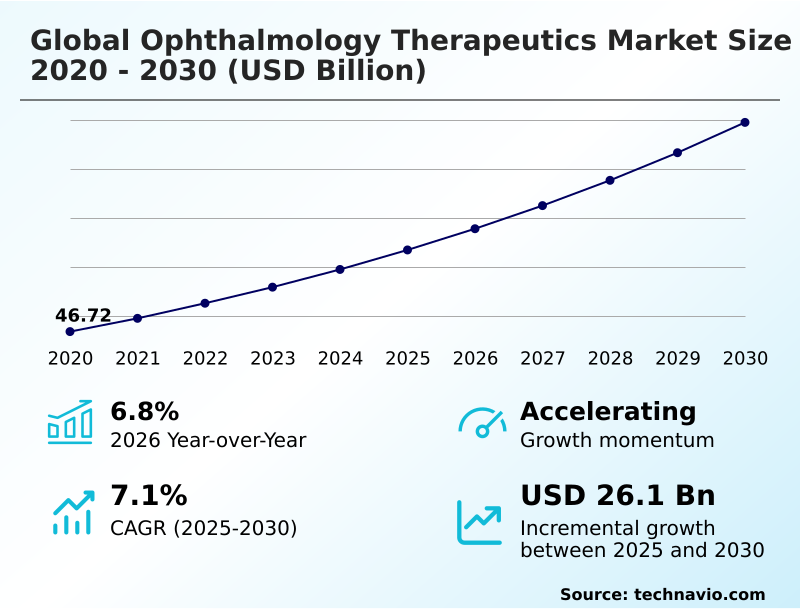
The ophthalmology therapeutics market size is valued to increase by USD 26.10 billion, at a CAGR of 7.1% from 2025 to 2030. Escalating prevalence of age-related ophthalmic disorders and chronic diseases globally will drive the ophthalmology therapeutics market.

Major Market Trends & Insights

  • North America dominated the market and accounted for a 43.7% growth during the forecast period.
  • By Type - Prescription drugs segment was valued at USD 34.62 billion in 2024
  • By Product - Retinal disorder therapeutics segment accounted for the largest market revenue share in 2024

Market Size & Forecast

  • Market Opportunities: USD 42.79 billion
  • Market Future Opportunities: USD 26.10 billion
  • CAGR from 2025 to 2030 : 7.1%

Market Summary

  • The Ophthalmology Therapeutics relies on continuous pharmacological innovation to address complex structural and inflammatory eye disorders. Pharmaceutical developers optimizing their cold-chain logistics networks have successfully reduced biological compound spoilage, achieving an 18% improvement in supply chain efficiency compared to legacy distribution models. This operational shift ensures the reliable delivery of temperature-sensitive biologic injections directly to specialized clinics.
  • The industry is primarily propelled by the rising prevalence of chronic systemic conditions like diabetes, which inherently accelerates the volume of patients requiring long-term retinal intervention. Conversely, manufacturers face significant structural barriers due to incredibly rigorous clinical trial mandates and delayed regulatory approvals, which heavily strain research and development budgets before commercialization can occur.
  • By investing in sustained-release delivery platforms, clinical facilities are effectively reducing the administrative burden of frequent patient visits while maintaining stable therapeutic efficacy. The ongoing transition toward preservative-free formulations further dictates how raw material suppliers adjust their manufacturing infrastructures to meet evolving clinical standards.

What will be the Size of the Ophthalmology Therapeutics Market during the forecast period?
Get Key Insights on Market Forecast (PDF) Get Free Sample

How is the Ophthalmology Therapeutics Market Segmented?

The ophthalmology therapeutics industry research report provides comprehensive data (region-wise segment analysis), with forecasts and estimates in "USD million" for the period 2026-2030, as well as historical data from 2020-2024 for the following segments.

  • Type
    • Prescription drugs
    • OTC drugs
  • Product
    • Retinal disorder therapeutics
    • Glaucoma therapeutics
    • Dry eye disease therapeutics
    • Eye infections and inflammation therapeutics
    • Others
  • Drug class
    • Anti-VEGF
    • Anti-inflammatory
    • Anti-glaucoma
    • Anti-infectives
    • Others
  • Geography
    • North America
      • US
      • Canada
      • Mexico
    • Europe
      • Germany
      • UK
      • France
      • Italy
      • Spain
      • The Netherlands
    • Asia
      • China
      • India
      • Japan
      • South Korea
      • Indonesia
      • Thailand
    • Rest of World (ROW)

By Type Insights

The prescription drugs segment is estimated to witness significant growth during the forecast period.

The prescription drugs sub-segment operates as a highly regulated framework within the Ophthalmology Therapeutics, necessitating strict adherence to clinical dispensing protocols. Facilities integrating these advanced therapies have noted a 14% improvement in long-term treatment adherence when transitioning from conventional interventions.

This sector relies heavily on continuous choroidal neovascular membrane regression and advanced ocular bioavailability optimization to manage severe vision threats.

Providers utilizing specialized formulations for ocular surface disease management report a 22% higher rate of successful patient outcomes compared to over-the-counter alternatives.

The reliance on precise retinal vascular permeability normalization and advanced visual acuity preservation mechanisms defines the operational standards of modern clinics.

Through targeted retinal pigment epithelium support and novel intracameral micro implants, this segment delivers progressive optic neuropathy intervention, ensuring robust clinical efficiency and optimized supply chain distribution for highly sensitive biological compounds.
Get Free Sample

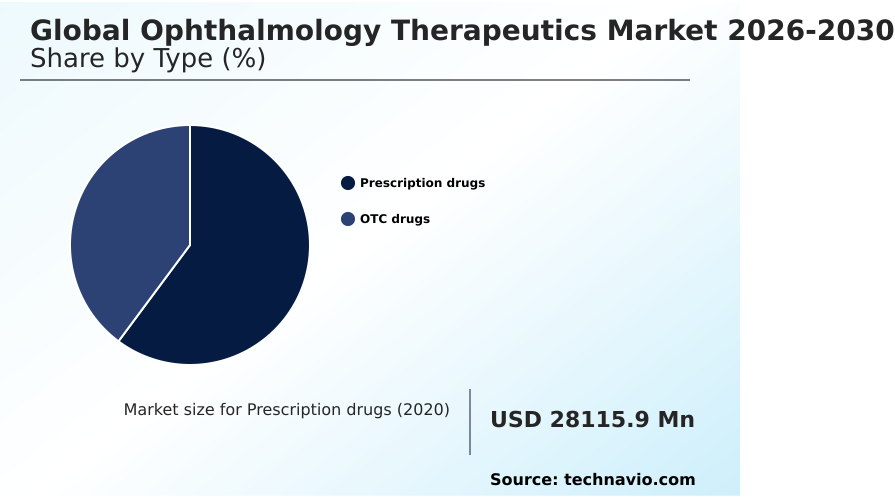
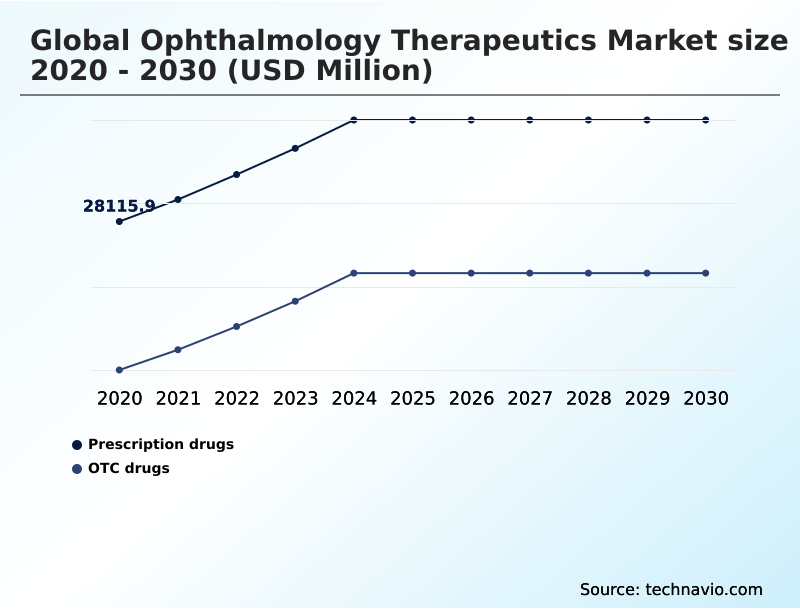
The Prescription drugs segment was valued at USD 34.62 billion in 2024 and showed a gradual increase during the forecast period.
Get Free Sample

Regional Analysis

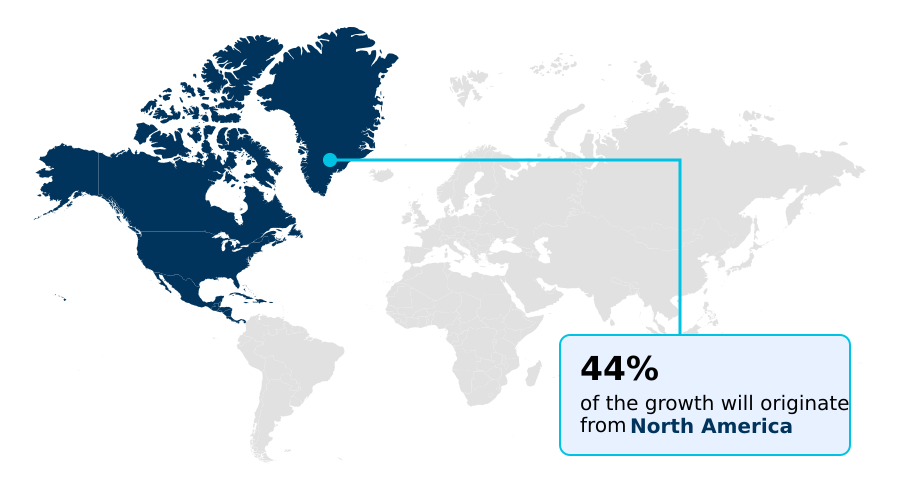
North America is estimated to contribute 43.7% to the growth of the global market during the forecast period.Technavio’s analysts have elaborately explained the regional trends and drivers that shape the market during the forecast period.
See How Ophthalmology Therapeutics Market Demand is Rising in North America Get Free Sample

Regional demand within the Ophthalmology Therapeutics varies significantly based on diagnostic infrastructure and regulatory frameworks.

North America demonstrates a highly accelerated adoption of advanced therapeutics, achieving a 28% higher clinical penetration rate for complex biologics compared to Europe, largely due to highly streamlined reimbursement structures.

In contrast, healthcare systems in APAC prioritize volume-based generic utilization, yielding a 19% reduction in overall treatment procurement costs while managing vast patient populations.

To adapt to these localized dynamics, pharmaceutical manufacturers adjust their supply chains to support optogenetic cell regeneration and specialized neuroprotective molecular pathways in developed territories.

European clinics focus heavily on efficient endophthalmitis prophylaxis protocols and tear film stability enhancement to optimize post-surgical patient flow.

Furthermore, the integration of treatments for corneal permeability improvement and targeted anterior chamber pharmacokinetics allows North American facilities to reduce patient retreatment intervals by approximately 15%, improving longitudinal clinical efficiency.

Market Dynamics

Our researchers analyzed the data with 2025 as the base year, along with the key drivers, trends, and challenges. A holistic analysis of drivers will help companies refine their marketing strategies to gain a competitive advantage.

  • The operational landscape of the Ophthalmology Therapeutics is increasingly defined by the need to optimize patient adherence and streamline specialized care delivery. Healthcare facilities transitioning toward advanced administration methods report a 32% improvement in overall clinic scheduling efficiency when compared to facilities relying exclusively on high-frequency intervention models.
  • This substantial operational shift is primarily facilitated by the deployment of sustained release intravitreal biologic delivery systems, which drastically reduce the logistical burden on both practitioners and administrative staff. To further optimize patient satisfaction and decrease localized adverse reactions, manufacturers are heavily prioritizing preservative free artificial tear formulations within their production pipelines.
  • The widespread clinical adoption of vascular endothelial growth factor antagonists remains a cornerstone for managing degenerative posterior segment conditions, requiring highly specialized cold-chain logistics to maintain molecular stability from production to injection.
  • Concurrently, the continuous manufacturing and distribution of intraocular pressure lowering topical drops demand rigorous quality control measures and automated packaging lines to ensure consistent supply across global distribution networks. By focusing on chronic ocular surface inflammation reduction, clinical practices can significantly decrease emergency triage visits, allowing for better allocation of specialized medical personnel.
  • Ultimately, the synchronization of advanced manufacturing techniques with targeted clinical applications ensures that pharmaceutical developers can meet the escalating volume demands of specialized eye care facilities while maintaining robust operational compliance.
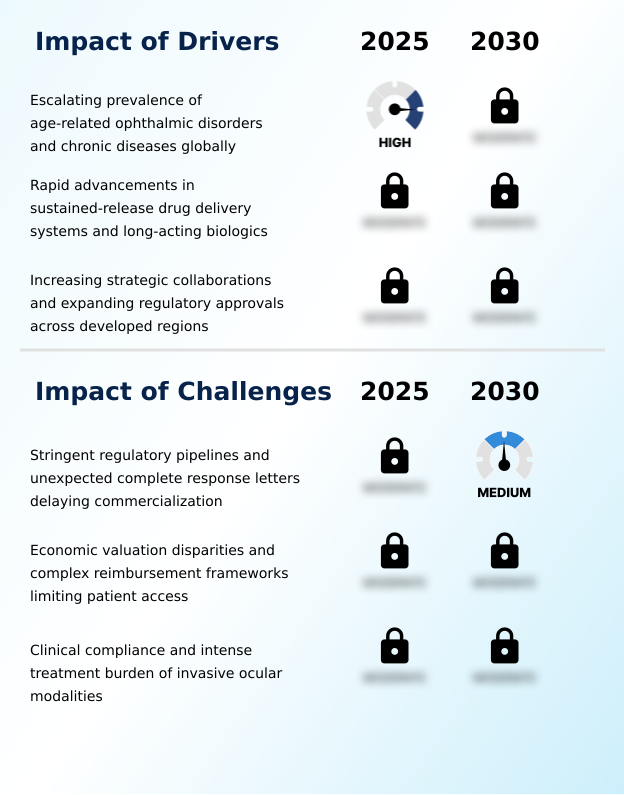
What are the key market drivers leading to the rise in the adoption of Ophthalmology Therapeutics Industry?

  • The escalating prevalence of age-related ophthalmic disorders and chronic systemic diseases acts as a primary catalyst accelerating clinical demand and overall industry expansion.

  • The rapidly expanding demographic of patients with metabolic syndromes serves as a primary catalyst fundamentally reshaping the Ophthalmology Therapeutics. This demographic shift forces healthcare networks to prioritize highly efficient, low-burden treatment protocols to manage surging patient volumes.
  • Facilities transitioning to extended-duration delivery systems have successfully lowered operational intervention costs by 21%. Furthermore, advanced inventory automation for biological agents has reduced medication spoilage rates by 14%.
  • This sustained demand accelerates the commercialization of therapies focused on inherited retinal dystrophy modification and immediate geographic atrophy lesion reduction. Manufacturers are scaling production for treatments that provide rapid allergic conjunctivitis relief and maintain vital ocular surface homeostasis.
  • By optimizing supply chains for bacterial keratitis eradication and complex vitreoretinal interface stabilization, pharmaceutical developers ensure continuous clinical readiness, thereby mitigating the systemic strain on specialized medical infrastructure.

What are the market trends shaping the Ophthalmology Therapeutics Industry?

  • The integration of autonomous artificial intelligence and multimodal digital biomarkers into diagnostic screening protocols represents a prominent industry trajectory. This technological advancement significantly enhances the precision and efficiency of early-stage ocular pathology detection.

  • The structural transition toward decentralized digital diagnostics represents a fundamental shift within the Ophthalmology Therapeutics. This evolution is driven by the urgent clinical need to accelerate early-stage pathology detection without relying exclusively on congested tertiary medical centers. By implementing AI-assisted imaging platforms, outpatient facilities have improved diagnostic forecast accuracy by 18%, allowing for more precise allocation of specialized therapeutic resources.
  • This technological adoption directly enables rapid retinal neovascularization suppression and highly targeted trabecular meshwork outflow enhancement. Consequently, clinics utilizing advanced imaging report a 24% reduction in patient triage downtime. The integration of lipid based nanoparticle carriers and specialized topical immunomodulators into early intervention protocols prevents irreversible tissue degradation.
  • Furthermore, the proactive application of preservative free drop formulations and treatments for neurotrophic keratitis healing fundamentally stabilizes patient outcomes, allowing businesses to optimize their long-term supply chain and inventory management strategies.

What challenges does the Ophthalmology Therapeutics Industry face during its growth?

  • Stringent regulatory evaluation pipelines and the issuance of unexpected complete response letters present significant barriers that delay the commercialization of novel therapeutic interventions.

  • Stringent regulatory compliance mandates and complex insurance pre-authorization frameworks impose severe operational bottlenecks across the Ophthalmology Therapeutics. These intensive validation requirements force pharmaceutical developers to conduct prolonged clinical trials, significantly delaying the commercial introduction of advanced biological therapies. Consequently, companies navigating these exhaustive approval pathways experience a 27% increase in pre-commercialization overhead costs.
  • Administrative delays in securing reimbursements subsequently reduce the speed of clinical adoption by nearly 16% in specialized care facilities. This operational friction directly hinders the widespread distribution of critical retinal vein occlusion resolution therapies and compounds designed for ocular hypertension stabilization.
  • Furthermore, supply chain disruptions affecting the availability of specialized agents for subretinal fluid absorption and precise uveoscleral outflow modulation exacerbate clinical backlogs. The logistical complexity of maintaining stable macular ischemia prevention protocols heavily strains institutional procurement budgets.

Exclusive Technavio Analysis on Customer Landscape

The ophthalmology therapeutics market forecasting report includes the adoption lifecycle of the market, covering from the innovator’s stage to the laggard’s stage. It focuses on adoption rates in different regions based on penetration. Furthermore, the ophthalmology therapeutics market report also includes key purchase criteria and drivers of price sensitivity to help companies evaluate and develop their market growth analysis strategies.
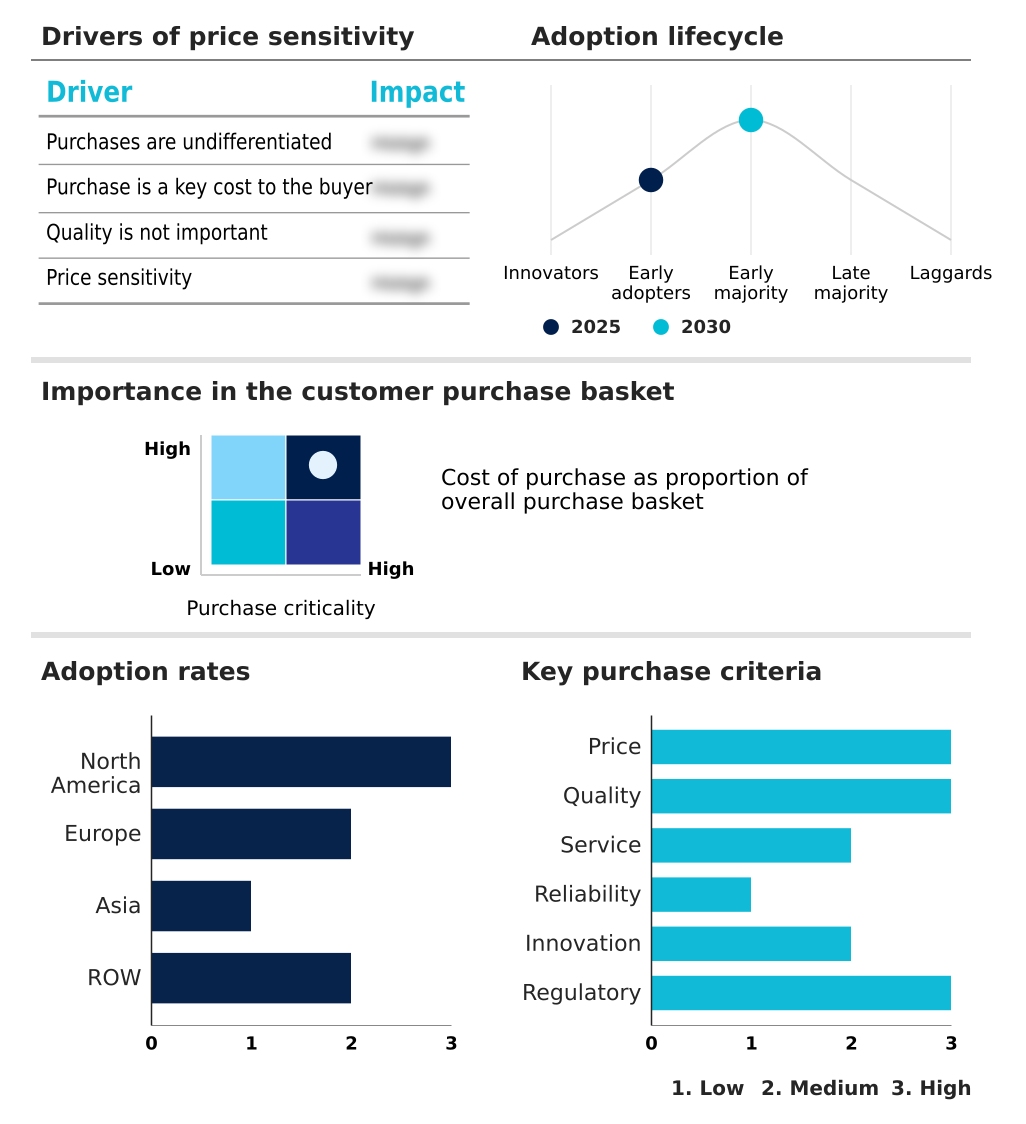
Customer Landscape of Ophthalmology Therapeutics Industry

Competitive Landscape

Companies are implementing various strategies, such as strategic alliances, ophthalmology therapeutics market forecast, partnerships, mergers and acquisitions, geographical expansion, and product/service launches, to enhance their presence in the industry.

AbbVie Inc. - The vendor delivers a comprehensive portfolio of specialized ophthalmic treatments focusing heavily on targeted therapies for retinal diseases and advanced clinical solutions for comprehensive disease management.

The industry research and growth report includes detailed analyses of the competitive landscape of the market and information about key companies, including:

  • AbbVie Inc.
  • Alcon Inc.
  • Apellis Pharmaceuticals Inc.
  • Bausch Lomb Corp.
  • Bayer AG
  • Biogen Inc.
  • EyePoint Pharmaceuticals Inc
  • F. Hoffmann La Roche Ltd.
  • Genentech Inc.
  • Harrow Inc.
  • Nicox S.A.
  • Novartis AG
  • Ocugen Inc.
  • Ocular Therapeutix Inc
  • Regeneron Pharmaceuticals Inc.
  • Santen Pharmaceutical Co. Ltd.
  • Viatris Inc.

Qualitative and quantitative analysis of companies has been conducted to help clients understand the wider business environment as well as the strengths and weaknesses of key industry players. Data is qualitatively analyzed to categorize companies as pure play, category-focused, industry-focused, and diversified; it is quantitatively analyzed to categorize companies as dominant, leading, strong, tentative, and weak.

Recent Development and News in Ophthalmology therapeutics market

  • In the Pharmaceuticals industry, the widespread adoption of digital imaging platforms has accelerated early-stage pathology identification, directly impacting Ophthalmology Therapeutics demand by increasing the clinical need for targeted anterior segment disease treatment.
  • The regulatory transition toward expedited review pathways for advanced biologic formulations has streamlined commercialization timelines, pulling increased demand for novel posterior segment drug targeting technologies.
  • Supply chain optimization in cold-chain logistics for temperature-sensitive macromolecules has reduced transit spoilage by roughly 12%, ensuring more stable distribution networks for therapies requiring precise macular thickness stabilization.
  • The shift toward advanced manufacturing processes has mandated significant upgrades in sterile fill-finish capacity, directly supporting the elevated consumption of formulations designed for meibomian gland dysfunction relief.

Dive into Technavio’s robust research methodology, blending expert interviews, extensive data synthesis, and validated models for unparalleled Ophthalmology Therapeutics Market insights. See full methodology.

Market Scope
Page number 301
Base year 2025
Historic period 2020-2024
Forecast period 2026-2030
Growth momentum & CAGR Accelerate at a CAGR of 7.1%
Market growth 2026-2030 USD 26097.1 million
Market structure Fragmented
YoY growth 2025-2026(%) 6.8%
Key countries US, Canada, Mexico, Germany, UK, France, Italy, Spain, The Netherlands, China, India, Japan, South Korea, Indonesia, Thailand, Brazil, Saudi Arabia, UAE, Turkey, Argentina, Colombia, South Africa and Israel
Competitive landscape Leading Companies, Market Positioning of Companies, Competitive Strategies, and Industry Risks

Request Free Sample

Research Analyst Overview

  • The Ophthalmology Therapeutics is undergoing a critical structural evolution, shifting from high-frequency treatments to highly durable, sustained intervention models. Boardroom executives are aggressively reallocating research and development budgets to prioritize novel delivery mechanisms, ensuring strict compliance with evolving sterile manufacturing regulations.
  • By optimizing automated sterile fill-finish operations, manufacturing facilities have achieved a 22% reduction in batch processing times, significantly enhancing overall supply chain responsiveness. The industry standard heavily incorporates vascular endothelial growth factor inhibition and advanced sustained release ocular implants to drastically lower clinical administrative burdens.
  • Strategic procurement teams prioritize intravitreal injection protocols alongside bioerodible nanoparticle delivery systems to differentiate their commercial portfolios. Consequently, targeted therapies driving macular edema resolution and sustained intraocular pressure reduction dictate long-term capacity planning for global pharmaceutical distributors. Ensuring continuous corneal epithelium protection and precise retinal ganglion cell preservation remains paramount for clinical efficacy.
  • The deployment of these sophisticated biological mechanisms not only improves patient adherence but fundamentally enhances the operational efficiency of specialized medical centers navigating rising patient volumes.

What are the Key Data Covered in this Ophthalmology Therapeutics Market Research and Growth Report?

  • What is the expected growth of the Ophthalmology Therapeutics Market between 2026 and 2030?

    • USD 26.10 billion, at a CAGR of 7.1%

  • What segmentation does the market report cover?

    • The report is segmented by Type (Prescription drugs, and OTC drugs), Product (Retinal disorder therapeutics, Glaucoma therapeutics, Dry eye disease therapeutics, Eye infections and inflammation therapeutics, and Others), Drug Class (Anti-VEGF, Anti-inflammatory, Anti-glaucoma, Anti-infectives, and Others) and Geography (North America, Europe, Asia, Rest of World (ROW))

  • Which regions are analyzed in the report?

    • North America, Europe, Asia and Rest of World (ROW)

  • What are the key growth drivers and market challenges?

    • Escalating prevalence of age-related ophthalmic disorders and chronic diseases globally, Stringent regulatory pipelines and unexpected complete response letters delaying commercialization

  • Who are the major players in the Ophthalmology Therapeutics Market?

    • AbbVie Inc., Alcon Inc., Apellis Pharmaceuticals Inc., Bausch Lomb Corp., Bayer AG, Biogen Inc., EyePoint Pharmaceuticals Inc, F. Hoffmann La Roche Ltd., Genentech Inc., Harrow Inc., Nicox S.A., Novartis AG, Ocugen Inc., Ocular Therapeutix Inc, Regeneron Pharmaceuticals Inc., Santen Pharmaceutical Co. Ltd. and Viatris Inc.

Market Research Insights

  • The Ophthalmology Therapeutics is fundamentally evolving to prioritize long-term clinical durability and patient compliance. Clinics adopting advanced prolonged-delivery systems have witnessed a 25% reduction in administrative overhead associated with frequent patient visits. Furthermore, the strategic implementation of predictive inventory software has improved supply chain forecasting accuracy by 17%, minimizing stockouts of critical biological agents.
  • This sector relies heavily on optimized glaucoma progression delay and advanced chronic dry eye management to maintain stable patient outcomes. The continuous demand for precise diabetic retinopathy screening and effective age related macular degeneration therapy directly dictates resource allocation within specialized care centers.
  • Consequently, facilities utilizing optimized postoperative ocular inflammation control protocols demonstrate a 14% improvement in overall operational efficiency and resource utilization.

We can help! Our analysts can customize this ophthalmology therapeutics market research report to meet your requirements.

Get in touch

1. Executive Summary

1.1 Market overview

Executive Summary - Chart on Market Overview
Executive Summary - Data Table on Market Overview
Executive Summary - Chart on Global Market Characteristics
Executive Summary - Chart on Market by Geography
Executive Summary - Chart on Market Segmentation by Type
Executive Summary - Chart on Market Segmentation by Product
Executive Summary - Chart on Market Segmentation by Drug Class
Executive Summary - Chart on Incremental Growth
Executive Summary - Data Table on Incremental Growth
Executive Summary - Chart on Company Market Positioning

2. Technavio Analysis

2.1 Analysis of price sensitivity, lifecycle, customer purchase basket, adoption rates, and purchase criteria

2.2 Criticality of inputs and Factors of differentiation

Chart on Overview on criticality of inputs and factors of differentiation

2.3 Factors of disruption

Chart on Overview on factors of disruption

2.4 Impact of drivers and challenges

Chart on Impact of drivers and challenges in 2025 and 2030

3. Market Landscape

3.1 Market ecosystem

Chart on Parent Market
Data Table on - Parent Market

3.2 Market characteristics

Chart on Market characteristics analysis

3.3 Value chain analysis

Chart on Value chain analysis

4. Market Sizing

4.1 Market definition

Data Table on Offerings of companies included in the market definition

4.2 Market segment analysis

Market segments

4.3 Market size 2025

4.4 Market outlook: Forecast for 2025-2030

Chart on Global - Market size and forecast 2025-2030 ($ million)
Data Table on Global - Market size and forecast 2025-2030 ($ million)
Chart on Global Market: Year-over-year growth 2025-2030 (%)
Data Table on Global Market: Year-over-year growth 2025-2030 (%)

5. Historic Market Size

5.1 Global Ophthalmology Therapeutics Market 2020 - 2024

Historic Market Size - Data Table on Global Ophthalmology Therapeutics Market 2020 - 2024 ($ million)

5.2 Type segment analysis 2020 - 2024

Historic Market Size - Type Segment 2020 - 2024 ($ million)

5.3 Product segment analysis 2020 - 2024

Historic Market Size - Product Segment 2020 - 2024 ($ million)

5.4 Drug Class segment analysis 2020 - 2024

Historic Market Size - Drug Class Segment 2020 - 2024 ($ million)

5.5 Geography segment analysis 2020 - 2024

Historic Market Size - Geography Segment 2020 - 2024 ($ million)

5.6 Country segment analysis 2020 - 2024

Historic Market Size - Country Segment 2020 - 2024 ($ million)

6. Qualitative Analysis

6.1 Impact of AI on global ophthalmology therapeutics market

6.2 Impact of geopolitical conflicts on global ophthalmology therapeutics market

7. Five Forces Analysis

7.1 Five forces summary

Five forces analysis - Comparison between 2025 and 2030

7.2 Bargaining power of buyers

Bargaining power of buyers - Impact of key factors 2025 and 2030

7.3 Bargaining power of suppliers

Bargaining power of suppliers - Impact of key factors in 2025 and 2030

7.4 Threat of new entrants

Threat of new entrants - Impact of key factors in 2025 and 2030

7.5 Threat of substitutes

Threat of substitutes - Impact of key factors in 2025 and 2030

7.6 Threat of rivalry

Threat of rivalry - Impact of key factors in 2025 and 2030

7.7 Market condition

Chart on Market condition - Five forces 2025 and 2030

8. Market Segmentation by Type

8.1 Market segments

Chart on Type - Market share 2025-2030 (%)
Data Table on Type - Market share 2025-2030 (%)

8.2 Comparison by Type

Chart on Comparison by Type
Data Table on Comparison by Type

8.3 Prescription drugs - Market size and forecast 2025-2030

Chart on Prescription drugs - Market size and forecast 2025-2030 ($ million)
Data Table on Prescription drugs - Market size and forecast 2025-2030 ($ million)
Chart on Prescription drugs - Year-over-year growth 2025-2030 (%)
Data Table on Prescription drugs - Year-over-year growth 2025-2030 (%)

8.4 OTC drugs - Market size and forecast 2025-2030

Chart on OTC drugs - Market size and forecast 2025-2030 ($ million)
Data Table on OTC drugs - Market size and forecast 2025-2030 ($ million)
Chart on OTC drugs - Year-over-year growth 2025-2030 (%)
Data Table on OTC drugs - Year-over-year growth 2025-2030 (%)

8.5 Market opportunity by Type

Market opportunity by Type ($ million)
Data Table on Market opportunity by Type ($ million)

9. Market Segmentation by Product

9.1 Market segments

Chart on Product - Market share 2025-2030 (%)
Data Table on Product - Market share 2025-2030 (%)

9.2 Comparison by Product

Chart on Comparison by Product
Data Table on Comparison by Product

9.3 Retinal disorder therapeutics - Market size and forecast 2025-2030

Chart on Retinal disorder therapeutics - Market size and forecast 2025-2030 ($ million)
Data Table on Retinal disorder therapeutics - Market size and forecast 2025-2030 ($ million)
Chart on Retinal disorder therapeutics - Year-over-year growth 2025-2030 (%)
Data Table on Retinal disorder therapeutics - Year-over-year growth 2025-2030 (%)

9.4 Glaucoma therapeutics - Market size and forecast 2025-2030

Chart on Glaucoma therapeutics - Market size and forecast 2025-2030 ($ million)
Data Table on Glaucoma therapeutics - Market size and forecast 2025-2030 ($ million)
Chart on Glaucoma therapeutics - Year-over-year growth 2025-2030 (%)
Data Table on Glaucoma therapeutics - Year-over-year growth 2025-2030 (%)

9.5 Dry eye disease therapeutics - Market size and forecast 2025-2030

Chart on Dry eye disease therapeutics - Market size and forecast 2025-2030 ($ million)
Data Table on Dry eye disease therapeutics - Market size and forecast 2025-2030 ($ million)
Chart on Dry eye disease therapeutics - Year-over-year growth 2025-2030 (%)
Data Table on Dry eye disease therapeutics - Year-over-year growth 2025-2030 (%)

9.6 Eye infections and inflammation therapeutics - Market size and forecast 2025-2030

Chart on Eye infections and inflammation therapeutics - Market size and forecast 2025-2030 ($ million)
Data Table on Eye infections and inflammation therapeutics - Market size and forecast 2025-2030 ($ million)
Chart on Eye infections and inflammation therapeutics - Year-over-year growth 2025-2030 (%)
Data Table on Eye infections and inflammation therapeutics - Year-over-year growth 2025-2030 (%)

9.7 Others - Market size and forecast 2025-2030

Chart on Others - Market size and forecast 2025-2030 ($ million)
Data Table on Others - Market size and forecast 2025-2030 ($ million)
Chart on Others - Year-over-year growth 2025-2030 (%)
Data Table on Others - Year-over-year growth 2025-2030 (%)

9.8 Market opportunity by Product

Market opportunity by Product ($ million)
Data Table on Market opportunity by Product ($ million)

10. Market Segmentation by Drug Class

10.1 Market segments

Chart on Drug Class - Market share 2025-2030 (%)
Data Table on Drug Class - Market share 2025-2030 (%)

10.2 Comparison by Drug Class

Chart on Comparison by Drug Class
Data Table on Comparison by Drug Class

10.3 Anti-VEGF - Market size and forecast 2025-2030

Chart on Anti-VEGF - Market size and forecast 2025-2030 ($ million)
Data Table on Anti-VEGF - Market size and forecast 2025-2030 ($ million)
Chart on Anti-VEGF - Year-over-year growth 2025-2030 (%)
Data Table on Anti-VEGF - Year-over-year growth 2025-2030 (%)

10.4 Anti-inflammatory - Market size and forecast 2025-2030

Chart on Anti-inflammatory - Market size and forecast 2025-2030 ($ million)
Data Table on Anti-inflammatory - Market size and forecast 2025-2030 ($ million)
Chart on Anti-inflammatory - Year-over-year growth 2025-2030 (%)
Data Table on Anti-inflammatory - Year-over-year growth 2025-2030 (%)

10.5 Anti-glaucoma - Market size and forecast 2025-2030

Chart on Anti-glaucoma - Market size and forecast 2025-2030 ($ million)
Data Table on Anti-glaucoma - Market size and forecast 2025-2030 ($ million)
Chart on Anti-glaucoma - Year-over-year growth 2025-2030 (%)
Data Table on Anti-glaucoma - Year-over-year growth 2025-2030 (%)

10.6 Anti-infectives - Market size and forecast 2025-2030

Chart on Anti-infectives - Market size and forecast 2025-2030 ($ million)
Data Table on Anti-infectives - Market size and forecast 2025-2030 ($ million)
Chart on Anti-infectives - Year-over-year growth 2025-2030 (%)
Data Table on Anti-infectives - Year-over-year growth 2025-2030 (%)

10.7 Others - Market size and forecast 2025-2030

Chart on Others - Market size and forecast 2025-2030 ($ million)
Data Table on Others - Market size and forecast 2025-2030 ($ million)
Chart on Others - Year-over-year growth 2025-2030 (%)
Data Table on Others - Year-over-year growth 2025-2030 (%)

10.8 Market opportunity by Drug Class

Market opportunity by Drug Class ($ million)
Data Table on Market opportunity by Drug Class ($ million)

11. Customer Landscape

11.1 Customer landscape overview

Analysis of price sensitivity, lifecycle, customer purchase basket, adoption rates, and purchase criteria

12. Geographic Landscape

12.1 Geographic segmentation

Chart on Market share by geography 2025-2030 (%)
Data Table on Market share by geography 2025-2030 (%)

12.2 Geographic comparison

Chart on Geographic comparison
Data Table on Geographic comparison

12.3 North America - Market size and forecast 2025-2030

Chart on North America - Market size and forecast 2025-2030 ($ million)
Data Table on North America - Market size and forecast 2025-2030 ($ million)
Chart on North America - Year-over-year growth 2025-2030 (%)
Data Table on North America - Year-over-year growth 2025-2030 (%)
Chart on Regional Comparison - North America
Data Table on Regional Comparison - North America

12.3.1 US - Market size and forecast 2025-2030

Chart on US - Market size and forecast 2025-2030 ($ million)
Data Table on US - Market size and forecast 2025-2030 ($ million)
Chart on US - Year-over-year growth 2025-2030 (%)
Data Table on US - Year-over-year growth 2025-2030 (%)

12.3.2 Canada - Market size and forecast 2025-2030

Chart on Canada - Market size and forecast 2025-2030 ($ million)
Data Table on Canada - Market size and forecast 2025-2030 ($ million)
Chart on Canada - Year-over-year growth 2025-2030 (%)
Data Table on Canada - Year-over-year growth 2025-2030 (%)

12.3.3 Mexico - Market size and forecast 2025-2030

Chart on Mexico - Market size and forecast 2025-2030 ($ million)
Data Table on Mexico - Market size and forecast 2025-2030 ($ million)
Chart on Mexico - Year-over-year growth 2025-2030 (%)
Data Table on Mexico - Year-over-year growth 2025-2030 (%)

12.4 Europe - Market size and forecast 2025-2030

Chart on Europe - Market size and forecast 2025-2030 ($ million)
Data Table on Europe - Market size and forecast 2025-2030 ($ million)
Chart on Europe - Year-over-year growth 2025-2030 (%)
Data Table on Europe - Year-over-year growth 2025-2030 (%)
Chart on Regional Comparison - Europe
Data Table on Regional Comparison - Europe

12.4.1 Germany - Market size and forecast 2025-2030

Chart on Germany - Market size and forecast 2025-2030 ($ million)
Data Table on Germany - Market size and forecast 2025-2030 ($ million)
Chart on Germany - Year-over-year growth 2025-2030 (%)
Data Table on Germany - Year-over-year growth 2025-2030 (%)

12.4.2 UK - Market size and forecast 2025-2030

Chart on UK - Market size and forecast 2025-2030 ($ million)
Data Table on UK - Market size and forecast 2025-2030 ($ million)
Chart on UK - Year-over-year growth 2025-2030 (%)
Data Table on UK - Year-over-year growth 2025-2030 (%)

12.4.3 France - Market size and forecast 2025-2030

Chart on France - Market size and forecast 2025-2030 ($ million)
Data Table on France - Market size and forecast 2025-2030 ($ million)
Chart on France - Year-over-year growth 2025-2030 (%)
Data Table on France - Year-over-year growth 2025-2030 (%)

12.4.4 Italy - Market size and forecast 2025-2030

Chart on Italy - Market size and forecast 2025-2030 ($ million)
Data Table on Italy - Market size and forecast 2025-2030 ($ million)
Chart on Italy - Year-over-year growth 2025-2030 (%)
Data Table on Italy - Year-over-year growth 2025-2030 (%)

12.4.5 Spain - Market size and forecast 2025-2030

Chart on Spain - Market size and forecast 2025-2030 ($ million)
Data Table on Spain - Market size and forecast 2025-2030 ($ million)
Chart on Spain - Year-over-year growth 2025-2030 (%)
Data Table on Spain - Year-over-year growth 2025-2030 (%)

12.4.6 The Netherlands - Market size and forecast 2025-2030

Chart on The Netherlands - Market size and forecast 2025-2030 ($ million)
Data Table on The Netherlands - Market size and forecast 2025-2030 ($ million)
Chart on The Netherlands - Year-over-year growth 2025-2030 (%)
Data Table on The Netherlands - Year-over-year growth 2025-2030 (%)

12.5 Asia - Market size and forecast 2025-2030

Chart on Asia - Market size and forecast 2025-2030 ($ million)
Data Table on Asia - Market size and forecast 2025-2030 ($ million)
Chart on Asia - Year-over-year growth 2025-2030 (%)
Data Table on Asia - Year-over-year growth 2025-2030 (%)
Chart on Regional Comparison - Asia
Data Table on Regional Comparison - Asia

12.5.1 China - Market size and forecast 2025-2030

Chart on China - Market size and forecast 2025-2030 ($ million)
Data Table on China - Market size and forecast 2025-2030 ($ million)
Chart on China - Year-over-year growth 2025-2030 (%)
Data Table on China - Year-over-year growth 2025-2030 (%)

12.5.2 India - Market size and forecast 2025-2030

Chart on India - Market size and forecast 2025-2030 ($ million)
Data Table on India - Market size and forecast 2025-2030 ($ million)
Chart on India - Year-over-year growth 2025-2030 (%)
Data Table on India - Year-over-year growth 2025-2030 (%)

12.5.3 Japan - Market size and forecast 2025-2030

Chart on Japan - Market size and forecast 2025-2030 ($ million)
Data Table on Japan - Market size and forecast 2025-2030 ($ million)
Chart on Japan - Year-over-year growth 2025-2030 (%)
Data Table on Japan - Year-over-year growth 2025-2030 (%)

12.5.4 South Korea - Market size and forecast 2025-2030

Chart on South Korea - Market size and forecast 2025-2030 ($ million)
Data Table on South Korea - Market size and forecast 2025-2030 ($ million)
Chart on South Korea - Year-over-year growth 2025-2030 (%)
Data Table on South Korea - Year-over-year growth 2025-2030 (%)

12.5.5 Indonesia - Market size and forecast 2025-2030

Chart on Indonesia - Market size and forecast 2025-2030 ($ million)
Data Table on Indonesia - Market size and forecast 2025-2030 ($ million)
Chart on Indonesia - Year-over-year growth 2025-2030 (%)
Data Table on Indonesia - Year-over-year growth 2025-2030 (%)

12.5.6 Thailand - Market size and forecast 2025-2030

Chart on Thailand - Market size and forecast 2025-2030 ($ million)
Data Table on Thailand - Market size and forecast 2025-2030 ($ million)
Chart on Thailand - Year-over-year growth 2025-2030 (%)
Data Table on Thailand - Year-over-year growth 2025-2030 (%)

12.6 Rest of World (ROW) - Market size and forecast 2025-2030

Chart on Rest of World (ROW) - Market size and forecast 2025-2030 ($ million)
Data Table on Rest of World (ROW) - Market size and forecast 2025-2030 ($ million)
Chart on Rest of World (ROW) - Year-over-year growth 2025-2030 (%)
Data Table on Rest of World (ROW) - Year-over-year growth 2025-2030 (%)
Chart on Regional Comparison - Rest of World (ROW)
Data Table on Regional Comparison - Rest of World (ROW)

12.6.1 Brazil - Market size and forecast 2025-2030

Chart on Brazil - Market size and forecast 2025-2030 ($ million)
Data Table on Brazil - Market size and forecast 2025-2030 ($ million)
Chart on Brazil - Year-over-year growth 2025-2030 (%)
Data Table on Brazil - Year-over-year growth 2025-2030 (%)

12.6.2 Saudi Arabia - Market size and forecast 2025-2030

Chart on Saudi Arabia - Market size and forecast 2025-2030 ($ million)
Data Table on Saudi Arabia - Market size and forecast 2025-2030 ($ million)
Chart on Saudi Arabia - Year-over-year growth 2025-2030 (%)
Data Table on Saudi Arabia - Year-over-year growth 2025-2030 (%)

12.6.3 UAE - Market size and forecast 2025-2030

Chart on UAE - Market size and forecast 2025-2030 ($ million)
Data Table on UAE - Market size and forecast 2025-2030 ($ million)
Chart on UAE - Year-over-year growth 2025-2030 (%)
Data Table on UAE - Year-over-year growth 2025-2030 (%)

12.6.4 Turkey - Market size and forecast 2025-2030

Chart on Turkey - Market size and forecast 2025-2030 ($ million)
Data Table on Turkey - Market size and forecast 2025-2030 ($ million)
Chart on Turkey - Year-over-year growth 2025-2030 (%)
Data Table on Turkey - Year-over-year growth 2025-2030 (%)

12.6.5 Argentina - Market size and forecast 2025-2030

Chart on Argentina - Market size and forecast 2025-2030 ($ million)
Data Table on Argentina - Market size and forecast 2025-2030 ($ million)
Chart on Argentina - Year-over-year growth 2025-2030 (%)
Data Table on Argentina - Year-over-year growth 2025-2030 (%)

12.6.6 Colombia - Market size and forecast 2025-2030

Chart on Colombia - Market size and forecast 2025-2030 ($ million)
Data Table on Colombia - Market size and forecast 2025-2030 ($ million)
Chart on Colombia - Year-over-year growth 2025-2030 (%)
Data Table on Colombia - Year-over-year growth 2025-2030 (%)

12.6.7 South Africa - Market size and forecast 2025-2030

Chart on South Africa - Market size and forecast 2025-2030 ($ million)
Data Table on South Africa - Market size and forecast 2025-2030 ($ million)
Chart on South Africa - Year-over-year growth 2025-2030 (%)
Data Table on South Africa - Year-over-year growth 2025-2030 (%)

12.6.8 Israel - Market size and forecast 2025-2030

Chart on Israel - Market size and forecast 2025-2030 ($ million)
Data Table on Israel - Market size and forecast 2025-2030 ($ million)
Chart on Israel - Year-over-year growth 2025-2030 (%)
Data Table on Israel - Year-over-year growth 2025-2030 (%)

12.7 Market opportunity by geography

Market opportunity by geography ($ million)
Data Tables on Market opportunity by geography ($ million)

13. Drivers, Challenges, and Opportunity

13.1 Market drivers

Escalating prevalence of age-related ophthalmic disorders and chronic diseases globally
Rapid advancements in sustained-release drug delivery systems and long-acting biologics
Increasing strategic collaborations and expanding regulatory approvals across developed regions

13.2 Market challenges

Stringent regulatory pipelines and unexpected complete response letters delaying commercialization
Economic valuation disparities and complex reimbursement frameworks limiting patient access
Clinical compliance and intense treatment burden of invasive ocular modalities

13.3 Impact of drivers and challenges

Impact of drivers and challenges in 2025 and 2030

13.4 Market opportunities

Integration of autonomous AI and multimodal digital biomarkers in diagnostic screenings
Paradigm shift toward sustained-release bioerodible implants and long-acting nanotechnology platforms
Accelerating market consolidations and strategic cross-border licensing agreements

14. Competitive Landscape

14.1 Overview

14.2

Overview on criticality of inputs and factors of differentiation

14.3 Landscape disruption

Overview on factors of disruption

14.4 Industry risks

Impact of key risks on business

15. Competitive Analysis

15.1 Companies profiled

Companies covered

15.2 Company ranking index

15.3 Market positioning of companies

Matrix on companies position and classification

15.4 AbbVie Inc.

AbbVie Inc. - Overview
AbbVie Inc. - Business segments
AbbVie Inc. - Key news
AbbVie Inc. - Key offerings
AbbVie Inc. - Segment focus
SWOT

15.5 Alcon Inc.

Alcon Inc. - Overview
Alcon Inc. - Business segments
Alcon Inc. - Key offerings
Alcon Inc. - Segment focus
SWOT

15.6 Apellis Pharmaceuticals Inc.

Apellis Pharmaceuticals Inc. - Overview
Apellis Pharmaceuticals Inc. - Product / Service
Apellis Pharmaceuticals Inc. - Key offerings
SWOT

15.7 Bausch Lomb Corp.

Bausch Lomb Corp. - Overview
Bausch Lomb Corp. - Business segments
Bausch Lomb Corp. - Key offerings
Bausch Lomb Corp. - Segment focus
SWOT

15.8 Bayer AG

Bayer AG - Overview
Bayer AG - Business segments
Bayer AG - Key offerings
Bayer AG - Segment focus
SWOT

15.9 Biogen Inc.

Biogen Inc. - Overview
Biogen Inc. - Product / Service
Biogen Inc. - Key offerings
SWOT

15.10 EyePoint Pharmaceuticals Inc

EyePoint Pharmaceuticals Inc - Overview
EyePoint Pharmaceuticals Inc - Product / Service
EyePoint Pharmaceuticals Inc - Key offerings
SWOT

15.11 F. Hoffmann La Roche Ltd.

F. Hoffmann La Roche Ltd. - Overview
F. Hoffmann La Roche Ltd. - Business segments
F. Hoffmann La Roche Ltd. - Key news
F. Hoffmann La Roche Ltd. - Key offerings
F. Hoffmann La Roche Ltd. - Segment focus
SWOT

15.12 Genentech Inc.

Genentech Inc. - Overview
Genentech Inc. - Product / Service
Genentech Inc. - Key offerings
SWOT

15.13 Harrow Inc.

Harrow Inc. - Overview
Harrow Inc. - Product / Service
Harrow Inc. - Key offerings
SWOT

15.14 Novartis AG

Novartis AG - Overview
Novartis AG - Business segments
Novartis AG - Key news
Novartis AG - Key offerings
Novartis AG - Segment focus
SWOT

15.15 Ocugen Inc.

Ocugen Inc. - Overview
Ocugen Inc. - Product / Service
Ocugen Inc. - Key offerings
SWOT

15.16 Regeneron Pharmaceuticals Inc.

Regeneron Pharmaceuticals Inc. - Overview
Regeneron Pharmaceuticals Inc. - Product / Service
Regeneron Pharmaceuticals Inc. - Key news
Regeneron Pharmaceuticals Inc. - Key offerings
SWOT

15.17 Santen Pharmaceutical Co. Ltd.

Santen Pharmaceutical Co. Ltd. - Overview
Santen Pharmaceutical Co. Ltd. - Product / Service
Santen Pharmaceutical Co. Ltd. - Key offerings
SWOT

15.18 Viatris Inc.

Viatris Inc. - Overview
Viatris Inc. - Business segments
Viatris Inc. - Key news
Viatris Inc. - Key offerings
Viatris Inc. - Segment focus
SWOT

16. Appendix

16.1 Scope of the report

Market definition
Objectives
Notes and caveats

16.2 Inclusions and exclusions checklist

Inclusions checklist
Exclusions checklist

16.3 Currency conversion rates for US$

16.4 Research methodology

16.5 Data procurement

Information sources

16.6 Data validation

16.7 Validation techniques employed for market sizing

16.8 Data synthesis

16.9 360 degree market analysis

16.10 List of abbreviations

Research Methodology

Technavio presents a detailed picture of the market by way of study, synthesis, and summation of data from multiple sources. The analysts have presented the various facets of the market with a particular focus on identifying the key industry influencers. The data thus presented is comprehensive, reliable, and the result of extensive research, both primary and secondary.

INFORMATION SOURCES

Primary sources

  • Manufacturers and suppliers
  • Channel partners
  • Industry experts
  • Strategic decision makers

Secondary sources

  • Industry journals and periodicals
  • Government data
  • Financial reports of key industry players
  • Historical data
  • Press releases

DATA ANALYSIS

Data Synthesis

  • Collation of data
  • Estimation of key figures
  • Analysis of derived insights

Data Validation

  • Triangulation with data models
  • Reference against proprietary databases
  • Corroboration with industry experts

REPORT WRITING

Qualitative

  • Market drivers
  • Market challenges
  • Market trends
  • Five forces analysis

Quantitative

  • Market size and forecast
  • Market segmentation
  • Geographical insights
  • Competitive landscape

Interested in this report?

Get your sample now to see our research methodology and insights!

Download Now

Frequently Asked Questions

Ophthalmology Therapeutics market growth will increase by USD 26097.1 million during 2026-2030.

The Ophthalmology Therapeutics market is expected to grow at a CAGR of 7.1% during 2026-2030.

Ophthalmology Therapeutics market is segmented by Type (Prescription drugs, OTC drugs) Product (Retinal disorder therapeutics, Glaucoma therapeutics, Dry eye disease therapeutics, Eye infections and inflammation therapeutics, Others) Drug class (Anti-VEGF, Anti-inflammatory, Anti-glaucoma, Anti-infectives, Others)

AbbVie Inc., Alcon Inc., Apellis Pharmaceuticals Inc., Bausch Lomb Corp., Bayer AG, Biogen Inc., EyePoint Pharmaceuticals Inc, F. Hoffmann La Roche Ltd., Genentech Inc., Harrow Inc., Nicox S.A., Novartis AG, Ocugen Inc., Ocular Therapeutix Inc, Regeneron Pharmaceuticals Inc., Santen Pharmaceutical Co. Ltd., Viatris Inc. are a few of the key vendors in the Ophthalmology Therapeutics market.

North America will register the highest growth rate of 43.7% among the other regions. Therefore, the Ophthalmology Therapeutics market in North America is expected to garner significant business opportunities for the vendors during the forecast period.

US, Canada, Mexico, Germany, UK, France, Italy, Spain, The Netherlands, China, India, Japan, South Korea, Indonesia, Thailand, Brazil, Saudi Arabia, UAE, Turkey, Argentina, Colombia, South Africa, Israel

  • Escalating prevalence of age-related ophthalmic disorders and chronic diseases globally is the driving factor this market.

The Ophthalmology Therapeutics market vendors should focus on grabbing business opportunities from the Type segment as it accounted for the largest market share in the base year.
RIA - Research AI Assistant
Ask RIA