



Optical Modulators Market Size 2024-2028
The optical modulators market size is forecast to increase by USD 9.3 billion at a CAGR of 6.21% between 2023 and 2028.
- The market is experiencing significant growth due to the increasing demand for fiber-coupled integrated optical modulators in various applications. This trend is driven by the rising adoption of optical communication systems in data centers and telecom networks. Optical modulators play a crucial role in converting high-frequency electrical signals into optical signals using a transparent medium, such as an optical fiber cable. They are integral to various applications, including laser transmitters, data communication, and fiber optic sensors. Furthermore, the emergence of silicon-based electro-optic modulators is expected to revolutionize the market, offering advantages such as compact size, high efficiency, and low power consumption. However, the market faces challenges, including the low reliability of optical modulators for spaceflights and the high cost of manufacturing these devices. These factors are expected to influence the market dynamics and shape the future growth trajectory of the market.
What will be the Size of the Optical Modulators Market During the Forecast Period?

- The market encompasses the production and sale of devices that convert electrical signals into time-varying optical signals for transmission through optical fiber cables. These modulators utilize the electro-optic effect, which alters the index of refraction of a transparent medium in response to a high-frequency electrical signal. Optical modulators can be categorized into direct modulation, using a light source such as a laser diode, and external modulation, employing a separate modulator circuit.
- Furthermore, direct modulation involves the light source directly modulating the amplitude or power level of the optical signal, while external modulation uses an electro-optic phase modulator or bulk/integrated-optic modulators to alter the phase of the light wave. Technological advancements in nonlinear optical crystals, waveguide technology, and lab equipment like optical tables and optical benches have led to improvements in data rates, power-handling capability, and reduced insertion losses. Optical modulators are integral to various applications, including telecommunications, data centers, and research laboratories, making this market a significant contributor to the global optical communications industry.
How is this Optical Modulators Industry segmented and which is the largest segment?
The optical modulators industry research report provides comprehensive data (region-wise segment analysis), with forecasts and estimates in "USD billion" for the period 2024-2028, as well as historical data from 2018-2022 for the following segments.
- Type
- 10 to 40 Gbps
- 40 Gbps and above
- Less than 10 Gbps
- Application
- Telecommunications
- Data centers
- CATV
- Others
- Geography
- APAC
- China
- Japan
- North America
- US
- Europe
- Germany
- Middle East and Africa
- South America
- APAC
By Type Insights
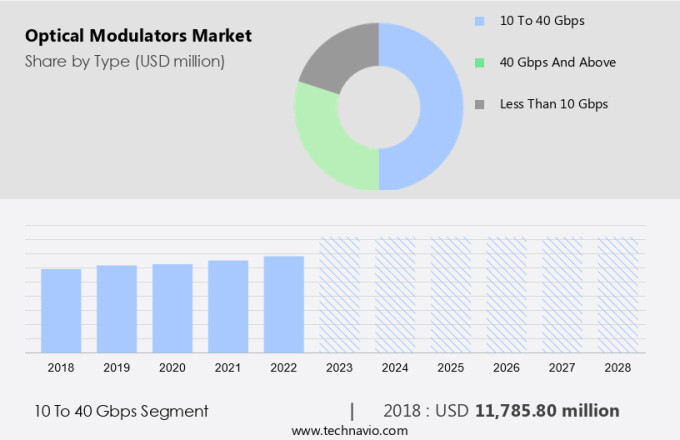
- The 10 to 40 gbps segment is estimated to witness significant growth during the forecast period.
Optical modulators play a pivotal role in high-speed optical communication systems, enabling the conversion of electrical signals into optical signals and vice versa. Utilizing advanced 40-nm technology, modern optical modulators and receivers offer energy-efficient solutions with data rates ranging from 10 to 40 Gbps. These devices exhibit impressive performance, achieving 135 fJ/b energy consumption for the transmitter when linked to an external silicon photonic ring modulator, and 395 fJ/b for the receiver when coupled with an external photodiode at a sensitivity level of -15 dBm.
Furthermore, the silicon optical modulator, a critical component of high-performance optical interconnects, employs the carrier depletion effect in a p-i-n diode. The resulting devices provide a favorable balance between efficiency, speed, and minimal optical loss. Integral to high-speed integrated photonic systems, these optical modulators are essential for producing reliable and efficient data lines.
Get a glance at the Optical Modulators Industry report of share of various segments Request Free Sample
The 10 to 40 Gbps segment was valued at USD 11.79 billion in 2018 and showed a gradual increase during the forecast period.
Regional Analysis
- APAC is estimated to contribute 54% to the growth of the global market during the forecast period.
Technavio's analysts have elaborately explained the regional trends and drivers that shape the market during the forecast period.

For more insights on the market share of various regions, Request Free Sample
The market is experiencing significant growth In the Asia-Pacific region due to the expanding telecommunications industry. Major international players in this sector are broadening their presence in Asia by entering the mobility market. Furthermore, substantial investments in 5G network infrastructure In the region are propelling the demand for optical modulators. Japan, in particular, is currently testing 5G networks in major cities and provinces, with commercial deployment anticipated by next year. These modulators operate by utilizing the Electro-optic effect, which alters the Index of Refraction in response to an applied electrical signal. Common modulator materials include lithium niobate, indium phosphide, and nonlinear optical crystals. Optical modulators come in various forms, including Bulk modulators, Integrated-optic modulators, and standard butterfly packages. Key performance factors include waveguide technology, drive voltages, fiber pigtailed, and power-handling capability.
Market Dynamics
Our optical modulators market researchers analyzed the data with 2023 as the base year, along with the key drivers, trends, and challenges. A holistic analysis of drivers will help companies refine their marketing strategies to gain a competitive advantage.
What are the key market drivers leading to the rise In the adoption of Optical Modulators Industry?
Growing demand for fiber-coupled integrated optical modulators is the key driver of the market.
- Fiber-coupled integrated optical modulators play a significant role in influencing the phase and amplitude of laser light with high dynamics. These devices are capable of handling high optical powers, up to 10 Watts, and can control the temporal characteristics of fiber laser outputs, providing a diverse range of pulse shapes. With high extinction ratios and optical power stability, these modulators are suitable for various wavelengths within the visible spectrum and infrared radiation range. Consequently, they are highly sought after by industries such as telecommunications due to their advantages. The increasing demand for digital modulation has led companies to offer fiber-coupled integrated optical modulators to enterprises in this sector and others.
- Furthermore, they operate based on the Electro-optic effect, which changes the Index of Refraction in response to an applied high-frequency electrical signal. Nonlinear optical crystals like lithium niobate and indium phosphide are commonly used In these modulators. Fiber-pigtailed Electro-optic amplitude modulators, such as lithium niobate modulators, are popular due to their transparency window and high drive voltages. Mach Zehnder Modulators, which include beam splitters, beam combiners, and lithium niobate waveguides, offer high optical power handling capability and low insertion losses. Electro-absorption modulators in indium phosphide use the electro-absorption effect to change the absorption coefficient of the material, resulting in a change In the transmitted optical power signal. The market for fiber-coupled integrated optical modulators is driven by the need for high data rates, with chirp modulation, frequency modulation, and amplitude modulation techniques used to achieve these rates. External Modulation is preferred over Direct Modulation due to its superior linearity and lower distortion.
- Thus, these modulators are used in various applications, including interferometric applications, fiber optic sensors, and laser stabilization, among others. Lock-in detection schemes, phase-sensitive detection, and pump-probe detection schemes are some of the techniques used to improve the performance of these modulators. Thermal drift and residual amplitude modulation are challenges that need to be addressed In the design and operation of these devices. Piezoelectric constants and thermal management techniques are used to minimize thermal drift, while resonant circuits, inductors, and transformers are employed to reduce residual amplitude modulation. In summary, fiber-coupled integrated optical modulators are essential components in various applications that require the manipulation of optical signals. Their high power handling capability, low insertion losses, and ability to work with high optical powers make them indispensable in industries such as telecommunications. The increasing demand for high data rates and the development of advanced modulation techniques continue to drive the growth of this market.
What are the market trends shaping the Optical Modulators Industry?
The emergence of silicon-based electro-optic modulators is the upcoming market trend.
- Optical modulators play a crucial role In the conversion of electrical signals into light wave signals in optical communication systems. These devices utilize the Electro-optic effect to modify the optical signal's amplitude, phase, or polarization based on the application. Silicon-based electro-optic modulators have gained significant attention due to their efficiency in reducing optical signal losses. This is achieved by minimizing the absorption of the light signal and controlling the waveguide's extent. These advanced modulators support high-frequency electrical signals and enable the transmission of data rates of up to 100 Gb/s per wavelength channel. Traditional optical communication networks rely on these systems to carry large amounts of digital information efficiently over medium and long distances. Electro-optic phase modulators, such as Mach Zehnder Modulators and Electro-absorption modulators, are widely used for phase modulation.
- Furthermore, Mach Zehnder Modulators employ a beam splitter and a beam combiner to manipulate the optical phase, while Electro-absorption modulators rely on the change in absorption as a function of the electric field. Integrated-optic modulators and Bulk modulators are other types of optical modulators. Integrated-optic modulators use waveguide technology to integrate the modulator circuit on a single chip, while Bulk modulators employ nonlinear optical crystals to achieve the desired modulation. The electro-optic effect's efficiency depends on factors like the index of refraction, carrier lifetimes, spontaneous emission, stimulated emission, photon lifetime, and the laser's linewidth and chirp. Drive voltages, fiber pigtailed, and power-handling capability are essential considerations when selecting an optical modulator.
- Thus, optical modulators have various applications, including fiber optic sensors, interferometric applications, laser stabilization, and phase-sensitive detection. Lock-in detection schemes, pump-probe detection schemes, and FM spectroscopy are some of the techniques used to measure the modulated optical signal's properties. In summary, advances in optical modulator technology have significantly impacted the efficiency and capabilities of optical communication systems. These devices enable the conversion of electrical signals into optical signals, facilitating the transmission of vast amounts of digital information over long distances. The selection of the appropriate optical modulator depends on factors such as modulation format, data rates, and application requirements.
What challenges does the Optical Modulators Industry face during its growth?
Low reliability on optical modulators for spaceflights is a key challenge affecting the industry growth.
- In the aerospace industry, single-mode fiber optics and lithium niobate (LiNbO3) optical modulators have become essential components for high-speed data transfer applications, such as communications and Light Detection and Ranging (LIDAR), due to their ability to support data rates exceeding 9.5 Gb/s. The electro-optic effect in LiNbO3 is utilized to modulate the intensity or phase of light signals using high-frequency electrical signals. This technology is particularly attractive for spaceflight applications due to its rapid data transfer capabilities.
- However, the long-duration and harsh environment of space missions pose challenges to optical modulators, which can result in failures that may impact mission success and incur significant costs. One common failure mode is fiber breakage, which can occur when the mechanical integrity of the optical modulator is compromised. Other potential failure mechanisms include carrier lifetime issues, such as spontaneous and stimulated emission, photon lifetime, and chirp, as well as modulator circuit-related issues, such as amplitude and power level instability, thermal drift, and residual amplitude modulation.
- Thus, to mitigate these risks, advanced waveguide technology, bulk and integrated-optic modulators, and electro-optic phase and amplitude modulators are employed. Additionally, proper design considerations, such as drive voltages, fiber pigtailed connections, and power-handling capabilities, are crucial for ensuring reliable operation in space.
Exclusive Customer Landscape
The optical modulators market forecasting report includes the adoption lifecycle of the market, covering from the innovator's stage to the laggard's stage. It focuses on adoption rates in different regions based on penetration. Furthermore, the optical modulators market report also includes key purchase criteria and drivers of price sensitivity to help companies evaluate and develop their market growth analysis strategies.

Customer Landscape
Key Companies & Market Insights
Companies are implementing various strategies, such as strategic alliances, optical modulators market forecast, partnerships, mergers and acquisitions, geographical expansion, and product/service launches, to enhance their presence In the industry. The industry research and growth report includes detailed analyses of the competitive landscape of the market and information about key companies, including:
- AA Opto Electronic
- AC Photonics Inc.
- Agiltron Inc.
- APE Angewandte Physik und Elektronik GmbH
- Cisco Systems Inc.
- Conoptics Inc.
- Excelitas Technologies Corp.
- Fujikura Co. Ltd.
- Gooch and Housego Plc
- Hamamatsu Photonics KK
- Intel Corp.
- International Business Machines Corp.
- Jenoptik AG
- Lightwave Logic, Inc.
- Lumentum Holdings Inc.
- MKS Instruments Inc.
- Qorvo Inc.
- Schafter Kirchhoff GmbH
- Thorlabs Inc.
- Timbercon Inc.
Qualitative and quantitative analysis of companies has been conducted to help clients understand the wider business environment as well as the strengths and weaknesses of key industry players. Data is qualitatively analyzed to categorize companies as pure play, category-focused, industry-focused, and diversified; it is quantitatively analyzed to categorize companies as dominant, leading, strong, tentative, and weak.
Research Analyst Overview
Optical modulators play a crucial role In the transmission and manipulation of optical signals in various communication and sensing applications. These devices convert electrical signals into time-varying optical signals, enabling the modulation of optical power, phase, or polarization. At the core of an optical modulator is a transparent medium, such as an optical fiber cable or a nonlinear optical crystal, which interacts with a high-frequency electrical signal to generate the desired optical response. The interaction between the electrical signal and the transparent medium results in a change In the refractive index, leading to a shift In the phase or amplitude of the optical signal. Two primary modulation techniques are employed in optical modulators: direct modulation and external modulation. In direct modulation, the optical signal itself is modulated by applying an electrical signal directly to the light source, typically a laser or a laser diode. This approach is suitable for low data rates and is commonly used in fiber optic communications.
In contrast, external modulation separates the modulation process from the light source. An external modulator circuit is used to apply the electrical signal to the transparent medium, allowing for more precise control and higher data rates. External modulators can be categorized into various types, such as electro-absorption modulators, Mach-Zehnder modulators, and electro-optic phase modulators. The performance of optical modulators is influenced by several factors, including carrier lifetimes, spontaneous emission, stimulated emission, photon lifetime, laser transmitter linewidth, chirp, and data rates. These parameters determine the modulation bandwidth, power-handling capability, insertion losses, and other key performance metrics. Optical modulators find extensive applications in various industries, including telecommunications, sensing, and defense. They are used in interferometric applications, fiber optic sensors, and laser stabilization systems, among others. Lock-in detection schemes, phase-sensitive detection, and pump-probe detection schemes are some of the techniques employed to enhance the sensitivity and accuracy of these applications.
Furthermore, optical modulators are available in various configurations, including bulk modulators, integrated-optic modulators, and waveguide technology-based modulators. These devices are available in standard packages, such as the butterfly package, and can be customized to meet specific application requirements. The design and optimization of optical modulators involve a deep understanding of the electro-optic effect, the index of refraction, nonlinear optical crystals, and other related phenomena. The performance of these devices is influenced by various factors, including drive voltages, fiber pigtailed configurations, and thermal drift. In summary, optical modulators are essential components In the transmission and manipulation of optical signals, enabling various applications in communication, sensing, and other industries. Their design and optimization involve a deep understanding of the underlying physical principles and the careful consideration of various performance metrics.
|
Optical Modulators Market Scope |
|
|
Report Coverage |
Details |
|
Page number |
180 |
|
Base year |
2023 |
|
Historic period |
2018-2022 |
|
Forecast period |
2024-2028 |
|
Growth momentum & CAGR |
Accelerate at a CAGR of 6.21% |
|
Market growth 2024-2028 |
USD 9.30 billion |
|
Market structure |
Fragmented |
|
YoY growth 2023-2024(%) |
5.75 |
|
Key countries |
Japan, US, China, Taiwan, and Germany |
|
Competitive landscape |
Leading Companies, Market Positioning of Companies, Competitive Strategies, and Industry Risks |
What are the Key Data Covered in this Optical Modulators Market Research and Growth Report?
- CAGR of the Optical Modulators industry during the forecast period
- Detailed information on factors that will drive the Optical Modulators growth and forecasting between 2024 and 2028
- Precise estimation of the size of the market and its contribution of the industry in focus to the parent market
- Accurate predictions about upcoming growth and trends and changes in consumer behaviour
- Growth of the market across APAC, North America, Europe, Middle East and Africa, and South America
- Thorough analysis of the market's competitive landscape and detailed information about companies
- Comprehensive analysis of factors that will challenge the optical modulators market growth of industry companies
We can help! Our analysts can customize this optical modulators market research report to meet your requirements.