



Optical Switches Market Size 2025-2029
The optical switches market size is forecast to increase by USD 8.35 billion at a CAGR of 14.7% between 2024 and 2029.
- The market is experiencing significant growth, driven by the increasing construction of data centers and the scaling opportunities presented by emerging new age technologies. Data centers require high-speed, efficient, and reliable connectivity solutions, making optical switches an essential component. However, challenges persist in the market. Regulatory hurdles impact adoption due to stringent regulations regarding optical switch technology and its implementation. Furthermore, inconsistencies in the supply chain, including raw material availability and price fluctuations, temper growth potential. To capitalize on market opportunities, companies must navigate these challenges effectively.
- Moreover, the increasing construction of data centers is driving market growth, as these facilities require advanced networking solutions to manage their vast amounts of data. Additionally, the emergence of new age technologies, such as artificial intelligence and the Internet of Things, presents scalable business opportunities for optical switch manufacturers. Strategic partnerships, technological innovations, and regulatory compliance are key strategies to overcome regulatory hurdles. Efficient supply chain management and diversification of raw material sources can help mitigate supply chain inconsistencies. By addressing these challenges, companies can seize the potential of the market and contribute to its continued growth.
What will be the Size of the Optical Switches Market during the forecast period?

- In the dynamic world of data communication, the market is experiencing significant growth due to the increasing demand for high-speed networks and digital transformation. With the surge in data traffic, particularly in verticals such as cloud computing and 5G communication networks, the need for efficient and reliable optical switch networks has become crucial. Wavelength routing, a key technology in optical communication, enables the efficient management of data packets and reduces energy consumption. However, high costs associated with optical switches and the need for switching protection to ensure data integrity remain challenges. Company innovations and technical improvements continue to address these concerns, with product offerings that include advanced restoration capabilities and open optical networking solutions.
- In addition, the market is experiencing significant growth due to the increasing demand for high-bandwidth, high-speed networks in various verticals, including data centers, cloud computing, and 5G infrastructure. Optical switches, which utilize optical fibers for data packet routing, offer advantages such as low energy consumption, high data transmission rates, and automation capabilities. Moreover, the fiber management and fiber communication are also critical components in the optical switch market, as data centers seek to maximize their capacity and minimize latency. The integration of automation and digital transformation further enhances the value proposition of optical switches, making them an essential element in the evolving communication landscape. Despite budget constraints, the benefits of high-speed, reliable, and energy-efficient optical switch networks are driving market growth. The future of data transmission rates and fiber optic technology is bright, as the industry continues to innovate and adapt to the ever-increasing demands of digital business.
How is this Optical Switches Industry segmented?
The optical switches industry research report provides comprehensive data (region-wise segment analysis), with forecasts and estimates in "USD million" for the period 2025-2029, as well as historical data from 2019-2023 for the following segments.
- Application
- Data communications
- Telecommunications
- Others
- Type
- Large enterprise
- SMEs
- Technique
- Circuit switching
- Multiplexing
- Cross-connects
- Signal monitoring
- Testing
- Geography
- North America
- US
- Canada
- Europe
- France
- Germany
- Italy
- UK
- APAC
- China
- India
- Japan
- South Korea
- Rest of World (ROW)
- North America
By Application Insights
The data communications segment is estimated to witness significant growth during the forecast period.
In the rapidly evolving digital landscape, the demand for high-speed data connections is surging due to the proliferation of Internet of Things (IoT) devices and increasing mobile and fixed broadband subscribers. The need for seamless communication between these devices has led to the expansion of high-speed networks and data centers. Light signals and optical fibers have emerged as essential components in this digital transformation, offering high bandwidth, low energy consumption, and minimal signal degradation. External modulators and receivers play a crucial role in the conversion and transmission of optical signals. Product innovations, such as wavelength routing and switching protection, ensure efficient data transmission and restoration in optical switch networks.
Service providers and telecom network operators are investing heavily in open optical networking and high-capacity optical switches to cater to the increasing data traffic. The integration of automation, AI, and 5G in communication networks is revolutionizing data packet routing and processing. Virtual reality applications and cloud computing are driving the need for next-generation data centers and supercomputers. However, high costs remain a significant challenge in the implementation of these advanced technologies. Fiber communication systems and network monitors are essential tools for managing and maintaining the intricacies of these complex networks. Optical switch capacity is a critical factor in ensuring uninterrupted data transmission, especially in verticals like finance, healthcare, and education.
Budget constraints and high costs are key challenges, with semiconductor products and communication network infrastructure being significant investments. The market is also influenced by the increasing importance of fiber communication, restoration, wavelength routing, fiber optic restoration, and switching protection. Key trends include the adoption of open optical networking, AI, the Internet of Things, virtual reality, and next-generation data centers and supercomputers.
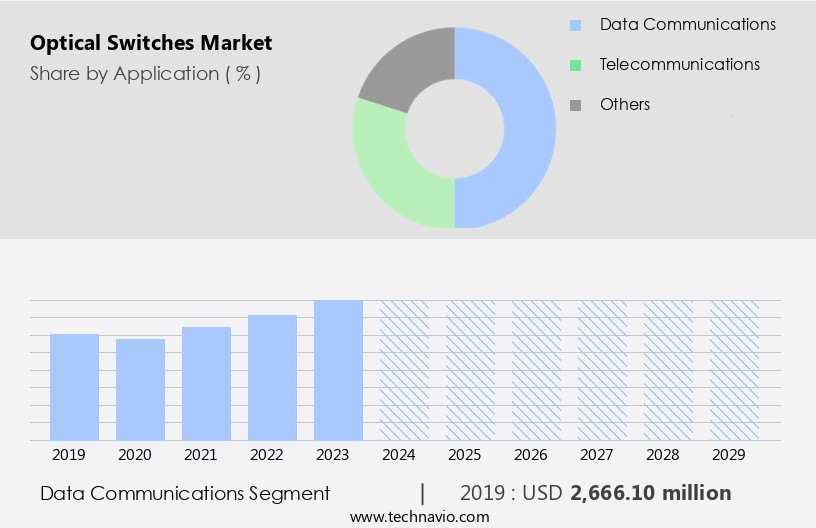
The Data communications segment was valued at USD 2.67 billion in 2019 and showed a gradual increase during the forecast period.
Regional Analysis
APAC is estimated to contribute 63% to the growth of the global market during the forecast period. Technavio's analysts have elaborately explained the regional trends and drivers that shape the market during the forecast period.

In the dynamic world of technology, the Optical Switch Market is witnessing significant advancements, driven by the escalating demand for high-speed data transmission and the digital transformation sweeping across various industries. This market is characterized by the integration of several entities: electrical data, energy consumption, external modulators, receivers, high bandwidth, light signals, mobile connectivity, service providers, high-speed networks, component testing, 5G Cloud, OXCs, product innovations, information interaction, data traffic, switching protection, high costs, optical switch network, wavelength routing, technical improvements, product innovation, restoration, optical switch, open optical networking, fiber optic, digital transformation, optical switch capacity, 5G, communication network, data packet routing, verticals, cloud computing, automation, AI, Nokia, budget constraints, virtual reality, OADM, fiber communication, optical communication, telecom network operators, telecommunications, optical fibers, transmitter, network monitors, fiber systems, optical signals, IOCs, data transmission paths, data transmission rates, Internet of Things, data processing, fiber management, data centers, supercomputers, and traffic.
Optical switches are essential components in high-speed networks, enabling efficient data transmission and interaction between various nodes. These switches utilize light signals instead of electrical signals, resulting in faster transmission rates and reduced energy consumption. The increasing adoption of 5G and the cloud, as well as the growing importance of automation, AI, and the Internet of Things, are propelling the market forward. Product innovations, such as restoration and open optical networking, are enhancing the capabilities of optical switches, making them indispensable in high-capacity communication networks. The telecom network operators and service providers are investing heavily in optical switch technology to cater to the burgeoning data traffic and the demands of verticals like cloud computing, financial services, and healthcare.
The integration of 5G and the 5G cloud is expected to further fuel the market's growth. However, the high costs associated with optical switch networks and the need for rigorous component testing remain challenges. Despite these hurdles, the market is poised for continued growth, driven by the relentless pursuit of faster data transmission and the digital transformation of industries.
Market Dynamics
Our researchers analyzed the data with 2024 as the base year, along with the key drivers, trends, and challenges. A holistic analysis of drivers will help companies refine their marketing strategies to gain a competitive advantage.
What are the Optical Switches market drivers leading to the rise in the adoption of Industry?
- The significant expansion of data center construction serves as the primary catalyst for market growth. Optical networking plays a pivotal role in storage area networking and business connectivity solutions. In response to the increasing demand for high bandwidth, low power consumption, and extended reach in data centers, there is a growing need for advanced optical modules. Traditional data centers have relied on available network resources and technologies. However, with the surge in data center investments, there is a pressing requirement for new-age optical solutions. Modern data centers transfer data at rates of 10 GB and above, making it increasingly challenging to maintain these rates using electrical interconnects based on copper wires.
- To address this challenge, data center operators are turning to fiber optic networks, which offer higher bandwidth and energy efficiency. The proliferation of cloud in data centers and applications is further driving the adoption of optical networking. As data traffic grows, data center operators need larger portfolios of fiber optic modules to connect servers and switches. External modulators, receiver technology, and high-speed networks are essential components of these optical solutions. Product innovations, such as Optical Cross-Connects (OXCs), enable efficient information interaction and management in high-density data center environments. Optical switches are an integral part of these solutions, enabling the efficient routing of light signals in fiber optic networks.
- Energy consumption is a critical consideration in data center design, and optical switches offer significant energy savings compared to electrical switches. Mobile connectivity and 5G cloud applications also benefit from the high bandwidth and low latency offered by optical networking. Component testing and quality assurance are essential to ensure the reliability and performance of these advanced optical solutions. As the market for optical networking continues to evolve, we can expect further innovations that will enable more efficient and cost-effective data transfer in data centers.
What are the Optical Switches market trends shaping the Industry?
- The emerging trend in the market involves the adoption and scaling of new age technologies, presenting significant business opportunities. These innovative technologies continue to shape industries and create new avenues for growth. Optical switches play a crucial role in modern communication networks, particularly as data traffic continues to increase significantly due to the proliferation of data-centric applications and emerging technologies. The market is driven by the growing demand for high-capacity networking solutions to manage this surge in data volume. Traditional fiber optic networks, which rely on digital packet routing, are being supplemented by open optical networking, which utilizes wavelength routing for more efficient and flexible data transmission. Optical switching protection and restoration are essential features that ensure network reliability and minimize downtime, making them indispensable in today's digital transformation era.
- High costs associated with optical switch networks have been a concern, but ongoing technical improvements and product innovation are addressing these challenges. The integration of optical switches in 5G communication networks is expected to further boost market growth. Additionally, the increasing adoption of sensor networks and the Internet of Things (IoT) will create new opportunities for optical switch technology. The success of these emerging technologies hinges on their ability to provide extensive services, making the optical switch market an essential component of the global communication infrastructure.
How does Optical Switches market faces challenges face during its growth?
- The deployment of optical fiber networks presents significant challenges that impact the industry's growth. These challenges must be addressed by professionals to ensure the successful implementation and expansion of these advanced communication systems. In the communications industry, optical switches hold significant importance for both telecom network operators and cloud computing service providers. The verticals of telecommunications and cloud computing are experiencing substantial growth, driven by automation, artificial intelligence (AI), and virtual reality applications. However, deploying optical communication systems, particularly in multi-dwelling units (MDUs), can face challenges. Engineering constraints, such as space limitations and the presence of multiple cable networks, can increase installation time and costs.
- Creating conduits, pulling fiber above ceilings, and making pathways within walls can cause bottlenecks, especially in brownfield MDUs. Obtaining necessary approvals from customers, residents, and government agencies further complicates the process. Despite these challenges, the demand for optical fibers and their associated components, including transmitters and network monitors, continues to rise. Nokia, among other key players, is investing in innovative solutions to address these deployment hurdles and cater to the increasing demand for fiber communication in various industries.
Exclusive Customer Landscape
The optical switches market forecasting report includes the adoption lifecycle of the market, covering from the innovator's stage to the laggard's stage. It focuses on adoption rates in different regions based on penetration. Furthermore, the optical switches market report also includes key purchase criteria and drivers of price sensitivity to help companies evaluate and develop their market growth analysis strategies.

Customer Landscape
Key Companies & Market Insights
Companies are implementing various strategies, such as strategic alliances, optical switches market forecast, partnerships, mergers and acquisitions, geographical expansion, and product/service launches, to enhance their presence in the industry.
Agilent Technologies Inc. - The company offers optical switching and routing protocol and a switching test system.
The industry research and growth report includes detailed analyses of the competitive landscape of the market and information about key companies, including:
- Agilent Technologies Inc.
- Agiltron Inc.
- Broadcom Inc.
- Cisco Systems Inc.
- D Link Corp.
- Fujitsu Ltd.
- Furukawa Electric Co. Ltd.
- HP Inc.
- Huawei Technologies Co. Ltd.
- Juniper Networks Inc.
- Keysight Technologies Inc.
- NEC Corp.
- Nokia Corp.
- NTT Advanced Technology Corp.
- ON Semiconductor Corp.
- Siemens AG
- Telefonaktiebolaget LM Ericsson
- Yokogawa Electric Corp.
- ZTE Corp.
Qualitative and quantitative analysis of companies has been conducted to help clients understand the wider business environment as well as the strengths and weaknesses of key industry players. Data is qualitatively analyzed to categorize companies as pure play, category-focused, industry-focused, and diversified; it is quantitatively analyzed to categorize companies as dominant, leading, strong, tentative, and weak.
Recent Development and News in Optical Switches Market
- In February 2023, Cisco Systems, a leading technology company, announced the launch of its new NCS 5500 Series Optical Line System, featuring advanced optical switching capabilities. This innovative solution is designed to support high-speed data transfer and improve network efficiency for service providers and data center operators (Cisco Press Release).
- In July 2024, Huawei, a global ICT solutions provider, entered into a strategic partnership with Corning Incorporated, a leading glass and specialty materials company. The collaboration aimed to accelerate the development and commercialization of optical interconnect solutions, including optical switches, to address the increasing demand for high-speed connectivity in data centers and telecommunications networks (Huawei Press Release).
- In October 2024, Lumentum Holdings Inc., a leading supplier of optical and photonic products, announced the completion of its acquisition of Oclaro Inc., a provider of optical communications components and modules. This strategic move expanded Lumentum's product portfolio and strengthened its position in the optical switching market, enabling the company to offer a broader range of solutions to its customers (Lumentum Press Release).
- In March 2025, the European Union approved the Horizon Europe research and innovation program, which includes a significant focus on advancing photonics technologies, including optical switches. This initiative is expected to boost R&D investments and drive technological advancements in the optical switching market, contributing to the development of more efficient, scalable, and cost-effective solutions (European Commission Press Release).
Research Analyst Overview
Optical switches, a crucial component in high-speed networks, continue to play a pivotal role in the digital transformation of various industries. These switches utilize optical signals to route data packets, enabling efficient information interaction and data traffic management in high bandwidth communication networks. Energy consumption is a significant concern in the optical switch market, with external modulators and receivers contributing to high power usage. Technical improvements in these components, such as the integration of digital signal processing and AI, aim to reduce energy consumption while maintaining high switching speeds and capacity. The advent of 5G and the cloud have fueled the demand for optical switches in mobile connectivity and data centers.
Service providers and telecom network operators are investing in high-speed networks to accommodate the increasing data traffic and ensure seamless communication. Component testing and optimization are essential to ensure the reliability and performance of optical switch networks. Open optical networking and OADM (Optical Add-Drop Multiplexers) are gaining popularity due to their flexibility and cost-effectiveness in managing data transmission paths and rates. Product innovations in the optical switch market include wavelength routing, which allows for efficient data packet routing and restoration in case of network failures. High-cost optical switches, such as those used in data centers and supercomputers, are undergoing price reductions due to advancements in semiconductor products and next-generation data center designs.
Optical fibers are the backbone of optical communication systems, and fiber systems are continuously evolving to meet the demands of high-speed networks. Telecommunications and the Internet of Things (IoT) are driving the growth of the optical switch market, with applications ranging from fiber management in data centers to automation in industrial processes. The optical switch market is dynamic, with ongoing technical improvements and product innovations shaping the landscape. Nokia, a leading player in the telecommunications industry, is investing in optical switch technology to enhance its 5G cloud offerings. Budget constraints and the need for scalability are driving the adoption of cost-effective solutions, such as OADM and open optical networking.
In the realm of virtual reality and AI, optical switches play a vital role in data processing and transmission rates. The integration of optical communication and electrical data in next-generation data centers is expected to revolutionize the way we process and manage information. In conclusion, the optical switch market is a vibrant and evolving landscape, shaped by the demands of high-speed networks, digital transformation, and the integration of AI and virtual reality. The ongoing technical improvements and product innovations ensure that optical switches continue to play a pivotal role in the efficient management of data traffic and the seamless interaction of information.
Dive into Technavio's robust research methodology, blending expert interviews, extensive data synthesis, and validated models for unparalleled Optical Switches Market insights. See full methodology.
|
Market Scope |
|
|
Report Coverage |
Details |
|
Page number |
228 |
|
Base year |
2024 |
|
Historic period |
2019-2023 |
|
Forecast period |
2025-2029 |
|
Growth momentum & CAGR |
Accelerate at a CAGR of 14.7% |
|
Market growth 2025-2029 |
USD 8.35 billion |
|
Market structure |
Fragmented |
|
YoY growth 2024-2025(%) |
12.6 |
|
Key countries |
US, China, Japan, India, South Korea, Germany, UK, France, Canada, and Italy |
|
Competitive landscape |
Leading Companies, Market Positioning of Companies, Competitive Strategies, and Industry Risks |
What are the Key Data Covered in this Optical Switches Market Research and Growth Report?
- CAGR of the Optical Switches industry during the forecast period
- Detailed information on factors that will drive the growth and forecasting between 2025 and 2029
- Precise estimation of the size of the market and its contribution of the industry in focus to the parent market
- Accurate predictions about upcoming growth and trends and changes in consumer behaviour
- Growth of the market across APAC, North America, Europe, Middle East and Africa, and South America
- Thorough analysis of the market's competitive landscape and detailed information about companies
- Comprehensive analysis of factors that will challenge the optical switches market growth and forecasting
We can help! Our analysts can customize this optical switches market research report to meet your requirements.