

Osat Market Size 2026-2030
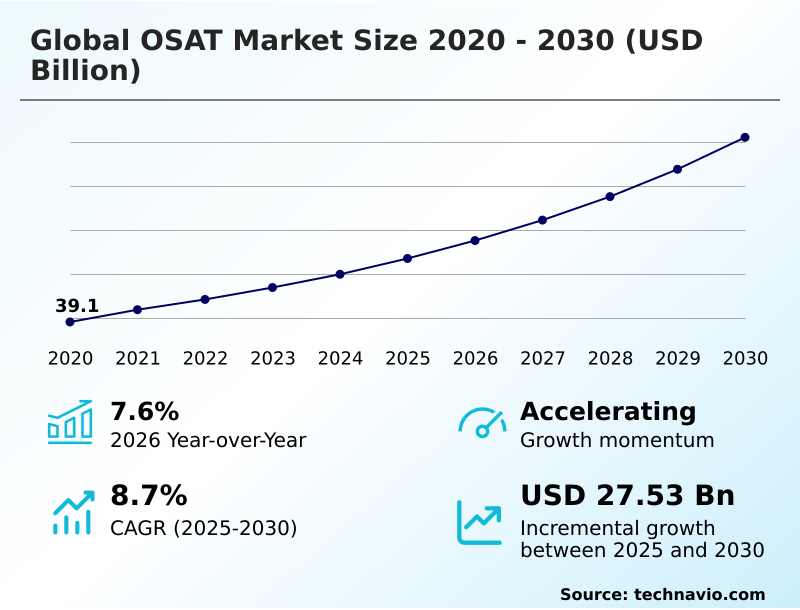
The osat market size is valued to increase by USD 27.53 billion, at a CAGR of 8.7% from 2025 to 2030. Proliferation of high-performance computing, AI, and advanced communication will drive the osat market.
Major Market Trends & Insights
- APAC dominated the market and accounted for a 64.1% growth during the forecast period.
- By Service - Assembly and packaging segment was valued at USD 32.81 billion in 2024
- By End-user - Telecommunication segment accounted for the largest market revenue share in 2024
Market Size & Forecast
- Market Opportunities: USD 41.97 billion
- Market Future Opportunities: USD 27.53 billion
- CAGR from 2025 to 2030 : 8.7%
Market Summary
- The OSAT market functions as the critical intermediary in the semiconductor value chain, transforming fabricated silicon wafers into fully functional, tested, and protected integrated circuits ready for electronic deployment. Operations involve complex physical integration techniques, stringent electrical testing, and precise thermal management engineering.
- As a primary growth driver, the escalating demand for artificial intelligence processors and high-frequency 5G telecommunication infrastructure requires advanced packaging solutions, such as 3D stacking, to achieve necessary performance metrics within constrained physical footprints. Implementing these heterogeneous integration strategies allows chip designers to realize a 25% improvement in processing latency compared to traditional monolithic architectures.
- However, the market faces significant structural challenges stemming from supply chain fragility and geographical concentration. Sudden disruptions in the availability of essential raw materials, like specialized molding compounds or advanced substrates, can immediately halt production lines.
- To mitigate these risks, major electronics manufacturers are pursuing localized ecosystem development, a strategy that enhances supply reliability but has concurrently increased facility setup timelines by up to 40% in emerging operational hubs.
What will be the Size of the Osat Market during the forecast period?
Get Key Insights on Market Forecast (PDF) Get Free Sample
How is the Osat Market Segmented?
The osat industry research report provides comprehensive data (region-wise segment analysis), with forecasts and estimates in "USD million" for the period 2026-2030, as well as historical data from 2020-2024 for the following segments.
- Service
- Assembly and packaging
- Testing
- End-user
- Telecommunication
- Consumer electronics
- Industrial electronics
- Automotive
- Others
- Technology
- Advanced nodes
- Mature nodes
- Geography
- APAC
- China
- South Korea
- Japan
- India
- Indonesia
- Australia
- North America
- US
- Canada
- Mexico
- Europe
- Germany
- UK
- France
- Italy
- The Netherlands
- Spain
- South America
- Brazil
- Argentina
- Chile
- Middle East and Africa
- Saudi Arabia
- UAE
- South Africa
- Israel
- Turkey
- APAC
By Service Insights
The assembly and packaging segment is estimated to witness significant growth during the forecast period.
The OSAT market splits operations between assembly and packaging and testing, each requiring specialized capabilities to handle advanced process node scaling constraints.
Assembly and packaging focus on physical techniques like wafer dicing and wire bonding, which collectively enhance integration within a miniaturized package. Testing procedures, including parametric testing and burn in testing, are critical for confirming signal integrity and ensuring reliability validation.
This dual focus directly impacts manufacturing viability; advanced integration techniques have been shown to elevate yield improvement by 14%. Sequences handle the encapsulation of the die using a specialized molding compound.
By isolating process qualification stages, an integrated device manufacturer achieves an 18% boost in production efficiency.
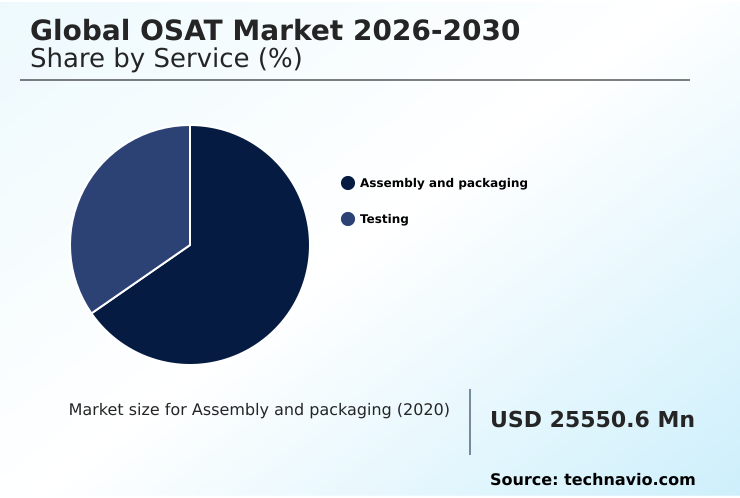
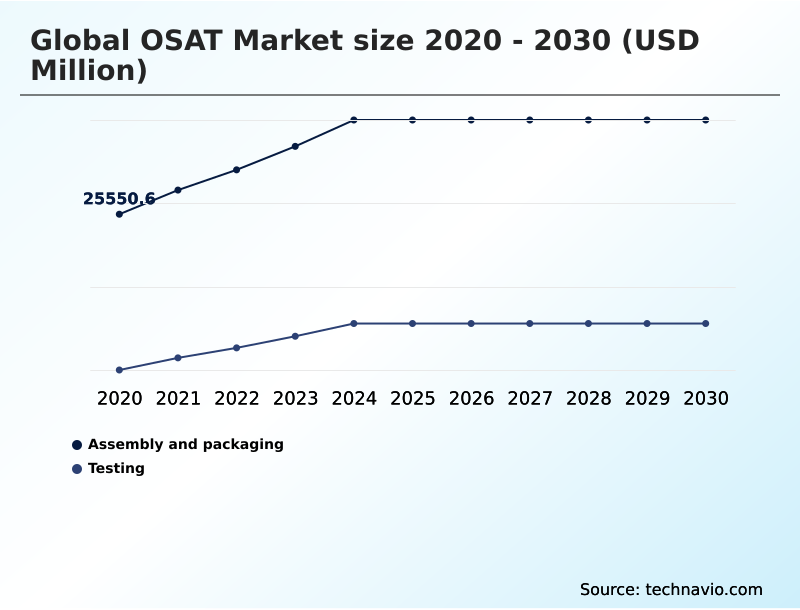
The Assembly and packaging segment was valued at USD 32.81 billion in 2024 and showed a gradual increase during the forecast period.
Regional Analysis
APAC is estimated to contribute 64.1% to the growth of the global market during the forecast period.Technavio’s analysts have elaborately explained the regional trends and drivers that shape the market during the forecast period.
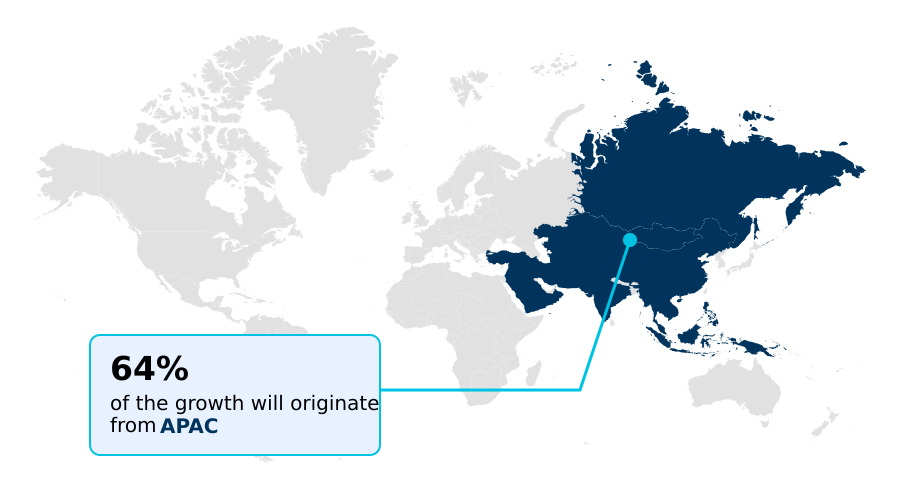
See How Osat Market Demand is Rising in APAC Get Free Sample
The Asia-Pacific region dominates the outsourced semiconductor landscape, supported by a dense manufacturing ecosystem and unparalleled foundry collaboration networks. APAC facilities handle the majority of global output, offering highly efficient wafer level packaging and advanced defect inspection at scale.
In contrast, North America is aggressively pursuing regional independence, aiming to reduce dependence on Asian supply vulnerabilities. North American efforts have increased domestic advanced packaging footprints by 20%, though still lagging behind APAC's established infrastructure.
European markets focus heavily on automotive compliance, integrating precise turnaround time metrics to offset higher labor costs. Leveraging established cleanroom infrastructure, APAC operators achieve a 35% faster processing cycle compared to emerging Western facilities.
This discrepancy compels global fabless design house entities to optimize production routing based on specific flip chip assembly capabilities.
Market Dynamics
Our researchers analyzed the data with 2025 as the base year, along with the key drivers, trends, and challenges. A holistic analysis of drivers will help companies refine their marketing strategies to gain a competitive advantage.
- The continuous evolution of semiconductor manufacturing necessitates sophisticated back-end processes to ensure component viability and performance. Within the modern production landscape, the shift toward miniaturization has elevated the importance of advanced system in package integration, allowing manufacturers to condense multiple functionalities into a single, power-efficient unit.
- This architectural density directly influences operational planning, as facilities must implement highly precise flip chip assembly defect inspection protocols to identify microscopic alignment errors before final encapsulation. The deployment of automated optical inspection at this stage has demonstrated a 22% improvement in identifying critical interconnect flaws compared to legacy manual sampling methods.
- Furthermore, the rise of artificial intelligence workloads introduces extreme heat generation within dense processing units. To counter this, facilities are heavily prioritizing high bandwidth memory thermal management, utilizing specialized heat spreaders and advanced interface materials to maintain optimal operating temperatures and prevent throttling.
- Ensuring the durability of these modular designs requires rigorous chiplet architecture reliability validation, which subjects multi-die configurations to intense environmental and electrical stress simulations. By integrating these comprehensive validation steps early in the production cycle, operators reduce post-deployment failure rates by up to 18%.
- Additionally, the implementation of fan out wafer level testing enables simultaneous electrical validation of thousands of dies directly on the reconstituted wafer, significantly accelerating throughput. This streamlined approach minimizes handling damage and enhances overall manufacturing yield, reinforcing the critical necessity of specialized testing and packaging partnerships in scaling advanced electronics.
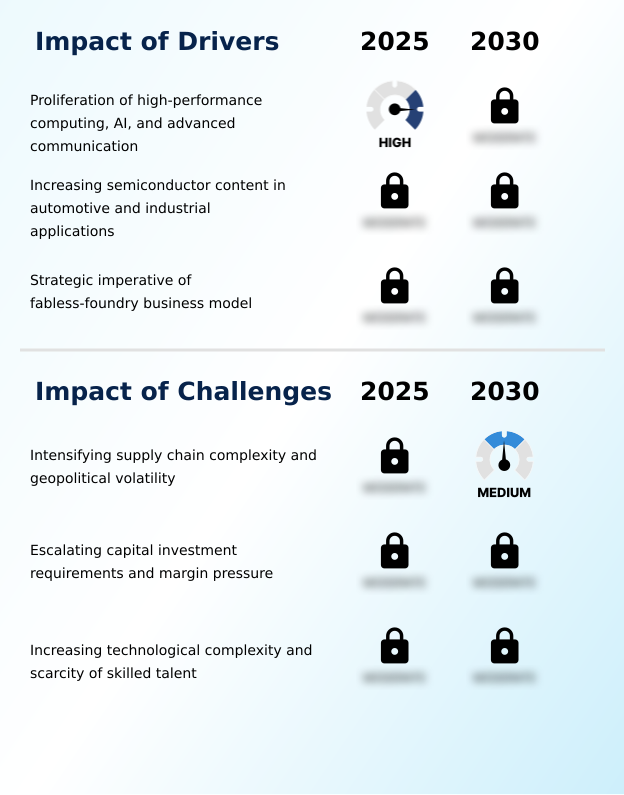
What are the key market drivers leading to the rise in the adoption of Osat Industry?
- The continuous proliferation of high-performance computing, artificial intelligence, and advanced communication infrastructure serves as the primary driver for market expansion.
- The rapid proliferation of data-intensive workloads and high-frequency communication protocols serves as a primary catalyst for outsourced assembly adoption. The deployment of 5G infrastructure necessitates the integration of complex radio frequency module components and antenna in package configurations.
- By utilizing advanced system in package formats, suppliers address stringent requirements for both power efficiency and spatial constraints during component integration. This capability enhancement allows operators to realize a 25% operational cost reduction through streamlined volume manufacturing processes.
- The surge in edge computing increases the demand for high bandwidth memory, compelling vendors to invest heavily in automation equipment. Integrating specialized solutions stabilizes the power delivery network, driving a 30% increase in data transfer speeds.
What are the market trends shaping the Osat Industry?
- The ascendancy of heterogeneous integration and chiplet-based architectures constitutes a pivotal market trend.
- The ongoing transition toward chiplet architecture and heterogeneous integration is redefining semiconductor workflows as monolithic die scaling reaches physical limits. Facilities are increasingly deploying silicon interposer structures and die stacking techniques to construct complex multi-die configurations. This architectural shift fundamentally alters collaboration dynamics, requiring co-design strategies that embed packaging standard compliance early.
- Implementing these modular designs has enabled facilities to achieve a 22% latency reduction while lowering overall defect rates. The adoption of fan out packaging mitigates heat density issues inherent in closely packed dies, ensuring optimal parallel processing. Partners leverage these capabilities to enhance thermal management, resulting in a 19% improvement in thermal dissipation efficiency.
What challenges does the Osat Industry face during its growth?
- Intensifying supply chain complexity and escalating geopolitical volatility present critical challenges to sustained industry growth.
- Intensifying geopolitical volatility and reliance on specialized material sourcing pipelines introduce critical constraints on global production stability. The concentration of advanced substrate production and essential chemical supplies creates a fragile logistics pathway vulnerable to sudden material shortage disruptions. Maintaining supply chain resilience requires significant ecosystem localization efforts, demanding elevated capital expenditure from major industry participants.
- Replicating established networks in new territories has led to a 40% increase in facility setup timelines, complicating capacity expansion initiatives. The scarcity of specialized engineering talent capable of overseeing complex bumping technology on the semiconductor die further bottlenecks throughput. Transitioning to localized sourcing improves stability but decreases procurement efficiency by 15%, straining operational margins.
Exclusive Technavio Analysis on Customer Landscape
The osat market forecasting report includes the adoption lifecycle of the market, covering from the innovator’s stage to the laggard’s stage. It focuses on adoption rates in different regions based on penetration. Furthermore, the osat market report also includes key purchase criteria and drivers of price sensitivity to help companies evaluate and develop their market growth analysis strategies.
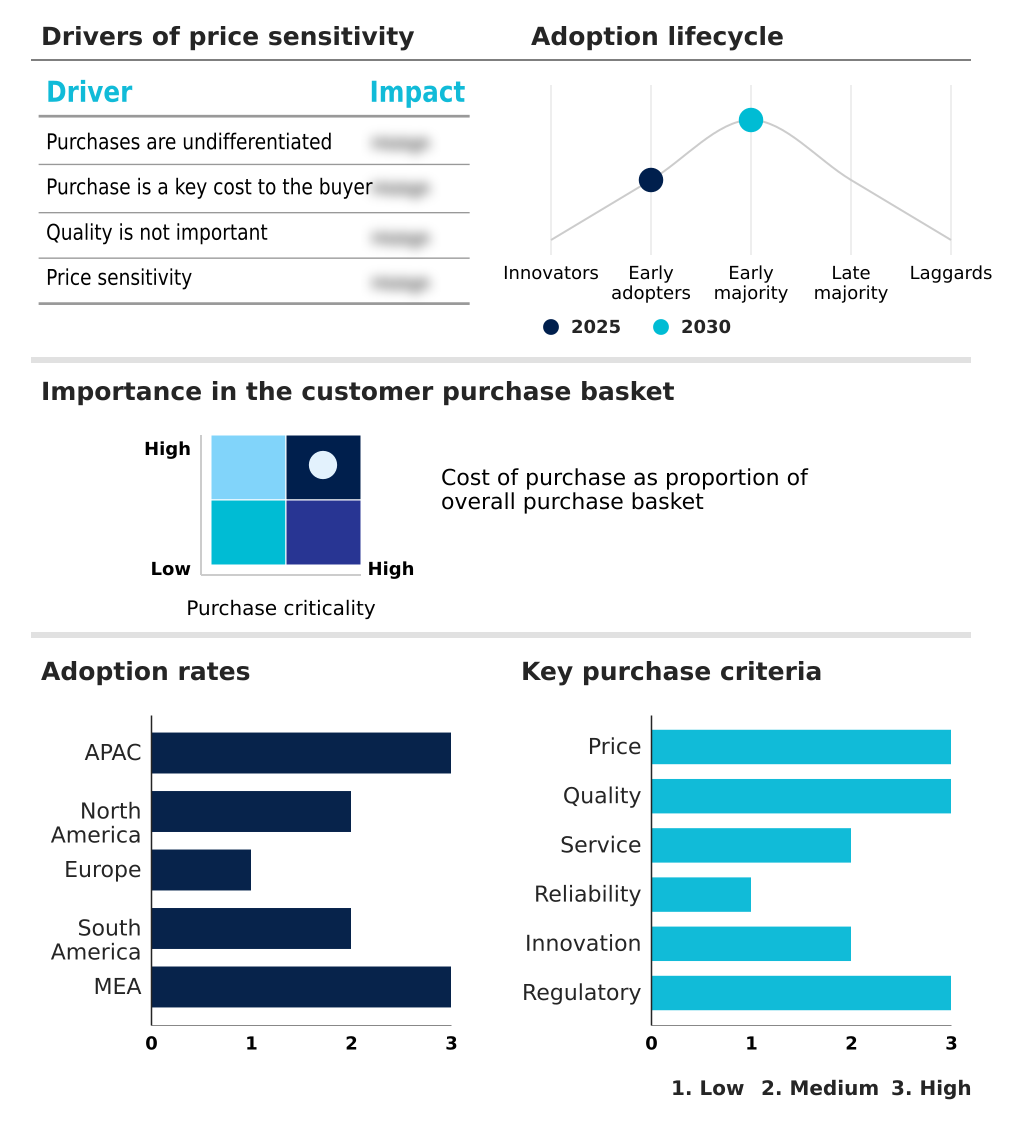
Customer Landscape of Osat Industry
Competitive Landscape
Companies are implementing various strategies, such as strategic alliances, osat market forecast, partnerships, mergers and acquisitions, geographical expansion, and product/service launches, to enhance their presence in the industry.
Amkor Technology Inc. - Advanced semiconductor assembly services provide critical wafer-level packaging, flip-chip configurations, and comprehensive system-in-package solutions, enabling seamless component integration and accelerated testing for high-performance processing applications.
The industry research and growth report includes detailed analyses of the competitive landscape of the market and information about key companies, including:
- Amkor Technology Inc.
- ASE Technology Holding Co. Ltd.
- Carsem Inc.
- Chipbond Technology Corp.
- ChipMOS TECHNOLOGIES Inc.
- Greatek Electronics Inc.
- HANA Micron Co. Ltd.
- Jiangsu Changdian Tech Co.
- King Yuan Electronics Co. Ltd.
- Lingsen Precision Industries Ltd.
- Nepes Corp.
- Orient Semiconductor Electronics
- Powertech Technology Inc.
- SFA Semicon Co. Ltd.
- Sigurd Microelectronics Corp.
- STATS ChipPAC Pte. Ltd.
- Tianshui Huatian Technology
- Tongfu Microelectronics Co.
- Unisem M Berhad
- UTAC Holdings Ltd.
Qualitative and quantitative analysis of companies has been conducted to help clients understand the wider business environment as well as the strengths and weaknesses of key industry players. Data is qualitatively analyzed to categorize companies as pure play, category-focused, industry-focused, and diversified; it is quantitatively analyzed to categorize companies as dominant, leading, strong, tentative, and weak.
Recent Development and News in Osat market
- In the Semiconductor Materials and Equipment industry, the transition to extreme ultraviolet lithography enabled advanced process node fabrication, directly impacting the OSAT market by accelerating component integration efforts to bypass monolithic die scaling limits and manage 30% higher thermal output.
- The enforcement of localized semiconductor manufacturing incentives redirected capital expenditure toward domestic fabrication plants, directly impacting the OSAT market by necessitating parallel 15% capacity expansions in regional assembly operations to support supply chain resilience.
- The standardization of Universal Chiplet Interconnect Express protocols synchronized multi-die integration techniques, directly impacting the OSAT market by streamlining process qualification requirements and reducing interconnect defect rates by 22% during volume manufacturing.
- The integration of AI-driven optical inspection tools within automated wafer processing lines enhanced early defect detection, directly impacting the OSAT market by improving production efficiency and reducing post-assembly turnaround time by 18% across established facilities.
Dive into Technavio’s robust research methodology, blending expert interviews, extensive data synthesis, and validated models for unparalleled Osat Market insights. See full methodology.
| Market Scope | |
|---|---|
| Page number | 290 |
| Base year | 2025 |
| Historic period | 2020-2024 |
| Forecast period | 2026-2030 |
| Growth momentum & CAGR | Accelerate at a CAGR of 8.7% |
| Market growth 2026-2030 | USD 27532.7 million |
| Market structure | Fragmented |
| YoY growth 2025-2026(%) | 7.6% |
| Key countries | China, South Korea, Japan, India, Indonesia, Australia, US, Canada, Mexico, Germany, UK, France, Italy, The Netherlands, Spain, Brazil, Argentina, Chile, Saudi Arabia, UAE, South Africa, Israel and Turkey |
| Competitive landscape | Leading Companies, Market Positioning of Companies, Competitive Strategies, and Industry Risks |
Research Analyst Overview
- The OSAT market is undergoing a profound structural evolution as product strategy decisions increasingly rely on advanced packaging capabilities to bypass the physical limitations of traditional semiconductor scaling. Boardroom executives are shifting budgeting priorities away from monolithic silicon development, instead directing capital toward heterogeneous integration and sophisticated die stacking architectures.
- This transition demands absolute precision in back-end manufacturing, elevating the strategic importance of processes like wafer dicing and legacy wire bonding to ensure foundational component stability. The deployment of a high-density silicon interposer allows for seamless communication between specialized chiplets, fundamentally altering product performance roadmaps.
- Consequently, facilities that have upgraded their wafer level packaging lines demonstrate a 28% improvement in interconnect density compared to standard substrate configurations. Ensuring the functionality of these complex assemblies requires rigorous parametric testing to validate optimal signal integrity before final deployment.
- By aligning manufacturing partnerships with these advanced testing and packaging capabilities, technology firms can significantly reduce time-to-market while achieving compliance with stringent consumer electronics and automotive performance standards.
What are the Key Data Covered in this Osat Market Research and Growth Report?
-
What is the expected growth of the Osat Market between 2026 and 2030?
-
USD 27.53 billion, at a CAGR of 8.7%
-
-
What segmentation does the market report cover?
-
The report is segmented by Service (Assembly and packaging, and Testing), End-user (Telecommunication, Consumer electronics, Industrial electronics, Automotive, and Others), Technology (Advanced nodes, and Mature nodes) and Geography (APAC, North America, Europe, South America, Middle East and Africa)
-
-
Which regions are analyzed in the report?
-
APAC, North America, Europe, South America and Middle East and Africa
-
-
What are the key growth drivers and market challenges?
-
Proliferation of high-performance computing, AI, and advanced communication, Intensifying supply chain complexity and geopolitical volatility
-
-
Who are the major players in the Osat Market?
-
Amkor Technology Inc., ASE Technology Holding Co. Ltd., Carsem Inc., Chipbond Technology Corp., ChipMOS TECHNOLOGIES Inc., Greatek Electronics Inc., HANA Micron Co. Ltd., Jiangsu Changdian Tech Co., King Yuan Electronics Co. Ltd., Lingsen Precision Industries Ltd., Nepes Corp., Orient Semiconductor Electronics, Powertech Technology Inc., SFA Semicon Co. Ltd., Sigurd Microelectronics Corp., STATS ChipPAC Pte. Ltd., Tianshui Huatian Technology, Tongfu Microelectronics Co., Unisem M Berhad and UTAC Holdings Ltd.
-
Market Research Insights
- The OSAT market relies heavily on optimized production efficiency and advanced automation equipment to meet the escalating volume demands of modern electronics. By refining process qualification workflows, an integrated device manufacturer can significantly reduce setup times, ultimately achieving a 15% reduction in overall processing bottlenecks.
- Furthermore, the strategic deployment of automated testing platforms and machine learning-driven defect analysis has accelerated turnaround time metrics by up to 20% across high-density packaging lines. Implementing strict packaging standard protocols across the supply chain ensures consistent quality while mitigating the operational risks associated with yield loss.
- These structural improvements directly support higher product reliability, enabling semiconductor companies to meet stringent compliance requirements while maintaining stable operational cost frameworks.
We can help! Our analysts can customize this osat market research report to meet your requirements.
 RIA -