



US Outdoor Furniture Market Size 2026-2030
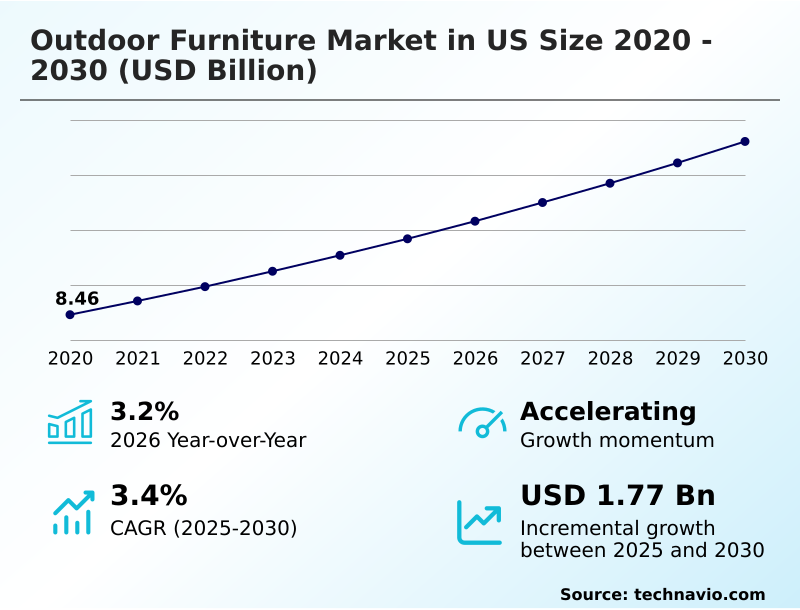
The us outdoor furniture market size is valued to increase by USD 1.77 billion, at a CAGR of 3.4% from 2025 to 2030. Increasing demand for patio-heating products will drive the us outdoor furniture market.
Major Market Trends & Insights
- By Distribution Channel - Offline segment was valued at USD 7.40 billion in 2024
- By End-user - Residential segment accounted for the largest market revenue share in 2024
Market Size & Forecast
- Market Opportunities: USD 3.15 billion
- Market Future Opportunities: USD 1.77 billion
- CAGR from 2025 to 2030 : 3.4%
Market Summary
- The outdoor furniture market in US is shaped by the enduring consumer desire to transform exterior areas into functional and aesthetically pleasing extensions of their living spaces. This evolution is driven by robust residential and commercial construction and a continuous push for product innovation that blends durability with high-end design.
- Key trends influencing purchasing decisions include the rising demand for sustainable and multifunctional products, such as modular seating made from recycled materials or tables with integrated storage. These preferences reflect a broader lifestyle shift toward versatile and eco-conscious living.
- For instance, a hospitality business might select weather-resistant, lightweight aluminum furniture that can be easily reconfigured for different events, thereby maximizing space utility and improving operational efficiency. However, the market's expansion is tempered by challenges like the long replacement cycle of durable goods and the volatility of raw material prices, which can compress manufacturer margins and impact pricing stability.
What will be the Size of the US Outdoor Furniture Market during the forecast period?
Get Key Insights on Market Forecast (PDF) Get Free Sample
How is the US Outdoor Furniture Market Segmented?
The us outdoor furniture industry research report provides comprehensive data (region-wise segment analysis), with forecasts and estimates in "USD million" for the period 2026-2030, as well as historical data from 2020-2024 for the following segments.
- Distribution channel
- Offline
- Online
- End-user
- Residential
- Commercial
- Material
- Wood
- Plastic
- Fabric
- Metal
- Others
- Product type
- Seating
- Tables
- Accessories
- Storage
- Others
- Price
- Economy
- Mid-range
- Premium
- Geography
- North America
- US
- North America
By Distribution Channel Insights
The offline segment is estimated to witness significant growth during the forecast period.
The offline segment maintains a significant market position, as discerning buyers prioritize direct physical evaluation for high-value outdoor furniture.
The ability to assess weather-resistant fabrics, high-performance composites, and UV-resistant coatings firsthand remains a critical part of the consumer purchasing behavior, particularly for premium collections.
This tactile experience is essential for judging comfort, material quality, and design accuracy—factors not fully conveyed through digital channels.
Experiential retail concepts are amplifying this advantage, with showrooms creating immersive environments that have been shown to boost engagement by over 30%.
This approach reinforces brand value and solidifies the channel's role in influencing high-consideration purchases, where product design innovation and superior weather-resistant material science are key differentiators.
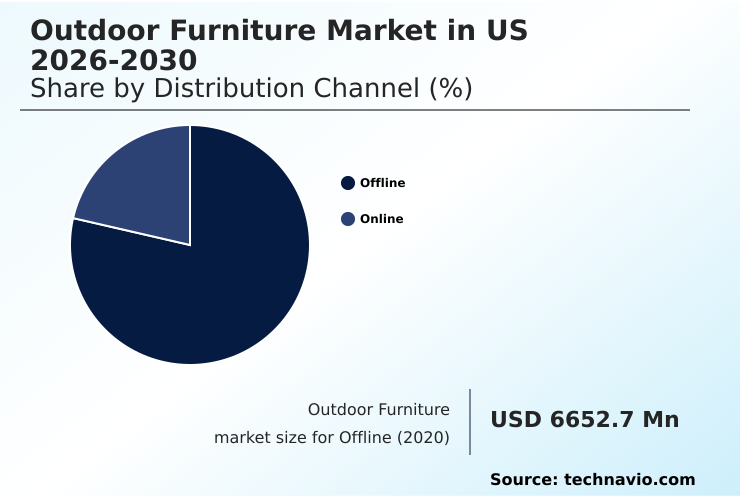
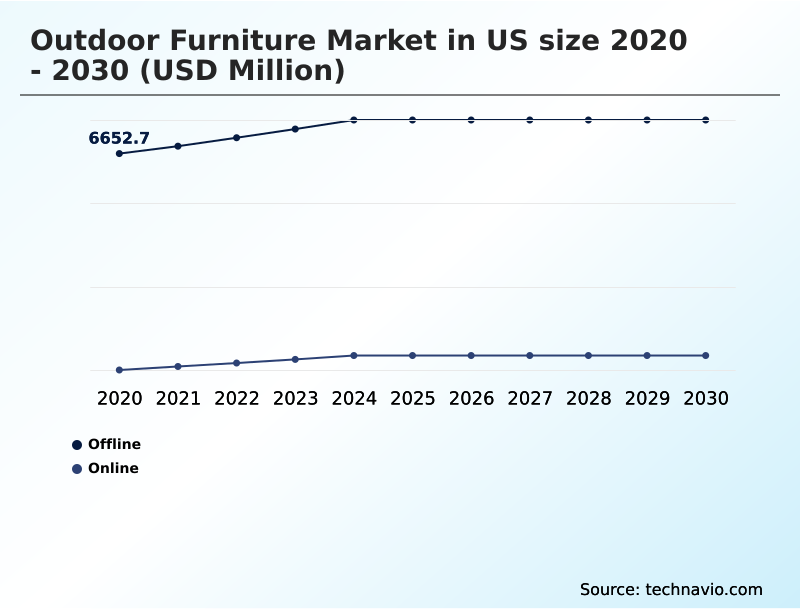
The Offline segment was valued at USD 7.40 billion in 2024 and showed a gradual increase during the forecast period.
Market Dynamics
Our researchers analyzed the data with 2025 as the base year, along with the key drivers, trends, and challenges. A holistic analysis of drivers will help companies refine their marketing strategies to gain a competitive advantage.
- Strategic decision-making in the market requires a deep understanding of evolving consumer needs and operational challenges. The benefits of modular outdoor furniture systems are increasingly evident, especially for designing space-efficient urban outdoor solutions.
- This trend is complemented by material science advancements, where the weather resistance of powder-coated aluminum is a key selling point, and the industry is actively exploring sustainable alternatives to teak outdoor furniture. Innovations in smart outdoor furniture technology are creating new avenues for growth, while multifunctional furniture for small urban patios addresses the demands of compact living.
- Durability remains a cornerstone, highlighting the durability of high-density polyethylene lumber and the impact of UV-resistant fabrics on longevity. Operationally, navigating the challenges of raw material price fluctuations necessitates improving supply chain in furniture manufacturing; agile firms have demonstrated the ability to react to cost spikes over 20% faster than their peers.
- This agility supports the growth of online direct-to-consumer sales and diverse omnichannel strategies for furniture retailers. As such, effectively managing the product lifecycle and developing strategies for managing long replacement cycles are crucial, especially for commercial applications for hospitality-grade furniture.
- Ultimately, aligning these efforts with customer preferences for premium outdoor living, including providing guidance on maintaining metal and wood outdoor furniture, is essential for sustained success.
What are the key market drivers leading to the rise in the adoption of US Outdoor Furniture Industry?
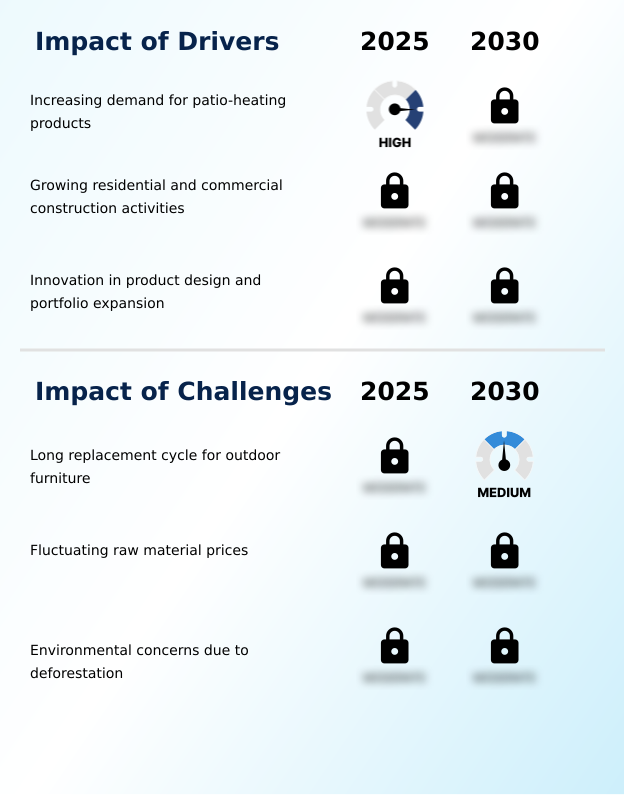
- The increasing demand for patio-heating products is a key market driver, extending the usability of outdoor spaces and encouraging investment in complementary furniture.
- Market growth is significantly fueled by material innovation and strategic market positioning. The development of corrosion-resistant frames, particularly those using lightweight aluminum frames, has enhanced product longevity and appeal.
- A strong brand differentiation strategy is increasingly tied to sustainable material sourcing, with eco-friendly product lines utilizing materials like high-density polyethylene and solution-dyed acrylics.
- This focus on sustainability is proving effective in the premium market segmentation, where discerning buyers seek quality and environmental responsibility. Innovations such as smart outdoor furniture with weather-adaptive features and integrated shade solutions are creating new value propositions.
- Concurrently, manufacturers are mitigating the impact of raw material cost management challenges through enhanced supply chain efficiency, achieving cost stabilization that supports competitive pricing.
- Firms adopting these integrated strategies have reported up to a 15% improvement in margin protection during periods of price volatility.
What are the market trends shaping the US Outdoor Furniture Industry?
- A significant upcoming trend is the increasing demand for environment-friendly outdoor furniture. This shift is driven by growing consumer and commercial prioritization of sustainability and responsible sourcing.
- Key market trends are centered on sustainability and hyper-functionality, reshaping product development and retail strategies. The demand for sustainable outdoor materials, including recycled plastic lumber and ethically sourced synthetic wicker, is driving a portfolio expansion strategy among manufacturers.
- This is coupled with the rising popularity of modular furniture systems and multifunctional outdoor tables, which offer the space-efficient designs required for modern urban outdoor solutions. In retail, omnichannel retail models are becoming standard, with direct-to-consumer sales leveraging digital visualization tools. These platforms, particularly those with augmented reality shopping features, have proven to increase user engagement by over 25%.
- Such innovations in foldable furniture mechanisms and versatile designs cater to a consumer base that prioritizes both environmental responsibility and practical adaptability in their outdoor living spaces.
What challenges does the US Outdoor Furniture Industry face during its growth?
- A key challenge affecting industry growth is the long replacement cycle for outdoor furniture, which limits repeat purchase frequency and slows revenue expansion.
- Primary market challenges stem from inherent product longevity and operational complexities. The industry grapples with long replacement cycle mitigation, as the durability of outdoor furniture limits repeat purchases, making product lifecycle management a critical strategic focus. This issue is pronounced for commercial hospitality furniture, designed for intensive use. Furthermore, seasonal demand planning adds complexity to inventory and production.
- On the operational side, manufacturers of residential patio setups and luxury outdoor furnishings must implement eco-friendly production methods while managing costs. The push toward a circular economy in furniture necessitates robust sustainable sourcing practices, which can be difficult to scale.
- Firms are developing modular seating configurations with low-maintenance finishes to appeal to buyers seeking both convenience and longevity, addressing the need for practical solutions in compact patio furniture and public space furniture.
Exclusive Technavio Analysis on Customer Landscape
The us outdoor furniture market forecasting report includes the adoption lifecycle of the market, covering from the innovator’s stage to the laggard’s stage. It focuses on adoption rates in different regions based on penetration. Furthermore, the us outdoor furniture market report also includes key purchase criteria and drivers of price sensitivity to help companies evaluate and develop their market growth analysis strategies.
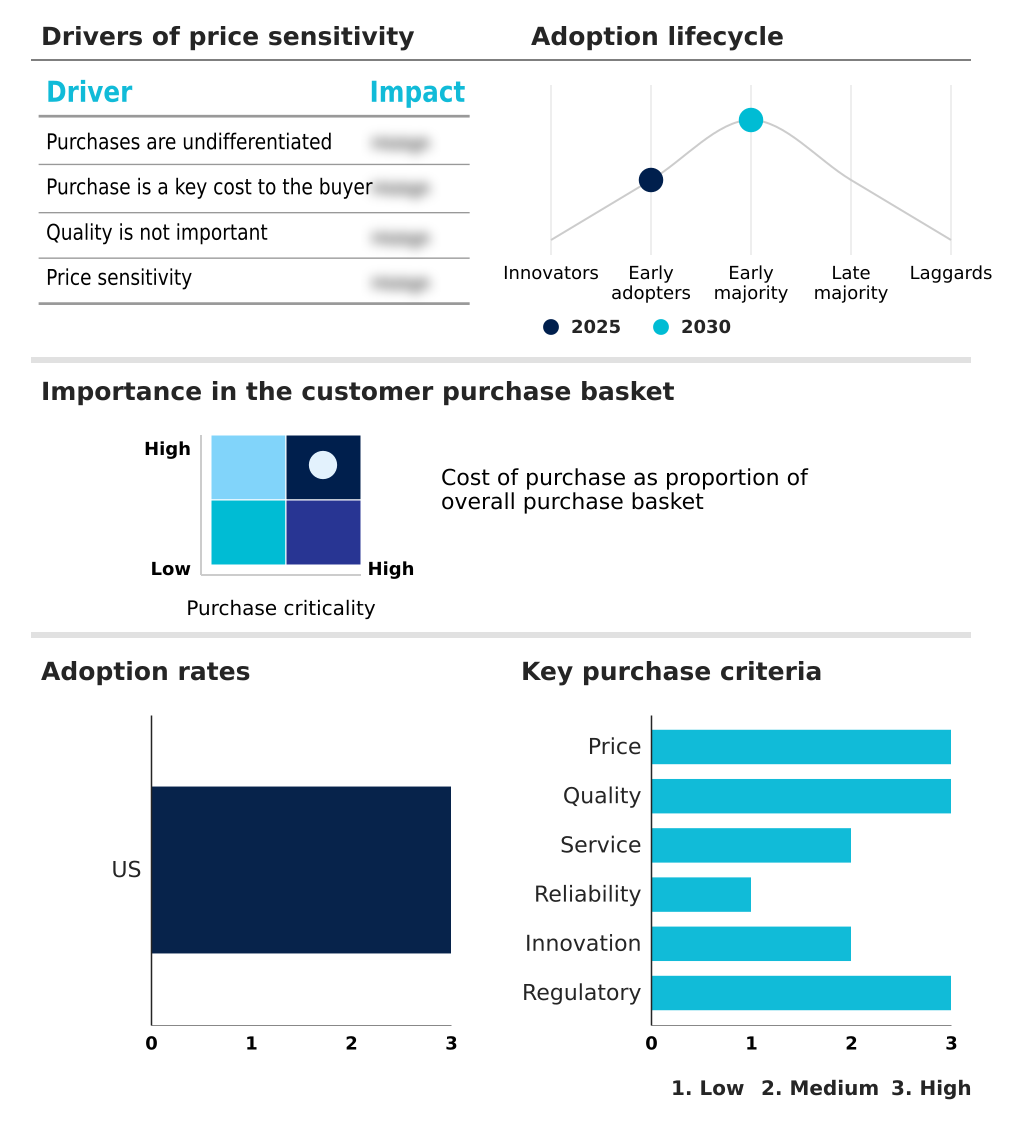
Customer Landscape of US Outdoor Furniture Industry
Competitive Landscape
Companies are implementing various strategies, such as strategic alliances, us outdoor furniture market forecast, partnerships, mergers and acquisitions, geographical expansion, and product/service launches, to enhance their presence in the industry.
Amazon.com Inc. - Key offerings include comprehensive outdoor furniture collections, featuring coordinated patio sets, sectionals, and dining solutions designed for residential use.
The industry research and growth report includes detailed analyses of the competitive landscape of the market and information about key companies, including:
- Amazon.com Inc.
- Ashley Furniture Industries
- B and B Italia SPA
- Brown Jordan Co.
- DEDON GmbH
- Fermob
- Gloster Furniture GmbH
- Inter IKEA Holding BV
- Janus et Cie
- Keter Group
- Kettal Group
- Lowes Co. Inc.
- Poly Wood LLC
- Restoration Hardware Inc.
- Target Corp.
- The Home Depot Inc.
- Tuuci LLC
- Vondom SL
- Walmart Inc.
- Wayfair Inc.
Qualitative and quantitative analysis of companies has been conducted to help clients understand the wider business environment as well as the strengths and weaknesses of key industry players. Data is qualitatively analyzed to categorize companies as pure play, category-focused, industry-focused, and diversified; it is quantitatively analyzed to categorize companies as dominant, leading, strong, tentative, and weak.
Recent Development and News in Us outdoor furniture market
- In September, 2024, Poly-Wood LLC launched its 'Marine' collection, a new line of outdoor furniture made from 100% recycled ocean-bound plastic, targeting eco-conscious consumers.
- In November, 2024, Brown Jordan Co. announced a strategic partnership with a leading smart home technology firm to integrate weather-adaptive sensors and automated lighting into its 2025 premium outdoor collections.
- In February, 2025, Kettal Group completed the expansion of its North American manufacturing facility, increasing its production capacity for aluminum-framed outdoor furniture by 40% to meet growing regional demand.
- In April, 2025, The Home Depot Inc. acquired a specialized e-commerce platform for custom outdoor furniture, aiming to enhance its online direct-to-consumer capabilities and personalized product offerings.
Dive into Technavio’s robust research methodology, blending expert interviews, extensive data synthesis, and validated models for unparalleled US Outdoor Furniture Market insights. See full methodology.
| Market Scope | |
|---|---|
| Page number | 227 |
| Base year | 2025 |
| Historic period | 2020-2024 |
| Forecast period | 2026-2030 |
| Growth momentum & CAGR | Accelerate at a CAGR of 3.4% |
| Market growth 2026-2030 | USD 1767.3 million |
| Market structure | Fragmented |
| YoY growth 2025-2026(%) | 3.2% |
| Key countries | US |
| Competitive landscape | Leading Companies, Market Positioning of Companies, Competitive Strategies, and Industry Risks |
Research Analyst Overview
- The market's evolution centers on creating highly functional and durable outdoor environments. This involves a sophisticated interplay of materials, from weather-resistant fabrics and all-weather upholstery on ergonomic outdoor seating to the structural integrity of treated hardwood and powder-coated aluminum.
- The growing adoption of recycled plastic lumber and advanced polymer materials underscores a shift toward sustainable sourcing practices and a circular economy in furniture, with companies implementing eco-friendly production methods reporting a 10% improvement in brand perception scores.
- For boardroom strategy, the focus is on balancing aesthetics with performance, offering modular furniture systems for both residential patio setups and demanding commercial hospitality furniture. Innovation is apparent in smart outdoor furniture with weather-adaptive features and integrated shade solutions.
- The durability offered by corrosion-resistant frames and low-maintenance finishes presents a strategic challenge to traditional business models, pushing for new approaches to value creation.
What are the Key Data Covered in this US Outdoor Furniture Market Research and Growth Report?
-
What is the expected growth of the US Outdoor Furniture Market between 2026 and 2030?
-
USD 1.77 billion, at a CAGR of 3.4%
-
-
What segmentation does the market report cover?
-
The report is segmented by Distribution Channel (Offline, and Online), End-user (Residential, and Commercial), Material (Wood, Plastic, Fabric, Metal, and Others), Product Type (Seating, Tables, Accessories, Storage, and Others), Price (Economy, Mid-range, and Premium) and Geography (North America)
-
-
Which regions are analyzed in the report?
-
North America
-
-
What are the key growth drivers and market challenges?
-
Increasing demand for patio-heating products, Long replacement cycle for outdoor furniture
-
-
Who are the major players in the US Outdoor Furniture Market?
-
Amazon.com Inc., Ashley Furniture Industries, B and B Italia SPA, Brown Jordan Co., DEDON GmbH, Fermob, Gloster Furniture GmbH, Inter IKEA Holding BV, Janus et Cie, Keter Group, Kettal Group, Lowes Co. Inc., Poly Wood LLC, Restoration Hardware Inc., Target Corp., The Home Depot Inc., Tuuci LLC, Vondom SL, Walmart Inc. and Wayfair Inc.
-
Market Research Insights
- Market dynamics are increasingly shaped by strategic product design innovation and the adoption of omnichannel retail models that cater to evolving consumer purchasing behavior. The use of digital visualization tools and augmented reality shopping experiences has enhanced online engagement, with some platforms reporting a conversion rate uplift of up to 25% compared to static galleries.
- Sustainable material sourcing has become integral to brand differentiation strategy, as eco-friendly product lines are demonstrating a 15% higher customer loyalty rate. Concurrently, effective raw material cost management is critical for navigating price volatility, compelling a focus on supply chain efficiency to maintain profitability.
- A well-defined portfolio expansion strategy enables companies to target diverse segments, from urban outdoor solutions to luxury outdoor furnishings, addressing specific consumer needs.
We can help! Our analysts can customize this us outdoor furniture market research report to meet your requirements.
 RIA -
RIA - 
