

Europe Pallet Market Size 2026-2030
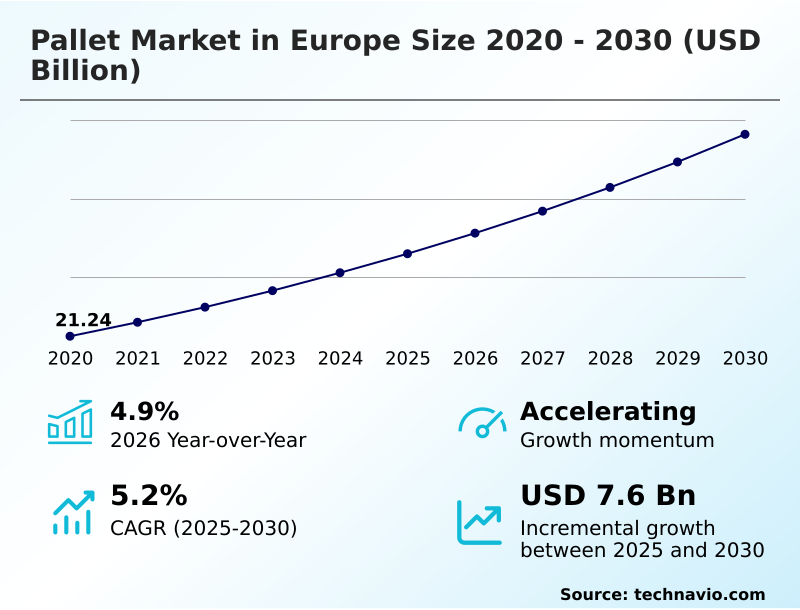
The europe pallet market size is valued to increase by USD 7.60 billion, at a CAGR of 5.2% from 2025 to 2030. Adoption of circular economy models and reuse legislation will drive the europe pallet market.
Major Market Trends & Insights
- By Product - Wooden pallet segment was valued at USD 21.92 billion in 2024
- By End-user - Food and beverages segment accounted for the largest market revenue share in 2024
Market Size & Forecast
- Market Opportunities: USD 12.85 billion
- Market Future Opportunities: USD 7.60 billion
- CAGR from 2025 to 2030 : 5.2%
Market Summary
- The pallet market in Europe is undergoing a fundamental transformation driven by demands for sustainability, efficiency, and digitalization. Beyond their basic function as load carriers, pallets are becoming critical data assets in a connected supply chain. The push for circularity, reinforced by stringent environmental regulations, is accelerating the shift from single-use models to reusable and trackable platforms.
- This requires significant investment in returnable transport packaging and systems for pallet reconditioning. For instance, a major food and beverage distributor must now ensure its hygienic plastic pallets not only comply with Good Distribution Practice but are also part of a closed-loop system where asset lifecycle data is tracked to prove regulatory adherence.
- This shift is creating demand for innovations like internet of things sensors and quick response codes that enable real time asset monitoring. Simultaneously, the rise of warehouse automation necessitates platforms with precise, consistent specifications to work with automated storage and retrieval systems, challenging the dominance of traditional, less uniform options and fostering innovation in materials and design.
What will be the Size of the Europe Pallet Market during the forecast period?
Get Key Insights on Market Forecast (PDF) Get Free Sample
How is the Europe Pallet Market Segmented?
The europe pallet industry research report provides comprehensive data (region-wise segment analysis), with forecasts and estimates in "USD million" for the period 2026-2030, as well as historical data from 2020-2024 for the following segments.
- Product
- Wooden pallet
- Plastic pallet
- Corrugated pallet
- Metal pallet
- End-user
- Food and beverages
- Transportation and warehousing
- Retail
- Pharmaceutical
- Others
- Type
- Standard pallets
- Lightweight and reusable pallets
- Geography
- Europe
- Germany
- France
- UK
- Europe
By Product Insights
The wooden pallet segment is estimated to witness significant growth during the forecast period.
Wooden pallets maintain a dominant market position due to cost-effectiveness and a robust infrastructure for repair and reuse. The emphasis is on building a resilient logistics network through sustainable wood sourcing and certified kiln drying processes to meet international standards.
Innovations focus on extending asset life, with advanced repair networks ensuring a high recovery rate, which in some circular models has been shown to reduce associated carbon emissions by over 60%.
This supports a transition to a zero-waste economy and ensures supply chain resilience.
Meanwhile, the demand for specialized platforms like hygienic plastic pallets made via single-injection molding of high density polyethylene is growing, especially where Good Distribution Practice and cold chain logistics are paramount. These alternatives often feature antimicrobial materials and anti-slip surfaces.
The market also sees niche use of presswood pallets and a focus on end-of-life pallet recovery across all material types.
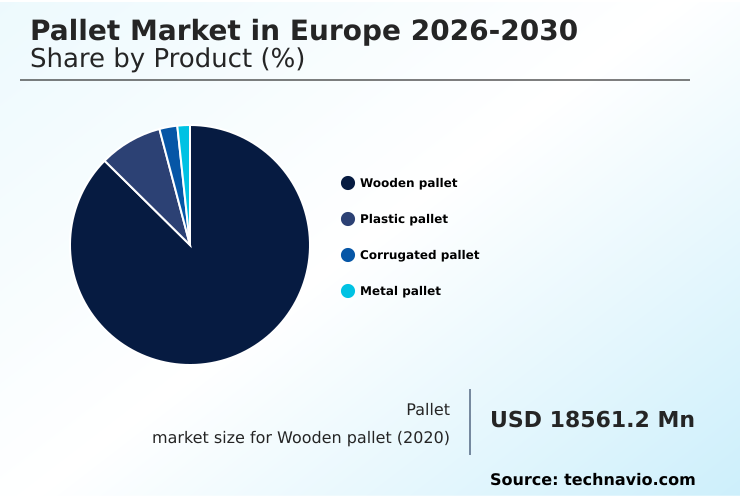
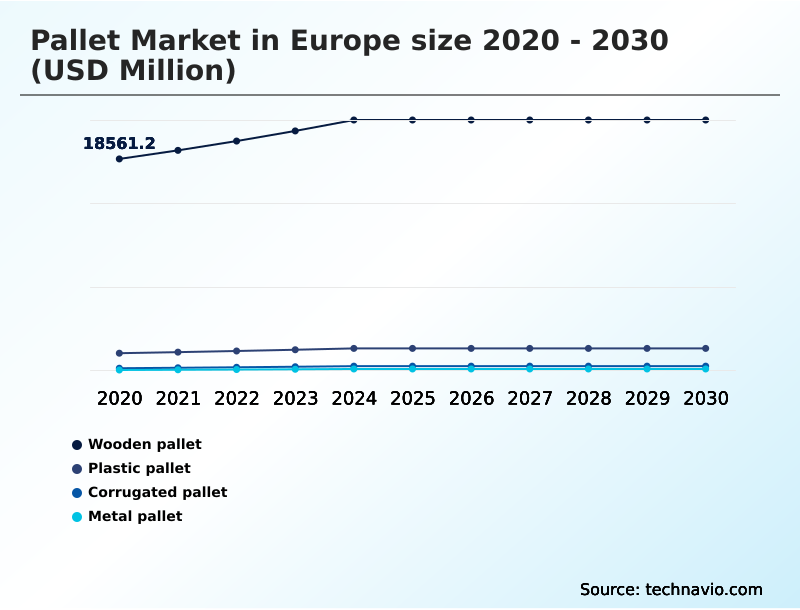
The Wooden pallet segment was valued at USD 21.92 billion in 2024 and showed a gradual increase during the forecast period.
Market Dynamics
Our researchers analyzed the data with 2025 as the base year, along with the key drivers, trends, and challenges. A holistic analysis of drivers will help companies refine their marketing strategies to gain a competitive advantage.
- The strategic direction of the market is increasingly shaped by the impact of robotics on pallet design, compelling a shift toward standardized and dimensionally stable platforms. The cost benefit of pallet pooling services is becoming more apparent as companies evaluate the wooden versus plastic pallet lifecycle cost and seek to lower capital expenditures.
- For specialized sectors, recycled plastic pallets for pharmaceuticals are gaining traction due to strict hygienic pallet standards for food processing. Similarly, lightweight corrugated pallets for air freight offer significant transportation cost savings, with some users reporting savings of over 30% on fuel compared to heavier alternatives.
- The need for ISPM-15 compliant pallets for export remains a baseline requirement for international trade. In retail, the focus is on sustainable pallet solutions for retail and automation-ready pallets for e-commerce fulfillment to manage high-volume logistics. The effectiveness of smart pallet tracking for inventory management is being proven through widespread adoption of RFID technology integration in wooden pallets.
- This addresses the need for data integration for pallet compliance tracking, which is a direct consequence of the impact of PPWR on pallet selection. Logistics operators are optimizing logistics with nestable pallets in last-mile delivery, while circular pooling models for beverage distribution demonstrate successful closed-loop systems.
- In industrial settings, the use of metal pallets in chemical industry logistics and heavy-duty pallets for construction materials is standard. Ultimately, the pallet design for automated retrieval systems is key to improving warehouse safety with pallet design and reducing carbon footprint with reusable pallets.
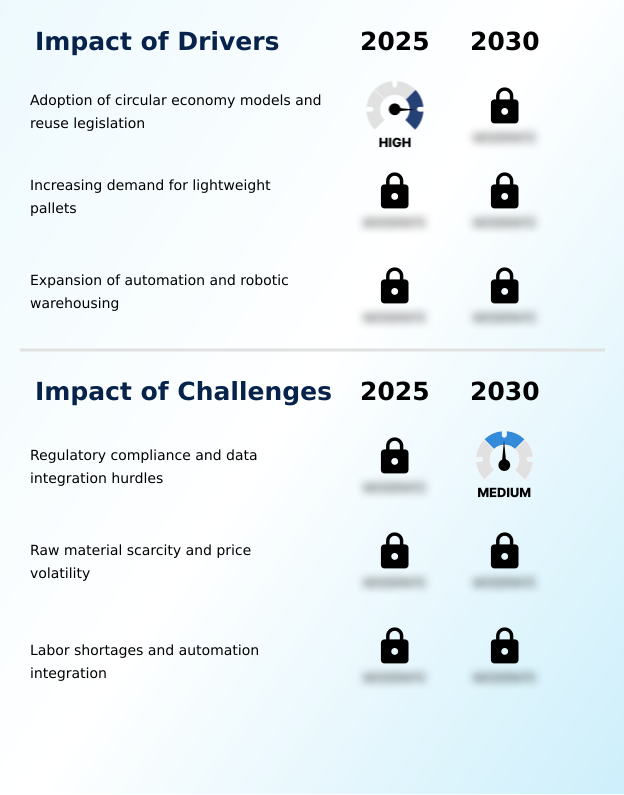
What are the key market drivers leading to the rise in the adoption of Europe Pallet Industry?
- The adoption of circular economy models, catalyzed by new reuse legislation, is a key driver for the market.
- The market is primarily driven by the push for a circular economy, compelling a shift toward sustainable logistics assets. Stringent regulations are accelerating the adoption of returnable transport packaging and closed-loop systems.
- Innovations in closed-loop material recovery include producing pallets from polyAl recycled material and using infrared detectable plastic, which ensures 100% recyclability. A comprehensive pallet lifecycle assessment allows companies to quantify carbon footprint reduction and improve resource efficiency.
- This focus on sustainability lowers the total cost of ownership and ensures a deforestation-free supply chain through certified sustainable wood sourcing.
- Adherence to these circular economy principles is no longer optional, with verifiable data now required to avoid penalties associated with reduced packaging waste regulations.
What are the market trends shaping the Europe Pallet Industry?
- The rapid adoption of digital integration and smart asset tracking technologies represents a prominent upcoming trend. This evolution is driven by the need for enhanced supply chain visibility and the reduction of asset loss.
- A primary trend is the digital transformation of logistics assets, enhancing supply chain visibility. The integration of radio frequency identification and internet of things sensors enables real time asset monitoring, with some pallet pooling services reporting a 20% reduction in asset loss.
- The widespread use of quick response codes on standard EPAL Euro pallets facilitates seamless entry into digital warehouse management systems, improving inventory management optimization. This connectivity supports advanced automated sorting technology, which can increase throughput by up to 30%.
- The demand for efficient last-mile delivery solutions is also driving innovation in specialized platforms like lightweight corrugated cardboard pallets and fiber based temperature controlled packaging, both of which benefit from optimized fleet management strategies.
What challenges does the Europe Pallet Industry face during its growth?
- Navigating regulatory compliance and overcoming data integration hurdles presents a key challenge to industry growth.
- A key challenge is navigating the complex regulatory landscape while managing operational costs. The requirement for geolocated timber sourcing and strict phytosanitary standards compliance via ISPM-15 regulations adds significant administrative burden. Concurrently, raw material price volatility forces companies to adopt a dual sourcing strategy and improve pallet reconditioning of second-hand pallets to mitigate costs.
- The persistent labor shortage mitigation need is accelerating automation, which in turn demands higher quality pallets and improves workplace safety. These pressures are compounded by the need for specialized assets like spill containment pallets, stainless steel pallets, and the reusable 3 skid steel pallet in industrial sectors, all of which require high capital investment and impact overall material handling efficiency.
Exclusive Technavio Analysis on Customer Landscape
The europe pallet market forecasting report includes the adoption lifecycle of the market, covering from the innovator’s stage to the laggard’s stage. It focuses on adoption rates in different regions based on penetration. Furthermore, the europe pallet market report also includes key purchase criteria and drivers of price sensitivity to help companies evaluate and develop their market growth analysis strategies.
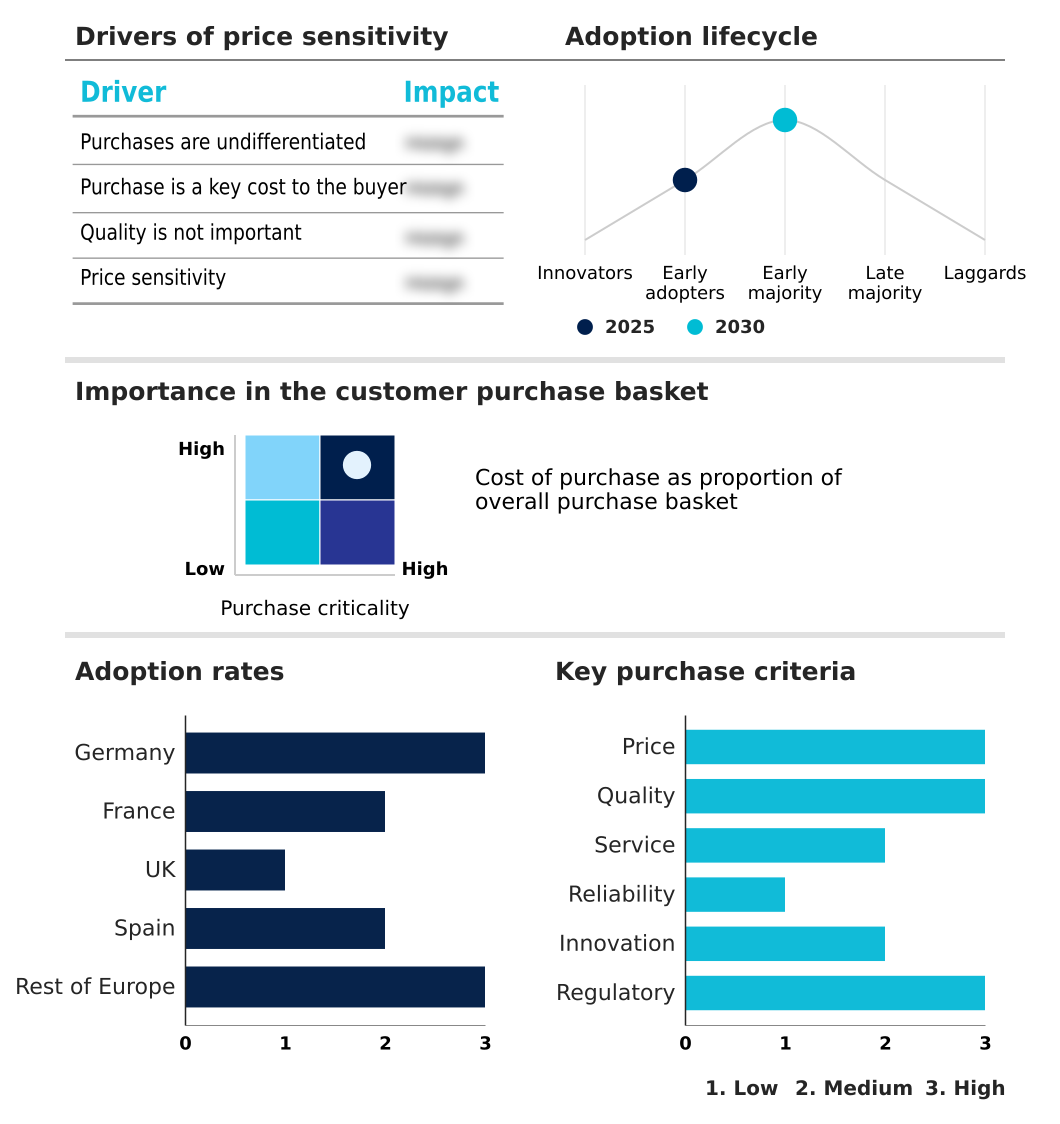
Customer Landscape of Europe Pallet Industry
Competitive Landscape
Companies are implementing various strategies, such as strategic alliances, europe pallet market forecast, partnerships, mergers and acquisitions, geographical expansion, and product/service launches, to enhance their presence in the industry.
AUER GmbH - Analyzes offerings from specialized manufacturers and large-scale pooling system operators competing on durability, sustainability, and advanced logistics integration.
The industry research and growth report includes detailed analyses of the competitive landscape of the market and information about key companies, including:
- AUER GmbH
- CABKA Group GmbH
- Cargopak Ltd
- Casadei Pallets Srl
- CHEP
- Craemer GmbH
- Dolav
- DS Smith Plc
- Faber Group B.V
- Falkenhahn AG
- HG Timber Ltd.
- INKA Paletten GmbH
- IPL Schoeller
- La Palette Rouge
- ORBIS Europe
- Palletways Group Ltd
- PGS Group
- Smurfit Kappa Group
- TranPak Inc.
Qualitative and quantitative analysis of companies has been conducted to help clients understand the wider business environment as well as the strengths and weaknesses of key industry players. Data is qualitatively analyzed to categorize companies as pure play, category-focused, industry-focused, and diversified; it is quantitatively analyzed to categorize companies as dominant, leading, strong, tentative, and weak.
Recent Development and News in Europe pallet market
- In May 2025, IPL and Schoeller Allibert completed a strategic merger to establish IPL Schoeller, a global leader in sustainable plastic packaging with a combined annual revenue of over $1.4 billion for 2024.
- In January 2025, International Paper finalized its acquisition of DS Smith, creating a global leader in sustainable packaging that serves a vast array of industrial end-users across Europe and North America.
- In November 2024, Goplasticpallets.com entered into a strategic partnership with XPO Logistics to supply 100% recyclable plastic pallets across European supply chains, replacing traditional wooden platforms.
- In March 2025, Schoeller Allibert, in collaboration with Tetra Pak, introduced a transport crate made from recycled polyAl recovered from used beverage cartons, providing a circular solution for the food supply chain.
Dive into Technavio’s robust research methodology, blending expert interviews, extensive data synthesis, and validated models for unparalleled Europe Pallet Market insights. See full methodology.
| Market Scope | |
|---|---|
| Page number | 212 |
| Base year | 2025 |
| Historic period | 2020-2024 |
| Forecast period | 2026-2030 |
| Growth momentum & CAGR | Accelerate at a CAGR of 5.2% |
| Market growth 2026-2030 | USD 7601.9 million |
| Market structure | Fragmented |
| YoY growth 2025-2026(%) | 4.9% |
| Key countries | Germany, France, UK, Spain and Rest of Europe |
| Competitive landscape | Leading Companies, Market Positioning of Companies, Competitive Strategies, and Industry Risks |
Research Analyst Overview
- The market's evolution is defined by a convergence of sustainability mandates and technological integration. Boardroom decisions now center on aligning logistics assets with new regulations, requiring a deforestation-free supply chain and verifiable geolocated timber sourcing. This drives the adoption of returnable transport packaging and sophisticated pallet pooling services that perform pallet reconditioning on second-hand pallets and manage closed-loop material recovery.
- Material innovation is accelerating; single-injection molding of high density polyethylene creates durable hygienic plastic pallets with antimicrobial materials and anti-slip surfaces, while polyAl recycled material and infrared detectable plastic advance circularity. The use of presswood pallets, corrugated cardboard pallets, and specialized fiber based temperature controlled packaging address niche needs.
- For heavy industry, stainless steel pallets, spill containment pallets, and the reusable 3 skid steel pallet are critical. Digitalization through radio frequency identification, internet of things sensors, and quick response codes on EPAL Euro pallets is standard.
- This data feeds into automated storage and retrieval systems that demand high-bay racking compatibility and platforms like lightweight pallets, heavy duty pallets, nestable pallets, stackable pallets, and rackable plastic pallets.
- Compliance with ISPM-15 regulations through kiln drying processes remains essential, and a comprehensive pallet lifecycle assessment, often using a computer based parametric algorithm, is now a strategic tool for evaluating operational impact, with some firms achieving a 10% reduction in waste.
What are the Key Data Covered in this Europe Pallet Market Research and Growth Report?
-
What is the expected growth of the Europe Pallet Market between 2026 and 2030?
-
USD 7.60 billion, at a CAGR of 5.2%
-
-
What segmentation does the market report cover?
-
The report is segmented by Product (Wooden pallet, Plastic pallet, Corrugated pallet, and Metal pallet), End-user (Food and beverages, Transportation and warehousing, Retail, Pharmaceutical, and Others), Type (Standard pallets, and Lightweight and reusable pallets) and Geography (Europe)
-
-
Which regions are analyzed in the report?
-
Europe
-
-
What are the key growth drivers and market challenges?
-
Adoption of circular economy models and reuse legislation, Regulatory compliance and data integration hurdles
-
-
Who are the major players in the Europe Pallet Market?
-
AUER GmbH, CABKA Group GmbH, Cargopak Ltd, Casadei Pallets Srl, CHEP, Craemer GmbH, Dolav, DS Smith Plc, Faber Group B.V, Falkenhahn AG, HG Timber Ltd., INKA Paletten GmbH, IPL Schoeller, La Palette Rouge, ORBIS Europe, Palletways Group Ltd, PGS Group, Smurfit Kappa Group and TranPak Inc.
-
Market Research Insights
- Market dynamics are increasingly shaped by the pursuit of resource efficiency and supply chain resilience. The adoption of circular economy principles has become a strategic imperative, with companies achieving up to a 10% carbon footprint reduction through optimized fleet management and empty truck mile reduction. This shift toward a closed-loop system lowers the total cost of ownership.
- Automation friendly design is critical for high throughput warehousing, where consistency can reduce goods damage by over 50%. The need for enhanced supply chain visibility is driving integration of digital warehouse management systems for real time asset monitoring. This ensures compliance with phytosanitary standards and Good Distribution Practice, particularly for cold chain logistics and last-mile delivery solutions.
We can help! Our analysts can customize this europe pallet market research report to meet your requirements.
 RIA -
RIA -