


Personal Loans Market Size 2026-2030
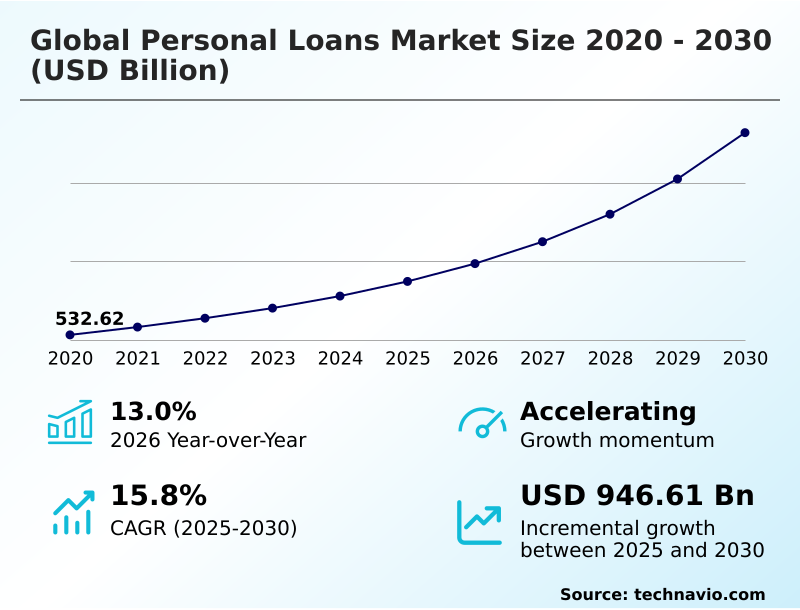
The personal loans market size is valued to increase by USD 946.61 billion, at a CAGR of 15.8% from 2025 to 2030. Mainstreaming of digital identity wallets and industrialization of frictionless remote KYC protocols will drive the personal loans market.
Major Market Trends & Insights
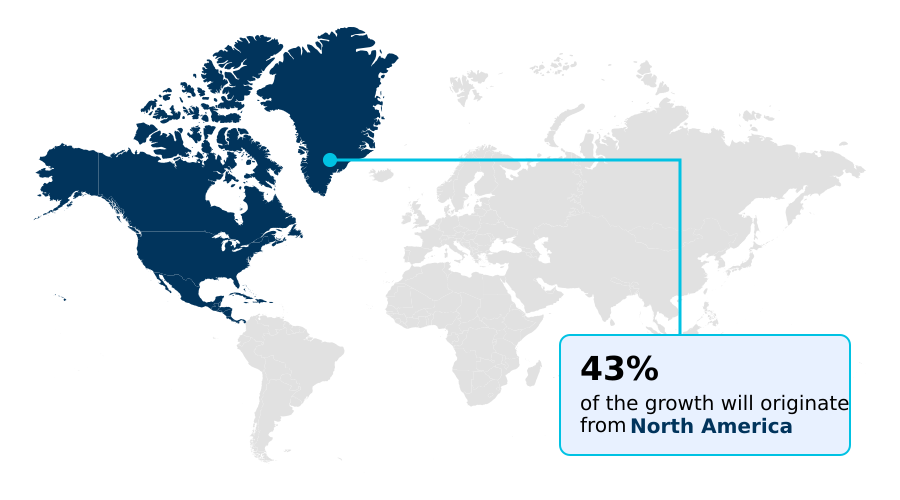
- North America dominated the market and accounted for a 43.4% growth during the forecast period.
- By Application - Short term loans segment was valued at USD 405.38 billion in 2024
- By Type - P2P marketplace lending segment accounted for the largest market revenue share in 2024
Market Size & Forecast
- Market Opportunities: USD 1,286.80 billion
- Market Future Opportunities: USD 946.61 billion
- CAGR from 2025 to 2030 : 15.8%
Market Summary
- The personal loans market is undergoing a significant transformation driven by technological advancements and evolving consumer behaviors. The convergence of traditional banking with agile fintech-led lending models is reshaping credit access. Key drivers include the adoption of alternative data points for more inclusive credit underwriting and the mainstreaming of digital identity wallets that streamline KYC processes.
- A major trend is the shift towards open banking frameworks, enabling real-time API-driven data portability and fostering a more competitive, transparent credit ecosystem. For instance, a lender can leverage user-permissioned data to offer a pre-approved, hyper-personalized loan for debt consolidation directly within a user's mobile banking app, reducing friction and improving conversion.
- However, the industry faces challenges, notably the need for explainable AI to mitigate algorithmic bias in automated underwriting algorithms and to comply with increasingly stringent regulations. The rise of embedded finance, which integrates lending services into non-financial platforms, further underscores the move toward seamless, on-demand credit solutions.
- This dynamic environment requires continuous innovation in proprietary data analytics and cyber-resiliency to manage risk effectively.
What will be the Size of the Personal Loans Market during the forecast period?
Get Key Insights on Market Forecast (PDF) Get Free Sample
How is the Personal Loans Market Segmented?
The personal loans industry research report provides comprehensive data (region-wise segment analysis), with forecasts and estimates in "USD million" for the period 2026-2030, as well as historical data from 2020-2024 for the following segments.
- Application
- Short term loans
- Medium term loans
- Long term loans
- Type
- P2P marketplace lending
- Balance sheet lending
- Channel
- Banks
- Credit union
- Online lenders
- Geography
- North America
- US
- Canada
- Mexico
- Europe
- Germany
- UK
- France
- APAC
- China
- India
- Japan
- South America
- Brazil
- Argentina
- Middle East and Africa
- Saudi Arabia
- UAE
- Turkey
- Rest of World (ROW)
- North America
By Application Insights
The short term loans segment is estimated to witness significant growth during the forecast period.
The short-term loans segment is adapting to demand for immediate liquidity, especially through fintech platforms and embedded finance. This market component is defined by its agility, with automated underwriting algorithms and digital identity assurance facilitating near-instantaneous approvals.
Lenders are using alternative credit scoring and AI-enabled underwriting to serve individuals with limited formal banking records.
This shift toward fintech-led lending and real-time pre-approved loans has reduced approval times significantly, with some platforms achieving a 95% reduction in processing duration.
The focus remains on leveraging user-permissioned data and open banking frameworks to enhance credit risk assessment while navigating regulations on interest rate transparency. The integration of digital lending into mobile banking solidifies this segment's role in providing accessible bridge financing.
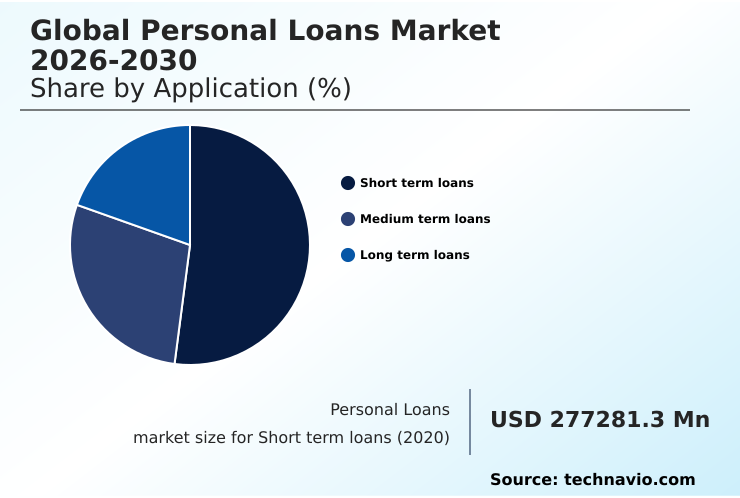
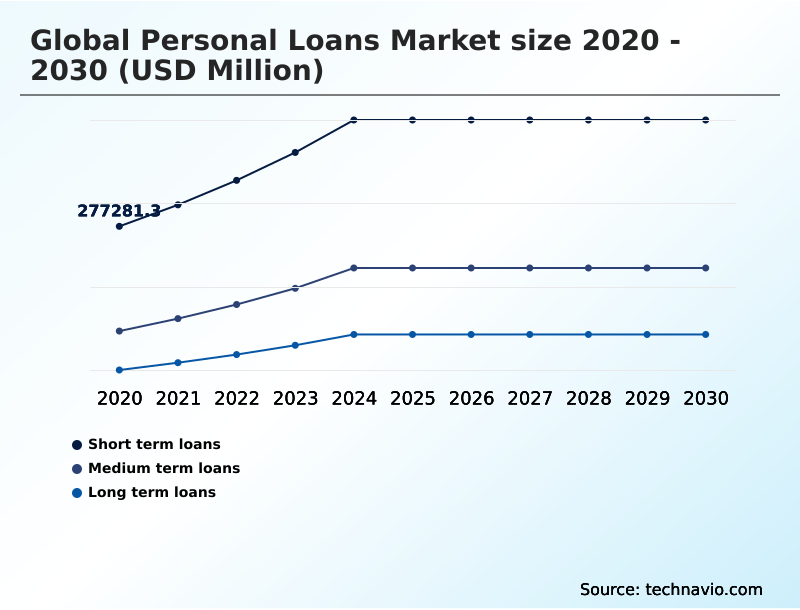
The Short term loans segment was valued at USD 405.38 billion in 2024 and showed a gradual increase during the forecast period.
Regional Analysis
North America is estimated to contribute 43.4% to the growth of the global market during the forecast period.Technavio’s analysts have elaborately explained the regional trends and drivers that shape the market during the forecast period.
See How Personal Loans Market Demand is Rising in North America Get Free Sample
The global geographic landscape for personal loans is marked by varied regional dynamics and growth rates.
While North America maintains a dominant market share due to its mature financial ecosystem, the APAC region is exhibiting the fastest growth, with a projected CAGR that is over 3 percentage points higher than that of North America.
This expansion is fueled by widespread mobile banking adoption, supportive data-sharing frameworks, and the rise of fintech-led lending. In Europe, the focus is on regulatory standardization and the adoption of open banking frameworks.
Markets in South America and the Middle East and Africa are also advancing, driven by the need for financial inclusion and the deployment of digital lending technologies.
These regions leverage automated investing tools and AI-driven loan origination to expand credit access.
Market Dynamics
Our researchers analyzed the data with 2025 as the base year, along with the key drivers, trends, and challenges. A holistic analysis of drivers will help companies refine their marketing strategies to gain a competitive advantage.
- The evolution of the global personal loans market is increasingly defined by sophisticated technological integrations and specialized financial models. The use of AI-driven credit underwriting for personal loans has become a cornerstone, enabling lenders to move beyond traditional metrics.
- This is complemented by the growing impact of open banking on loan portability, which empowers consumers with greater control over their financial data. Security is paramount, with blockchain for secure digital identity verification emerging as a critical tool to combat fraud. Concurrently, firms are actively managing algorithmic bias in lending models to ensure fairness and compliance.
- As the digital ecosystem expands, addressing cybersecurity risks in P2P lending platforms is a key priority. The role of fintech in unsecured personal lending continues to grow, with smart contracts for automated loan agreements streamlining processes. A significant challenge is implementing explainable AI in personal loan approvals to meet regulatory demands.
- Compliance with sovereign data residency laws adds another layer of complexity. Platforms using alternative data for thin-file borrower assessment are expanding access to credit. Digital identity wallets in KYC processes have become standard, enhancing efficiency. The shift toward real-time credit risk assessment models allows for dynamic pricing.
- Hyper-personalized loan offers via mobile banking improve customer engagement, while embedded finance for point-of-need credit is reshaping product distribution. Many platforms now process transaction volumes twice as large as their predecessors, highlighting the scalability of new technologies.
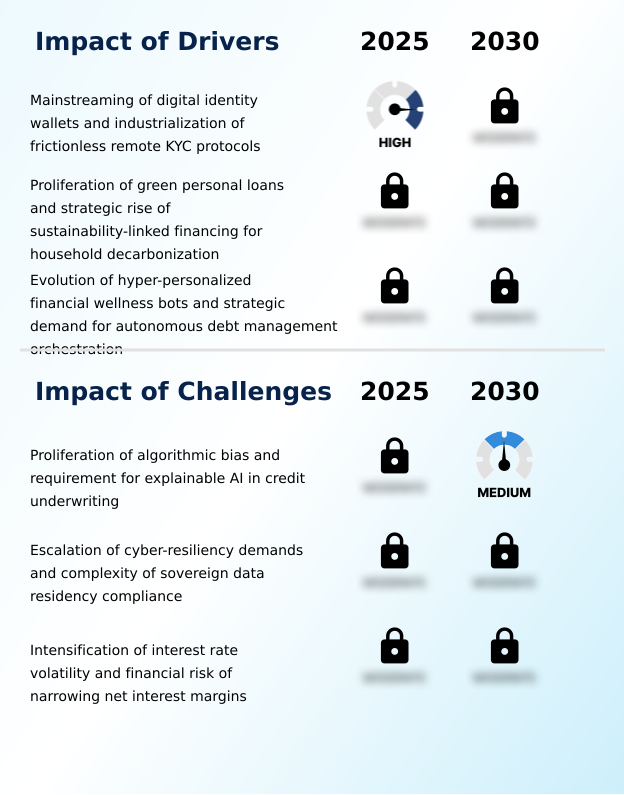
What are the key market drivers leading to the rise in the adoption of Personal Loans Industry?
- A key market driver is the mainstreaming of digital identity wallets and the industrialization of frictionless remote KYC protocols.
- Market growth is significantly propelled by the mainstreaming of digital identity wallets and the industrialization of frictionless remote KYC protocols.
- This transition, particularly in regulated markets, streamlines the borrowing lifecycle by replacing manual document submission with reusable digital credentials, a shift that has cut down application abandonment rates by up to 40%.
- The technical underpinning involves blockchain-based trust frameworks and zero-knowledge proofs, which enhance security without compromising privacy. The proliferation of green personal loans and sustainability-linked financing is also creating new market segments.
- Furthermore, the evolution of hyper-personalized financial wellness bots and autonomous debt management systems is driving demand by offering sophisticated, AI-driven financial guidance, improving customer retention by 15%.
What are the market trends shaping the Personal Loans Industry?
- The institutionalization of open finance is a key market trend, accelerating the transition toward real-time, API-driven data portability.
- Key trends are reshaping the personal loans market, driven by the institutionalization of open finance and a move toward real-time, API-driven portability. This shift from siloed data to seamless, user-permissioned data exchange allows lenders to gain a granular cash flow view, enabling more precise credit risk assessment.
- The adoption of smart contract lending on decentralized platforms is also growing, promising greater efficiency and transparency. This technological integration has led to a 30% reduction in loan processing times for participating institutions. Furthermore, the strategic integration of biometric security and continuous digital identity assurance is becoming standard, with deployments showing a 25% decrease in account takeover fraud.
- These data-sharing frameworks foster a more competitive and transparent credit ecosystem.
What challenges does the Personal Loans Industry face during its growth?
- A key challenge affecting industry growth is the proliferation of algorithmic bias and the corresponding requirement for explainable AI in credit underwriting.
- The market faces significant challenges, primarily the proliferation of algorithmic bias and the corresponding need for explainable AI in credit underwriting. As AI-driven loan origination replaces traditional scoring, the opacity of black-box models presents a primary operational and regulatory hurdle.
- Regulators are demanding auditable trails for automated decisions, compelling a shift toward Explainable AI frameworks and continuous bias-monitoring telemetry, which can increase operational costs by 10-15%. Another key challenge is the escalation of cyber-resiliency demands and the complexity of complying with sovereign data residency laws.
- The threat of synthetic identity fraud and sophisticated generative AI-driven cyber threats requires constant vigilance and investment in advanced security protocols to protect sensitive borrower information.
Exclusive Technavio Analysis on Customer Landscape
The personal loans market forecasting report includes the adoption lifecycle of the market, covering from the innovator’s stage to the laggard’s stage. It focuses on adoption rates in different regions based on penetration. Furthermore, the personal loans market report also includes key purchase criteria and drivers of price sensitivity to help companies evaluate and develop their market growth analysis strategies.
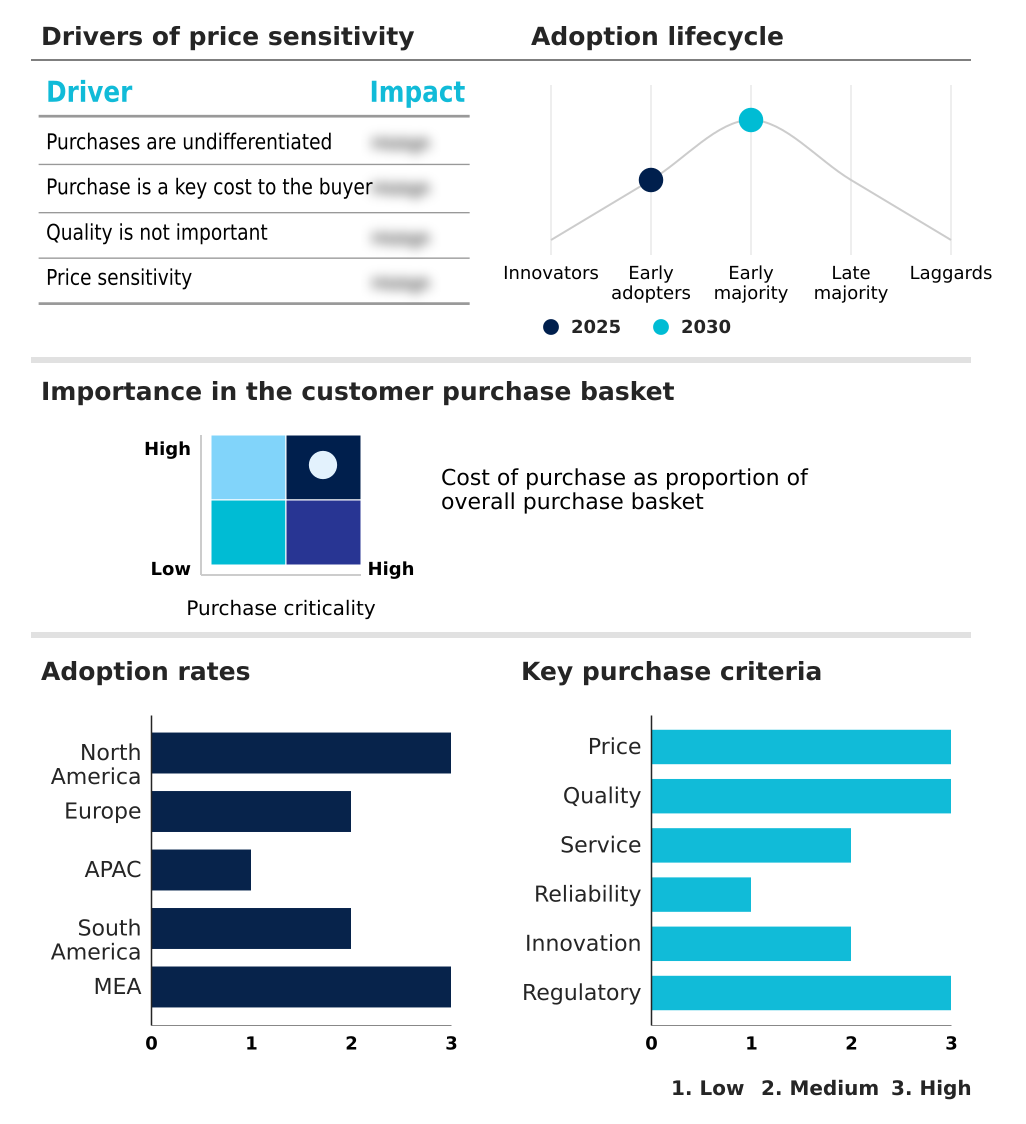
Customer Landscape of Personal Loans Industry
Competitive Landscape
Companies are implementing various strategies, such as strategic alliances, personal loans market forecast, partnerships, mergers and acquisitions, geographical expansion, and product/service launches, to enhance their presence in the industry.
American Express Co. - Provides unsecured financing for cardholders, featuring competitive rates and flexible repayment structures to enhance financial management capabilities.
The industry research and growth report includes detailed analyses of the competitive landscape of the market and information about key companies, including:
- American Express Co.
- auxmoney GmbH
- Avant LLC
- Best Egg Inc.
- Bondora AS
- Citigroup Inc.
- Credibly
- Discover Financial Services
- Earnest LLC
- Funding Circle Holdings Plc
- ICICI Bank Ltd.
- LendingClub Corp.
- LendingTree LLC
- Lendio Inc.
- Peerform
- Prosper Marketplace Inc.
- smava GmbH
- SoFi Technologies Inc.
- Upstart Network Inc.
- Zopa Bank Ltd.
Qualitative and quantitative analysis of companies has been conducted to help clients understand the wider business environment as well as the strengths and weaknesses of key industry players. Data is qualitatively analyzed to categorize companies as pure play, category-focused, industry-focused, and diversified; it is quantitatively analyzed to categorize companies as dominant, leading, strong, tentative, and weak.
Recent Development and News in Personal loans market
- In January, 2025, LendingClub Corp. announced a 40% year-over-year increase in loan originations for the fourth quarter of 2024, attributing the performance to its underwriting advantage and successful checking account integrations.
- In February, 2025, Upstart Network Inc. reported a significant recovery in transaction volume, originating nearly 456,000 loans in the final quarter of 2024, which marked an 86% increase compared to the previous year.
- In February, 2025, Citigroup Inc. detailed a strategic realignment at a major financial services conference, outlining plans to separate its retail bank and cards business to optimize deposit capture and customer synergies.
- In March, 2025, the Reserve Bank of India implemented new guidelines that abolish prepayment penalties for certain floating-rate personal loans, a move designed to enhance cost transparency and borrower control over interest rates.
Dive into Technavio’s robust research methodology, blending expert interviews, extensive data synthesis, and validated models for unparalleled Personal Loans Market insights. See full methodology.
| Market Scope | |
|---|---|
| Page number | 282 |
| Base year | 2025 |
| Historic period | 2020-2024 |
| Forecast period | 2026-2030 |
| Growth momentum & CAGR | Accelerate at a CAGR of 15.8% |
| Market growth 2026-2030 | USD 946605.3 million |
| Market structure | Fragmented |
| YoY growth 2025-2026(%) | 13.0% |
| Key countries | US, Canada, Mexico, Germany, UK, France, Italy, Spain, The Netherlands, China, India, Japan, South Korea, Australia, Indonesia, Brazil, Argentina, Chile, Saudi Arabia, UAE, Turkey, South Africa and Israel |
| Competitive landscape | Leading Companies, Market Positioning of Companies, Competitive Strategies, and Industry Risks |
Research Analyst Overview
- The personal loans market is experiencing a structural shift, moving beyond traditional lending paradigms toward a digitally integrated ecosystem. This evolution is defined by the strategic implementation of financial wellness bots and autonomous debt management systems to enhance consumer financial health. At the core, technologies like digital identity wallets and frictionless remote KYC protocols are industrializing loan origination.
- The adoption of blockchain-based trust frameworks, zero-knowledge proofs, and on-device biometrics with sensor attestation is critical for boardroom decisions on risk management and compliance, with some firms achieving a 40% reduction in fraudulent applications. The market is bifurcated between P2P marketplace lending and conventional balance sheet lending, with both models leveraging AI-driven loan origination and AI-enabled underwriting.
- Key trends include the growth of open banking frameworks enabling API-driven portability, the use of smart contract lending, and a focus on biometric security for digital identity assurance. However, challenges such as algorithmic bias in credit underwriting, the need for explainable AI, and navigating sovereign data residency rules persist.
- Unsecured personal loans for debt consolidation remain a primary use case, driven by alternative credit scoring and automated underwriting algorithms on platforms like digital marketplace banks.
What are the Key Data Covered in this Personal Loans Market Research and Growth Report?
-
What is the expected growth of the Personal Loans Market between 2026 and 2030?
-
USD 946.61 billion, at a CAGR of 15.8%
-
-
What segmentation does the market report cover?
-
The report is segmented by Application (Short term loans, Medium term loans, and Long term loans), Type (P2P marketplace lending, and Balance sheet lending), Channel (Banks, Credit union, and Online lenders) and Geography (North America, Europe, APAC, South America, Middle East and Africa)
-
-
Which regions are analyzed in the report?
-
North America, Europe, APAC, South America and Middle East and Africa
-
-
What are the key growth drivers and market challenges?
-
Mainstreaming of digital identity wallets and industrialization of frictionless remote KYC protocols, Proliferation of algorithmic bias and requirement for explainable AI in credit underwriting
-
-
Who are the major players in the Personal Loans Market?
-
American Express Co., auxmoney GmbH, Avant LLC, Best Egg Inc., Bondora AS, Citigroup Inc., Credibly, Discover Financial Services, Earnest LLC, Funding Circle Holdings Plc, ICICI Bank Ltd., LendingClub Corp., LendingTree LLC, Lendio Inc., Peerform, Prosper Marketplace Inc., smava GmbH, SoFi Technologies Inc., Upstart Network Inc. and Zopa Bank Ltd.
-
Market Research Insights
- The market's dynamics are shaped by a strategic push toward digital transformation and hyper-personalization. The use of non-traditional data points and behavioral patterns is becoming standard, improving credit scoring models for thin-file borrowers and leading to a 25% increase in loan approvals for previously underserved demographics.
- Real-time, pre-approved loans are now common, powered by instant verification and real-time API integration, which has reduced application processing times by over 80% compared to legacy systems. The adoption of automated investing tools within P2P platforms has also enhanced portfolio diversification for investors. As lenders adopt more sophisticated, data-fluid lending practices, the focus on creating a transparent credit ecosystem intensifies.
We can help! Our analysts can customize this personal loans market research report to meet your requirements.
 RIA -
RIA -