



Photo Editing Software Market Size 2026-2030
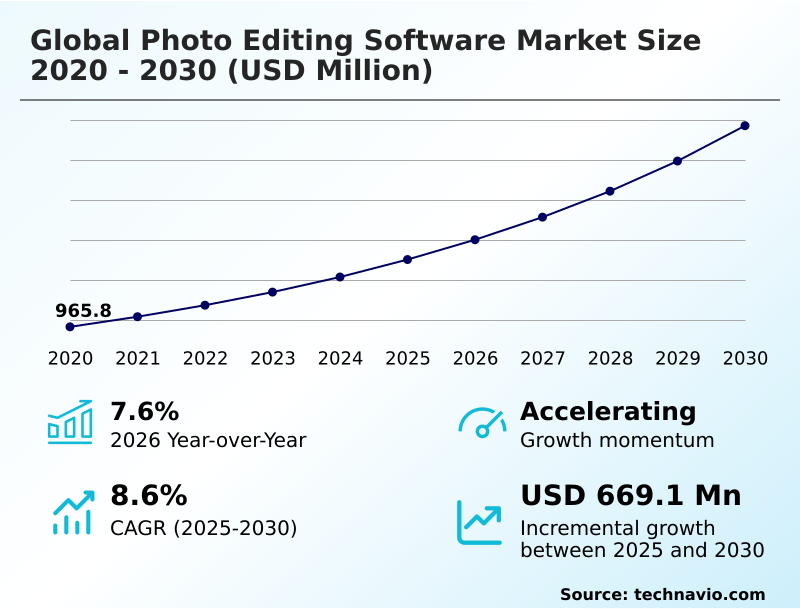
The photo editing software market size is valued to increase by USD 669.1 million, at a CAGR of 8.6% from 2025 to 2030. Integration of AI technologies for complex editing tasks will drive the photo editing software market.
Major Market Trends & Insights
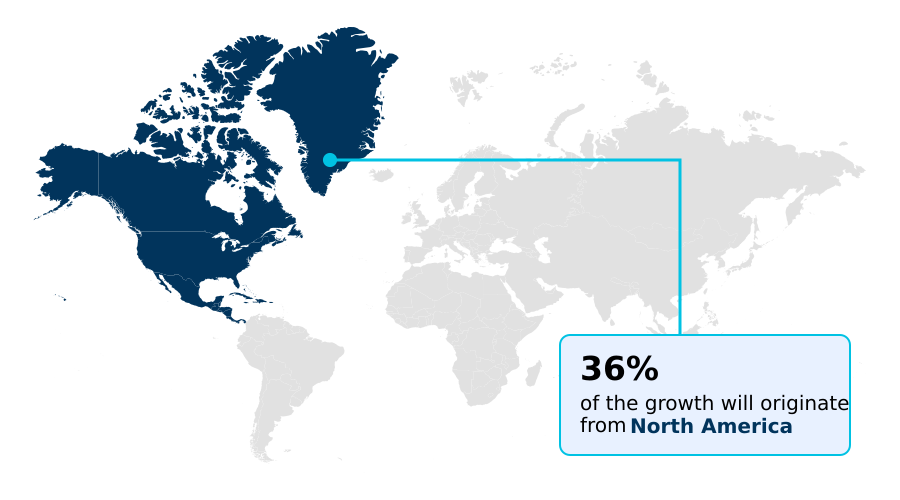
- North America dominated the market and accounted for a 36.5% growth during the forecast period.
- By End-user - Commercial segment was valued at USD 998.9 million in 2024
- By Platform - Windows segment accounted for the largest market revenue share in 2024
Market Size & Forecast
- Market Opportunities: USD 1.01 billion
- Market Future Opportunities: USD 669.1 million
- CAGR from 2025 to 2030 : 8.6%
Market Summary
- The Photo Editing Software market is advancing beyond manual adjustments, driven by the integration of AI-powered creative tools that redefine creative possibilities and operational efficiency. Core to this evolution is the focus on creative workflow automation, where features like intelligent color grading and content-aware fill significantly reduce the time required for complex edits.
- This shift is not just about speed but also about accessibility, enabling a broader range of users to achieve professional-level results. A key trend is the deep ecosystem integration of these tools into larger digital platforms, supporting a seamless professional photography workflow from capture to final output.
- For instance, a retail enterprise can leverage AI-assisted editing to process thousands of images for e-commerce product photography overnight, ensuring digital brand consistency and maintaining a cohesive brand visual identity across all online channels.
- While these advancements fuel growth, the market also grapples with challenges related to data privacy and the need for ethically sourced training models, pushing developers toward more transparent and secure solutions.
What will be the Size of the Photo Editing Software Market during the forecast period?
Get Key Insights on Market Forecast (PDF) Get Free Sample
How is the Photo Editing Software Market Segmented?
The photo editing software industry research report provides comprehensive data (region-wise segment analysis), with forecasts and estimates in "USD million" for the period 2026-2030, as well as historical data from 2020-2024 for the following segments.
- End-user
- Commercial
- Personal
- Platform
- Windows
- Mac OS
- Android
- iOS
- Application
- Advertising and marketing
- Media and entertainment
- Fashion and photography
- Others
- Geography
- North America
- US
- Canada
- Mexico
- Europe
- Germany
- UK
- France
- APAC
- China
- Japan
- India
- South America
- Brazil
- Argentina
- Middle East and Africa
- Saudi Arabia
- UAE
- South Africa
- Rest of World (ROW)
- North America
By End-user Insights
The commercial segment is estimated to witness significant growth during the forecast period.
The commercial segment is driven by the need for high-volume, high-quality visual assets in digital marketing and e-commerce. Professional entities require sophisticated tools that support a streamlined professional photography workflow, including tethered shooting and efficient batch processing of high-resolution images.
Advanced features such as AI-powered retouching and AI-driven generative fill are no longer niche but essential for maintaining digital brand consistency.
Effective brand asset management and integrated digital asset management systems are critical for large teams, with a strong focus on creative workflow automation to reduce manual work.
For instance, automated generative edit functions for e-commerce product photography have demonstrated a capacity to reduce post-production timelines by over 40%. The demand for seamless ecosystem integration with other enterprise applications continues to shape purchasing decisions.
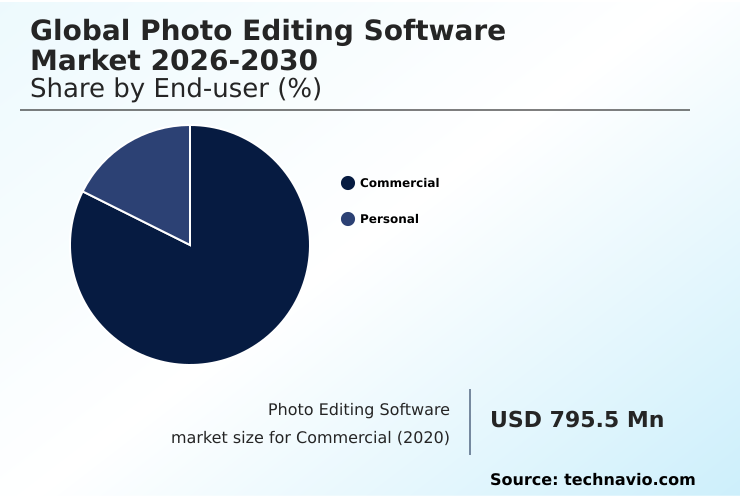
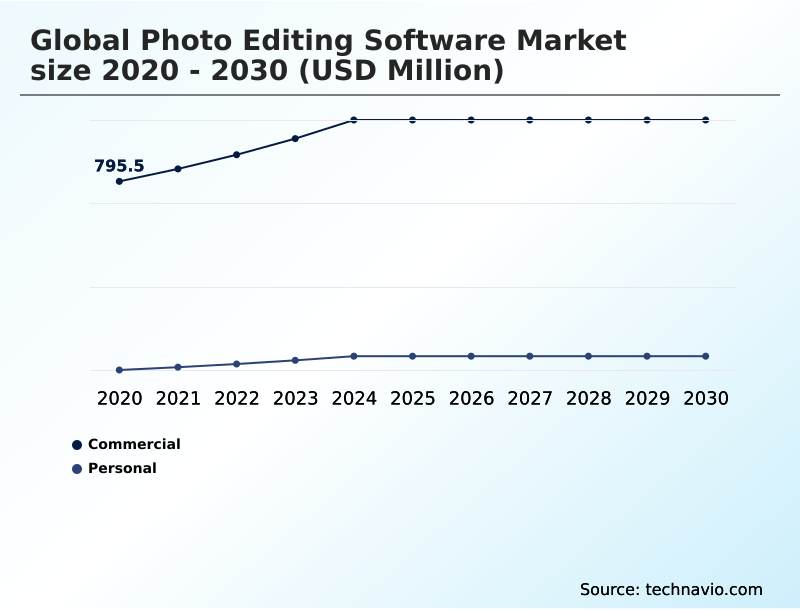
The Commercial segment was valued at USD 998.9 million in 2024 and showed a gradual increase during the forecast period.
Regional Analysis
North America is estimated to contribute 36.5% to the growth of the global market during the forecast period.Technavio’s analysts have elaborately explained the regional trends and drivers that shape the market during the forecast period.
See How Photo Editing Software Market Demand is Rising in North America Get Free Sample
The geographic landscape is characterized by high adoption in North America and Europe, driven by mature creative industries, while APAC emerges as the fastest-growing region, contributing over 35% of new user growth.
In developed markets, demand is high for sophisticated features like precise image compositing and contextual adjustments, powered by GPU acceleration and unified memory architecture.
These regions prioritize cloud-based collaboration and real-time collaboration tools, with team productivity increasing by up to 40% with integrated workflows. In contrast, emerging markets focus on mobile-first user-generated content enhancement and accessible visual storytelling platforms.
Across all regions, generative fill technology and precise print-ready color management are becoming key differentiators, bridging the gap between professional and consumer-grade applications.
Market Dynamics
Our researchers analyzed the data with 2025 as the base year, along with the key drivers, trends, and challenges. A holistic analysis of drivers will help companies refine their marketing strategies to gain a competitive advantage.
- Enterprises are increasingly adopting AI photo editing for e-commerce to standardize product visuals, which has been shown to improve conversion rates by over 15% compared to inconsistent, manually edited images. For professional photographers, the focus is on workflow efficiency. Using batch processing for wedding photography and the best software for raw photo editing are now standard practices.
- Non-destructive editing for professional photographers ensures creative flexibility, while advanced masking techniques for photo editing allow for precise selections. For creators focused on social media, automated photo enhancement for social media provides quick, high-quality results. The market also addresses specific creative needs, with generative fill for background replacement and generative AI for creative photo composites enabling complex manipulations.
- AI tools for portrait retouching deliver natural-looking results, and AI-powered background removal tools are essential for clean cutouts. Technical advancements like AI-powered photo upscaling and sharpening and software for high-resolution image upscaling are critical for print and large-format displays. The demand for automating repetitive editing tasks with AI is a major driver, freeing up creative resources.
- Specialized tools like photo restoration software for old photos and AI noise reduction for low-light photos open up new service lines for studios. Businesses benefit from managing digital assets for marketing teams within integrated platforms, while cloud-based photo editing collaboration supports remote workflows.
- Color grading for cinematic photos and professional image retouching with AI cater to high-end media production, and optimizing images for web and mobile is a foundational requirement for all digital content.
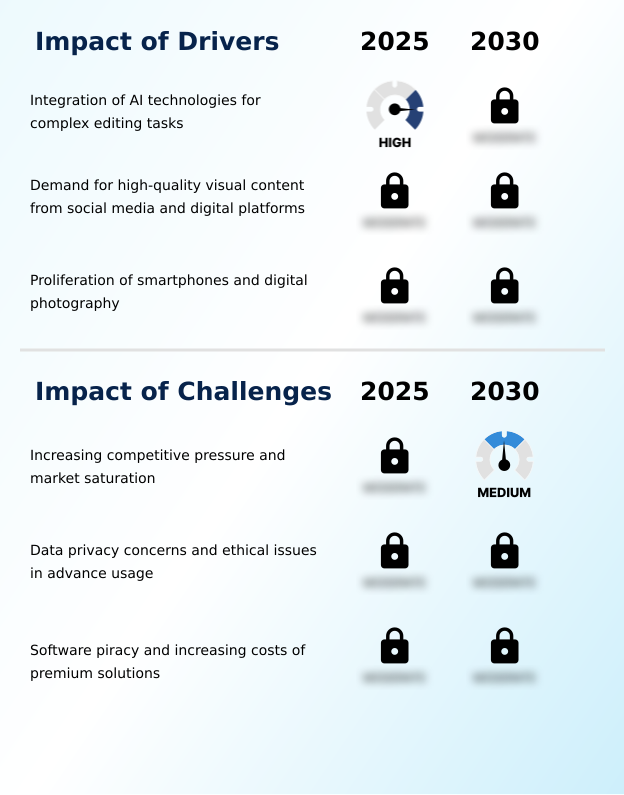
What are the key market drivers leading to the rise in the adoption of Photo Editing Software Industry?
- The integration of AI technologies to automate complex editing tasks serves as a key driver for market growth.
- The proliferation of smartphones with advanced computational photography capabilities is a primary market driver, fueling massive demand for visual content creation. This has accelerated the adoption of tools supporting a mobile-first design and seamless cross-platform compatibility.
- AI-driven automation is key, with automated background removal now 95% accurate in ideal conditions. AI-assisted editing, including real-time image processing and low-light image enhancement, empowers the growing number of creator economy tools.
- For instance, generative upscale technology can now increase image resolution by 400% with minimal artifacting. These advancements are crucial for social media content optimization, where visual quality directly impacts engagement.
- The integration of features like a sophisticated facial recognition engine further enhances usability for both personal and commercial applications.
What are the market trends shaping the Photo Editing Software Industry?
- The democratization of professional-grade tools through accessible platforms is an emerging market trend, enabling a wider array of users to utilize sophisticated editing capabilities.
- Market trends are centered on democratizing advanced capabilities through a more user-friendly interface and accessible freemium models. The adoption of non-destructive editing within a non-destructive workflow is now a baseline expectation, allowing for greater experimentation.
- Specialized features like image restoration and AI-powered photo restoration and repair are gaining traction, with some tools achieving up to a 70% success rate in recovering details from damaged photos. The content authenticity initiative is becoming crucial for verifying image provenance.
- Innovations such as generative expand and AI denoise are being integrated into hybrid creative workflows, with on-device processing improving performance by 25% while addressing privacy. The use of smart masking tools further simplifies complex selection processes, making professional techniques available to a wider audience.
What challenges does the Photo Editing Software Industry face during its growth?
- Increasing competitive pressure and market saturation represent a key challenge affecting industry growth.
- Market challenges are increasingly centered on data ethics and security. The reliance on vast datasets raises concerns about ethical AI training data, with over 60% of professional creators expressing apprehension about copyright infringement. This necessitates stronger intellectual property protection and robust digital rights management (DRM) frameworks.
- The high cost of some subscription-based services also creates a barrier, pushing nearly 30% of users in emerging markets toward unauthorized alternatives.
- Furthermore, while the technical demands of raw processing, complex layer-based editing, and high dynamic range (HDR) imaging require powerful hardware like neural processing units, ensuring a consistent color management system across devices remains a significant hurdle for achieving perfect visual content optimization and brand accuracy.
Exclusive Technavio Analysis on Customer Landscape
The photo editing software market forecasting report includes the adoption lifecycle of the market, covering from the innovator’s stage to the laggard’s stage. It focuses on adoption rates in different regions based on penetration. Furthermore, the photo editing software market report also includes key purchase criteria and drivers of price sensitivity to help companies evaluate and develop their market growth analysis strategies.
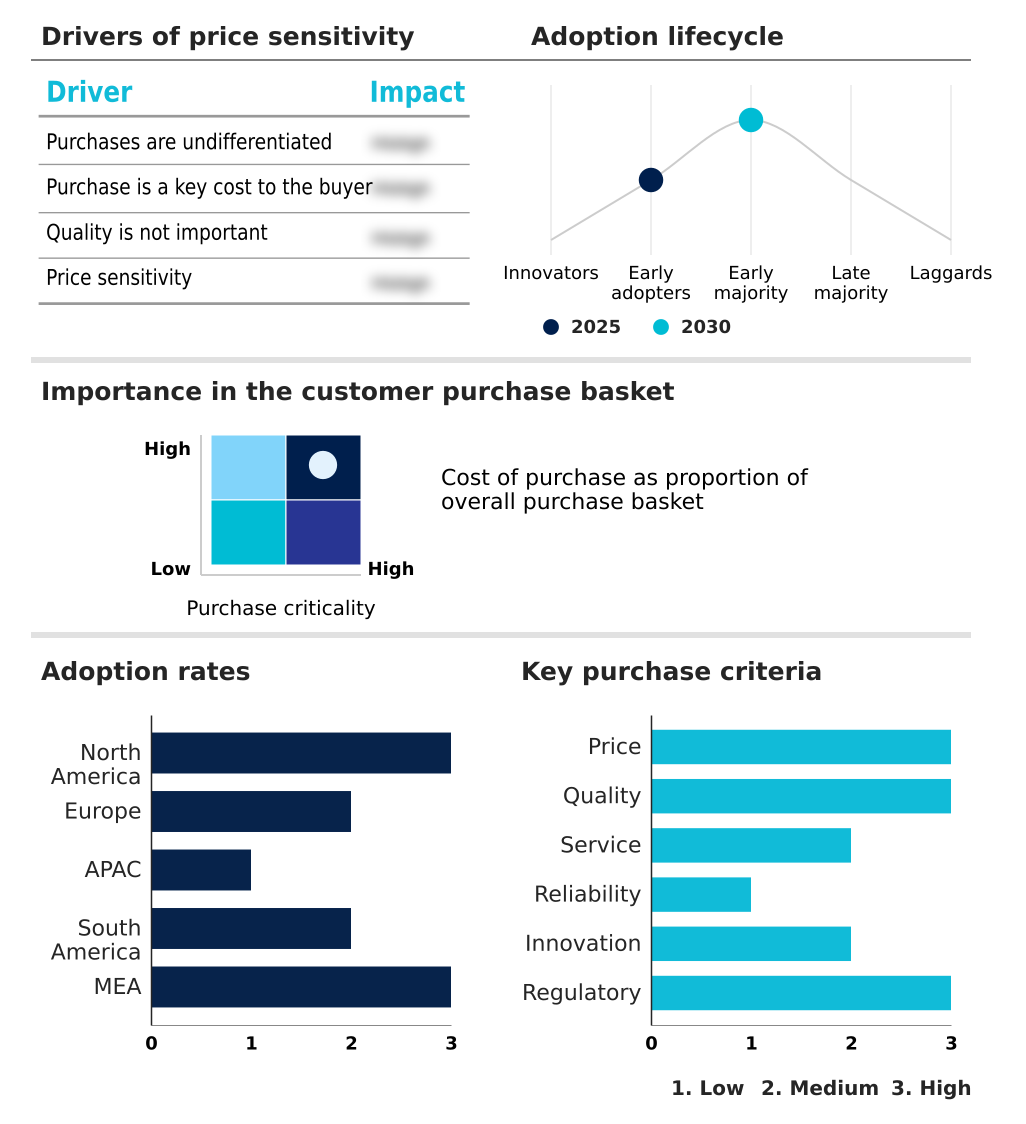
Customer Landscape of Photo Editing Software Industry
Competitive Landscape
Companies are implementing various strategies, such as strategic alliances, photo editing software market forecast, partnerships, mergers and acquisitions, geographical expansion, and product/service launches, to enhance their presence in the industry.
ACD Systems International Inc. - Delivers professional-grade solutions for advanced image editing, high-end retouching, and comprehensive creative design, setting industry benchmarks for digital media creation.
The industry research and growth report includes detailed analyses of the competitive landscape of the market and information about key companies, including:
- ACD Systems International Inc.
- Adobe Inc.
- Afterlight Collective Inc.
- Apple Inc.
- Canva Pty Ltd.
- Capture One AS
- Corel Corp.
- CyberLink Corp.
- DxO Labs
- Lightricks Ltd.
- MAGIX Software GmbH
- ON1 Inc.
- PicsArt Inc.
- Pixlr
- Polarr Inc.
- Samsung Electronics Co. Ltd.
- Skylum Software USA Inc.
- The GIMP Team
- Topaz Labs LLC
Qualitative and quantitative analysis of companies has been conducted to help clients understand the wider business environment as well as the strengths and weaknesses of key industry players. Data is qualitatively analyzed to categorize companies as pure play, category-focused, industry-focused, and diversified; it is quantitatively analyzed to categorize companies as dominant, leading, strong, tentative, and weak.
Recent Development and News in Photo editing software market
- In October 2024, Adobe Inc. introduced an update to its Photoshop software featuring refined generative AI capabilities powered by an advanced Adobe Firefly image model, including a Remove Tool for eliminating distractions and controls for guiding AI behavior.
- In October 2024, Canva Pty Ltd. launched the Affinity application, a unified platform merging photo editing, vector design, and layout tools, offered free to all users to broaden market access and democratize professional-grade features.
- In November 2024, Skylum Software USA Inc. delivered updates to Luminar Neo, introducing AI-powered features including Light Depth for sophisticated three-dimensional illumination adjustments and Restoration for recovering and repairing damaged photographs.
- In March 2025, ON1 Inc. released its latest Photo RAW software, featuring smarter masking intelligence, integrated Resize AI for effective image upscaling, and new creative filters to enhance professional photography workflows.
Dive into Technavio’s robust research methodology, blending expert interviews, extensive data synthesis, and validated models for unparalleled Photo Editing Software Market insights. See full methodology.
| Market Scope | |
|---|---|
| Page number | 305 |
| Base year | 2025 |
| Historic period | 2020-2024 |
| Forecast period | 2026-2030 |
| Growth momentum & CAGR | Accelerate at a CAGR of 8.6% |
| Market growth 2026-2030 | USD 669.1 million |
| Market structure | Fragmented |
| YoY growth 2025-2026(%) | 7.6% |
| Key countries | US, Canada, Mexico, Germany, UK, France, Italy, Spain, The Netherlands, China, Japan, India, South Korea, Australia, Indonesia, Brazil, Argentina, Chile, Saudi Arabia, UAE, South Africa, Israel and Turkey |
| Competitive landscape | Leading Companies, Market Positioning of Companies, Competitive Strategies, and Industry Risks |
Research Analyst Overview
- The Photo Editing Software market is defined by rapid technological evolution, where core functionalities like generative fill, non-destructive editing, and professional raw processing have become industry standards. The integration of neural processing units is accelerating real-time image processing, enhancing features such as image upscaling and computational photography.
- For professionals, AI-powered retouching and layer-based editing are essential, with AI-assisted editing now integral to the entire process. Advanced color grading, precise lens correction profiles, and tethered shooting streamline the professional workflow. Key innovations include AI-driven generative fill, generative expand, and generative upscale, which leverage sophisticated algorithms for content-aware fill and image compositing.
- Modern software utilizes GPU acceleration and unified memory architecture to handle high dynamic range (HDR) imaging and complex tasks. For instance, a robust noise reduction algorithm like AI denoise can improve low-light image clarity by over 60%. The emphasis is on automation through smart masking tools, automatic subject selection, and automated background removal.
- Features such as the facial recognition engine and image restoration tools are becoming commonplace. Furthermore, the content authenticity initiative is addressing trust in generative edit tools, while efficient batch processing and integrated digital asset management are critical for enterprise-level operations, supported by AI-powered creative tools that redefine content creation.
What are the Key Data Covered in this Photo Editing Software Market Research and Growth Report?
-
What is the expected growth of the Photo Editing Software Market between 2026 and 2030?
-
USD 669.1 million, at a CAGR of 8.6%
-
-
What segmentation does the market report cover?
-
The report is segmented by End-user (Commercial, and Personal), Platform (Windows, Mac OS, Android, and iOS), Application (Advertising and marketing, Media and entertainment, Fashion and photography, and Others) and Geography (North America, Europe, APAC, South America, Middle East and Africa)
-
-
Which regions are analyzed in the report?
-
North America, Europe, APAC, South America and Middle East and Africa
-
-
What are the key growth drivers and market challenges?
-
Integration of AI technologies for complex editing tasks, Increasing competitive pressure and market saturation
-
-
Who are the major players in the Photo Editing Software Market?
-
ACD Systems International Inc., Adobe Inc., Afterlight Collective Inc., Apple Inc., Canva Pty Ltd., Capture One AS, Corel Corp., CyberLink Corp., DxO Labs, Lightricks Ltd., MAGIX Software GmbH, ON1 Inc., PicsArt Inc., Pixlr, Polarr Inc., Samsung Electronics Co. Ltd., Skylum Software USA Inc., The GIMP Team and Topaz Labs LLC
-
Market Research Insights
- The market is shaped by the demand for cross-platform compatibility and a superior user-friendly interface, where freemium models have increased user adoption rates by over 50% in emerging markets. Cloud-based collaboration is now a standard, with platforms offering real-time collaboration tools that improve project completion times by 30%.
- The rise of the creator economy tools is fueling the need for efficient social media content optimization and user-generated content enhancement. As a result, subscription-based services are evolving to offer tiered access to AI-driven image generation and creative workflow automation.
- Firms that prioritize a seamless non-destructive workflow and robust brand asset management are better positioned to maintain digital brand consistency in an increasingly visual marketplace.
We can help! Our analysts can customize this photo editing software market research report to meet your requirements.
 RIA -
RIA - 
