



Post Production Market Size 2026-2030
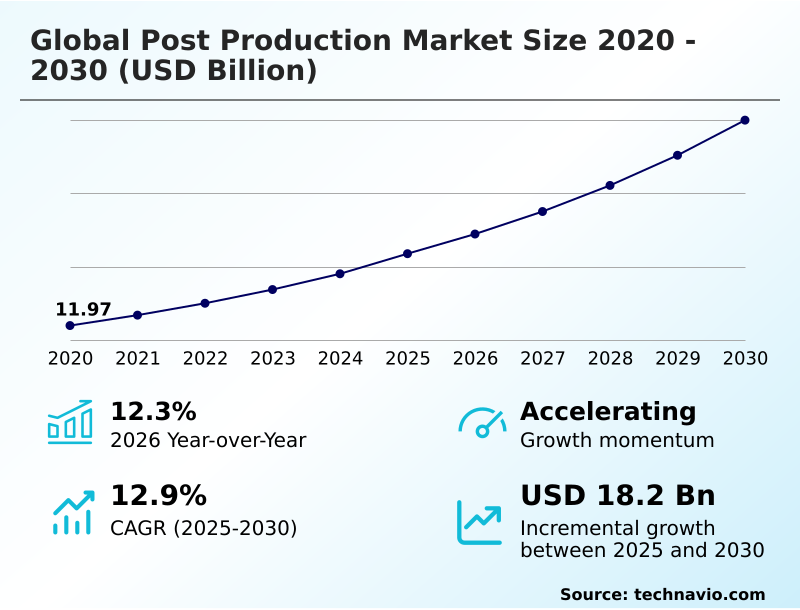
The post production market size is valued to increase by USD 18.20 billion, at a CAGR of 12.9% from 2025 to 2030. Rising consumer expectations for immersive and high-resolution media content will drive the post production market.
Major Market Trends & Insights
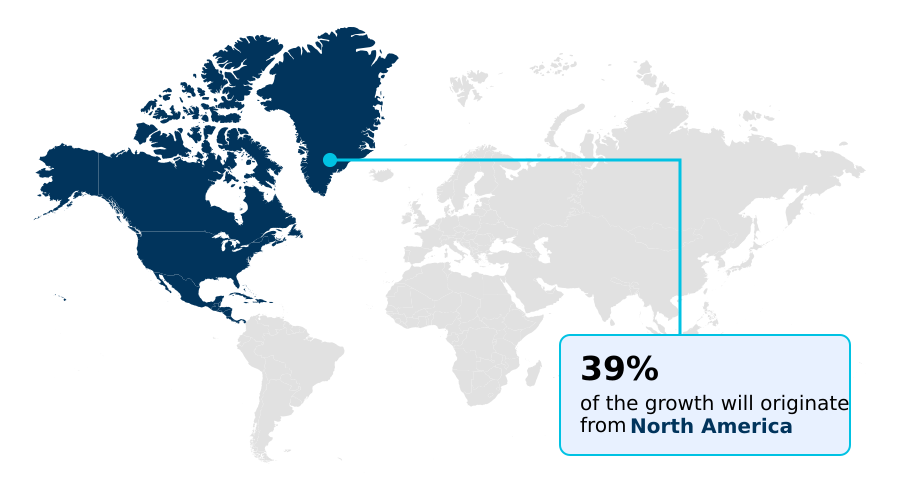
- North America dominated the market and accounted for a 38.6% growth during the forecast period.
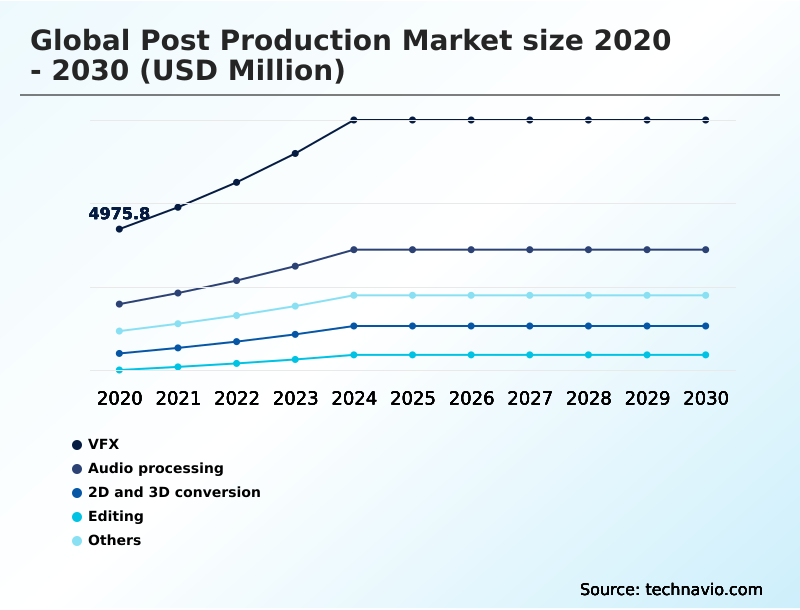
- By Technique - VFX segment was valued at USD 8.16 billion in 2024
- By Application - Movies segment accounted for the largest market revenue share in 2024
Market Size & Forecast
- Market Opportunities: USD 28.01 billion
- Market Future Opportunities: USD 18.20 billion
- CAGR from 2025 to 2030 : 12.9%
Market Summary
- The post production market is undergoing a significant transformation, driven by the convergence of technological innovation and evolving content consumption habits. Key industry shifts include the widespread adoption of cloud-native workflows, which dismantle geographical barriers and enable global collaboration among creative professionals.
- This decentralized model is critical for managing the massive data loads associated with high dynamic range (HDR) and 8K video formats. Concurrently, the integration of artificial intelligence and machine learning is redefining efficiency.
- For instance, in a typical visual effects pipeline, AI-powered tools for tasks like rotoscoping and object removal can automate thousands of manual hours, allowing artists to focus on more complex creative challenges. This automation not only accelerates project timelines to meet the demands of streaming platforms but also enhances the final quality.
- However, this progress introduces challenges related to data security in distributed environments and the substantial capital investment required for high-performance computing infrastructure. The market continues to balance the pursuit of technological advancement with the need for robust, scalable, and secure operational frameworks to support the next generation of media creation.
What will be the Size of the Post Production Market during the forecast period?
Get Key Insights on Market Forecast (PDF) Get Free Sample
How is the Post Production Market Segmented?
The post production industry research report provides comprehensive data (region-wise segment analysis), with forecasts and estimates in "USD million" for the period 2026-2030, as well as historical data from 2020-2024 for the following segments.
- Technique
- VFX
- Audio processing
- 2D and 3D conversion
- Editing
- Others
- Application
- Movies
- Television
- Commercials
- Online videos
- End-user
- Production houses
- Independent filmmakers
- Television studios
- Geography
- North America
- US
- Canada
- Mexico
- APAC
- China
- India
- Japan
- Europe
- UK
- Germany
- France
- Middle East and Africa
- UAE
- South Africa
- Saudi Arabia
- South America
- Brazil
- Argentina
- Rest of World (ROW)
- North America
By Technique Insights
The vfx segment is estimated to witness significant growth during the forecast period.
The global post production market is segmented by technique, application, and geography, with the visual effects (VFX) segment being the most technologically intensive. This area involves integrating computer-generated imagery with live-action footage, a standard for cinematic and streaming content.
The evolution toward virtual production and the use of real-time rendering engines allows directors to visualize digital environments during filming. This shift demands higher technical proficiency from artists using sophisticated software for complex simulations like fluid dynamics and particle systems.
The adoption of machine learning algorithms for tasks such as rotoscoping and match-moving automates labor-intensive processes.
For instance, recent software updates incorporating neural engines have reduced manual frame manipulation tasks by up to 30%, allowing for greater focus on creative aspects like digital character design.
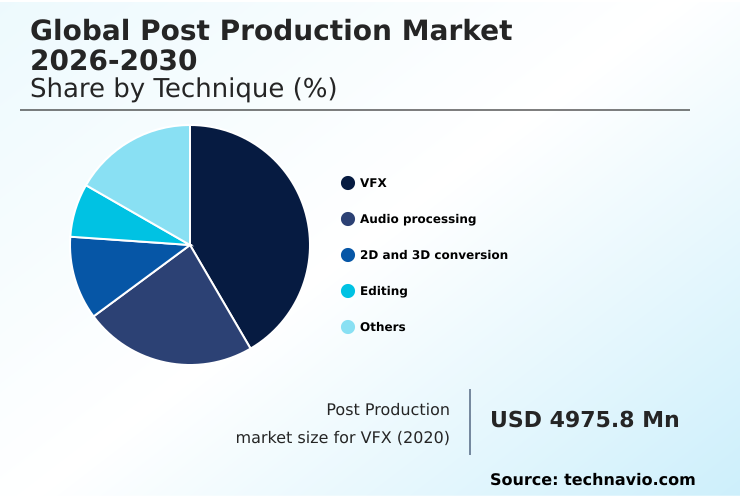
The VFX segment was valued at USD 8.16 billion in 2024 and showed a gradual increase during the forecast period.
Regional Analysis
North America is estimated to contribute 38.6% to the growth of the global market during the forecast period.Technavio’s analysts have elaborately explained the regional trends and drivers that shape the market during the forecast period.
See How Post Production Market Demand is Rising in North America Get Free Sample
The geographic landscape of the global post production market is characterized by distinct regional strengths and growth trajectories.
North America remains the dominant region, contributing approximately 39% of the market's incremental growth, driven by its high concentration of major studios and technology developers in the United States and Canada.
This region leads in adopting advanced technologies like in-camera visual effects and neural engines.
Meanwhile, APAC is the fastest-growing region, accounting for nearly 27% of new growth, with countries like India and China emerging as global hubs for VFX outsourcing and large-scale domestic productions.
Europe holds its position with specialized centers in the UK, France, and Germany, excelling in high-end visual effects, animation, and sophisticated localization services.
The adoption of object-based sound design and high-frame-rate video standards is prominent across these developed markets, reinforcing their critical role in the industry.
Market Dynamics
Our researchers analyzed the data with 2025 as the base year, along with the key drivers, trends, and challenges. A holistic analysis of drivers will help companies refine their marketing strategies to gain a competitive advantage.
- The strategic direction of the global post production market is increasingly shaped by the sophisticated interplay of advanced technologies designed to meet escalating consumer expectations for quality and immersion. The implementation of AI in post production workflow automation is central to this shift, enabling studios to manage complex projects with greater efficiency.
- For instance, firms leveraging cloud collaboration for remote video editing report project turnaround times that are up to 30% faster than those relying on traditional, localized infrastructure. This efficiency is critical as the industry standardizes around HDR color grading for streaming content and prepares for the broader adoption of post production for 8K video content.
- The creative possibilities are expanding with the use of generative AI for VFX and scene extension, which allows for visual adjustments without costly reshoots. Simultaneously, the adoption of Dolby Atmos mixing for immersive audio is becoming a key differentiator for premium content.
- The move toward real-time rendering for virtual production is blurring the lines between principal photography and post production, streamlining the entire content creation cycle. As these trends converge, data security in decentralized post production emerges as a paramount concern, requiring robust protocols to protect intellectual property.
- Furthermore, VFX pipeline optimization for feature films and the push to automate localization with AI tools are becoming essential for maintaining competitiveness in a globalized media environment. These interconnected developments define the modern post production landscape, demanding continuous investment in technology and talent.
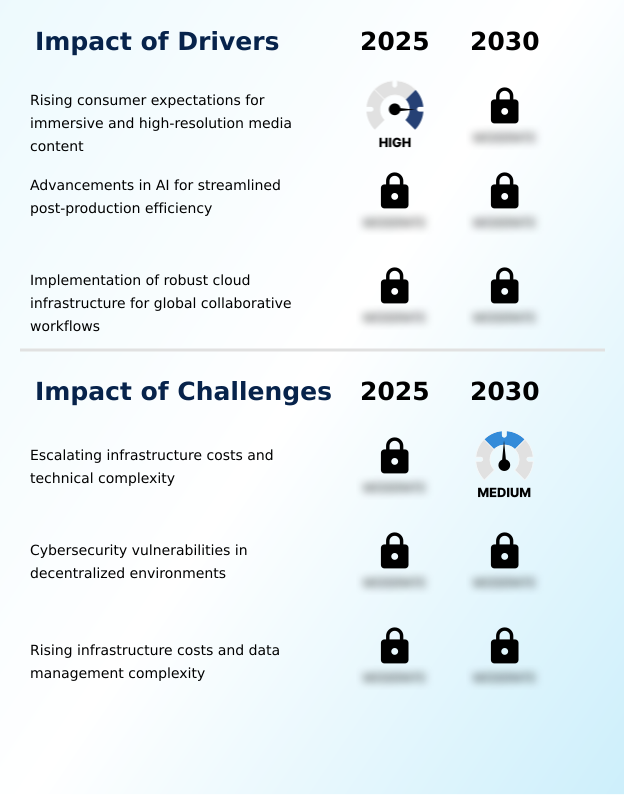
What are the key market drivers leading to the rise in the adoption of Post Production Industry?
- A key market driver is the rising consumer expectation for immersive and high-resolution media content, which necessitates advanced post production capabilities to deliver premium viewing experiences.
- Rising consumer expectations for immersive, high-resolution media are a primary driver for the global post production market. The demand for 4K, 8K, and high-dynamic-range content necessitates continuous investment in advanced technology and infrastructure.
- Managing these high-resolution files increases data throughput requirements by up to 400% when moving from 4K to 8K, driving demand for specialized storage and computational solutions. Another key driver is the integration of AI and machine learning to streamline efficiency.
- AI-driven automation of tasks like rotoscoping and color matching can reduce post production cycles by up to 30%.
- Furthermore, the shift to cloud-native workflows and remote collaboration is reshaping the industry's structure, allowing studios to access global talent and scale computational resources on demand, thereby improving operational flexibility and reducing dependency on localized hardware.
What are the market trends shaping the Post Production Industry?
- The integration of generative AI within creative pipelines is emerging as a transformative market trend. This technology is becoming a core component of the content creation process, automating complex tasks and enhancing visual innovation.
- The global post production market is being transformed by the integration of generative AI within creative pipelines and the proliferation of cloud-native architectures. These trends facilitate a hybrid model where AI handles labor-intensive tasks, such as background expansion and object replacement, allowing editors to focus on narrative direction.
- The adoption of generative video tools has been shown to reduce manual frame manipulation time by over 40%, significantly accelerating project timelines. Concurrently, the migration to cloud-native platforms supports a decentralized workforce, with some studios reporting a 25% increase in talent pool access.
- This shift also democratizes access to high-performance virtual workstations and scalable rendering, enabling smaller firms to compete with major studios. The convergence of gaming engine technology with cinematic post production is also creating new paradigms in virtual production and real-time rendering.
What challenges does the Post Production Industry face during its growth?
- Escalating infrastructure costs and associated technical complexity represent a key challenge impacting the industry's growth trajectory, particularly with the shift to high-resolution content formats.
- The global post production market faces significant challenges from escalating infrastructure costs and growing data management complexity. The transition to 4K and 8K resolutions exponentially increases data volumes, requiring substantial investments in high-speed network storage and powerful server architectures, which can increase capital expenditures by over 60% for facilities.
- The operational costs for cooling and high-bandwidth connectivity for cloud-based collaboration add further financial pressure. A second major challenge is the rise of cybersecurity vulnerabilities in decentralized workflows. Securing intellectual property across remote networks introduces complexities, with the attack surface for cybercriminals expanding significantly.
- Implementing multi-factor authentication and advanced threat detection systems is critical but adds layers of technical difficulty and cost, forcing a difficult balance between seamless collaboration and absolute data security.
Exclusive Technavio Analysis on Customer Landscape
The post production market forecasting report includes the adoption lifecycle of the market, covering from the innovator’s stage to the laggard’s stage. It focuses on adoption rates in different regions based on penetration. Furthermore, the post production market report also includes key purchase criteria and drivers of price sensitivity to help companies evaluate and develop their market growth analysis strategies.
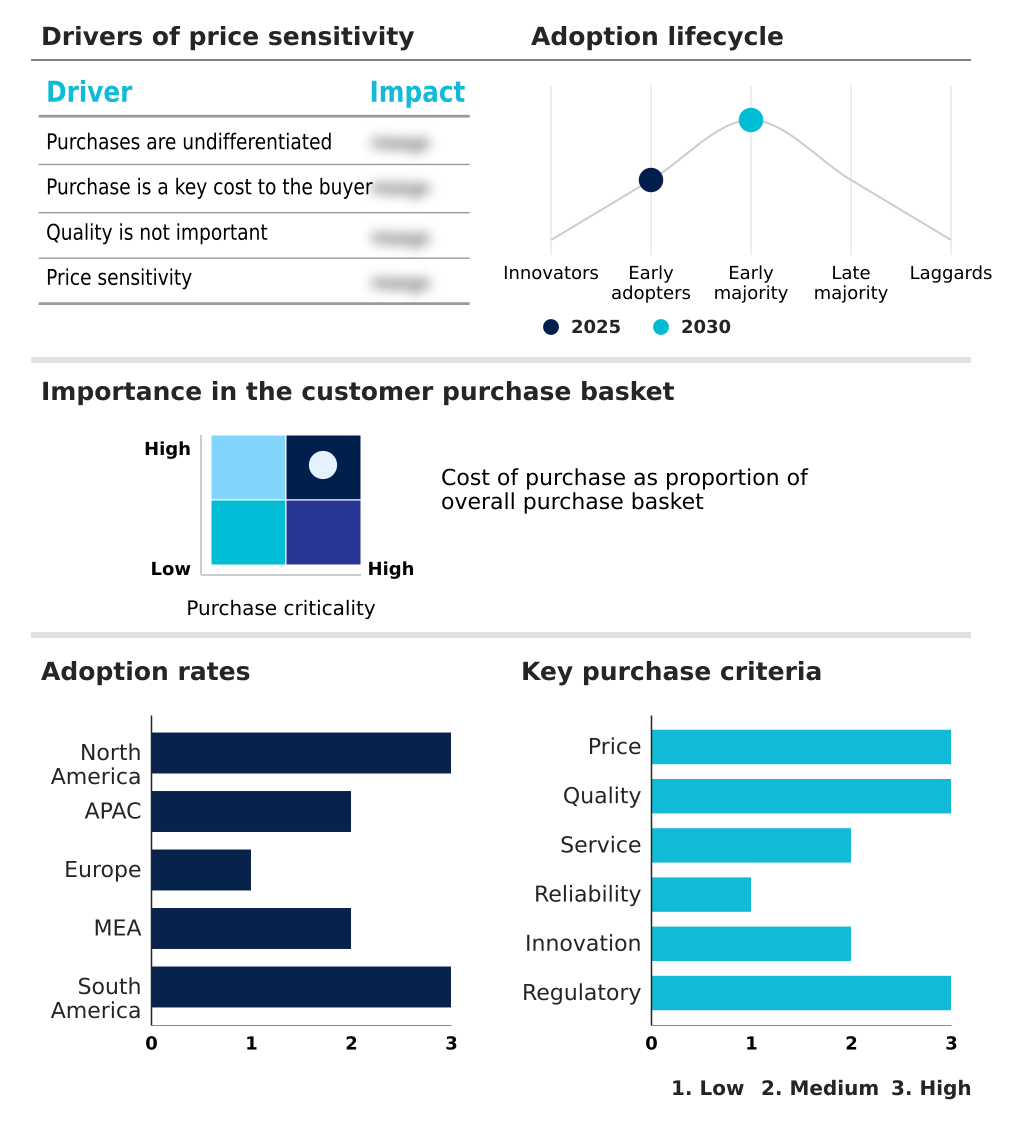
Customer Landscape of Post Production Industry
Competitive Landscape
Companies are implementing various strategies, such as strategic alliances, post production market forecast, partnerships, mergers and acquisitions, geographical expansion, and product/service launches, to enhance their presence in the industry.
Amazon.com Inc. - Analysis shows a focus on delivering end-to-end, cloud-based workflows featuring scalable rendering, remote editorial workstations, and automated media ingest to improve post production efficiency.
The industry research and growth report includes detailed analyses of the competitive landscape of the market and information about key companies, including:
- Amazon.com Inc.
- AT and T Inc.
- Comcast Corp.
- Deluxe Media Inc.
- Eros International Media Ltd.
- Framestore Ltd.
- Lantern Entertainment
- Lions Gate Entertainment Corp.
- Netflix Inc.
- Paramount Global
- Pixel Digital Studios
- Prime Focus Ltd.
- Red Chillies Entertainments
- Sony Group Corp.
- Storyteller Distribution Co. LLC
- Streamland Media Inc.
- STUDIO GHIBLI Inc.
- The Walt Disney Co.
- Weta Digital Ltd.
Qualitative and quantitative analysis of companies has been conducted to help clients understand the wider business environment as well as the strengths and weaknesses of key industry players. Data is qualitatively analyzed to categorize companies as pure play, category-focused, industry-focused, and diversified; it is quantitatively analyzed to categorize companies as dominant, leading, strong, tentative, and weak.
Recent Development and News in Post production market
- In September, 2024, Lionsgate Entertainment Corporation established a strategic partnership to implement a customized generative artificial intelligence suite to assist in the final mastering and color grading of large-scale cinematic projects.
- In October, 2024, Adobe Systems Incorporated integrated generative AI features directly into its Premiere Pro application, enabling editors to use text-based editing and generative extension capabilities.
- In April, 2025, Netflix Incorporated implemented a new global framework for its production partners, which mandates the use of specific cloud-integrated security protocols for all high-definition content processing.
- In May, 2025, Sony Corporation introduced an enhanced version of its Ci Media Cloud platform, which includes real-time synchronization features for multi-user editing and frame-accurate review tools for uncompressed 8K video streams.
Dive into Technavio’s robust research methodology, blending expert interviews, extensive data synthesis, and validated models for unparalleled Post Production Market insights. See full methodology.
| Market Scope | |
|---|---|
| Page number | 306 |
| Base year | 2025 |
| Historic period | 2020-2024 |
| Forecast period | 2026-2030 |
| Growth momentum & CAGR | Accelerate at a CAGR of 12.9% |
| Market growth 2026-2030 | USD 18203.5 million |
| Market structure | Fragmented |
| YoY growth 2025-2026(%) | 12.3% |
| Key countries | US, Canada, Mexico, China, India, Japan, South Korea, Australia, Singapore, UK, Germany, France, Italy, Spain, The Netherlands, UAE, South Africa, Saudi Arabia, Egypt, Israel, Brazil, Argentina and Chile |
| Competitive landscape | Leading Companies, Market Positioning of Companies, Competitive Strategies, and Industry Risks |
Research Analyst Overview
- The global post production market is advancing through the deep integration of sophisticated technologies that are reshaping creative and operational workflows. Innovations such as cloud-native workflows and real-time rendering are now foundational, allowing for decentralized global collaboration and more efficient production cycles.
- The adoption of generative AI has moved beyond automation to become a pivotal creative tool for tasks like digital compositing and motion graphics. Boardroom decisions are increasingly influenced by the need to invest in infrastructure capable of handling high dynamic range (HDR) content and immersive audio formats, impacting capital expenditure on specialized color grading and sound design suites.
- Visual effects pipelines now heavily rely on neural engines for complex processes like rotoscoping and multi-source editing. This technological push, which has led to processing time reductions of up to 30% in certain tasks, is essential for managing the demands of stereoscopic 3D conversion, automated dialogue replacement (ADR), and high-frame-rate video.
- Consequently, digital asset management and metadata management systems have become critical for maintaining quality and security across the entire post production process, including the creation of the final digital cinema package (DCP) and the implementation of in-camera visual effects and object-based sound design.
What are the Key Data Covered in this Post Production Market Research and Growth Report?
-
What is the expected growth of the Post Production Market between 2026 and 2030?
-
USD 18.20 billion, at a CAGR of 12.9%
-
-
What segmentation does the market report cover?
-
The report is segmented by Technique (VFX, Audio processing, 2D and 3D conversion, Editing, and Others), Application (Movies, Television, Commercials, and Online videos), End-user (Production houses, Independent filmmakers, and Television studios) and Geography (North America, APAC, Europe, Middle East and Africa, South America)
-
-
Which regions are analyzed in the report?
-
North America, APAC, Europe, Middle East and Africa and South America
-
-
What are the key growth drivers and market challenges?
-
Rising consumer expectations for immersive and high-resolution media content, Escalating infrastructure costs and technical complexity
-
-
Who are the major players in the Post Production Market?
-
Amazon.com Inc., AT and T Inc., Comcast Corp., Deluxe Media Inc., Eros International Media Ltd., Framestore Ltd., Lantern Entertainment, Lions Gate Entertainment Corp., Netflix Inc., Paramount Global, Pixel Digital Studios, Prime Focus Ltd., Red Chillies Entertainments, Sony Group Corp., Storyteller Distribution Co. LLC, Streamland Media Inc., STUDIO GHIBLI Inc., The Walt Disney Co. and Weta Digital Ltd.
-
Market Research Insights
- The post production market is defined by a dynamic interplay of technological advancements and shifting workflow paradigms. The proliferation of remote collaboration tools has become central, with adoption rates increasing by over 40% as studios embrace decentralized talent pools. This is supported by the development of virtual workstations and robust edge server networks, which reduce latency in global production pipelines.
- Concurrently, the efficiency of the media supply chain is being optimized through AI-driven archival footage restoration and advanced localization services, which have been shown to accelerate content delivery to international markets by up to 25%. However, rising data management complexity remains a significant hurdle.
- The need for sophisticated cybersecurity in media is paramount, as distributed workflows expand the potential for intellectual property breaches, demanding a strategic balance between accessibility and security.
We can help! Our analysts can customize this post production market research report to meet your requirements.
 RIA -
RIA - 
