


Secondhand Apparel Market Size 2026-2030
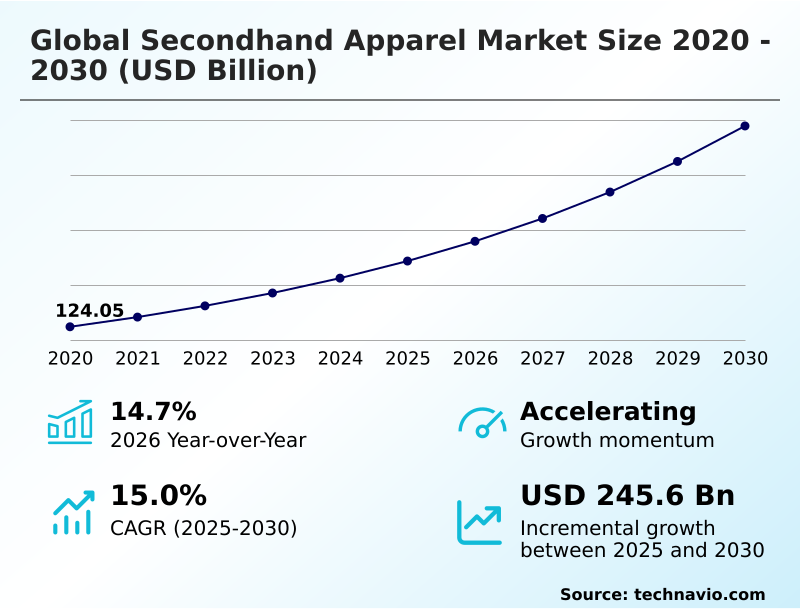
The secondhand apparel market size is valued to increase by USD 245.60 billion, at a CAGR of 15% from 2025 to 2030. Economic considerations and heightened value perception will drive the secondhand apparel market.
Major Market Trends & Insights
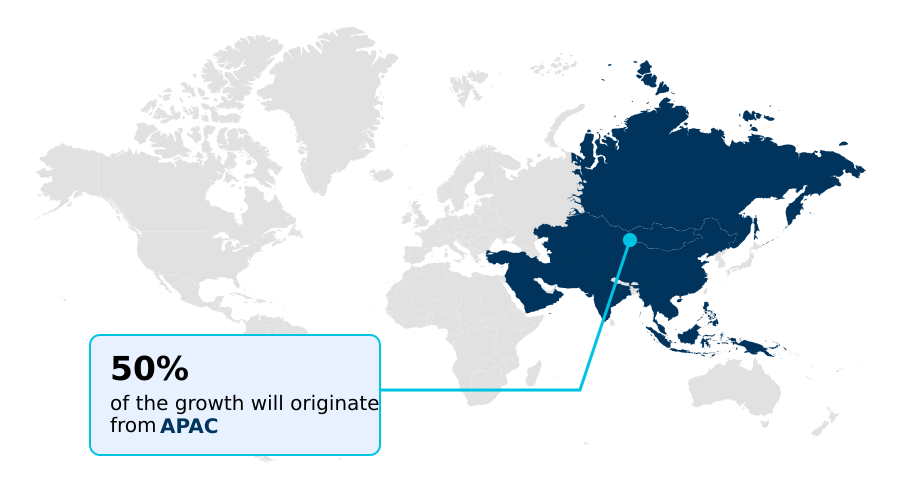
- APAC dominated the market and accounted for a 49.8% growth during the forecast period.
- By End-user - Women segment was valued at USD 92.15 billion in 2024
- By Type - TTSD segment accounted for the largest market revenue share in 2024
Market Size & Forecast
- Market Opportunities: USD 365.10 billion
- Market Future Opportunities: USD 245.60 billion
- CAGR from 2025 to 2030 : 15%
Market Summary
- The secondhand apparel market is transitioning from a niche interest to a pivotal force in the fashion industry, fueled by a consumer shift toward sustainability, value, and individuality. This evolution is facilitated by digital resale platforms offering professionalized services, including authentication and curated collections, which builds consumer trust and broadens market participation.
- A significant trend involves the adoption of resale-as-a-service (RaaS) frameworks, allowing primary market brands to enter the circular economy. For example, a mainstream retailer might integrate a take-back program, offering customers store credit for used items. This strategy increases customer lifetime value and yields data on product lifecycle performance, directly informing future design and manufacturing.
- Despite this momentum, the sector faces substantial operational challenges. The fundamental reliance on a decentralized, consumer-driven supply stream creates unpredictability in inventory volume and quality, demanding sophisticated logistics and stringent quality control protocols to manage single-SKU items effectively. Successfully scaling these human-intensive processes is key to sustained growth.
What will be the Size of the Secondhand Apparel Market during the forecast period?
Get Key Insights on Market Forecast (PDF) Get Free Sample
How is the Secondhand Apparel Market Segmented?
The secondhand apparel industry research report provides comprehensive data (region-wise segment analysis), with forecasts and estimates in "USD million" for the period 2026-2030, as well as historical data from 2020-2024 for the following segments.
- End-user
- Women
- Men
- Kids
- Type
- TTSD
- Resale
- Product type
- Clothing
- Footwear
- Accessories
- Bags
- Geography
- APAC
- China
- Japan
- India
- North America
- US
- Canada
- Mexico
- Europe
- UK
- Germany
- France
- South America
- Brazil
- Argentina
- Middle East and Africa
- UAE
- South Africa
- Saudi Arabia
- Rest of World (ROW)
- APAC
By End-user Insights
The women segment is estimated to witness significant growth during the forecast period.
The women's segment is the primary engine of the secondhand apparel market, driven by value-seeking, sustainability ethics, and style individuality.
Consumers are highly engaged across diverse channels, from managed marketplaces to peer-to-peer platforms, often using online consignment for aspirational consumption of luxury goods.
This demographic is both the largest source of demand and the primary supplier, creating a self-sustaining brand ecosystem integration. Utilizing a curated vintage collection and embracing product lifecycle extension are key behaviors.
The implementation of ai-driven personalization has improved user engagement by over 15% on some platforms, reflecting the segment's pivotal role in advancing the circular fashion movement and recommerce platform adoption.
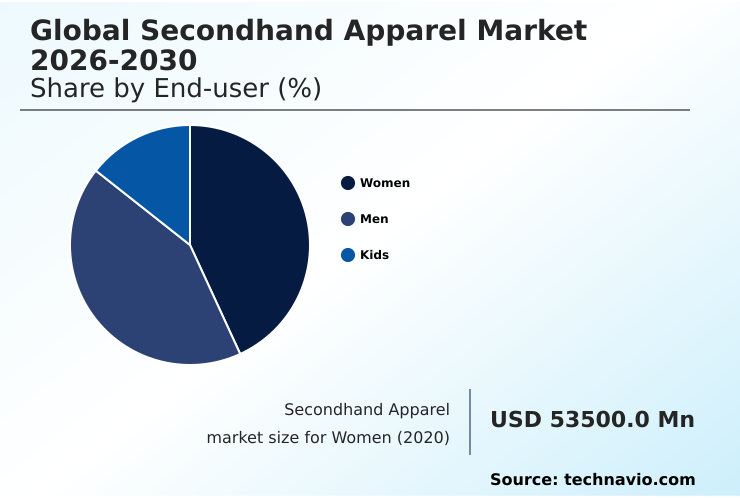
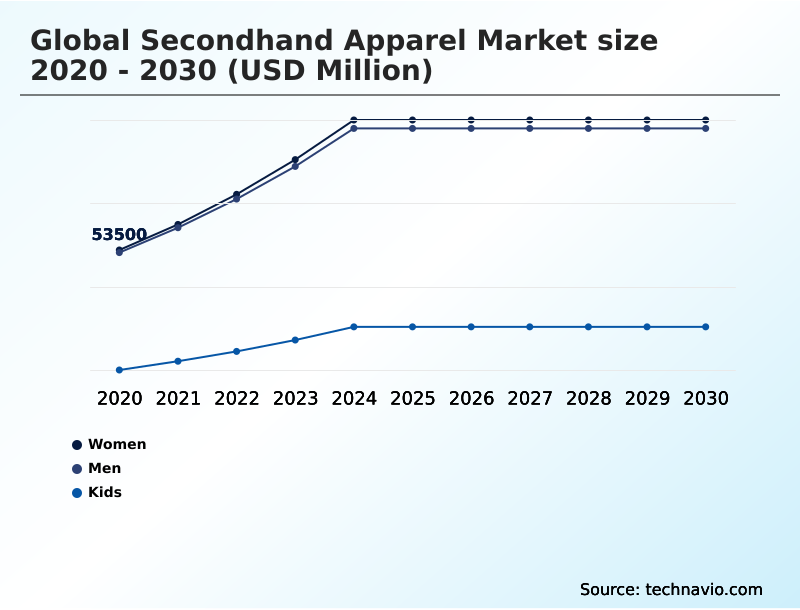
The Women segment was valued at USD 92.15 billion in 2024 and showed a gradual increase during the forecast period.
Regional Analysis
APAC is estimated to contribute 49.8% to the growth of the global market during the forecast period.Technavio’s analysts have elaborately explained the regional trends and drivers that shape the market during the forecast period.
See How Secondhand Apparel Market Demand is Rising in APAC Get Free Sample
The geographic landscape is characterized by varied maturity and growth trajectories. APAC is the fastest-growing region, projected to contribute nearly 50% of the market's incremental growth, driven by a youthful, digitally-native population.
In contrast, North America and Europe, while more mature, remain significant, accounting for approximately 21% and 21% of the opportunity, respectively. In these developed markets, the shift towards a circular economy is more pronounced.
The operational efficiency of reverse logistics in Europe has improved, with some platforms achieving a 15% reduction in processing times for returned goods.
This highlights how regional infrastructure and consumer attitudes shape the adoption of resale market models, from physical thrift stores to advanced online marketplaces for pre-owned clothing.
Market Dynamics
Our researchers analyzed the data with 2025 as the base year, along with the key drivers, trends, and challenges. A holistic analysis of drivers will help companies refine their marketing strategies to gain a competitive advantage.
- The global secondhand apparel market's trajectory is increasingly shaped by the impact of recommerce on retail strategy, compelling traditional brands to reconsider their business models. Many are now exploring brand-led resale impact on customer loyalty, using take-back programs to enhance customer lifetime value.
- This shift is enabled by the role of raas in mainstream brand adoption, which simplifies entry into the circular economy. However, this transition is not without hurdles; the challenges in secondhand apparel reverse logistics and the complexities of managing single-sku inventory in secondhand retail demand significant operational investment.
- Data analytics for secondhand style longevity is becoming crucial for pricing and curation. For high-value segments, counterfeit authentication for luxury resale is a non-negotiable trust factor. The rise of social commerce influence on pre-loved fashion sales and the power of user-generated content's role in online thrift stores are reshaping marketing.
- Success often hinges on comparing managed vs peer-to-peer marketplaces to find the right operational fit, with some c2b2c business model for secondhand luxury platforms reporting 2x higher engagement than pure P2P sites.
- Ultimately, measuring sustainability in the circular economy while integrating phygital models in apparel resale and optimizing textile recycling in circular fashion are key to long-term viability and navigating supply chain fragmentation in used clothing.
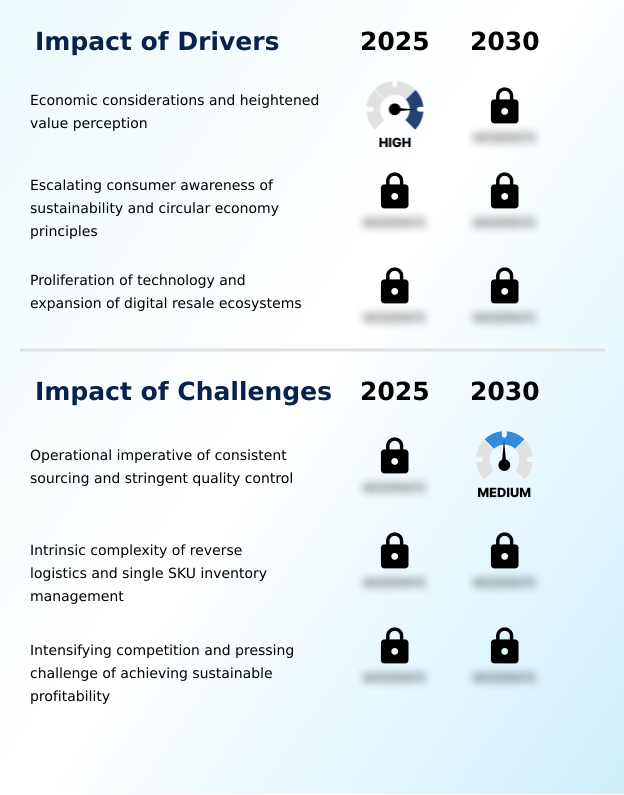
What are the key market drivers leading to the rise in the adoption of Secondhand Apparel Industry?
- Economic considerations and a heightened perception of value are primary drivers propelling the expansion of the secondhand apparel market.
- Economic pressures and an evolution in consumer value perception are formidable drivers. Facing diminished disposable income, consumers are adopting prudent purchasing behaviors, making the secondhand market an attractive fast fashion alternative.
- The market's value proposition of affordability and quality has democratized access to premium brands, where items on some platforms retain up to 70% of their original resale value.
- This shift fosters a sophisticated approach to consumption, where garment durability and brand equity are prioritized. Platforms leveraging social commerce and user-generated content see engagement rates 40% higher than those without, turning economic necessity into a socially validated, savvy choice.
- This dynamic promotes aspirational consumption and conscious consumption.
What are the market trends shaping the Secondhand Apparel Industry?
- The strategic integration of recommerce into mainstream retail and brand strategy is a defining trend. This pivot marks a significant departure from historical models where the secondary market operated as a separate ecosystem.
- A defining trend is the strategic integration of recommerce into mainstream retail. This movement, often termed brand-led resale, allows brands to capture resale value and enhance customer lifetime value. This pivot is supported by the proliferation of the digital resale ecosystem, where platforms utilizing a consumer-to-business-to-consumer (c2b2c) model report customer retention rates over 60% higher than traditional retail.
- The convergence of physical and digital channels into a phygital resale model further legitimizes secondhand shopping. By offering take-back programs, brands participate in the full garment durability lifecycle, which resonates with consumers focused on circular economy principles. Platforms that have integrated these services have seen a 25% increase in repeat seller activity.
What challenges does the Secondhand Apparel Industry face during its growth?
- The operational imperative of maintaining consistent sourcing and enforcing stringent quality control presents a fundamental challenge to the industry's growth.
- A persistent challenge is establishing a consistent and scalable supply chain from a fragmented, decentralized source. This reliance on consumer supply complicates demand forecasting and requires sophisticated inventory management systems for single-sku inventory management.
- The need for stringent quality control protocols is paramount, as lapses can damage brand reputation; platforms investing in multi-point inspections report return rates up to 50% lower than competitors. Furthermore, the threat of counterfeit goods necessitates resource-intensive counterfeit authentication processes, especially for secondhand luxury goods.
- Scaling these human-dependent operations of sourcing and inspection without eroding profitability is a defining challenge for the clothing resale and apparel resale markets.
Exclusive Technavio Analysis on Customer Landscape
The secondhand apparel market forecasting report includes the adoption lifecycle of the market, covering from the innovator’s stage to the laggard’s stage. It focuses on adoption rates in different regions based on penetration. Furthermore, the secondhand apparel market report also includes key purchase criteria and drivers of price sensitivity to help companies evaluate and develop their market growth analysis strategies.
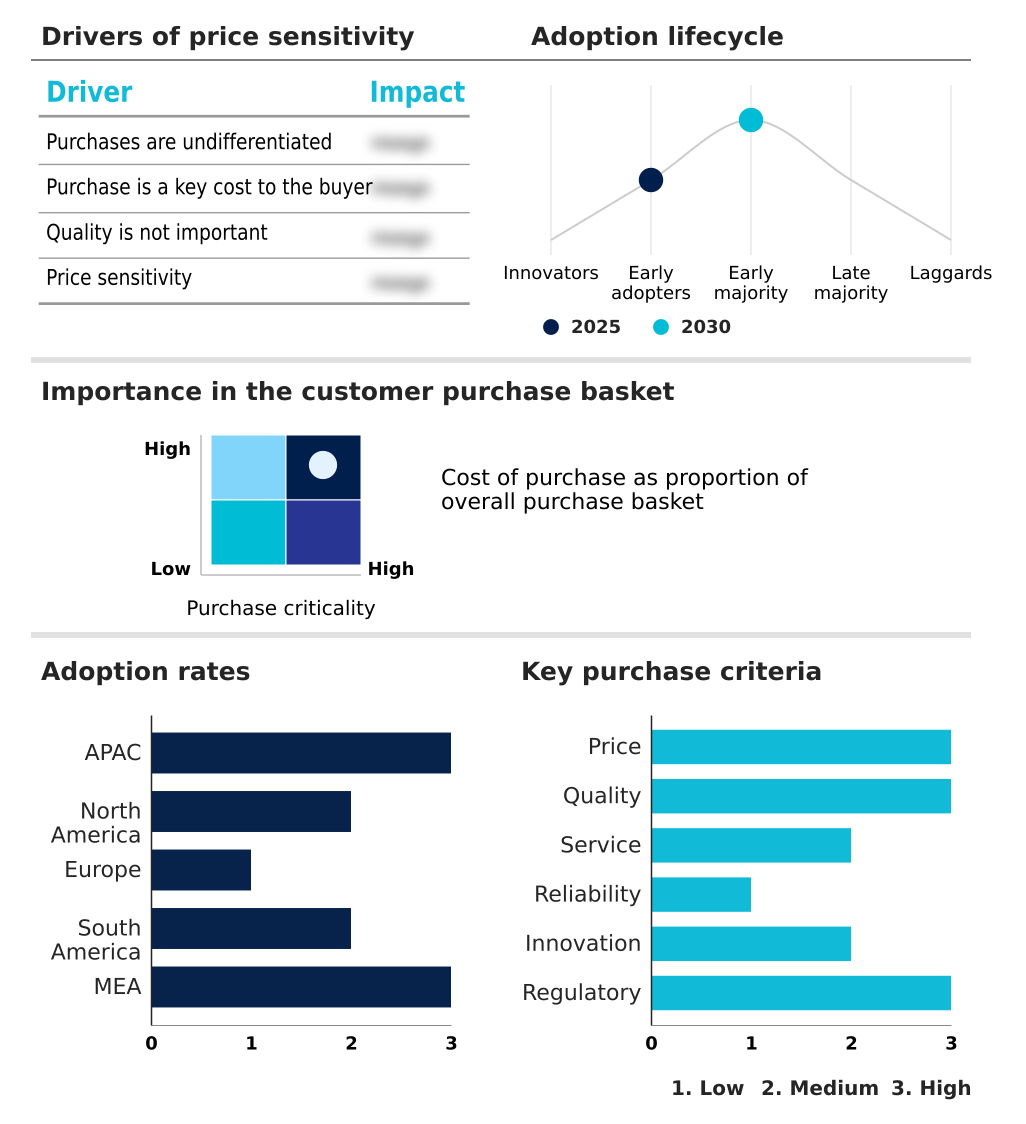
Customer Landscape of Secondhand Apparel Industry
Competitive Landscape
Companies are implementing various strategies, such as strategic alliances, secondhand apparel market forecast, partnerships, mergers and acquisitions, geographical expansion, and product/service launches, to enhance their presence in the industry.
2nd Street USA Inc. - The company's offering focuses on the purchase and sale of curated secondhand clothing and accessories, sourced from diverse channels for both retail and online.
The industry research and growth report includes detailed analyses of the competitive landscape of the market and information about key companies, including:
- 2nd Street USA Inc.
- Allbirds Inc.
- Arcteryx Sports Corp.
- Beyond Retro Ltd
- Clothes Mentor
- Crossroads Trading
- Depop Ltd.
- E.L.V. Denim Ltd
- Eileen Fisher Inc
- lululemon athletica Inc.
- Madewell Inc
- MUD Jeans International B.V.
- Patagonia Inc.
- Poshmark Inc.
- Recreational Equipment Inc.
- Savers Value Village Inc
- The RealReal Inc.
- ThredUp Inc.
- VINTED INC.
Qualitative and quantitative analysis of companies has been conducted to help clients understand the wider business environment as well as the strengths and weaknesses of key industry players. Data is qualitatively analyzed to categorize companies as pure play, category-focused, industry-focused, and diversified; it is quantitatively analyzed to categorize companies as dominant, leading, strong, tentative, and weak.
Recent Development and News in Secondhand apparel market
- In August 2024, ThredUp Inc. launched a suite of artificial intelligence tools, including a natural-language search tool and an AI-powered chatbot, to enhance personalization and solve the discovery challenge on its platform.
- In January 2025, Fanatics, a prominent sports apparel provider, announced plans to launch a new luxury sports brand, reflecting a growing consumer demand for high-quality, branded apparel that influences the secondhand market.
- In May 2025, ThredUp Inc. announced a partnership with UK-based vintage retailer Beyond Retro, introducing a curated collection of 17,000 vintage pieces to US shoppers for the first time, highlighting a trend toward cross-border curation.
- In January 2026, Lands End partnered with ThredUp Inc., leveraging its Resale-as-a-Service (RaaS) platform to launch a clean-out program that incentivizes customers with shopping credit, illustrating the mainstream adoption of recommerce.
Dive into Technavio’s robust research methodology, blending expert interviews, extensive data synthesis, and validated models for unparalleled Secondhand Apparel Market insights. See full methodology.
| Market Scope | |
|---|---|
| Page number | 282 |
| Base year | 2025 |
| Historic period | 2020-2024 |
| Forecast period | 2026-2030 |
| Growth momentum & CAGR | Accelerate at a CAGR of 15% |
| Market growth 2026-2030 | USD 245603.5 million |
| Market structure | Fragmented |
| YoY growth 2025-2026(%) | 14.7% |
| Key countries | China, Japan, India, South Korea, Australia, Indonesia, US, Canada, Mexico, UK, Germany, France, Italy, Spain, The Netherlands, Brazil, Argentina, Chile, UAE, South Africa, Saudi Arabia, Nigeria and Kenya |
| Competitive landscape | Leading Companies, Market Positioning of Companies, Competitive Strategies, and Industry Risks |
Research Analyst Overview
- The secondhand apparel market is undergoing a profound structural transformation, moving beyond traditional physical thrift stores to a sophisticated digital resale ecosystem. This evolution is driven by circular economy principles and enabled by technologies that facilitate brand ecosystem integration and product lifecycle extension. Key operational components include recommerce platforms, ranging from peer-to-peer marketplaces to managed marketplace models offering online consignment.
- The development of Resale-as-a-Service (RaaS) is a critical trend, allowing primary brands to implement take-back programs and engage in brand-led resale. For boardroom decisions, this represents a strategic pivot toward sustainable revenue models. For example, firms that have implemented robust quality control protocols and counterfeit authentication have achieved a 35% reduction in product return rates, directly impacting profitability.
- Navigating the complexities of reverse logistics, single-sku inventory management, and supply chain fragmentation, while integrating phygital resale models and exploring upcycling and textile recycling, remains central to achieving a competitive advantage.
What are the Key Data Covered in this Secondhand Apparel Market Research and Growth Report?
-
What is the expected growth of the Secondhand Apparel Market between 2026 and 2030?
-
USD 245.60 billion, at a CAGR of 15%
-
-
What segmentation does the market report cover?
-
The report is segmented by End-user (Women, Men, and Kids), Type (TTSD, and Resale), Product Type (Clothing, Footwear, Accessories, and Bags) and Geography (APAC, North America, Europe, South America, Middle East and Africa)
-
-
Which regions are analyzed in the report?
-
APAC, North America, Europe, South America and Middle East and Africa
-
-
What are the key growth drivers and market challenges?
-
Economic considerations and heightened value perception, Operational imperative of consistent sourcing and stringent quality control
-
-
Who are the major players in the Secondhand Apparel Market?
-
2nd Street USA Inc., Allbirds Inc., Arcteryx Sports Corp., Beyond Retro Ltd, Clothes Mentor, Crossroads Trading, Depop Ltd., E.L.V. Denim Ltd, Eileen Fisher Inc, lululemon athletica Inc., Madewell Inc, MUD Jeans International B.V., Patagonia Inc., Poshmark Inc., Recreational Equipment Inc., Savers Value Village Inc, The RealReal Inc., ThredUp Inc. and VINTED INC.
-
Market Research Insights
- The secondhand apparel market is defined by a structural shift toward a circular fashion model, driven by consumer demand for value and sustainability. Platforms are evolving from simple online thrift store directories to sophisticated managed marketplaces offering value-added services.
- The adoption of resale-as-a-service (RaaS) integrations by mainstream brands has been pivotal, with partners reporting a 20-30% increase in customer lifetime value. This strategy transforms the value perception of pre-loved fashion. Furthermore, the integration of peer-to-peer marketplace functionalities with robust authentication has addressed consumer trust issues, leading to a 40% lower cart abandonment rate for verified luxury items.
- This dynamic highlights the market's professionalization and its challenge to the traditional fast fashion alternative.
We can help! Our analysts can customize this secondhand apparel market research report to meet your requirements.
 RIA -
RIA -