


Smart Washing Machine Market Size 2024-2028
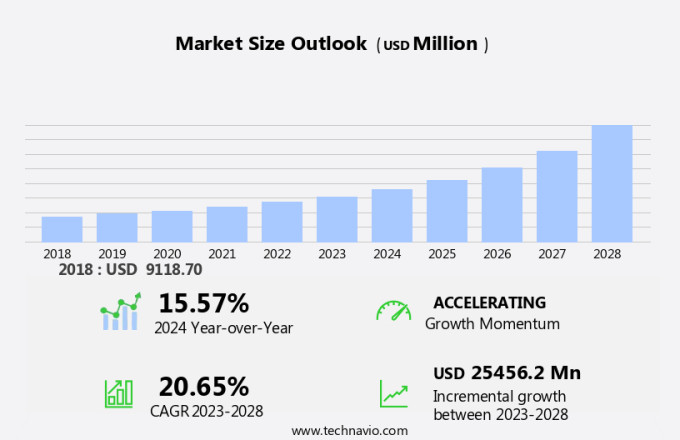
The smart washing machine market size is forecast to increase by USD 25.46 billion at a CAGR of 20.65% between 2023 and 2028. The market is experiencing significant growth due to several key factors. One of the primary drivers is the increasing demand for energy-efficient appliances as consumers seek to reduce their utility bills and minimize their carbon footprint. Another trend influencing the market is the integration of Wi-Fi connectivity, enabling users to remotely monitor and control their washing machines, as well as receive notifications and diagnostics. However, energy consumption and water usage remain critical challenges for manufacturers, as they strive to create more eco-friendly and cost-effective solutions. To address these concerns, the industry is focusing on developing advanced technologies, such as artificial intelligence and machine learning, to optimize energy and water usage, and enhance overall performance. By staying abreast of these trends and challenges, market participants can capitalize on the growing demand for smart washing machines and position themselves as leaders in the industry.
What will be the Size of the Market During the Forecast Period?
The washing machine market in the US is witnessing significant advancements with the integration of smart technologies. These innovations are transforming traditional washing machines into intelligent appliances, offering enhanced functionality and convenience to consumers. Smart washing machines are increasingly becoming a popular choice in both residential and commercial applications. In the US residential sector, the demand for energy-efficient appliances is on the rise due to growing awareness about water scarcity and energy consumption. Smart washing machines, with their Wi-Fi connectivity and energy star ratings, cater to this need, allowing consumers to monitor and manage their laundry remotely, reducing water and energy usage.
Additionally, the commercial application segment, including the hospitality sector and hospitals, is also embracing smart washing machines. The ability to monitor and manage multiple loads, compatibility with various detergent types, and improved energy efficiency are key factors driving the adoption of these appliances in commercial settings. Urbanization is another significant factor contributing to the growth of the market in the US. With increasing population density, the demand for compact, space-saving appliances is on the rise. Top-load and front-load smart washing machines cater to this need, offering high capacity and advanced features in a compact design. Compatibility issues with various brands and models are a concern for consumers when purchasing smart washing machines.
However, the availability of multi-brand stores and exclusive stores offering a wide range of options, as well as online platforms, ensures that consumers have access to a diverse selection of smart washing machines. In conclusion, the market in the US is witnessing growth due to the increasing demand for energy-efficient appliances, the need for remote monitoring and management, and the availability of compact, space-saving designs. The integration of Wi-Fi connectivity and advanced features is transforming the washing machine market, offering consumers convenience and improved functionality.
Market Segmentation
The market research report provides comprehensive data (region-wise segment analysis), with forecasts and estimates in "USD billion" for the period 2024-2028, as well as historical data from 2018-2022 for the following segments.
- Product Type
- Front load
- Top load
- Distribution Channel
- Offline
- Online
- Geography
- North America
- Canada
- US
- Europe
- Germany
- UK
- APAC
- China
- Middle East and Africa
- South America
- North America
By Product Type Insights
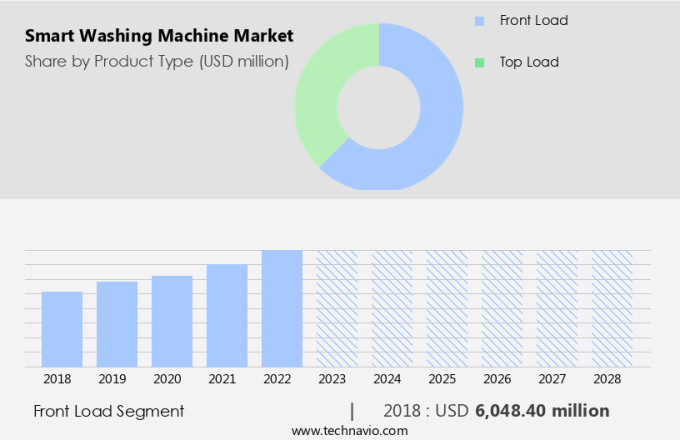
The front-load segment is estimated to witness significant growth during the forecast period. Front load washing machines, such as those with LG's Turbo Wash technology, offer eco-friendly advantages for consumers seeking to reduce water and energy usage in their daily lives. These advanced machines use approximately 40% less water than traditional top load washers and dry clothes faster due to their high-speed spin cycle. LG's latest offering includes both front and top load models, with the former featuring an optional LG Sidekick pedestal washer for smaller loads. The smart front load machines are compatible with the LG SmartThinQ mobile app, allowing users to monitor wash times and receive notifications for added convenience. As the middle class population in the US continues to prioritize energy efficiency and time-saving features in their household appliances, brands like LG are meeting these consumer preferences with innovative solutions. By integrating technology into their appliances, manufacturers are enhancing the overall washing experience while catering to the growing demand for eco-friendly lifestyles.
Get a glance at the market share of various segments Request Free Sample
The front load segment was valued at USD 6.05 billion in 2018 and showed a gradual increase during the forecast period.
Regional Insights
North America is estimated to contribute 32% to the growth of the global market during the forecast period. Technavio's analysts have elaborately explained the regional trends and drivers that shape the market during the forecast period.

For more insights on the market share of various regions Request Free Sample
The market in North America is experiencing significant growth due to the increasing adoption of commercial laundry equipment with advanced technologies. These smart appliances, which are integral to the development of digitized homes, are gaining popularity in the region. The market's expansion can be attributed to the rising demand for water-conserving and energy-efficient electronic appliances. Furthermore, the burgeoning online laundry service sector in the US is fueling the demand for smart washing machines. Additionally, the construction of smart homes is driving the market's growth, as homeowners seek to integrate technology into their daily lives.
Market Dynamics
Our researchers analyzed the data with 2023 as the base year, along with the key drivers, trends, and challenges. A holistic analysis of drivers will help companies refine their marketing strategies to gain a competitive advantage.
Market Driver
Changes in the global labor force are the key drivers of the market. The commercial laundry equipment market, specifically smart washing machines, is experiencing significant growth due to the increasing adoption of smart appliances in both residential and commercial applications. With the rise of smart homes and digitized media platforms like Digitized House Media, NPS Publishing, and others, consumers are increasingly prioritizing energy efficiency and eco-friendly lifestyles. Smart washing machines, with their Wi-Fi connectivity, Energy Star ratings, and water usage optimization, align perfectly with these consumer preferences. The residential application segment is expected to dominate the market, driven by the middle class population's increasing disposable income and brand recognition. However, the commercial application segment, including the hospitality sector, hospitals, and other institutions, also presents a substantial opportunity.
Moreover, urbanization and the need for energy-efficient appliances are key factors driving demand in this segment. Compatibility issues with multi-brand stores and exclusive stores, as well as the availability of top-load and front-load washing machines, may pose challenges to market growth. Nevertheless, the benefits of smart washing machines, such as reduced energy consumption and water usage, make them an attractive investment for both residential and commercial consumers. As the world grapples with water scarcity and energy concerns, the demand for smart washing machines is poised to increase.
Market Trends
The introduction of IoT-enabled washing machine and laundry services is the upcoming trend in the market. The global market for smart washing machines, also known as commercial laundry equipment with IoT capabilities, is experiencing significant growth as consumers and businesses increasingly prioritize energy efficiency, water conservation, and convenience. Smart appliances, such as digitized washing machines, are becoming a staple in both residential and commercial applications, including the hospitality sector, hospitals, and urban areas. These energy-efficient appliances, often boasting Wi-Fi connectivity and Energy Star ratings, cater to eco-friendly lifestyles and the needs of the middle class population. Online sales channels further expand accessibility.
However, compatibility issues between various brands and models can pose challenges. Top-loading and front-loading smart washing machines are popular choices, with the former offering larger capacities and the latter providing better energy efficiency. As water scarcity and energy consumption become pressing concerns, the demand for smart washing machines continues to rise. Stay tuned for more insights on this evolving market.
Market Challenge
Long product lifecycle is a key challenge affecting the market growth. The commercial laundry equipment market, encompassing smart washing machines, is experiencing significant growth due to the increasing adoption of smart appliances in both residential and commercial applications. With the digitization of homes and the rise of smart homes, there is a growing demand for energy-efficient and water-saving appliances, such as those with Energy Star ratings. The residential application segment, driven by the middle-class population's preference for eco-friendly lifestyles and brand recognition, is expected to dominate the market.
In contrast, the commercial application segment, including the hospitality sector, hospitals, and urbanization, seeks energy-efficient appliances with Wi-Fi connectivity to optimize energy consumption and water usage. Compatibility issues between multi-brand stores and exclusive stores, as well as the availability of smart washing machines in online channels, may impact market growth. Manufacturers must address these challenges to cater to consumer preferences and maintain their brand reputation.
Exclusive Customer Landscape
The market forecasting report includes the adoption lifecycle of the market, covering from the innovator's stage to the laggard's stage. It focuses on adoption rates in different regions based on penetration. Furthermore, the report also includes key purchase criteria and drivers of price sensitivity to help companies evaluate and develop their market growth analysis strategies.

Customer Landscape
Key Companies & Market Insights
Companies are implementing various strategies, such as strategic alliances, partnerships, mergers and acquisitions, geographical expansion, and product/service launches, to enhance their presence in the market.
Arcelik A.S: The company offers smart washing machines such as HygieneShield.
The market research and growth report includes detailed analyses of the competitive landscape of the market and information about key companies, including:
- Electrolux group
- General Electric Co.
- Haier Smart Home Co. Ltd.
- Hitachi Ltd.
- Hwasung Washing Machine Co.
- IFB Industries Ltd.
- Lenovo Group Ltd.
- LG Corp.
- MIDEA Group Co. Ltd.
- Miele and Cie. KG
- Panasonic Holdings Corp.
- Robert Bosch GmbH
- Samsung Electronics Co. Ltd.
- Sharp Corp.
- Siemens AG
- Tata Sons Pvt. Ltd.
- TCL Electronics Holdings Ltd.
- Toshiba Corp.
- Whirlpool Corp.
Qualitative and quantitative analysis of companies has been conducted to help clients understand the wider business environment as well as the strengths and weaknesses of key market players. Data is qualitatively analyzed to categorize companies as pure play, category-focused, industry-focused, and diversified; it is quantitatively analyzed to categorize companies as dominant, leading, strong, tentative, and weak.
Research Analyst Overview
In today's digitized world, smart washing machines are revolutionizing the laundry industry. These advanced appliances, falling under the umbrella of smart homes and commercial laundry equipment, offer Wi-Fi connectivity and energy efficiency. In the residential application segment, eco-friendly lifestyles and middle class population preferences lean towards energy star rated, water-saving machines. In the commercial application segment, sectors like hospitality and healthcare, including hotels and hospitals, are embracing these smart solutions. Urbanization and water scarcity concerns further fuel the demand for energy-efficient, water-saving appliances. Brands with strong recognition cater to both markets through multi-brand stores and exclusive outlets.
However, compatibility issues between various brands and models may arise, making it essential to consider top-load or front-load machines based on specific needs. Overall, the market for smart washing machines continues to grow, driven by consumer preferences for convenience, energy savings, and sustainability.
|
Market Scope |
|
|
Report Coverage |
Details |
|
Page number |
169 |
|
Base year |
2023 |
|
Historic period |
2018-2022 |
|
Forecast period |
2024-2028 |
|
Growth momentum & CAGR |
Accelerate at a CAGR of 20.65% |
|
Market growth 2024-2028 |
USD 25.46 billion |
|
Market structure |
Fragmented |
|
YoY growth 2023-2024(%) |
15.57 |
|
Regional analysis |
North America, Europe, APAC, Middle East and Africa, and South America |
|
Performing market contribution |
North America at 32% |
|
Key countries |
US, China, Germany, Canada, and UK |
|
Competitive landscape |
Leading Companies, Market Positioning of Companies, Competitive Strategies, and Industry Risks |
|
Key companies profiled |
Arcelik A.S., Electrolux group, General Electric Co., Haier Smart Home Co. Ltd., Hitachi Ltd., Hwasung Washing Machine Co., IFB Industries Ltd., Lenovo Group Ltd., LG Corp., MIDEA Group Co. Ltd., Miele and Cie. KG, Panasonic Holdings Corp., Robert Bosch GmbH, Samsung Electronics Co. Ltd., Sharp Corp., Siemens AG, Tata Sons Pvt. Ltd., TCL Electronics Holdings Ltd., Toshiba Corp., and Whirlpool Corp. |
|
Market dynamics |
Parent market analysis, market growth inducers and obstacles, market forecast, fast-growing and slow-growing segment analysis, COVID-19 impact and recovery analysis and future consumer dynamics, market condition analysis for the forecast period |
|
Customization purview |
If our market report has not included the data that you are looking for, you can reach out to our analysts and get segments customized. |
What are the Key Data Covered in this Market Research and Growth Report?
- CAGR of the market during the forecast period
- Detailed information on factors that will drive the market growth and forecasting between 2024 and 2028
- Precise estimation of the size of the market and its contribution of the market in focus to the parent market
- Accurate predictions about upcoming market growth and trends and changes in consumer behaviour
- Growth of the market across North America, Europe, APAC, Middle East and Africa, and South America
- Thorough analysis of the market's competitive landscape and detailed information about companies
- Comprehensive analysis of factors that will challenge the growth of market companies
We can help! Our analysts can customize this market research report to meet your requirements. Get in touch