



Space Heaters Market Size 2026-2030
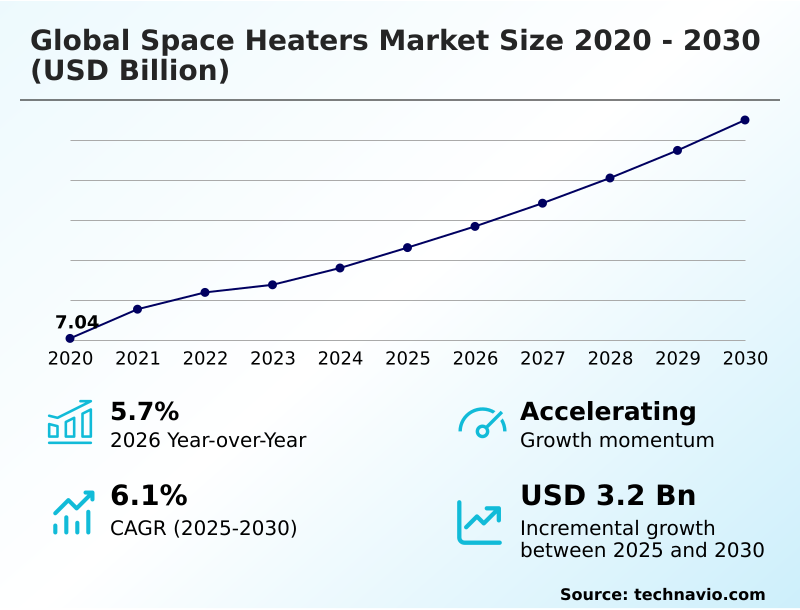
The space heaters market size is valued to increase by USD 3.20 billion, at a CAGR of 6.1% from 2025 to 2030. Increasing demand for highly efficient, energy-saving, and safe domestic heating appliances will drive the space heaters market.
Major Market Trends & Insights
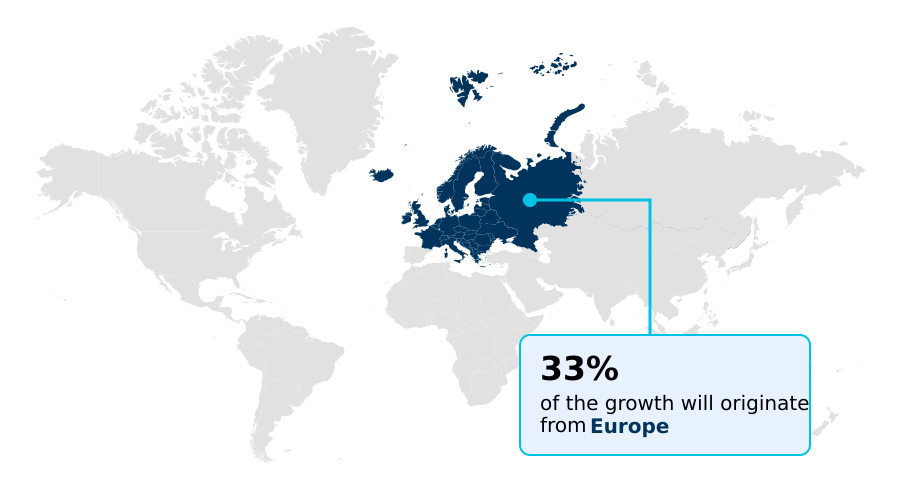
- Europe dominated the market and accounted for a 32.9% growth during the forecast period.
- By Application - Residential segment was valued at USD 3.71 billion in 2024
- By Product - Fan heaters segment accounted for the largest market revenue share in 2024
Market Size & Forecast
- Market Opportunities: USD 5.47 billion
- Market Future Opportunities: USD 3.20 billion
- CAGR from 2025 to 2030 : 6.1%
Market Summary
- The space heaters market is undergoing significant evolution, driven by a confluence of technological innovation and shifting consumer priorities. The demand for energy-efficient home appliances is compelling manufacturers to move beyond traditional designs, focusing on advancements like ptc heating element technology and improved thermal circulation for better performance.
- Concurrently, stringent regulations, such as the ecodesign for sustainable products regulation, are reshaping product development, mandating higher efficiency and safety standards. This regulatory pressure creates a complex operational scenario for businesses, where supply chain and manufacturing processes must be adapted to incorporate compliant components and materials without escalating costs prohibitively.
- For instance, a manufacturer aiming for compliance must re-engineer its production line to integrate certified smart thermostat integration, balancing R&D investment with market price sensitivity. The market is also characterized by the growing adoption of smart home connectivity, which allows for remote temperature regulation and programmable heating schedules, further pushing the industry toward more sophisticated, user-centric heating solutions.
What will be the Size of the Space Heaters Market during the forecast period?
Get Key Insights on Market Forecast (PDF) Get Free Sample
How is the Space Heaters Market Segmented?
The space heaters industry research report provides comprehensive data (region-wise segment analysis), with forecasts and estimates in "USD million" for the period 2026-2030, as well as historical data from 2020-2024 for the following segments.
- Application
- Residential
- Commercial
- Industrial
- Product
- Fan heaters
- Convection heaters
- Radiant heaters
- Ceramic heaters
- Distribution channel
- Offline
- Online
- Geography
- Europe
- Germany
- UK
- France
- North America
- US
- Canada
- Mexico
- APAC
- China
- Japan
- India
- South America
- Brazil
- Argentina
- Colombia
- Middle East and Africa
- Saudi Arabia
- UAE
- South Africa
- Rest of World (ROW)
- Europe
By Application Insights
The residential segment is estimated to witness significant growth during the forecast period.
The residential segment is shifting toward advanced supplemental heating solutions, driven by a desire for greater household thermal comfort and energy consumption reduction. Consumers increasingly prioritize units featuring smart thermostat integration and advanced safety features, which are becoming standard.
This move is supported by data indicating that smart residential heaters can reduce average household energy use by up to 15%.
The demand for compact and portable design aesthetics that complement modern interiors influences purchasing decisions, alongside the need for quiet operation heaters in living spaces.
Manufacturers are responding with innovations in convection heating and bladeless fan technology, incorporating durable construction materials to meet consumer expectations for both performance and longevity, aligning with modern eco-design principles.
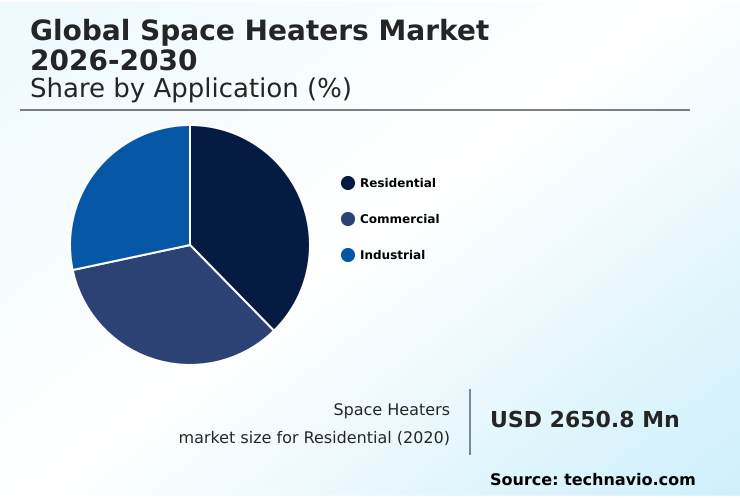
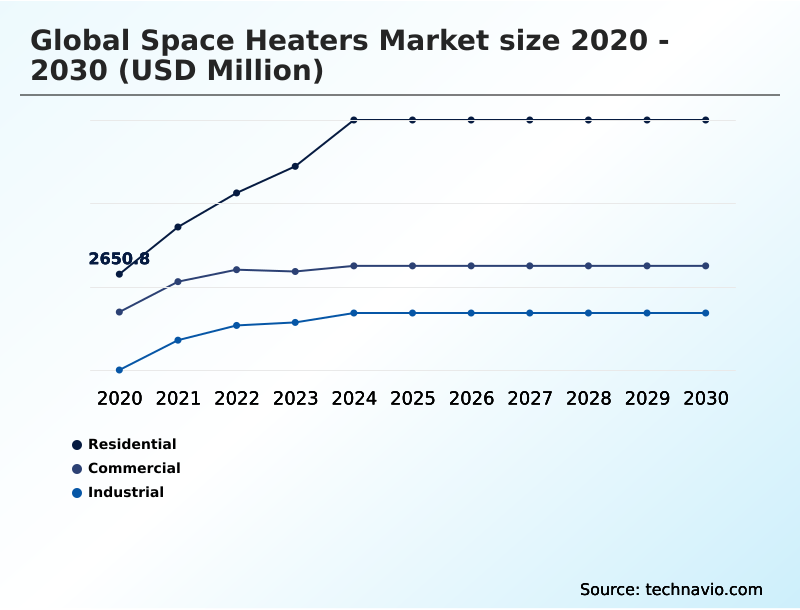
The Residential segment was valued at USD 3.71 billion in 2024 and showed a gradual increase during the forecast period.
Regional Analysis
Europe is estimated to contribute 32.9% to the growth of the global market during the forecast period.Technavio’s analysts have elaborately explained the regional trends and drivers that shape the market during the forecast period.
See How Space Heaters Market Demand is Rising in Europe Get Free Sample
The geographic landscape is defined by varied regional demands and regulatory pressures.
In Europe, the push for energy efficiency is paramount, with district heating systems gaining traction as a substitute and new capacity from alternatives like solar thermal reaching 141 MWth in key countries like Germany.
In North America, stringent safety protocols like UL1278 standards and the California fire code section 605.10 dictate product design.
Meanwhile, APAC is a hub for sustainable manufacturing processes and innovation in graphene enhanced heating, with a focus on explosion-proof heaters for industrial heating equipment.
Across regions, a common thread is the need for localized heating that balances performance with compliance.
This dynamic requires manufacturers to navigate differing standards, from CE mark certification in Europe to specific energy performance certificate (EPC) ratings, while delivering effective residential heating solutions.
Market Dynamics
Our researchers analyzed the data with 2025 as the base year, along with the key drivers, trends, and challenges. A holistic analysis of drivers will help companies refine their marketing strategies to gain a competitive advantage.
- Strategic decision-making in the space heaters market is increasingly complex, requiring a deep understanding of nuanced performance trade-offs and operational costs. For instance, evaluating the benefits of convection versus radiant heating is no longer just about thermal output; it involves assessing how each technology impacts energy bills, a critical factor for both residential and commercial end-users.
- Businesses must analyze the total cost of ownership, where the lower upfront price of some models is offset by higher long-term expenses, with some electric variants costing over three times more to operate annually than gas alternatives. This economic reality directly influences supply chain strategies, as manufacturers must forecast demand for different product tiers.
- Understanding the role of IoT in commercial building heating and how to integrate heaters with home automation systems has become vital for differentiation. As consumer awareness grows, topics such as the safety features in modern ceramic heaters, how smart thermostats reduce energy costs, and maintenance requirements for oil-filled radiators are shaping purchasing decisions.
- Firms that effectively communicate the value proposition of advancements in bladeless fan heater design and how tip-over sensors prevent fire hazards are better positioned to capture market share. The ability to cater to niche demands, such as using infrared heaters for outdoor patios or choosing heaters for poorly insulated homes, while navigating compliance with ecodesign regulations, defines market leadership.
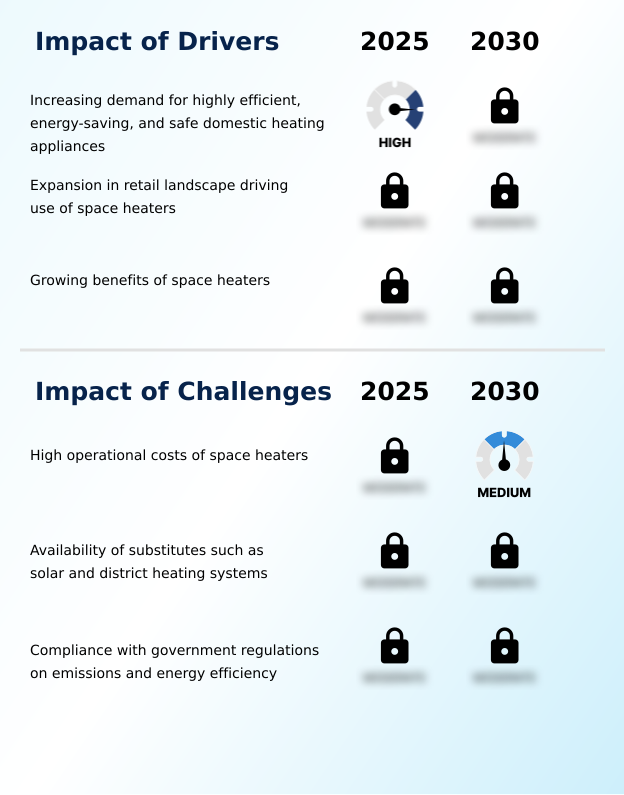
What are the key market drivers leading to the rise in the adoption of Space Heaters Industry?
- The primary market driver is the growing consumer demand for highly efficient, energy-saving, and safe domestic heating appliances.
- Market growth is fueled by rising consumer demand for energy-efficient home appliances that offer both safety and convenience. The expansion of retail channels, particularly e-commerce, has broadened consumer access to a variety of indoor heating solutions.
- This shift toward online platforms has streamlined supply chains, with some direct-to-consumer models achieving a 10-15% improvement in margin preservation by eliminating intermediary costs.
- Product innovation focuses on core technologies like the ptc heating element and micathermic heating technology to deliver superior performance.
- Demand is also strong for supplemental heating solutions that provide zonal heating, allowing users to warm specific areas and reduce overall energy use.
- The availability of advanced safety features and the development of specialized industrial heating equipment further contribute to market expansion, meeting diverse needs across residential and commercial sectors.
What are the market trends shaping the Space Heaters Industry?
- An emerging market trend is the increase in strategic collaborations and new product launches among manufacturers. These initiatives are driven by intensifying competition and evolving consumer demands.
- Key market trends are centered on enhancing efficiency and user experience through technological innovation. New models are engineered for enhanced heat dispersion, achieving up to 35% greater efficiency in warming a space. Concurrently, advancements in bladeless fan technology are leading to products with 25% reduced noise levels, addressing consumer demand for quiet operation heaters.
- The integration of smart climate control allows for precise temperature management and energy savings. There is also a growing focus on modern aesthetic design and user-friendly interface, making these appliances a seamless part of home decor. Innovations include the use of quartz heating tubes and carbon fiber heating elements, which offer faster heating and improved durability.
- These trends collectively push the industry toward more sophisticated and efficient portable room heaters, aligning with consumer desires for both performance and convenience.
What challenges does the Space Heaters Industry face during its growth?
- A key challenge affecting industry growth is the high operational costs associated with certain types of space heaters.
- The market faces significant challenges from the availability of viable substitutes and stringent regulatory hurdles. Alternative technologies such as solar thermal systems and district heating systems are gaining traction, with the former accounting for 62%-88% of residential heating energy consumption in some cold climates.
- The global installed base for large-scale solar thermal district heating has grown to 346 systems, presenting a competitive threat. Furthermore, manufacturers must navigate a complex web of regulations, including the california fire code section 605.10 and evolving energy performance certificate (EPC) ratings, which impose strict low-power mode requirements and efficiency thresholds.
- The high operational costs of some electric units, combined with the market penetration of reverse cycle ac systems, also restrain adoption. These factors compel companies to innovate in areas like positive temperature coefficient materials to remain competitive.
Exclusive Technavio Analysis on Customer Landscape
The space heaters market forecasting report includes the adoption lifecycle of the market, covering from the innovator’s stage to the laggard’s stage. It focuses on adoption rates in different regions based on penetration. Furthermore, the space heaters market report also includes key purchase criteria and drivers of price sensitivity to help companies evaluate and develop their market growth analysis strategies.
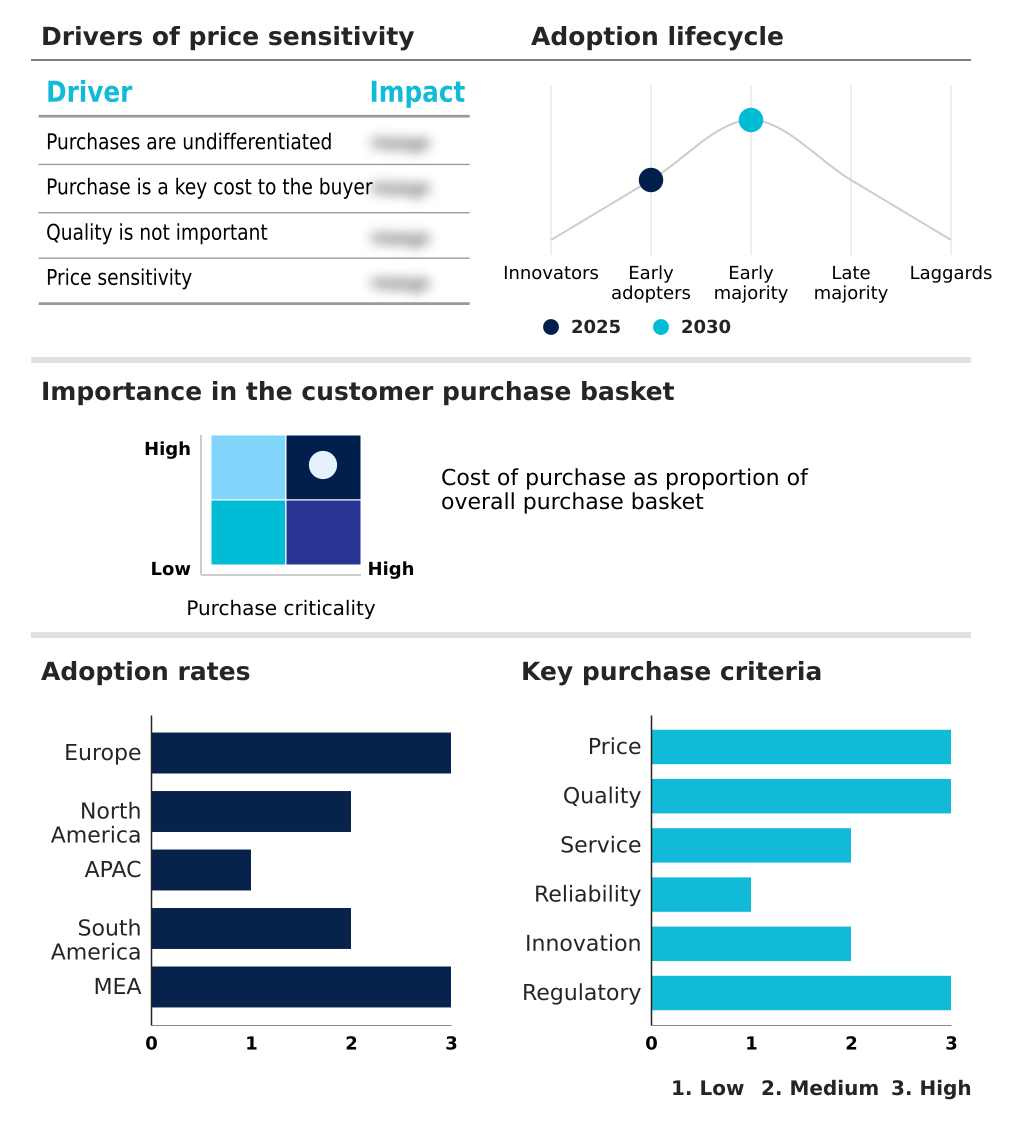
Customer Landscape of Space Heaters Industry
Competitive Landscape
Companies are implementing various strategies, such as strategic alliances, space heaters market forecast, partnerships, mergers and acquisitions, geographical expansion, and product/service launches, to enhance their presence in the industry.
Crane USA - Offerings center on advanced indoor heating solutions, featuring portable electric and ceramic units engineered for efficient and targeted thermal comfort.
The industry research and growth report includes detailed analyses of the competitive landscape of the market and information about key companies, including:
- Crane USA
- Daikin Industries Ltd.
- DeLonghi Group
- Dr. Infrared Heater
- Duraflame Inc.
- Dyson Ltd.
- Energy Wise Solutions
- Honeywell International Inc.
- Lasko Products LLC
- MIDEA Group Co. Ltd.
- Mill International AS
- Newell Brands Inc.
- Optimus Enterprise Inc.
- Rinnai Corp.
- Stadler Form
- SUNHEAT International
- Sunpentown International Inc.
- Vornado Air LLC
Qualitative and quantitative analysis of companies has been conducted to help clients understand the wider business environment as well as the strengths and weaknesses of key industry players. Data is qualitatively analyzed to categorize companies as pure play, category-focused, industry-focused, and diversified; it is quantitatively analyzed to categorize companies as dominant, leading, strong, tentative, and weak.
Recent Development and News in Space heaters market
- In September 2025, Dreo launched its latest space heater lineup, the Whole-Room Heater 715 and 714 models, which feature 3D whole-room heating technology designed to reduce energy consumption by up to 40%.
- In May 2025, the European Commission implemented the updated Ecodesign for Sustainable Products Regulation, establishing higher energy efficiency benchmarks for portable heating units.
- In September 2025, the German government introduced a subsidy program aimed at helping low-income households replace inefficient oil heaters with modern electric space heaters equipped with smart thermostats.
- In October 2025, the South Korean Ministry of Interior and Safety provided direct subsidies to senior living facilities for installing smart heaters with fall-detection sensors and automatic emergency shut-off capabilities.
Dive into Technavio’s robust research methodology, blending expert interviews, extensive data synthesis, and validated models for unparalleled Space Heaters Market insights. See full methodology.
| Market Scope | |
|---|---|
| Page number | 294 |
| Base year | 2025 |
| Historic period | 2020-2024 |
| Forecast period | 2026-2030 |
| Growth momentum & CAGR | Accelerate at a CAGR of 6.1% |
| Market growth 2026-2030 | USD 3196.8 million |
| Market structure | Fragmented |
| YoY growth 2025-2026(%) | 5.7% |
| Key countries | Germany, UK, France, Italy, The Netherlands, Spain, US, Canada, Mexico, China, Japan, India, South Korea, Australia, Indonesia, Brazil, Argentina, Colombia, Saudi Arabia, UAE, South Africa, Israel and Turkey |
| Competitive landscape | Leading Companies, Market Positioning of Companies, Competitive Strategies, and Industry Risks |
Research Analyst Overview
- The space heaters market is defined by a rapid innovation cycle centered on enhancing both performance and safety. Advances in ptc heating element and infrared heating technology are enabling manufacturers to deliver superior whole-room heating and targeted spot heating with greater efficiency.
- New models incorporating innovative 3d whole-room heating technology have demonstrated up to 40% less energy consumption than their predecessors. This push is not merely market-driven; it is also a response to regulatory mandates like the ecodesign for sustainable products regulation and UL1278 standards, which enforce strict criteria for seasonal space heating energy efficiency and safety mechanisms.
- Boardroom decisions are increasingly influenced by the need to balance R&D investment in features like smart thermostat integration and vortex circulation technology with the high costs of compliance. The industry is moving toward sophisticated supplemental heating solutions that leverage oil-filled radiator designs, bladeless fan technology, and advanced convection heating principles.
- Technologies such as tip-over protection sensor systems and overheat protection mechanism are now standard, reflecting a market where safety and efficiency are paramount.
What are the Key Data Covered in this Space Heaters Market Research and Growth Report?
-
What is the expected growth of the Space Heaters Market between 2026 and 2030?
-
USD 3.20 billion, at a CAGR of 6.1%
-
-
What segmentation does the market report cover?
-
The report is segmented by Application (Residential, Commercial, and Industrial), Product (Fan heaters, Convection heaters, Radiant heaters, and Ceramic heaters), Distribution Channel (Offline, and Online) and Geography (Europe, North America, APAC, South America, Middle East and Africa)
-
-
Which regions are analyzed in the report?
-
Europe, North America, APAC, South America and Middle East and Africa
-
-
What are the key growth drivers and market challenges?
-
Increasing demand for highly efficient, energy-saving, and safe domestic heating appliances, High operational costs of space heaters
-
-
Who are the major players in the Space Heaters Market?
-
Crane USA, Daikin Industries Ltd., DeLonghi Group, Dr. Infrared Heater, Duraflame Inc., Dyson Ltd., Energy Wise Solutions, Honeywell International Inc., Lasko Products LLC, MIDEA Group Co. Ltd., Mill International AS, Newell Brands Inc., Optimus Enterprise Inc., Rinnai Corp., Stadler Form, SUNHEAT International, Sunpentown International Inc. and Vornado Air LLC
-
Market Research Insights
- The market's momentum is increasingly tied to technological advancements that deliver measurable performance improvements and align with modern lifestyle demands. Innovations in product design have led to a 25% reduction in noise levels in certain high-end models, enhancing user-friendly interface appeal.
- Simultaneously, a focus on efficiency has resulted in new systems that offer up to 40% energy consumption reduction compared to conventional units, a key selling point for cost-conscious consumers. The integration of iot-enabled controls is also becoming a standard expectation, allowing for remote temperature regulation and seamless inclusion in smart home ecosystems.
- This push for sophisticated functionality, from enhanced heat dispersion to dual-function heating and cooling, is reshaping consumer preferences and driving competition based on performance metrics rather than price alone.
We can help! Our analysts can customize this space heaters market research report to meet your requirements.
 RIA -
RIA - 
