

Sports Turf Market Size 2024-2028
The sports turf market size is forecast to increase by USD 5.05 billion at a CAGR of 15.42% between 2023 and 2028.
- The market is experiencing significant growth due to the increasing popularity of outdoor sports in North America, including baseball, hockey, rugby, and others. This trend is driving market expansion as demand for high-quality turf solutions rises to accommodate the growing number of athletes and sports enthusiasts. Additionally, the availability of advanced hybrid grass turfs is contributing to market growth, offering improved performance, durability, and cost-effectiveness compared to natural grass. However, health and safety concerns associated with sports turf products remain a challenge, with potential risks such as injuries from hard surfaces and exposure to harmful chemicals. Addressing these concerns through research and development of safer and more sustainable turf solutions will be crucial for market growth In the coming years.
What will be the Size of the Sports Turf Market During the Forecast Period?

- The market In the United States is experiencing significant growth, driven by the increasing demand for high-performance surfaces that cater to various sports and applications. Artificial turf, made from polyethylene and polypropylene fibers, continues to gain popularity due to its durability, low maintenance, and water conservation benefits. Technology launches focusing on enhancing turf performance and appearance are frequent. Fertilizer and mowing requirements are minimized with the use of artificial turf, making it an attractive option for homeowners, commercial properties, sports facilities, municipalities, urban landscapes, rooftops, and even large-scale installations like stadium pitches and training pitches. The trend towards water conservation is particularly relevant in regions experiencing water scarcity.
- Hybrid turf, which combines natural grass and artificial turf, is also gaining traction as it offers the best of both worlds. The market serves a diverse range of applications, including association football, rugby, American football, golf, and baseball grounds.
How is this Sports Turf Industry segmented and which is the largest segment?
The sports turf industry research report provides comprehensive data (region-wise segment analysis), with forecasts and estimates in "USD million" for the period 2024-2028, as well as historical data from 2018-2022 for the following segments.
- Type
- Private sports facilities
- Schools/colleges and universities
- Professional world class stadiums
- Product
- PP sports turf
- PE sports turf
- Nylon sports turf
- Geography
- Europe
- Germany
- UK
- France
- North America
- US
- APAC
- China
- South America
- Middle East and Africa
- Europe
By Type Insights
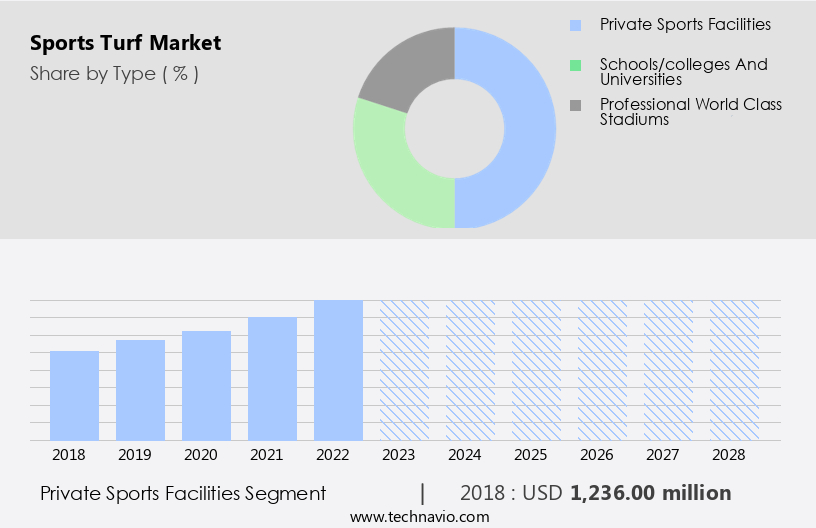
- The private sports facilities segment is estimated to witness significant growth during the forecast period.
Private sports facilities, owned and operated by individuals, organizations, or companies, invest in premium sports turf to ensure optimal playing surfaces and an exceptional user experience. Factors influencing turf selection include the specific sport offered, maintenance requirements, budget, and user preferences. High-quality sports turf is essential for private facilities to maintain a competitive edge and cater to their members' needs. Sports turf options range from original grass to low maintenance alternatives, with irrigation requirements varying depending on the chosen turf type. Proper maintenance is crucial to maximize the lifespan and performance of the turf. In making an informed decision, facility managers should consider the unique characteristics and benefits of each turf type to create a sports environment that caters to their users' expectations.
Get a glance at the Sports Turf Industry report of share of various segments Request Free Sample
The Private sports facilities segment was valued at USD 1.24 billion in 2018 and showed a gradual increase during the forecast period.
Regional Analysis
- Europe is estimated to contribute 38% to the growth of the global market during the forecast period.
Technavio’s analysts have elaborately explained the regional trends and drivers that shape the market during the forecast period.

For more insights on the market share of various regions, Request Free Sample
The European the market is characterized by a diverse company landscape, with both small and large companies participating. Key countries In the region driving market growth include Germany, the UK, France, and Italy. Artificial grass surfaces have gained popularity in European sports events, with an increase in installations in Germany, particularly among municipalities and sports clubs, including the Bundesliga. In France, the market is fueled by the popularity of sports such as football, tennis, hockey, and golf, with notable stadiums like Stade Gaston Petit, Stade Marcel-Picot, and Stade du Moustoir-Yves Allainmat adopting sports turfs. The market's growth is influenced by factors such as water conservation, reduced need for fertilizers, and minimal mowing requirements, becoming increasingly relevant In the context of water scarcity.
Technological advancements in artificial turf, including the use of polyethylene and polypropylene, continue to shape the industry.
Market Dynamics
Our sports turf market researchers analyzed the data with 2023 as the base year, along with the key drivers, trends, and challenges. A holistic analysis of drivers will help companies refine their marketing strategies to gain a competitive advantage.
What are the key market drivers leading to the rise in adoption of Sports Turf Industry?
Increasing outdoor sports (baseball, hockey, rugby, etc.) driving market growth is the key driver of the market.
- The Artificial the market In the US is experiencing significant growth due to the increasing demand for outdoor sports and the water conservation efforts in various sectors. With water scarcity becoming a major concern, the use of Artificial Grass industry solutions, including Polyethylene and Polypropylene fibers, is gaining popularity for sports surfaces. This trend is particularly noticeable in sports facilities, municipalities, urban landscapes, rooftops, balconies, indoor spaces, event venues, and even In the pet industry for dog parks. Several technology launches In the market have led to the development of advanced cooling solutions, using materials like Nylon, Hybrid, and Synthetic fibers from companies like Chemstrand and Monsanto.
- These new materials offer enhanced resiliency and softness, making them ideal for sports fields and other outdoor applications. The adoption rate of Artificial Turf is increasing due to its low maintenance requirements, making it a cost-effective solution for homeowners, commercial properties, schools, and public playgrounds. Additionally, the use of Artificial Turf in large stadiums and training pitches for association football, rugby, American football, golf, and baseball grounds is becoming increasingly common. The market for Flooring products is expected to grow as more companies offer solutions for various sports surfaces, including stadium pitches and training pitches. The durability and cost-effectiveness of these products make them a popular choice for maintenance-intensive sports facilities.
- In conclusion, the Artificial the market In the US is poised for growth due to the increasing demand for low-maintenance, water-conserving sports surfaces. With advancements in technology and the growing popularity of outdoor sports, the market for Artificial Turf is expected to continue its upward trajectory.
What are the market trends shaping the Sports Turf Industry?
Increase in availability of hybrid grass turfs is the upcoming market trend.
- The market is experiencing significant growth due to the increasing adoption of artificial grass solutions, such as Artificial Sports Turf, in various sectors. This trend is driven by the use of advanced technologies, including Polyethylene and Polypropylene fibers, In the production of synthetic fibers like Multifilament fibers and Monofilament fibers from companies like Chemstrand and Monsanto. Hybrid turf, a combination of natural grass and synthetic fibers, is gaining popularity in sports surfaces for stadium pitches, training pitches, and other outdoor sports applications. The synthetic fibers enhance the resiliency and softness of the sports surfaces, making them suitable for association football, rugby, American football, golf, baseball grounds, and even indoor spaces like event venues, schools, public playgrounds, and municipalities.
- Moreover, the use of hybrid turf in urban landscapes, such as rooftops, balconies, and decorating processes for homes and commercial properties, is increasing due to its low maintenance requirements and water conservation benefits. The material type, which includes Nylon, Hybrid, and Synthetic fibers, is also being used in cooling solutions for sports facilities and dog parks. The market for sports turf is expanding as water scarcity becomes a concern for homeowners and municipalities. The use of artificial grass reduces the need for frequent mowing and fertilizer applications, making it a cost-effective and durable solution for various outdoor applications.
- The installation of developed and small stadiums, training pitches, and sports fields is also contributing to the market's growth. The market's adoption rate is increasing as the technology continues to evolve, offering more advanced features and benefits. The market's future looks promising, with continued innovation and the development of new flooring products for various outdoor applications. The market is poised to provide cost-effective and durable solutions for various industries, including the pet industry and event venues.
What challenges does Sports Turf Industry face during the growth?
Health and safety issues associated with sports turf products is a key challenge affecting the industry growth.
- The Artificial the market In the US is witnessing significant growth due to various factors, including water conservation, low maintenance, and the adaptability of sports surfaces for diverse applications. Technology launches In the artificial grass industry have led to advancements in material types, such as Polyethylene, Polypropylene, Nylon, and Hybrid fibers from companies like Chemstrand and Monsanto. These synthetic fibers offer superior resiliency and softness, making them ideal for homes, lawns, commercial properties, sports facilities, municipalities, urban landscapes, rooftops, balconies, indoor spaces, event venues, and even dog parks. Water scarcity is a pressing concern, and the adoption rate of artificial turf is increasing as it requires minimal irrigation.
- Moreover, synthetic grass is durable and cost-effective, making it a popular choice for home renovation projects, hybrid turf, stadium pitches, training pitches, and various sports fields. However, health and safety concerns associated with the use of artificial turf, such as potential injury risks and links to cancer due to crumb rubber infills, may hinder market growth. The industry continues to innovate, introducing cooling solutions and alternative infill materials like Polyprene, to mitigate these concerns and maintaIn the market's momentum.
Exclusive Customer Landscape
The sports turf market forecasting report includes the adoption lifecycle of the market, covering from the innovator’s stage to the laggard’s stage. It focuses on adoption rates in different regions based on penetration. Furthermore, the sports turf market report also includes key purchase criteria and drivers of price sensitivity to help companies evaluate and develop their market growth analysis strategies.

Customer Landscape
Key Companies & Market Insights
Companies are implementing various strategies, such as strategic alliances, sports turf market forecast, partnerships, mergers and acquisitions, geographical expansion, and product/service launches, to enhance their presence In the industry.
AstroTurf Corp. - Shaw Industries Inc. Is a leading provider of high-quality sports turf solutions In the United States. Our sports turf offerings, marketed under the Shaw brand, cater to various athletic fields, golf courses, and other recreational spaces. With a focus on innovation, durability, and performance, we deliver top-tier turf systems that meet the unique demands of American sports and recreation industries. Our commitment to excellence ensures that our clients receive superior products and unparalleled customer service.
The industry research and growth report includes detailed analyses of the competitive landscape of the market and information about key companies, including:
- AstroTurf Corp.
- Avalon BV
- BellinturfÂ
- Berkshire Hathaway Inc.
- Challenger Turf Inc.Â
- CoCreation Grass Corp.
- Controlled Products LLC
- DuPont de Nemours Inc.
- FieldTurf USA Inc.
- Global Syn Turf Inc.
- GTR TURF Inc.
- Hellas Construction Inc
- Leling Taishan Artificial Turf Industry Co. Ltd.
- Mondo Spa
- Polytan GmbH
- Sport Group Holding GmbH
- Sports Turf and Golf Enterprises
- Sprinturf
- SYNLawn
- TenCate Grass Holding bv
Qualitative and quantitative analysis of companies has been conducted to help clients understand the wider business environment as well as the strengths and weaknesses of key industry players. Data is qualitatively analyzed to categorize companies as pure play, category-focused, industry-focused, and diversified; it is quantitatively analyzed to categorize companies as dominant, leading, strong, tentative, and weak.
Research Analyst Overview
The market encompasses a wide range of artificial surfaces designed for various applications, including homeowners' lawns, commercial properties, sports facilities, municipalities, urban landscapes, rooftops, balconies, indoor spaces, event venues, and even pet industry facilities such as dog parks. These surfaces offer numerous benefits, including water conservation, reduced maintenance requirements, and improved resiliency and softness. Artificial sports turf is typically made from synthetic fibers, such as polyethylene and polypropylene, which have advanced significantly in recent years. The technology behind these fibers has led to the development of new materials, including multifilament and monofilament fibers, which offer enhanced durability and realism.
One of the primary drivers of the market is the increasing water scarcity in many regions, making artificial grass an attractive alternative to natural grass. Additionally, the low maintenance requirements of synthetic turf make it a cost-effective solution for large stadiums, schools, public playgrounds, and other outdoor sports facilities. The adoption rate of artificial sports turf has been growing steadily, with applications ranging from association football and rugby pitches to American football fields, golf courses, baseball grounds, and even indoor sports surfaces. The versatility of these surfaces allows them to be used in a variety of settings, from small municipal parks to large stadiums and event venues.
The sports turf industry has seen numerous technology launches in recent years, including cooling solutions and hybrid turf systems that offer improved performance and durability. These innovations have led to increased demand for synthetic sports surfaces, particularly in urban landscapes where space is at a premium. The decorating process for synthetic sports turf involves careful installation to ensure optimal performance and longevity. Developed stadiums and small stadiums alike have turned to artificial turf to reduce maintenance costs and improve the overall playing experience. The market is expected to continue growing as more homeowners and commercial property owners recognize the benefits of these surfaces.
The market is also seeing increased adoption In the pet industry, with dog parks and other pet facilities turning to synthetic turf to provide a safe and low-maintenance surface for animals. Despite the numerous benefits of artificial sports turf, there are still some concerns regarding the environmental impact of these surfaces. However, advancements in technology and manufacturing processes have led to more sustainable and eco-friendly options, such as those made from recycled materials. In conclusion, the market offers a range of innovative and sustainable solutions for various applications, from residential lawns to large commercial and municipal projects. The benefits of these surfaces, including water conservation, reduced maintenance requirements, and improved performance, have led to increased adoption rates and a growing demand for synthetic sports surfaces.
|
Sports Turf Market Scope |
|
|
Report Coverage |
Details |
|
Page number |
154 |
|
Base year |
2023 |
|
Historic period |
2018-2022 |
|
Forecast period |
2024-2028 |
|
Growth momentum & CAGR |
Accelerate at a CAGR of 15.42% |
|
Market growth 2024-2028 |
USD 5045.5 million |
|
Market structure |
Fragmented |
|
YoY growth 2023-2024(%) |
12.09 |
|
Key countries |
US, Germany, China, France, and UK |
|
Competitive landscape |
Leading Companies, Market Positioning of Companies, Competitive Strategies, and Industry Risks |
What are the Key Data Covered in this Sports Turf Market Research and Growth Report?
- CAGR of the Sports Turf industry during the forecast period
- Detailed information on factors that will drive the Sports Turf growth and forecasting between 2024 and 2028
- Precise estimation of the size of the market and its contribution of the industry in focus to the parent market
- Accurate predictions about upcoming growth and trends and changes in consumer behaviour
- Growth of the market across Europe, North America, APAC, South America, and Middle East and Africa
- Thorough analysis of the market’s competitive landscape and detailed information about companies
- Comprehensive analysis of factors that will challenge the sports turf market growth of industry companies
We can help! Our analysts can customize this sports turf market research report to meet your requirements.
 RIA -
RIA -