


Supply Risk Analytics Market Size 2026-2030
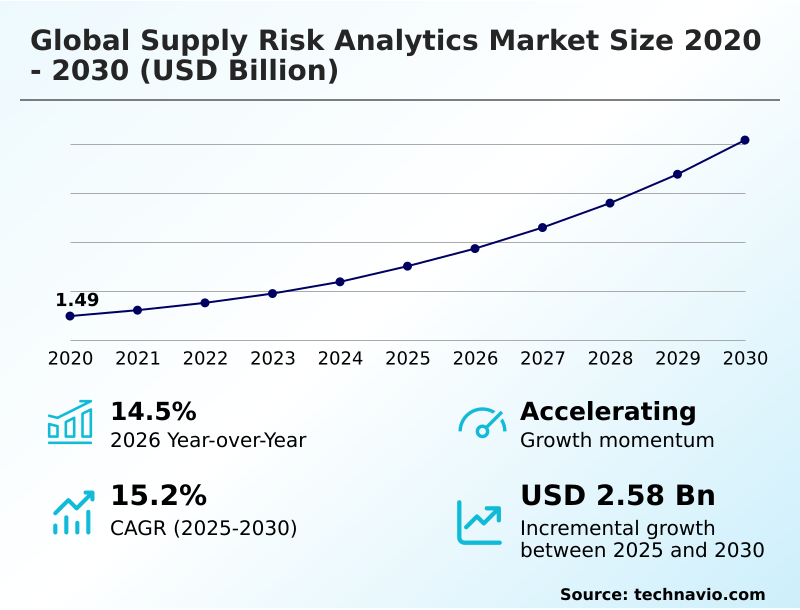
The supply risk analytics market size is valued to increase by USD 2.58 billion, at a CAGR of 15.2% from 2025 to 2030. Escalating frequency of global supply disruptions will drive the supply risk analytics market.
Major Market Trends & Insights
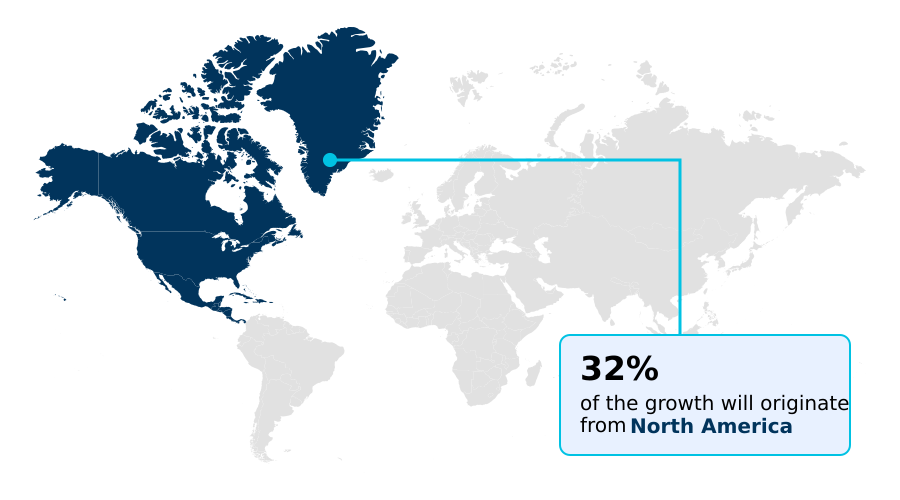
- North America dominated the market and accounted for a 31.6% growth during the forecast period.
- By Type - Supplier risk segment was valued at USD 649.9 million in 2024
- By End-user - Manufacturing segment accounted for the largest market revenue share in 2024
Market Size & Forecast
- Market Opportunities: USD 3.59 billion
- Market Future Opportunities: USD 2.58 billion
- CAGR from 2025 to 2030 : 15.2%
Market Summary
- The Supply Risk Analytics Market is rapidly expanding as multinational organizations transition from reactive crisis management to predictive operational continuity. In a real-world scenario, automotive manufacturers managing thousands of specialized component providers utilize automated platforms to simulate port closures and dynamically reroute shipments.
- This proactive approach has allowed early adopters to experience a 35% reduction in unplanned factory downtime compared to those relying on legacy spreadsheet forecasting. The escalating frequency of logistical disruptions acts as a primary catalyst for adoption, driving enterprises to invest heavily in visibility software to identify single points of failure before production is impacted.
- Conversely, immense complexities in data formatting and the reluctance of secondary providers to share sensitive operational metrics create significant blind spots, restraining the seamless integration of risk intelligence software. Ultimately, the Supply Risk Analytics Market serves as a foundational digital defense, empowering procurement executives to navigate an increasingly volatile commercial landscape with data-backed precision.
What will be the Size of the Supply Risk Analytics Market during the forecast period?
Get Key Insights on Market Forecast (PDF) Get Free Sample
How is the Supply Risk Analytics Market Segmented?
The supply risk analytics industry research report provides comprehensive data (region-wise segment analysis), with forecasts and estimates in "USD million" for the period 2026-2030, as well as historical data from 2020-2024 for the following segments.
- Type
- Supplier risk
- Operational risk
- Cybersecurity risk
- Geopolitical risk
- Financial risk
- End-user
- Manufacturing
- Retail and consumer goods
- Automotive
- Pharmaceuticals
- Others
- Technology
- AI analytics
- Predictive analytics
- Big data analytics
- IoT enabled monitoring
- Blockchain traceability
- Geography
- North America
- US
- Canada
- Mexico
- Europe
- Germany
- UK
- France
- The Netherlands
- Italy
- Spain
- APAC
- China
- Japan
- India
- South Korea
- Australia
- Indonesia
- South America
- Brazil
- Argentina
- Colombia
- Middle East and Africa
- Saudi Arabia
- UAE
- South Africa
- Israel
- Turkey
- North America
By Type Insights
The supplier risk segment is estimated to witness significant growth during the forecast period.
Supplier risk evaluation serves as a critical defense mechanism within enterprise procurement frameworks, enabling organizations to maintain operational continuity amid global volatility. By deploying predictive disruption modeling, companies can systematically execute logistical infrastructure evaluation and raw material provenance tracking.
This transition enables organizations to shift from reactive troubleshooting toward dynamic sourcing optimization. Utilizing distributed ledger traceability, businesses have reported that component shortage detection improved by 25% compared to manual assessment methodologies.
Furthermore, integrating natural language processing alerts with climate event forecasting allows organizations to generate automated disruption alerts instantly.
This strategic capability directly enhances just-in-time manufacturing resilience by optimizing strategic stockpile allocation, effectively protecting profit margins and shielding the parent organization from severe reputational damage during unforeseen systemic failures.
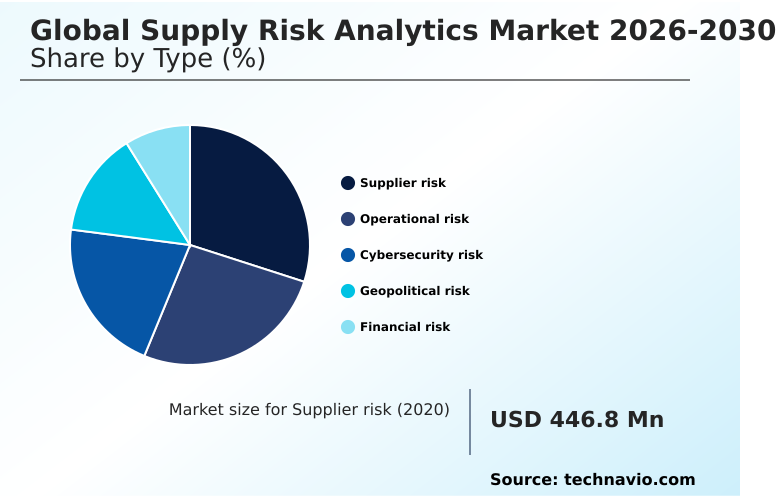
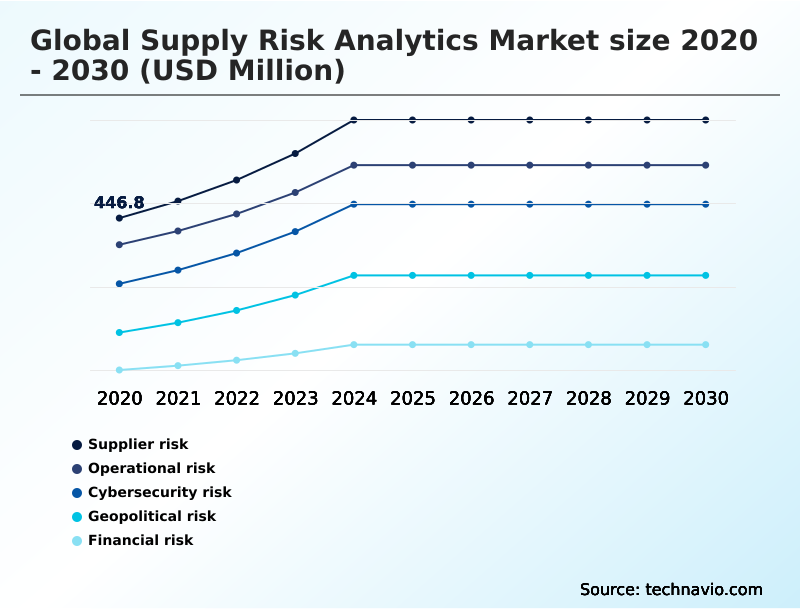
The Supplier risk segment was valued at USD 649.9 million in 2024 and showed a gradual increase during the forecast period.
Regional Analysis
North America is estimated to contribute 31.6% to the growth of the global market during the forecast period.Technavio’s analysts have elaborately explained the regional trends and drivers that shape the market during the forecast period.
See How Supply Risk Analytics Market Demand is Rising in North America Get Free Sample
The adoption of supply visibility platforms varies significantly across regional landscapes due to distinct industrial priorities.
North America leads the rapid deployment of operational resilience modeling, where manufacturers leverage deep network mapping to evaluate geopolitical threat quantification alongside sudden trade policy shifts.
This approach yields a 40% improvement in logistics bottleneck prediction compared to traditional European methodologies. Conversely, the European sector prioritizes continuous threat surveillance and cyber risk quantification due to stringent data sovereignty mandates.
European conglomerates mandate rigorous digital hygiene assessment and vulnerability patching analysis to audit their networks, reducing supply chain auditing costs by 22%.
North American organizations focus primarily on algorithmic threat detection, whereas European enterprises embed cybersecurity threat integration directly into procurement workflows. These divergent strategic imperatives ensure that platform developers must customize risk algorithms to address regional operational efficiency effectively.
Market Dynamics
Our researchers analyzed the data with 2025 as the base year, along with the key drivers, trends, and challenges. A holistic analysis of drivers will help companies refine their marketing strategies to gain a competitive advantage.
- Modern enterprise resilience necessitates moving beyond static spreadsheets toward highly dynamic, automated frameworks that can anticipate global friction. Implementing machine learning for supplier risk has fundamentally altered how multinational corporations safeguard their procurement channels. By rapidly analyzing historical performance data and external market signals, organizations can predict vendor defaults before they trigger critical material shortages.
- This transition allows procurement teams to optimize inventory positioning while evaluating tier-n operational vulnerabilities deep within complex secondary and tertiary vendor networks. Companies deploying these sophisticated analytical ecosystems frequently witness disruption response times accelerate by over 40% compared to industry peers relying on manual risk reviews.
- Furthermore, the introduction of digital twin supply chain simulation provides strategists with an unparalleled capability to stress-test their logistical architectures against hypothetical disaster scenarios without impacting physical operations. This virtual modeling is heavily augmented by real-time geopolitical threat monitoring, which continuously tracks international trade policy shifts to calculate the probabilistic impact on cross-border material flows.
- To feed these complex mathematical models, organizations rely on advanced unstructured data ingestion for procurement, transforming scattered news feeds, financial reports, and social media alerts into actionable intelligence. By merging physical logistics oversight with advanced digital foresight, business leaders can proactively secure alternative sourcing routes, ensuring uninterrupted production and shielding revenue margins.
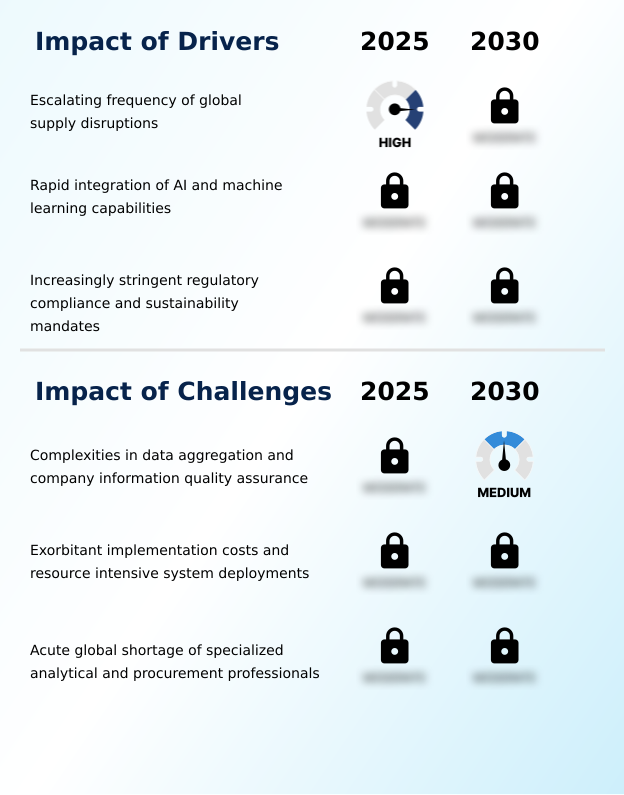
What are the key market drivers leading to the rise in the adoption of Supply Risk Analytics Industry?
- The escalating frequency of global supply disruptions serves as a primary catalyst, compelling enterprises to prioritize proactive vulnerability identification over reactive crisis management.
- The escalating enforcement of stringent international sustainability mandates acts as a massive catalyst for expanding tier-n supplier visibility. Regulatory bodies hold parent organizations accountable for the environmental compliance metrics of their extended networks.
- To avoid penalties, corporations deploy automated compliance tracking and algorithmic vulnerability detection to deeply scrutinize tertiary providers. By actively executing ethical sourcing verification and carbon footprint tracking, enterprises can isolate vendors violating critical emission standards.
- This proactive real-time procurement monitoring has enabled manufacturers to lower their regulatory penalty exposure by 40% and improve ESG reporting efficiency by 25% compared to manual audits.
- Furthermore, ensuring cold chain integrity and active pharmaceutical ingredient tracking provides business leaders with the critical intelligence necessary to align global operations with rigid corporate governance standards.
What are the market trends shaping the Supply Risk Analytics Industry?
- The proliferation of digital twin technology for advanced scenario modeling represents a defining trend in the current market landscape. Organizations are increasingly adopting these virtual replicas to conduct rigorous stress tests and optimize proactive operational resilience.
- The rapid proliferation of digital twin supply mapping is fundamentally reengineering how global organizations execute third-party risk management. By constructing virtual replicas of physical networks, strategists perform advanced scenario simulation and scenario stress testing without disrupting live operations. This technological evolution allows organizations to integrate supplier financial health scoring with geospatial risk mapping to proactively identify structural vulnerabilities.
- Consequently, facilities utilizing these virtual environments for freight transit monitoring have improved factory downtime prevention by 35% and enhanced inventory buffer optimization by over 20% compared to conventional models. Ultimately, this integration empowers executives to refine inventory positioning algorithms and secure secondary sourcing agreements, ensuring continuous product delivery amid unpredictable global friction.
What challenges does the Supply Risk Analytics Industry face during its growth?
- The immense complexities inherent in cross-platform data aggregation and ensuring third-party information quality severely impede the seamless deployment of comprehensive vulnerability assessment frameworks.
- Consolidating highly fragmented operational data from disparate sources remains a formidable structural barrier to achieving true network transparency, severely complicating legacy system integration. Countless international suppliers exhibit extreme reluctance to share production metrics, creating blind spots that degrade machine learning risk forecasting.
- This persistent lack of data standardization protocols directly compromises the accuracy of vendor insolvency prediction and customs clearance prediction models. When risk engines process incomplete unstructured data ingestion, the resulting strategies regarding commodity price volatility are fundamentally flawed.
- Consequently, organizations struggling with cloud-based risk architecture report that their transportation network reliability metrics are 30% less accurate, while deployment costs soar 18% above projections. Overcoming these massive data hygiene obstacles requires highly specialized talent, constraining the rapid deployment of comprehensive cross-border trade friction mitigation systems.
Exclusive Technavio Analysis on Customer Landscape
The supply risk analytics market forecasting report includes the adoption lifecycle of the market, covering from the innovator’s stage to the laggard’s stage. It focuses on adoption rates in different regions based on penetration. Furthermore, the supply risk analytics market report also includes key purchase criteria and drivers of price sensitivity to help companies evaluate and develop their market growth analysis strategies.
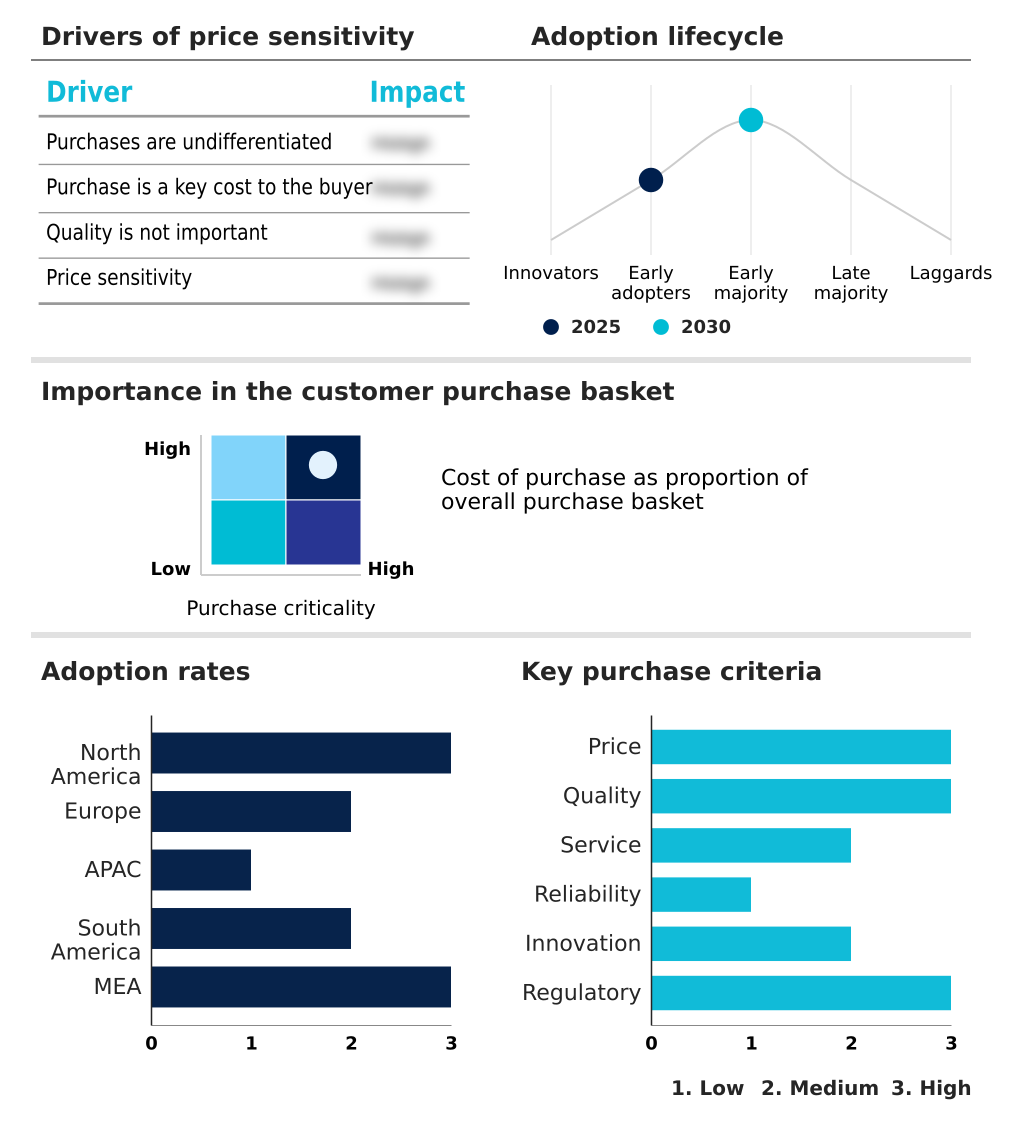
Customer Landscape of Supply Risk Analytics Industry
Competitive Landscape
Companies are implementing various strategies, such as strategic alliances, supply risk analytics market forecast, partnerships, mergers and acquisitions, geographical expansion, and product/service launches, to enhance their presence in the industry.
Alchemai - This solution leverages artificial intelligence to automate complex supply chain mapping, enabling proactive threat mitigation and comprehensive operational visibility across global procurement networks.
The industry research and growth report includes detailed analyses of the competitive landscape of the market and information about key companies, including:
- Alchemai
- Avetta LLC
- Blue Yonder Group Inc.
- Coupa Software Inc.
- Dun and Bradstreet Holdings Inc.
- EcoVadis SAS
- EiQ
- Everstream Analytics
- Exiger
- Interos Inc.
- Intertek Group Plc
- Ivalua Inc.
- Jaggaer LLC
- KHARON
- NQC Ltd.
- Oracle Corp.
- Prewave GmbH
- Resilinc Corp.
- SAP SE
- Sphera Solutions Inc.
Qualitative and quantitative analysis of companies has been conducted to help clients understand the wider business environment as well as the strengths and weaknesses of key industry players. Data is qualitatively analyzed to categorize companies as pure play, category-focused, industry-focused, and diversified; it is quantitatively analyzed to categorize companies as dominant, leading, strong, tentative, and weak.
Recent Development and News in Supply risk analytics market
- In the Application Software industry, the widespread transition toward cloud-based risk architecture has fundamentally democratized advanced simulation capabilities, directly impacting Supply Risk Analytics demand by enabling real-time network oversight.
- The enforcement of stringent enterprise data privacy regulations mandates robust compliance frameworks, prompting organizations to integrate algorithmic threat detection protocols that measure the cyber vulnerability of interconnected supply nodes.
- The rapid adoption of cognitive intelligence within enterprise resource planning suites has significantly automated unstructured data extraction, elevating the precision of deep network mapping for complex manufacturing sectors.
- The integration of sustainability tracking into legacy system workflows has accelerated automated reporting, enabling organizations to deploy carbon footprint tracking when confronting sudden trade policy shifts or climate regulations.
Dive into Technavio’s robust research methodology, blending expert interviews, extensive data synthesis, and validated models for unparalleled Supply Risk Analytics Market insights. See full methodology.
| Market Scope | |
|---|---|
| Page number | 320 |
| Base year | 2025 |
| Historic period | 2020-2024 |
| Forecast period | 2026-2030 |
| Growth momentum & CAGR | Accelerate at a CAGR of 15.2% |
| Market growth 2026-2030 | USD 2578.6 million |
| Market structure | Fragmented |
| YoY growth 2025-2026(%) | 14.5% |
| Key countries | US, Canada, Mexico, Germany, UK, France, The Netherlands, Italy, Spain, China, Japan, India, South Korea, Australia, Indonesia, Brazil, Argentina, Colombia, Saudi Arabia, UAE, South Africa, Israel and Turkey |
| Competitive landscape | Leading Companies, Market Positioning of Companies, Competitive Strategies, and Industry Risks |
Research Analyst Overview
- The integration of predictive intelligence into global enterprise resource planning represents a massive operational shift, compelling corporate leadership to align risk management directly with long-term product strategy. Executives now mandate continuous supply surveillance to safeguard highly complex manufacturing ecosystems against unforeseen friction.
- By utilizing deep dependency mapping, organizations can accurately visualize the cascading effects of a localized failure on their broader global output. This level of transparency is essential for boardrooms prioritizing dynamic sourcing and evaluating corporate governance standards across secondary vendor networks.
- Empirical data demonstrates that enterprises deploying distributed tracing to authenticate raw material origins achieve a 30% reduction in compliance violation penalties compared to organizations lacking automated oversight. Furthermore, the application of cybersecurity evaluation within procurement workflows ensures that digital vulnerabilities among third-party contractors do not compromise the parent organization.
- Ultimately, the ability to anticipate and neutralize logistical disruptions via algorithmic forecasting empowers strategic planners to optimize inventory buffers, protect brand equity, and navigate volatile international trade environments with absolute precision.
What are the Key Data Covered in this Supply Risk Analytics Market Research and Growth Report?
-
What is the expected growth of the Supply Risk Analytics Market between 2026 and 2030?
-
USD 2.58 billion, at a CAGR of 15.2%
-
-
What segmentation does the market report cover?
-
The report is segmented by Type (Supplier risk, Operational risk, Cybersecurity risk, Geopolitical risk, and Financial risk), End-user (Manufacturing, Retail and consumer goods, Automotive, Pharmaceuticals, and Others), Technology (AI analytics, Predictive analytics, Big data analytics, IoT enabled monitoring, and Blockchain traceability) and Geography (North America, Europe, APAC, South America, Middle East and Africa)
-
-
Which regions are analyzed in the report?
-
North America, Europe, APAC, South America and Middle East and Africa
-
-
What are the key growth drivers and market challenges?
-
Escalating frequency of global supply disruptions, Complexities in data aggregation and company information quality assurance
-
-
Who are the major players in the Supply Risk Analytics Market?
-
Alchemai, Avetta LLC, Blue Yonder Group Inc., Coupa Software Inc., Dun and Bradstreet Holdings Inc., EcoVadis SAS, EiQ, Everstream Analytics, Exiger, Interos Inc., Intertek Group Plc, Ivalua Inc., Jaggaer LLC, KHARON, NQC Ltd., Oracle Corp., Prewave GmbH, Resilinc Corp., SAP SE and Sphera Solutions Inc.
-
Market Research Insights
- Supply chain resilience has transitioned from a backend logistical function into a critical boardroom priority. By implementing automated monitoring, enterprises actively minimize their exposure to unpredictable global shocks. Organizations leveraging advanced weather forecasting have improved their strategic warehousing efficiency by 28%, significantly reducing the financial burden of over-stocking capital-intensive merchandise.
- Furthermore, the integration of predictive algorithms enables procurement teams to identify subtle component shortage signals weeks in advance. This proactive visibility ensures that manufacturers utilizing multi-tier visibility experience a 35% reduction in costly factory downtime compared to those employing reactive management strategies, directly enhancing overall return on investment and sustaining competitive market advantages.
We can help! Our analysts can customize this supply risk analytics market research report to meet your requirements.
 RIA -
RIA -