



Sustainability Management Software Market Size 2025-2029
The sustainability management software market size is forecast to increase by USD 1.62 billion at a CAGR of 15% between 2024 and 2029.
- The market is experiencing significant growth due to the increasing shift towards green initiatives in various industries. This trend is driven by the increasing awareness of the environmental impact of business operations and the need to reduce carbon footprints. To mitigate these emissions, sustainability solutions are increasingly adopted for energy management, carbon emissions tracking, and resource management.
- Another key factor fueling market growth is the emergence of analytics in sustainability, which enables organizations to gain valuable insights into their energy usage, water consumption, and waste production. However, the integration with existing ERP solutions poses a challenge for market growth. Organizations must address these integration issues to fully leverage the benefits and effectively manage their environmental impact.
What will be the Size of the Sustainability Management Software Market During the Forecast Period?
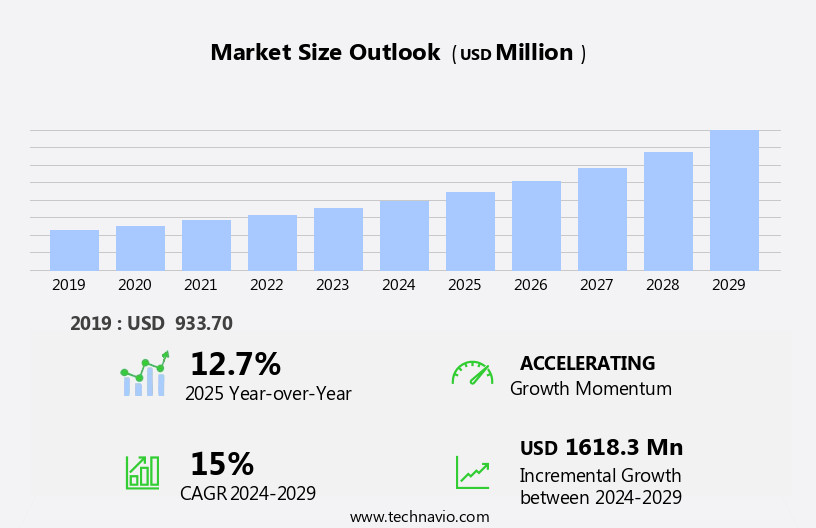
- The market encompasses solutions designed to help organizations manage and reduce their carbon emissions, energy usage, and consumption of renewable resources. These offerings facilitate the implementation and tracking of green energy initiatives, enabling businesses to transition towards more sustainable practices. The market includes both cloud-based and on-premise solutions, as well as hybrid cloud alternatives.
- Moreover, key features of these software solutions include automated data management, reporting, project planning, scenario planning, and energy saving capabilities. Consulting services and implementation support are often provided to ensure successful adoption. It is increasingly essential for organizations seeking to minimize their carbon footprint, reduce pollution, and address climate change. The manufacturing sector, in particular, stands to benefit significantly from these solutions, as they offer valuable tools for optimizing energy usage and resource management.
How is this Sustainability Management Software Industry segmented and which is the largest segment?
The sustainability management software industry research report provides comprehensive data (region-wise segment analysis), with forecasts and estimates in "USD billion" for the period 2025-2029, as well as historical data from 2019-2023 for the following segments.
- Application
- IT and telecom
- Healthcare
- Automotive
- Manufacturing
- Oil and gas
- Deployment
- Cloud
- On-premises
- Module
- Utility Data Management
- Carbon Reporting & Management
- Sustainability Reporting and Management
- Energy Optimization
- Facility & Asset Management
- Compliance Management
- Geography
- North America
- Canada
- US
- Europe
- Germany
- UK
- France
- APAC
- China
- India
- Japan
- South America
- Brazil
- Middle East and Africa
- North America
By Application Insights
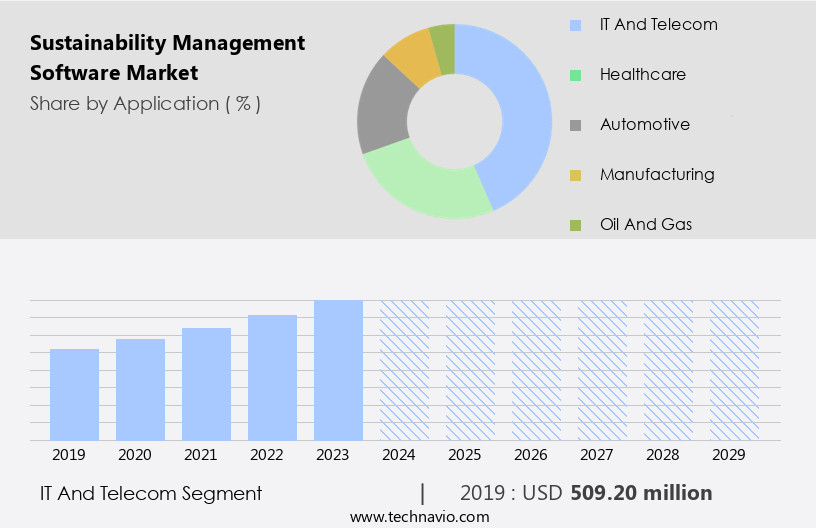
The IT and telecom segment is estimated to witness significant growth during the forecast period. The ICT sector, comprising sustainability management software, is projected to dominate the global market due to its significant contribution to carbon emissions. ICT is currently responsible for approximately 3-4% of global CO2 emissions, with telecommunications accounting for 1.6%. Upstream and downstream operations, including energy usage, account for up to 90% of telco firms' emissions. The rapid expansion of global data traffic is anticipated to increase ICT's carbon footprint to 14% by 2040. These systems facilitate real-time information, automated data management, reporting, project planning, and scenario planning, leading to energy savings, pollution reduction, and climate change mitigation.
Get a glance at the share of various segments. Request Free Sample
The IT and telecom segment was valued at USD 509.20 million in 2019 and showed a gradual increase during the forecast period.
Regional Analysis
North America is estimated to contribute 44% to the growth of the global market during the forecast period. Technavio's analysts have elaborately explained the regional trends and drivers that shape the market during the forecast period.

For more insights on the market share of various regions, Request Free Sample
The North American market holds the largest share In the market due to stringent regulations, a strong economy, and the presence of several industrial clean air technology companies. Factors such as the implementation of the Clean Air Act and advancements in clean air technology have driven the region's dominance. The significant reduction in industrial emissions is another factor contributing to the market's growth. It plays a crucial role in energy management, carbon footprint reduction, and pollution control, particularly In the manufacturing and chemicals sectors. The software enables real-time information, automated data management, reporting, project planning, and scenario planning, leading to cost savings and energy efficiency.
Market Dynamics
Our sustainability management software market researchers analyzed the data with 2024 as the base year, along with the key drivers, trends, and challenges. A holistic analysis of drivers will help companies refine their marketing strategies to gain a competitive advantage.
What are the key market drivers leading to the rise In the adoption of Sustainability Management Software Industry?
Shift toward green initiatives is the key driver of the market.
- It plays a crucial role in addressing the challenge of carbon emissions by facilitating the use of renewable resources for energy generation. This software provides real-time information on energy usage and carbon footprint, enabling organizations to implement cost-saving strategies and reduce their environmental impact. The software automates data management, offering reporting, project planning, and scenario planning capabilities. It also helps identify opportunities for energy saving and pollution reduction, contributing to climate change mitigation efforts. In the manufacturing sector, it can assist in green development and energy efficiency, while in the chemicals sector, it can aid in supply chain derisking and resource management in resourcestressed areas.
- Moreover, by providing automated data management and real-time information, it enables organizations to make informed decisions and adopt sustainable practices, ultimately contributing to a low-carbon economy.
What are the market trends shaping the Sustainability Management Software Industry?
Emergence of analytics in sustainability management software is the upcoming market trend.
- It plays a crucial role in helping businesses effectively manage energy usage, carbon emissions, and resource consumption. With increasing focus on reducing carbon footprints and adhering to regulatory requirements, organizations in various sectors, such as chemicals and manufacturing, are turning for solutions. This software enables automated data management, real-time reporting, project planning, and scenario planning, all aimed at promoting energy efficiency and pollution reduction. Cloud-based, on-premise, and hybrid cloud solutions are available to cater to different organizational needs. Consulting and implementation services are also provided by software companies to ensure seamless integration and optimal usage of the software.
- Furthermore, the software also aids in supply chain derisking and resource management in resourcestressed areas. Therefore, it is an essential tool for organizations aiming to adopt sustainable practices and reduce their carbon footprint. The software's capabilities in energy management, resource management, data management, and reporting are driving its adoption across various sectors, enabling organizations to make informed decisions and optimize their energy usage.
What challenges does the Sustainability Management Software Industry face during its growth?
Integration issues with ERP solutions is a key challenge affecting the industry growth.
- It plays a crucial role in helping businesses manage and reduce their carbon emissions, energy usage, and resource consumption. This software often includes features for energy management, green energy, renewable energy, and low-carbon technology. Implementation and consulting services are available to assist with the integration of these systems, which can be delivered through cloud-based, on-premise, or hybrid cloud solutions. Collaboration and communication systems are essential components, enabling real-time information sharing and project planning. The software also offers automated data management, reporting, and scenario planning to help companies save energy and reduce their carbon footprint.
- Furthermore, in the chemicals sector, it can support supply chain derisking and sustainable practices. Manufacturing sectors can benefit by implementing green development and energy efficiency strategies. Cloud-based solutions offer cost-saving strategies and easy access to data management tools, while on-premise and hybrid cloud options provide more control over data security and customization. Energy management is a significant aspect with features for monitoring and reporting energy usage. The software can also assist in pollution reduction and climate change mitigation efforts. In resource-stressed areas, it can be an essential tool for corporate strategy and sustainable practices.
Exclusive Customer Landscape
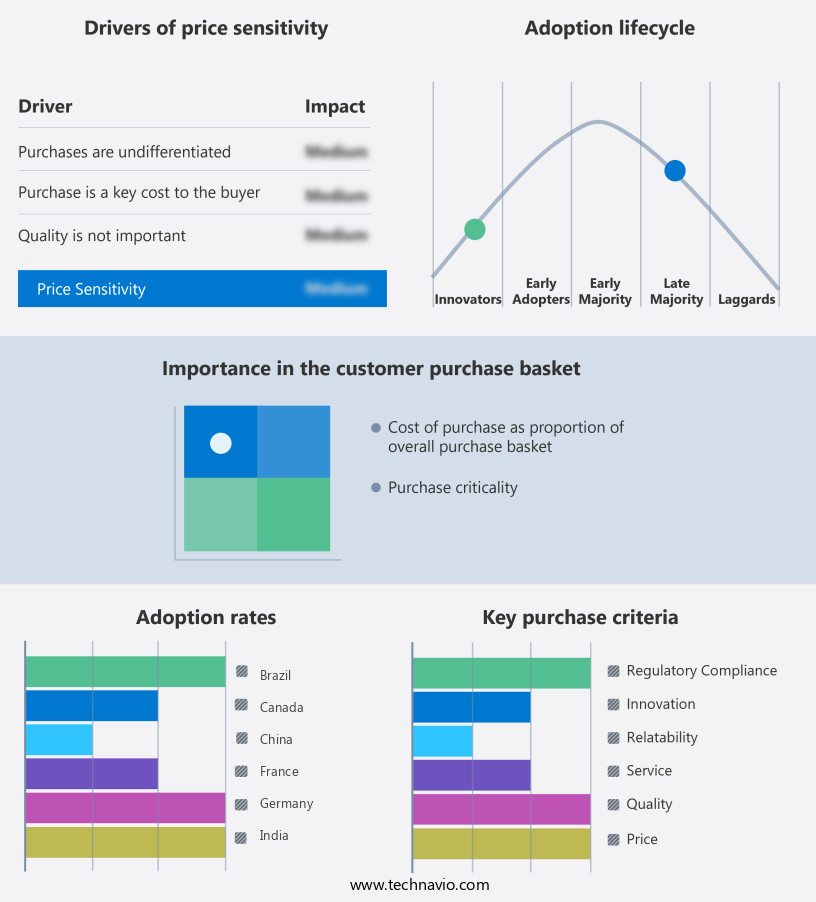
The market forecasting report includes the adoption lifecycle of the market, covering from the innovator's stage to the laggard's stage. It focuses on adoption rates in different regions based on penetration. Furthermore, the market growth analysis report also includes key purchase criteria and drivers of price sensitivity to help companies evaluate and develop their market growth analysis strategies.
Customer Landscape
Key Companies & Market Insights
Companies are implementing various strategies, such as strategic alliances, sustainability management software market forecast, partnerships, mergers and acquisitions, geographical expansion, and product/service launches, to enhance their presence In the industry.
Benchmark Digital Partners LLC - The company offers sustainability management software such as cloud-based management solutions for ESG and EHS Program.
The industry research and growth report includes detailed analyses of the competitive landscape of the market and information about key companies, including:
- Dakota Software Corp.
- Diligent Corp.
- ENGIE SA
- Figbytes Inc.
- Fortive Corp.
- International Business Machines Corp.
- LogicLadder Technologies Pvt. Ltd.
- Mitsubishi Electric Corp.
- PDS Group
- Quentic GmbH
- SAP SE
- Schneider Electric SE
- Sphera Solutions Inc.
- UL Solutions Inc.
- Urjanet Inc.
- VelocityEHS Holdings Inc.
- Wolters Kluwer NV
Qualitative and quantitative analysis of companies has been conducted to help clients understand the wider business environment as well as the strengths and weaknesses of key industry players. Data is qualitatively analyzed to categorize companies as pure play, category-focused, industry-focused, and diversified; it is quantitatively analyzed to categorize companies as dominant, leading, strong, tentative, and weak.
Research Analyst Overview
Sustainability management software has emerged as a crucial tool for businesses seeking to minimize their carbon emissions and enhance energy management. This software assists organizations in optimizing their use of renewable resources, implementing low-carbon technology, and devising cost-saving strategies. The market for sustainability management software is experiencing significant growth due to the increasing global focus on environmental issues and the need for corporations to adopt sustainable practices. The software solutions in this domain encompass a range of functionalities, including data management, real-time information, collaboration systems, and communication systems. These tools enable organizations to monitor and analyze their energy usage, resource management, and project planning.
Moreover, they offer automated data management and reporting capabilities, facilitating efficient decision-making and scenario planning. Sustainability management software can be deployed in various ways, including cloud-based, on-premise, and hybrid cloud. Cloud-based solutions offer the advantage of flexibility and scalability, allowing businesses to access their data and applications from anywhere. On-premise solutions, on the other hand, provide organizations with greater control over data security. Hybrid cloud solutions offer a combination of both, providing the benefits of both deployment models. The market caters to various industries, with the chemicals sector and manufacturing sector being significant adopters. In the chemicals sector, the software helps in supply chain derisking and managing resource-stressed areas.
In addition, in the manufacturing sector, it aids in green development and energy efficiency. The implementation and consulting services associated with sustainability management software play a vital role in ensuring successful adoption. These services help organizations navigate the complexities of software selection, implementation, and customization. They also provide guidance on best practices and offer ongoing support to optimize the software's performance. The market dynamics of sustainability management software are driven by several factors, including increasing environmental regulations, growing awareness of climate change, and the need for organizations to reduce their carbon footprint and pollution. Additionally, the cost savings associated with energy efficiency and resource optimization are significant incentives for businesses to invest In these solutions.
|
Sustainability Management Software Market Scope |
|
|
Report Coverage |
Details |
|
Page number |
211 |
|
Base year |
2024 |
|
Historic period |
2019-2023 |
|
Forecast period |
2025-2029 |
|
Growth momentum & CAGR |
Accelerate at a CAGR of 15% |
|
Market growth 2025-2029 |
USD 1.62 billion |
|
Market structure |
Fragmented |
|
YoY growth 2024-2025(%) |
12.7 |
|
Key countries |
US, China, UK, Germany, France, Japan, Canada, Brazil, India, and UAE |
|
Competitive landscape |
Leading Companies, market growth and forecasting , Market Positioning of Companies, Competitive Strategies, and Industry Risks |
What are the Key Data Covered in this Sustainability Management Software Market Research and Growth Report?
- CAGR of the Sustainability Management Software industry during the forecast period
- Detailed information on factors that will drive the Sustainability Management Software growth and forecasting between 2025 and 2029
- Precise estimation of the size of the market and its contribution of the industry in focus to the parent market
- Accurate predictions about upcoming growth and trends and changes in consumer behaviour
- Growth of the market across North America, Europe, APAC, South America, and Middle East and Africa
- Thorough analysis of the market's competitive landscape and detailed information about companies
- Comprehensive analysis of factors that will challenge the sustainability management software market growth of industry companies
We can help! Our analysts can customize this sustainability management software market research report to meet your requirements.