

Thermal Treatment Air Filtration Market Size 2024-2028
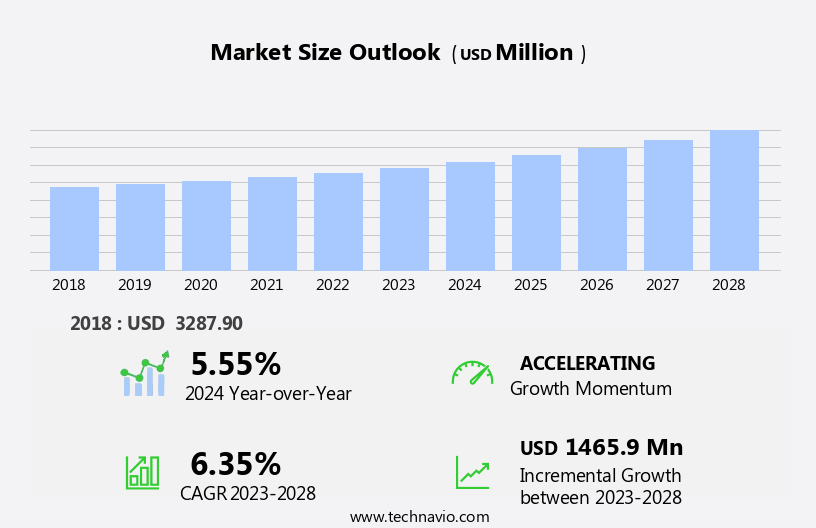
The thermal treatment air filtration market size is forecast to increase by USD 1.47 billion at a CAGR of 6.35% between 2023 and 2028.
What will be the Size of the Thermal Treatment Air Filtration Market During the Forecast Period?
How is this Thermal Treatment Air Filtration Industry segmented and which is the largest segment?
The thermal treatment air filtration industry research report provides comprehensive data (region-wise segment analysis), with forecasts and estimates in "USD million" for the period 2024-2028, as well as historical data from 2018-2022 for the following segments.
- End-user
- Oil and gas
- Chemicals
- Transportation
- Pulp and paper
- Others
- Type
- RTO
- Thermal oxidizer
- Catalytic oxidizer
- RCO
- Geography
- APAC
- China
- India
- North America
- US
- Europe
- Germany
- UK
- Middle East and Africa
- South America
- APAC
By End-user Insights
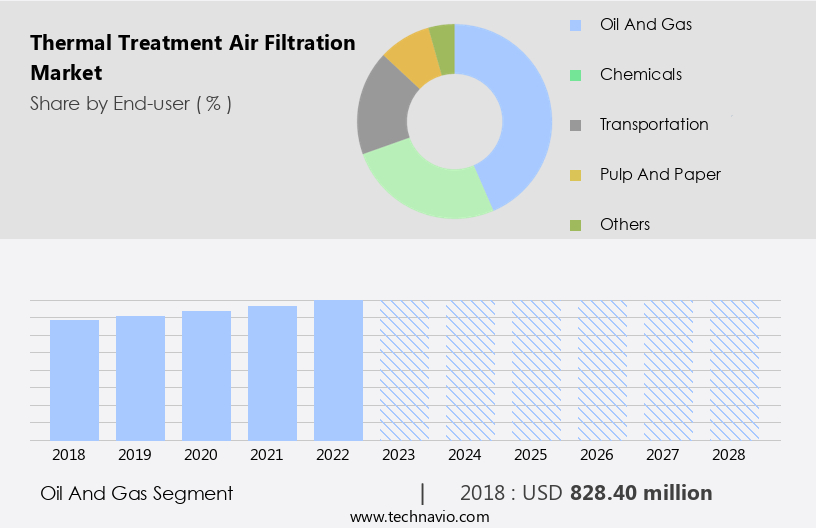
The oil and gas segment is estimated to witness significant growth during the forecast period. Thermal treatment air filtration plays a vital role In the oil and gas industry, where operations frequently result In the emission of pollutants that necessitate effective filtration for both environmental compliance and health concerns. In this sector, thermal treatment air filtration is employed in various processes, including vapor recovery, flare gas emissions control, and the treatment of air pollutants from refining and petrochemical operations. These processes generate hazardous air pollutants (HAPs), volatile organic compounds (VOCs), sulfur compounds, and particulate matter. Thermal treatment air filtration systems are indispensable for eliminating these pollutants and ensuring emissions adhere to environmental regulations. These systems are particularly crucial in addressing pollutants such as VOCs, which contribute to health issues like asthma, cardiovascular problems, lung cancer, stroke, and ischaemic heart disease.
Thermal treatment air filtration technologies include Thermal Oxidizers (TOx), Catalytic Oxidizers (CATOx), Regenerative Thermal Oxidizers (RTOx), and Regenerative Catalytic Oxidizers (RCOx). Advanced technologies like artificial intelligence, machine learning, and the Internet of Things are increasingly being integrated into these systems for improved moisture control, air treatment, and thermal energy recovery. Thermal treatment air filtration is also essential in industries such as building materials, cement and lime, consumer goods, energy and resources, metals and mining, and the coating and printing sectors, where exhaust gases and industrial processes generate polluting compounds. Pollution control guidelines and sustainable development initiatives emphasize the importance of implementing advanced technologies and adhering to pollution control regulations to minimize the environmental impact of industrial operations.
Get a glance at the market report of various segments Request Free Sample
The Oil and gas segment was valued at USD 828.40 billion in 2018 and showed a gradual increase during the forecast period.
Regional Analysis
APAC is estimated to contribute 49% to the growth of the global market during the forecast period. Technavio’s analysts have elaborately explained the regional trends and drivers that shape the market during the forecast period.

For more insights on the market size of various regions, Request Free Sample
The Asia-Pacific (APAC) the market is projected to expand substantially due to the increasing industrialization and urbanization In the region. Key industries, including oil and gas, power, chemical, and electronics, are significant contributors to market growth. The demand for power generation is surging, leading to an increase in new projects, such as Myanmar's plans to invest in coal-fired power plants. Strict environmental regulations necessitate effective air filtration systems to combat rising pollution levels, which pose health risks, including asthma, cardiovascular problems, lung cancer, stroke, and ischaemic heart disease. Pollutants, including volatile organic compounds, hazardous air pollutants, sulfur dioxide, carbon monoxide, carbon dioxide, and particulate matter, require advanced technologies, such as Thermal Oxidizers (TOx), Catalytic Oxidizers (CATOx), Regenerative Thermal Oxidizers (RTOx), and Regenerative Catalytic Oxidizers (RCOx), to ensure workplace safety and adhere to pollution control guidelines.
Sustainable development and the integration of advanced technologies, including artificial intelligence, machine learning, and the Internet of Things, are crucial to moisture control, air treatment, and thermal energy recovery. Building Materials, Consumer Goods Industry, Energy and Resource, Metals and Mining, and other sectors also rely on air filtration for exhaust gases and industrial processes.
Market Dynamics
Our researchers analyzed the data with 2023 as the base year, along with the key drivers, trends, and challenges. A holistic analysis of drivers will help companies refine their marketing strategies to gain a competitive advantage.
What are the key market drivers leading to the rise In the adoption of Thermal Treatment Air Filtration Industry?
- Stringent environmental regulations is the key driver of the market.The market is experiencing significant growth due to increasing concerns over pollution levels and associated health diseases caused by pollutants, including volatile organic compounds and hazardous air pollutants. Industrial processes, particularly in sectors such as oil and gas, coating and printing, and energy and resource extraction, contribute substantially to the release of these pollutants. Exposure to these toxic contaminants can lead to asthma, cardiovascular problems, lung cancer, stroke, and ischaemic heart disease. Governments worldwide are implementing stringent regulations to mitigate the environmental impact of these pollutants. For instance, several countries are adopting emission standards for various industries to reduce the release of sulfur dioxide, carbon monoxide, carbon dioxide, and particulate matter.
In the transportation sector, countries such as Russia and Germany are implementing EURO IV and EURO V emission standards. Advanced technologies, such as Thermal Oxidizers, Catalytic Oxidizers, Regenerative Thermal Oxidizers, and Regenerative Catalytic Oxidizers, are increasingly being adopted for air treatment to ensure workplace safety and meet pollution control guidelines. These technologies use an oxidizing chamber to convert polluting compounds into harmless gases, thereby reducing the release of hazardous airborne pollutants. Moreover, the integration of advanced technologies such as artificial intelligence, machine learning, and the Internet of Things In thermal treatment air filtration systems is enabling more efficient moisture control, air treatment, and thermal energy recovery.
Building Materials, Consumer Goods Industry, and Metals and Mining sectors are also adopting these technologies to minimize their carbon footprint and contribute to sustainable development.
What are the market trends shaping the Thermal Treatment Air Filtration market?
- Growing petroleum refining is the upcoming market trend.The market experiences significant growth due to the expanding oil and gas industry and the increasing awareness of workplace safety. With the global population and energy demand on the rise, the oil and gas sector has seen notable growth, leading to an increase in industrial air streams containing pollutants such as volatile organic compounds, hazardous air pollutants, sulfur dioxide, carbon monoxide, carbon dioxide, and particulate matter. These pollutants can lead to health issues like asthma, cardiovascular problems, lung cancer, stroke, and ischaemic heart disease, making pollution control a priority. Advanced technologies, including Thermal Oxidizers like Catalytic Oxidizers, Regenerative Thermal Oxidizers, and Regenerative Catalytic Oxidizers, are being employed to address toxic contaminants in exhaust gases from industrial processes.
Additionally, sectors like coating and printing, building materials (Cement and Lime), consumer goods, energy and resource, and metals and mining also contribute to the market's growth due to their need for air filtration systems. The market is further driven by pollution control guidelines and the push for sustainable development. Key technologies, such as moisture control, air treatment, and thermal energy recovery, are also gaining traction In the market.
What challenges does the Thermal Treatment Air Filtration Industry face during its growth?
- Risk of volatility in natural gas prices is a key challenge affecting the industry growth.The market addresses the growing concern over pollution levels and associated health diseases caused by pollutants, including volatile organic compounds and hazardous air pollutants, in various industrial air streams. These pollutants can lead to respiratory issues such as asthma, cardiovascular problems, lung cancer, stroke, and ischaemic heart disease, as well as exposure to toxic contaminants like sulfur dioxide, carbon monoxide, carbon dioxide, and particulate matter. Industries like oil and gas, coating and printing, and the consumer goods industry contribute significantly to these emissions. To ensure workplace safety and adhere to pollution control guidelines, advanced technologies such as Thermal Oxidizers, Catalytic Oxidizers, Regenerative Thermal Oxidizers, and Regenerative Catalytic Oxidizers are employed to treat exhaust gases from industrial processes.
However, the market growth faces challenges due to the volatility of natural gas prices, which are often used as an assist gas for thermal oxidizers. Power utilities aim to maintain a balanced feedstock portfolio to mitigate electricity price fluctuations. Advanced technologies, such as artificial intelligence, machine learning, and the Internet of Things, are being integrated into moisture control, air treatment, and thermal energy recovery systems to optimize performance and sustainability. Building Materials sectors like cement and lime, Energy and Resource, Metals and Mining, and the Air filtration industry also benefit from these advancements. Thermal oxidizers work by burning polluting compounds in an oxidizing chamber, converting them into harmless gases.
These systems require a steady fuel source, with low-heat content waste streams needing an assist fuel and medium-to-high heating value waste streams functioning as fuel for the system. The ignition waste stream or assist gas burner necessitates a pilot gas, typically natural gas or other gases like propane. In conclusion, the market plays a crucial role in addressing pollution problems, a global issue, by effectively treating industrial exhaust gases and ensuring compliance with pollution control guidelines. The integration of advanced technologies is driving sustainable development and improving overall performance and efficiency.
Exclusive Customer Landscape
The thermal treatment air filtration market forecasting report includes the adoption lifecycle of the market, covering from the innovator’s stage to the laggard’s stage. It focuses on adoption rates in different regions based on penetration. Furthermore, the thermal treatment air filtration market report also includes key purchase criteria and drivers of price sensitivity to help companies evaluate and develop their market growth analysis strategies.

Customer Landscape
Key Companies & Market Insights
Companies are implementing various strategies, such as strategic alliances, thermal treatment air filtration market forecast, partnerships, mergers and acquisitions, geographical expansion, and product/service launches, to enhance their presence In the industry.
Accurate Thermal Systems LLC - Thermal treatment processes in Extrusion and Injection molding applications generate significant airborne pollutants, including smoke, particulate matter, fumes, and volatile organic compounds (VOCs). HEPA (High-Efficiency Particulate Air) air filtration systems are an effective solution for capturing and removing these contaminants during thermal tool cleaning operations. By utilizing advanced filtration technology, these systems ensure improved indoor air quality, enhancing worker safety and productivity. HEPA filters capture 99.97% of particles as small as 0.3 microns, making them highly effective in eliminating a wide range of pollutants. Additionally, activated carbon filters can be integrated into the system to further address VOCs and other gaseous contaminants, ensuring comprehensive air purification.
The industry research and growth report includes detailed analyses of the competitive landscape of the market and information about key companies, including:
- Accurate Thermal Systems LLC
- Air Clear LLC
- Anguil Environmental Systems Inc.
- APC Technologies Inc.
- Catalytic Products International Inc.
- CECO Environmental Corp.
- COLT TECHNOLOGIES INC.
- CTP Chemisch Thermische Prozesstechnik GmbH.
- Deuring Group GmbH.
- Durr AG
- FIVES SAS
- Freudenberg and Co. KG
- Glenro Inc.
- Koch Industries Inc.
- Taikisha Ltd.
- Tellkamp Systems Inc.
- The CMM Group
- Zeeco Inc.
Qualitative and quantitative analysis of companies has been conducted to help clients understand the wider business environment as well as the strengths and weaknesses of key industry players. Data is qualitatively analyzed to categorize companies as pure play, category-focused, industry-focused, and diversified; it is quantitatively analyzed to categorize companies as dominant, leading, strong, tentative, and weak.
Research Analyst Overview
The market encompasses various industrial applications that aim to mitigate the presence of pollutants in air streams. These pollutants, including volatile organic compounds (VOCs) and hazardous air pollutants (HAPs), can originate from numerous industries such as oil and gas, coating and printing, and metals and mining. The significance of thermal treatment air filtration lies in its ability to address the health diseases and environmental concerns associated with these pollutants. Industrial processes generate exhaust gases laden with polluting compounds, which can lead to respiratory diseases like asthma and cardiovascular problems. Long-term exposure to these contaminants can result in more severe health issues, including lung cancer, stroke, and ischaemic heart disease.
Moreover, the release of toxic contaminants into the environment can contribute to pollution problems, posing an international issue. Thermal treatment air filtration systems employ advanced technologies like thermal oxidizers and catalytic converters to eliminate pollutants. Thermal oxidizers utilize high temperatures to oxidize pollutants, converting them into harmless by-products. Catalytic oxidizers, on the other hand, use catalysts to facilitate the oxidation process, making it more energy-efficient. Regenerative thermal oxidizers and regenerative catalytic oxidizers are popular choices due to their thermal energy recovery capabilities. These systems not only eliminate pollutants but also recover heat that can be reused in industrial processes, contributing to sustainable development.
The building materials industry, including cement and lime production, also benefits from thermal treatment air filtration. These industries generate significant amounts of dust and VOCs, which can negatively impact workplace safety and contribute to environmental pollution. Thermal treatment air filtration systems help mitigate these issues, ensuring a cleaner and safer working environment. The consumer goods industry, energy and resource sectors, and water and wastewater treatment plants also rely on thermal treatment air filtration to manage their exhaust gases and ensure compliance with pollution control guidelines. Advanced technologies like artificial intelligence (AI), machine learning, and the Internet of Things (IoT) are increasingly being integrated into thermal treatment air filtration systems.
These technologies enable real-time monitoring and optimization of filtration processes, improving efficiency and reducing operational costs. Moisture control is another essential aspect of thermal treatment air filtration. Humidity in industrial air streams can lead to corrosion and other issues, necessitating the use of commercial filters and heat exchangers to maintain optimal moisture levels. In conclusion, thermal treatment air filtration plays a crucial role in managing pollutants in industrial air streams, addressing health and environmental concerns. Technological advancements continue to drive innovation in this market, enabling more efficient and cost-effective solutions.
|
Market Scope |
|
|
Report Coverage |
Details |
|
Page number |
179 |
|
Base year |
2023 |
|
Historic period |
2018-2022 |
|
Forecast period |
2024-2028 |
|
Growth momentum & CAGR |
Accelerate at a CAGR of 6.35% |
|
Market growth 2024-2028 |
USD 1465.9 million |
|
Market structure |
Fragmented |
|
YoY growth 2023-2024(%) |
5.55 |
|
Key countries |
China, US, India, Germany, and UK |
|
Competitive landscape |
Leading Companies, Market Positioning of Companies, Competitive Strategies, and Industry Risks |
What are the Key Data Covered in this Thermal Treatment Air Filtration Market Research and Growth Report?
- CAGR of the Thermal Treatment Air Filtration industry during the forecast period
- Detailed information on factors that will drive the growth and forecasting between 2024 and 2028
- Precise estimation of the size of the market and its contribution of the industry in focus to the parent market
- Accurate predictions about upcoming growth and trends and changes in consumer behaviour
- Growth of the market across APAC, North America, Europe, Middle East and Africa, and South America
- Thorough analysis of the market’s competitive landscape and detailed information about companies
- Comprehensive analysis of factors that will challenge the thermal treatment air filtration market growth of industry companies
We can help! Our analysts can customize this thermal treatment air filtration market research report to meet your requirements.
 RIA -
RIA -