


Translation Management Software Market Analysis Europe, North America, APAC, Middle East and Africa, South America - US, Germany, France, UK, Canada, China, Italy, Spain, Japan, South Korea - Size and Forecast 2024-2028

Translation Management Software Market Analysis Europe, North America, APAC, Middle East and Africa, South America - US, Germany, France, UK, Canada, China, Italy, Spain, Japan, South Korea - Size and Forecast 2024-2028

Published: Aug 2024 211 Pages SKU: IRTNTR72034

Market Overview at a Glance

$2.33 B
Market Opportunity
14.66%
CAGR
14.26
YoY growth 2023-2024(%)

Translation Management Software Market Size 2024-2028

The translation management software market size is forecast to increase by USD 2.33 billion at a CAGR of 14.66% between 2023 and 2028.

  • The market is experiencing significant growth due to the increasing volume of data among organizations and the adoption of advanced technologies such as neural machine translation (NMT). This technology enables machines to learn and improve from experience, leading to more accurate translations. However, the market also faces challenges, including the threat from open-source translation management software. Open-source solutions offer cost-effective alternatives, but they may lack the advanced features and support offered by commercial software. Organizations must carefully evaluate their translation needs and budgets to determine which solution is best for them. In summary, the market is driven by the growing need for efficient and accurate translation solutions, while the adoption of advanced technologies and the threat from open-source software present both opportunities and challenges.
  • What will be the Size of the Translation Management Software Market During the Forecast Period?

    Translation Management Software Market Size

     Request Free Sample

  • The market caters to businesses seeking to overcome language barriers In their digital content, cross-border transactions, and customer communications. This market is driven by the increasing demand for translation solutions in various sectors, including e-commerce, social media, digital marketing, and travel and hospitality. Translation workflows are becoming more automated through artificial intelligence (AI) and machine learning, enabling real-time, cost-effective translation of web content, customer support documentation, and voice over. Neural machine translation and machine translation software are increasingly popular, offering improved linguistic consistency and accuracy. Cloud computing facilitates easy access to translation services, while data analysis ensures efficient content delivery.
  • AI-based solutions are also being used for project management, voice recognition, and content localization in industries like airlines, hotel chains, and car rental firms. The market is expected to grow significantly due to the increasing need for multilingual digital content In the global economy.
  • How is this Translation Management Software Industry segmented and which is the largest segment?

    The translation management software industry research report provides comprehensive data (region-wise segment analysis), with forecasts and estimates in "USD million" for the period 2024-2028, as well as historical data from 2018-2022 for the following segments.

    • Deployment
      • On-premises
      • Cloud
    • End-user
      • BFSI
      • Legal
      • Life sciences
      • Tourism and travel
      • Others
    • Geography
      • Europe
        • Germany
        • UK
        • France
      • North America
        • Canada
        • US
      • APAC
        • Middle East and Africa
          • South America

          By Deployment Insights

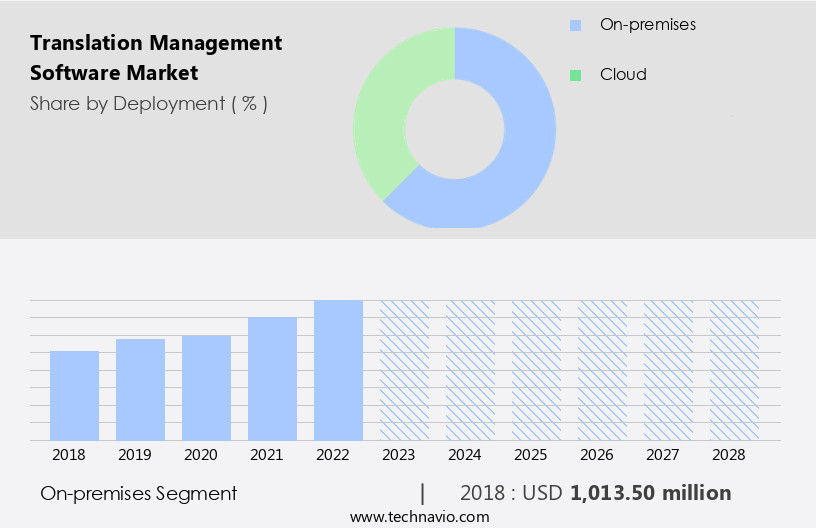
          • The on-premises segment is estimated to witness significant growth during the forecast period.

          On-premises translation management software enables businesses to install and operate translation solutions on their own servers and IT infrastructure. This deployment model offers organizations control over their translation processes, ensuring data security, privacy, and customization. Key industries, such as healthcare, finance, and legal sectors, which prioritize data sensitivity and regulatory compliance, often prefer on-premises solutions. Machine translation, artificial intelligence, and natural language processing are integral components of translation management software, enhancing linguistic consistency, improving translation accuracy, and facilitating multimodal translation. API capabilities, data security, and collaboration technologies further streamline workflows and ensure quality and accuracy. Industry-specific language, digital content proliferation, and cross-border collaboration necessitate advanced translation solutions.

          Cloud-based platforms and project management tools further optimize translation services, enabling real-time collaboration and content delivery across various digital platforms, including social media, e-commerce, and digital marketing.
          Translation Management Software Market Size

          Get a glance at the  Translation Management Software Industry report of share of various segments Request Free Sample

          The On-premises segment was valued at USD 1.01 billion in 2018 and showed a gradual increase during the forecast period.

          Regional Analysis

          • Europe is estimated to contribute 42% to the growth of the global market during the forecast period.

          Technavio’s analysts have elaborately explained the regional trends and drivers that shape the market during the forecast period.

          Translation Management Software Market Share by Geography

          For more insights on the market share of various regions, Request Free Sample

          The European the market experiences significant growth due to the region's diverse linguistic landscape and high international business activity. With advanced economies like the UK, Germany, and France, which have a thriving industrial sector, driving market expansion, the adoption of translation software is high. In the EU, which is a global trade hub, countries such as France and Germany, where English is not the primary language for documentation, have a high demand for translation solutions. The market is saturated with large companies, providing advanced translation offerings, including AI-based solutions, machine translation, neural machine translation, and terminology management. These tools address language barriers, ensuring linguistic consistency, precision, and cultural sensitivity in cross-border communication.

          Translation workflows are streamlined with collaboration technologies, cloud computing, and project management tools. Additionally, industry-specific language, multimedia content, and content localization are addressed through automatic speech recognition, multimodal translation, and natural language processing. Data security, API capabilities, and blockchain integration are essential features for businesses to ensure data confidentiality.

          Market Dynamics

          Our  researchers analyzed the data with 2023 as the base year, along with the key drivers, trends, and challenges. A holistic analysis of drivers will help companies refine their marketing strategies to gain a competitive advantage.

          What are the key market drivers leading to the rise In the adoption of Translation Management Software Industry?

          Increasing volume of data among organizations is the key driver of the market.

        • In today's digital age, cross-border business expansion has become a necessity for organizations seeking to reach global audiences. However, language barriers can hinder effective communication and hinder success. Translation solutions have emerged as a crucial component of digital content management, enabling businesses to overcome linguistic inconsistencies and ensure linguistic precision In their global communication. Artificial intelligence (AI) and machine learning have revolutionized the translation industry, with advancements such as Neural Machine Translation (NMT) and Natural Language Processing (NLP) enabling automated translation tools to deliver high-quality translations. However, ensuring data security is paramount, with API capabilities and blockchain integration becoming essential features for translation management software.
        • Industry-specific language, multimodal translation, and terminology management are also critical considerations for organizations seeking to deliver accurate and culturally sensitive translations. Translation workflows must be streamlined, with collaboration technologies and project management tools enabling efficient cross-border collaboration. With the proliferation of digital content, the demand for translation services has surged. Social media, e-commerce, digital marketing, and audiovisual content require translation to reach global audiences. Automated translation tools, cloud computing, and machine learning are essential for managing the large volumes of text-based, audio-based, and video-based content. Translation accuracy is essential for maintaining the flow of communication and ensuring customer satisfaction.
        • Less common languages and complex language structures require specialized linguistic resources and professional services. Managed services and automated translations enable organizations to scale their translation efforts and reduce costs. In conclusion, translation management software is a vital component of digital content management for organizations seeking to expand their reach and communicate effectively with global audiences. AI-based solutions, data analysis, and collaboration technologies enable efficient translation workflows, ensuring linguistic consistency, cultural sensitivity, and high-quality translations.
        • What are the market trends shaping the Translation Management Software Industry?

          Increasing adoption of neural machine translation (NMT) is the upcoming market trend.

        • Neural machine translation (NMT) is transforming the market by utilizing deep learning algorithms to generate more precise and natural translations. NMT employs artificial neural networks to model entire sentences as sequences, capturing context and meaning more effectively than traditional statistical methods. This leads to translations that are not only grammatically correct but also contextually relevant. Google, under Alphabet Inc., is a leading company implementing NMT with its Google Translate service. By continuously learning and improving from extensive multilingual data, Google's NMT can generate translations that closely mimic human language patterns, especially when dealing with complex sentences or industry-specific jargon. This results in higher quality and fluency, essential for cross-border businesses seeking to overcome language barriers and ensure linguistic consistency across digital content, including text-based, audiovisual, and multimedia content.
        • Translation workflows, collaboration technologies, and project management tools are further enhanced by NMT, enabling better communication flow and cultural sensitivity in global business environments. Additionally, NMT's integration with artificial intelligence (AI), natural language processing (NLP), and machine learning (ML) technologies further bolsters its capabilities, making it an indispensable solution for businesses dealing with data security concerns and the need for API capabilities, terminiology management, and multimodal translation. The translation services industry is experiencing digital content proliferation, necessitating automated translation tools, and NMT's ability to deliver accurate translations at scale makes it an attractive option for businesses looking to localize content for social media, e-commerce, digital marketing, and other digital platforms.
        • Cloud computing and machine translation software are also driving the market, with AI-based solutions becoming increasingly popular for their ability to process big data and improve translation accuracy, even for less common languages and language structures. The market is further fueled by the growing demand for professional and managed services, as well as the integration of blockchain technology, voice over, dubbing, and other advanced features for audio and video-based content. Ultimately, NMT is revolutionizing the market by enabling businesses to overcome language barriers, ensure linguistic precision, and maintain cultural sensitivity while effectively communicating with customers and partners across the globe.
        • What challenges does the Translation Management Software Industry face during its growth?

          Threat from open-source translation management software is a key challenge affecting the industry growth.

        • The market faces intense competition from open-source solutions, posing a significant challenge. Open-source platforms, such as MateCat and OmegaT, offer cost-effective alternatives with translation memory, project management, and collaboration tools. Their availability puts pressure on commercial software companies to justify pricing models. Open-source software's community-driven development leads to rapid innovation and feature updates, rivaling paid solutions. This dynamic reduces market share for proprietary translation management software providers, compelling them to innovate continually. Digital content's proliferation in cross-border business necessitates translation solutions to overcome language barriers. Translation workflows require linguistic consistency, precision, and cultural sensitivity. Artificial intelligence (AI) and machine translation, including Neural Machine Translation, play a crucial role.
        • Data security and API capabilities are essential for secure communication. Natural Language Processing (NLP) and Blockchain integration enhance accuracy and security. Multimodal translation, including audiovisual and simultaneous interpretation, is vital for global communication. Industry-specific language, terminology management, and collaboration technologies ensure quality and accuracy. Automated translation tools, such as machine learning and machine translation software, improve efficiency. Less common languages and language structures require specialized attention. Translation services, including social media, e-commerce, digital marketing, and customer support documentation, demand high-quality translations. Cloud computing, multimedia content, and automatic speech recognition expand application areas. Quality and accuracy, linguistic resources, and professional services ensure successful content localization.
        • The market dynamics include the impact of AI-based solutions, voice over, dubbing, multilingual content, and content management tools. Project management, data analysis, and content delivery are critical aspects. The travel and hospitality industry, web content, and government tourism portals are significant sectors. Mobile-based translation software, smartphones, and app development are emerging trends. Capital expenditure on cloud-based software and marketing campaigns drives growth. User-generated content and big data expand opportunities. Business process outsourcing (BPO) services and automakers utilize rule-based translation software.
        • Exclusive Customer Landscape

          The translation management software market forecasting report includes the adoption lifecycle of the market, covering from the innovator’s stage to the laggard’s stage. It focuses on adoption rates in different regions based on penetration. Furthermore, the translation management software market report also includes key purchase criteria and drivers of price sensitivity to help companies evaluate and develop their market growth analysis strategies.

          Translation Management Software Market Share by Geography

           Customer Landscape

          Key Companies & Market Insights

          Companies are implementing various strategies, such as strategic alliances, translation management software market forecast, partnerships, mergers and acquisitions, geographical expansion, and product/service launches, to enhance their presence In the industry.

          Acolad Group - The company provides translation management software services encompassing portal-based solutions for website, document, and video translation. These offerings facilitate efficient and effective language processing for businesses seeking multilingual communication. Translation Management Software (TMS) streamlines workflows, ensuring consistency and accuracy across various projects and formats. By utilizing advanced technologies and integrations, this solution caters to diverse industries and enterprises, enabling seamless global communication.

          The industry research and growth report includes detailed analyses of the competitive landscape of the market and information about key companies, including:

          • Acolad Group
          • Across Systems GmbH
          • Alphabet Inc.
          • Babylon Software Ltd.
          • Crowdin
          • International Business Machines Corp.
          • LanguageLine Solutions
          • Lionbridge Technologies LLC
          • Lokalise Inc.
          • MemoQ Translation Technologies Ltd.
          • Microsoft Corp.
          • Pairaphrase LLC
          • RWS Holdings PLC
          • SAP SE
          • Smartling Inc.
          • STAR AG
          • TextUnited GmbH
          • TransPerfect Global Inc.
          • Welocalize Inc.
          • Wordfast LLC
          • XTM International Ltd.

          Qualitative and quantitative analysis of companies has been conducted to help clients understand the wider business environment as well as the strengths and weaknesses of key industry players. Data is qualitatively analyzed to categorize companies as pure play, category-focused, industry-focused, and diversified; it is quantitatively analyzed to categorize companies as dominant, leading, strong, tentative, and weak.

          Research Analyst Overview

          Translation management software (TMS) is a crucial tool for businesses aiming to expand their reach across borders and communicate effectively with diverse audiences. This software facilitates the management of translation workflows, ensuring linguistic consistency and precision in an increasingly digital world. As digital content proliferates, language barriers pose significant challenges for businesses seeking to engage with customers and stakeholders In their native languages. TMS addresses these challenges by streamlining translation processes and enabling real-time collaboration between linguistic resources and project teams. The translation industry has seen significant advancements in technology, with artificial intelligence (AI) and machine learning playing increasingly important roles.

          Neural machine translation and natural language processing have revolutionized the way businesses approach translation, providing more accurate and efficient solutions. Data security is a critical concern for businesses using TMS. API capabilities and cloud computing enable secure integration with other systems, while blockchain integration adds an additional layer of security. TMS also offers collaboration technologies, enabling seamless communication between team members and language service providers. Multimodal translation is another key feature of TMS, allowing businesses to translate text-based, audio-based, and video-based content. Industry-specific language and terminology management ensure that translations are accurate and culturally sensitive, enhancing global communication and customer engagement.

          The translation services market is experiencing significant growth, driven by the digital transformation of industries such as travel and hospitality, e-commerce, and digital marketing. TMS enables businesses to localize content for these industries, ensuring that communication flows effectively and accurately. Social media and customer support documentation are essential channels for businesses to engage with their customers. TMS enables automated translation of user-generated content, ensuring that businesses can respond to customer queries in a timely and accurate manner. The increasing use of AI-based solutions in TMS has led to improvements in translation accuracy, particularly for less common languages and complex language structures.

          Rule-based translation software and linguistic resources continue to play a role, ensuring that translations are of the highest quality and accuracy. Cloud-based platforms and workflow management tools enable cross-border collaboration, reducing the need for physical travel and enabling businesses to work with language service providers from anywhere In the world. Professional and managed services offer additional support, ensuring that businesses can focus on their core competencies while leaving translation and localization to the experts. In conclusion, TMS is an essential tool for businesses seeking to expand their reach and communicate effectively with diverse audiences. With features such as AI-based solutions, collaboration technologies, and industry-specific language management, TMS enables businesses to overcome language barriers and engage with customers In their native languages.

          The market for TMS is expected to continue growing, driven by the digital transformation of industries and the increasing importance of global communication.

          Market Scope

          Report Coverage

          Details

          Page number

          211

          Base year

          2023

          Historic period

          2018-2022

          Forecast period

          2024-2028

          Growth momentum & CAGR

          Accelerate at a CAGR of 14.66%

          Market growth 2024-2028

          USD 2331.2 million

          Market structure

          Fragmented

          YoY growth 2023-2024(%)

          14.26

          Key countries

          US, Germany, France, UK, and Canada

          Competitive landscape

          Leading Companies, Market Positioning of Companies, Competitive Strategies, and Industry Risks

          Request Free Sample

          What are the Key Data Covered in this Translation Management Software Market Research and Growth Report?

          • CAGR of the Translation Management Software industry during the forecast period
          • Detailed information on factors that will drive the growth and forecasting between 2024 and 2028
          • Precise estimation of the size of the market and its contribution of the industry in focus to the parent market
          • Accurate predictions about upcoming growth and trends and changes in consumer behaviour
          • Growth of the market across Europe, North America, APAC, Middle East and Africa, and South America
          • Thorough analysis of the market’s competitive landscape and detailed information about companies
          • Comprehensive analysis of factors that will challenge the translation management software market growth of industry companies

          We can help! Our analysts can customize this translation management software market research report to meet your requirements.

          Get in touch


          Table of Contents not available.

          Research Methodology

          Technavio presents a detailed picture of the market by way of study, synthesis, and summation of data from multiple sources. The analysts have presented the various facets of the market with a particular focus on identifying the key industry influencers. The data thus presented is comprehensive, reliable, and the result of extensive research, both primary and secondary.

          INFORMATION SOURCES

          Primary sources

          • Manufacturers and suppliers
          • Channel partners
          • Industry experts
          • Strategic decision makers

          Secondary sources

          • Industry journals and periodicals
          • Government data
          • Financial reports of key industry players
          • Historical data
          • Press releases

          DATA ANALYSIS

          Data Synthesis

          • Collation of data
          • Estimation of key figures
          • Analysis of derived insights

          Data Validation

          • Triangulation with data models
          • Reference against proprietary databases
          • Corroboration with industry experts

          REPORT WRITING

          Qualitative

          • Market drivers
          • Market challenges
          • Market trends
          • Five forces analysis

          Quantitative

          • Market size and forecast
          • Market segmentation
          • Geographical insights
          • Competitive landscape

          Interested in this report?

          Get your sample now to see our research methodology and insights!

          Download Now

          Frequently Asked Questions

          Translation Management Software market growth will increase by $ 2331.2 mn during 2024-2028.

          The Translation Management Software market is expected to grow at a CAGR of 14.66% during 2024-2028.

          Translation Management Software market is segmented by Deployment( On-premises, Cloud) End-user( BFSI, Legal, Life sciences, Tourism and travel, Others)

          Acolad Group, Across Systems GmbH, Alphabet Inc., Babylon Software Ltd., Crowdin, International Business Machines Corp., LanguageLine Solutions, Lionbridge Technologies LLC, Lokalise Inc., MemoQ Translation Technologies Ltd., Microsoft Corp., Pairaphrase LLC, RWS Holdings PLC, SAP SE, Smartling Inc., STAR AG, TextUnited GmbH, TransPerfect Global Inc., Welocalize Inc., Wordfast LLC, XTM International Ltd. are a few of the key vendors in the Translation Management Software market.

          Europe will register the highest growth rate of 42% among the other regions. Therefore, the Translation Management Software market in Europe is expected to garner significant business opportunities for the vendors during the forecast period.

          US, Germany, France, UK, Canada

          • Increasing volume of data among organizationsCurrently is the driving factor this market.
          • large volumes of data are being generated through several sources is the driving factor this market.
          • such as the Internet is the driving factor this market.
          • mobile devices is the driving factor this market.
          • and social media. With the increasing volume is the driving factor this market.
          • variety is the driving factor this market.
          • and velocity of data (commonly known as 3Vs) is the driving factor this market.
          • organizations are facing challenges to efficiently analyze and manage large databases. In addition is the driving factor this market.
          • veracity is the driving factor this market.
          • the fourth component of big data management systems is the driving factor this market.
          • eliminates the amount of data that are irrelevant to organizations. This can save a lot of money. The irrelevant data that are generated from various sources provides incorrect information and predictions about consumer behavior is the driving factor this market.
          • consumer buying patterns is the driving factor this market.
          • and other information that can be used for key decision-making processes. Essentially is the driving factor this market.
          • every industry is a digital industry in the current world. Due to the digitalization of businesses and processes is the driving factor this market.
          • there is an abundance of complex and diversified data sets in the world. Data are the essence of any enterprise in this digital world. Furthermore is the driving factor this market.
          • due to the use of advanced and diverse machines and devices across business processes is the driving factor this market.
          • the data and content generated by organizations are rich is the driving factor this market.
          • varied is the driving factor this market.
          • and complex. Thus is the driving factor this market.
          • proper translation management software is required to ensure data accuracy and to reduce the time consumed. This is expected to fuel the adoption of translation management software during the forecast period. For example is the driving factor this market.
          • the BFSI industry has been generating huge volumes of data is the driving factor this market.
          • primarily due to the automation of processes and the adoption of digital mediums by various businesses for their core financial transactions. With the advent of embedded analytics technologies is the driving factor this market.
          • organizations can transform unstructured and semi-structured data into structured and meaningful data. This helps organizations get accurate data with proper translation at the right time is the driving factor this market.
          • which makes business-related decision-making processes easier. Thus is the driving factor this market.
          • the exponential increase in the volume of data is expected to drive the growth of the global translation management software market during the forecast period. is the driving factor this market.

          The Translation Management Software market vendors should focus on grabbing business opportunities from the On-premises segment as it accounted for the largest market share in the base year.