


UHT Processing Market Size 2024-2028
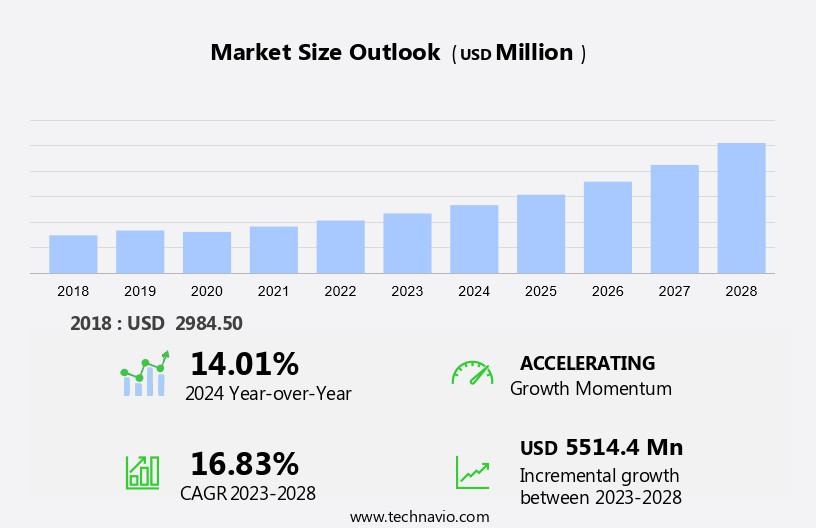
The UHT processing market size is forecast to increase by USD 5.51 billion at a CAGR of 16.83% between 2023 and 2028.
- The market is experiencing significant growth, driven by the increasing urbanization and changing consumer lifestyles that favor convenient and long-lasting food products. This trend is particularly prominent In the dairy sector, where expansions by processing plants to meet the rising demand for UHT milk and other dairy products are underway. However, the market faces challenges due to health concerns surrounding processed foods. As consumers become more health-conscious, there is a growing demand for natural and organic food options.
- The liquid segment, including milk, cream, yogurt, soups, fruit juices, dairy alternatives, and organic food products, dominates the market. Indirect UHT processing also benefits plant-based beverages, soy, almonds, oats, rice, dairy-free cheese, ice creams, canned soups, broths, stews, wines, tomato paste, and juices. Companies In the market must respond by innovating and offering healthier alternatives to meet this demand. Additionally, ensuring food safety and quality is crucial to maintain consumer trust and comply with regulatory requirements. By focusing on these areas, companies can capitalize on the market's growth potential and navigate the challenges effectively.
What will be the Size of the UHT Processing Market during the forecast period?
- The ultrahigh temperature (UHT) processing market encompasses the production of food and beverage products utilizing UHT technology for indirect heating, primarily employing steam at temperatures above 135°C to eliminate bacteria and microorganisms. UHT machines are integral to this sector, enabling the production of long-shelf-life items, including milk, cream, yogurt, and various liquid food products, such as soups, honeys, and ESL milk. This technology enhances food safety by eliminating the need for refrigeration during storage and distribution. The dairy sector dominates the UHT market due to the high demand for extended shelf life and pasteurized products.
- Aseptic packaging is a crucial component of UHT processing, ensuring product integrity and maintaining the quality of perishable items. The UHT equipment market continues to grow as food processing technology advances, offering alternatives to traditional refrigeration, freezing, and dried processing methods.
How is this UHT Processing Industry segmented?
The UHT processing industry research report provides comprehensive data (region-wise segment analysis), with forecasts and estimates in "USD million" for the period 2024-2028, as well as historical data from 2018-2022 for the following segments.
- Type
- Indirect UHT
- Direct UHT
- Application
- Dairy
- Juices
- Others
- Geography
- APAC
- Australia
- China
- Europe
- France
- Germany
- North America
- US
- Middle East and Africa
- South America
- APAC
By Type Insights
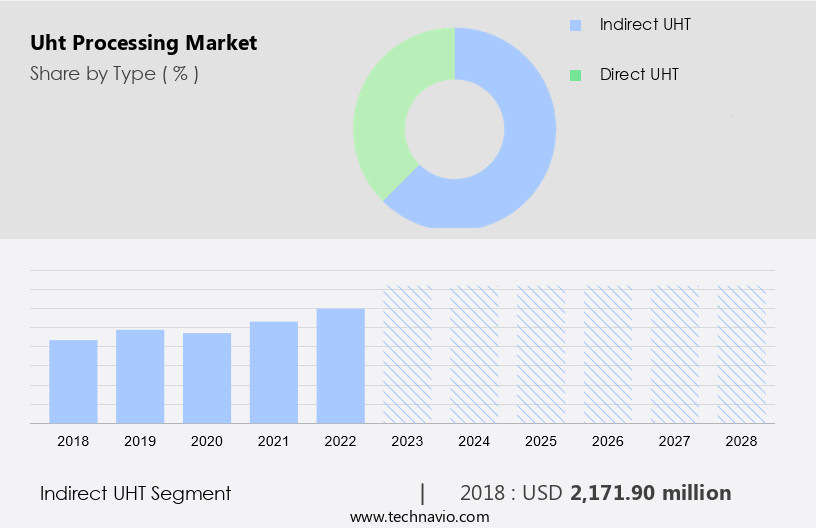
The indirect UHT segment is estimated to witness significant growth during the forecast period.
The market experienced significant growth in 2023, with the indirect heating segment leading the way. Indirect UHT processing involves heating food products without direct contact with the heating source, utilizing cross-flow heat transfer and solid heat exchangers like scraped-surface, tubular, and plate heat exchangers. This method offers a more gentle heat transfer for viscous food items and is extensively used in dairy processing for milk, flavored milk, yogurt drinks, cream, buffalo milk, and formulated dairy products. Ultrahigh temperature processing eliminates bacteria and microorganisms, ensuring extended shelf life and enhanced food safety for perishable products. Machine technologies such as automation and artificial intelligence are integrated into UHT equipment for efficient processing and production.
Get a glance at the market report of share of various segments Request Free Sample
The indirect UHT segment was valued at USD 2.17 billion in 2018 and showed a gradual increase during the forecast period.
Regional Analysis
APAC is estimated to contribute 35% to the growth of the global market during the forecast period. Technavio's analysts have elaborately explained the regional trends and drivers that shape the market during the forecast period.

For more insights on the market size of various regions, Request Free Sample
The market in APAC is anticipated to experience significant growth due to rising personal income, changing consumer preferences, and increasing demand for value-added processed products, including milk, yogurt, jams, candies, cheese, jellies, juices, and other dairy alternatives. The region's processing industry is expected to expand further during the forecast period, driven by investments to enhance processing capacity. UHT machines are widely used for indirect heating and ultrahigh temperature processing of various food and beverage products, such as milk, cream, soup, stew, wine, tomato paste, juices, and dairy desserts. Machine technologies, including automation and artificial intelligence, are increasingly being adopted to improve efficiency and ensure food safety.
The market encompasses various liquid and semi-liquid food products, including dairy, soups, fruit juices, and plant-based beverages. The implementation of aseptic packaging and UHT equipment is crucial for maintaining shelf life and reducing food loss. Key players In the food processing technology sector are focusing on innovation to cater to the growing demand for organic food products, pulps, soy, almonds, oats, rice, dairy-free cheese, ice creams, canned soups, broths, stews, wines, and liquid products.
Market Dynamics
Our researchers analyzed the data with 2023 as the base year, along with the key drivers, trends, and challenges. A holistic analysis of drivers will help companies refine their marketing strategies to gain a competitive advantage.
What are the key market drivers leading to the rise In the adoption of UHT Processing Industry?
- The increasing urbanization and changing consumer lifestyles is the key driver of the market. The market experiences continuous expansion due to shifting consumer preferences and urbanization. With hectic lifestyles and increasing health concerns, there is a growing demand for convenient, nutritious food and beverage options. On-the-go foods and beverages, such as UHT processed juices and snacks, cater to this need. The global trend of snacking between meals has intensified, leading to a rise in demand for these products.
- In metropolitan areas, the working population's preference for quick and healthy options has significantly impacted the foodservice industry, particularly local food chains and smoothie outlets. The economic growth in developing countries, particularly in Asia Pacific, has resulted in increased disposable incomes, further fueling market growth.
What are the market trends shaping the UHT Processing Industry?
- Expansions by dairy processing plants is the upcoming market trend. Dairy processing companies are broadening their horizons by increasing production capacity and introducing new product lines to cater to evolving consumer preferences and expanding market opportunities. For instance, Darigold, a Northwest Dairy Association member and dairy product processor, unveiled plans in October 2020 to expand its organic dairy pool and product offerings.
- Similarly, Milk Mantra Dairy, a leading dairy company, announced in August 2020 its intentions to acquire a plant in Kolkata and establish a new curd manufacturing facility at its existing Odisha plant. These strategic moves underscore the industry's commitment to growth and innovation, ensuring a competitive edge In the dynamic dairy processing market.
What challenges does the UHT Processing Industry face during its growth?
- Health hazards associated with processed products is a key challenge affecting the industry growth. Processed fruit products may contain mycotoxins, which are harmful compounds produced by fungi. Mycotoxins, such as aflatoxins, ochratoxin A, patulin, alternariol, alternariol methyl ether, and altenuene, can pose health risks, including disease and death in extreme cases. Fungal growth during processing is a primary cause of mycotoxin contamination. Although preservatives and additives like sugar enhance taste and flavor, they can diminish nutritional value and contribute to health issues with prolonged consumption.
- In contrast, fresh fruit, when consumed whole, offers natural sweetness, fiber, and essential vitamins, making it a healthier choice. The presence of mycotoxins in processed fruit products underscores the importance of maintaining optimal processing conditions and implementing rigorous quality control measures to ensure consumer safety.
Exclusive Customer Landscape
The UHT processing market forecasting report includes the adoption lifecycle of the market, market growth and forecasting, covering from the innovator's stage to the laggard's stage. It focuses on adoption rates in different regions based on penetration. Furthermore, the UHT processing market report also includes key purchase criteria and drivers of price sensitivity to help companies evaluate and develop their market growth analysis strategies.

Customer Landscape
Key Companies & Market Insights
Companies are implementing various strategies, such as strategic alliances, UHT processing market forecast, partnerships, mergers and acquisitions, geographical expansion, and product/service launches, to enhance their presence In the industry. The industry research and growth report includes detailed analyses of the competitive landscape of the market and information about key companies, including:
- Alfa Laval AB
- Elecster Oyj
- GEA Group AG
- Goma Engineering Pvt. Ltd.
- Granarolo S.p.A.
- Iwai Kikai Kogyo Co. Ltd.
- John Bean Technologies Corp.
- Keventer Agro Ltd.
- Krones AG
- MicroThermics Inc.
- Neologic Engineers Pvt. Ltd.
- Proxes GmbH
- Reda S.p.A.
- Repute Engineers Pvt. Ltd.
- Scherjon Equipment Holland BV
- Shanghai Jimei Food Machinery Co. Ltd.
- Shanghai Triowin Intelligent Machinery Co. Ltd.
- SPX FLOW Inc.
- Tetra Laval SA
- Wilmar International Ltd.
Qualitative and quantitative analysis of companies has been conducted to help clients understand the wider business environment as well as the strengths and weaknesses of key industry players. Data is qualitatively analyzed to categorize companies as pure play, category-focused, industry-focused, and diversified; it is quantitatively analyzed to categorize companies as dominant, leading, strong, tentative, and weak.
Research Analyst Overview
Ultrahigh Temperature (UHT) processing is a modern food and beverage manufacturing technology that ensures long shelf life and maintains the nutritional value and organoleptic properties of perishable products. This processing method utilizes indirect heating techniques, which differ from traditional direct heating methods, to process a wide range of liquid and semi-liquid food products. The indirect heating segment in UHT processing employs steam as a heat transfer medium to heat the product. The product is kept separate from the heating medium, ensuring the product's integrity and preventing contamination from the heating medium. This segment caters to various food and beverage categories, including dairy products such as milk, cream, yogurt, and dairy alternatives like soy, almonds, oats, and rice.
Additionally, it is used for processing honey, soups, stews, wines, tomato paste, juices, and fruit juices. UHT machines play a crucial role In the food and beverage industry by providing aseptic packaging and ensuring food safety. These machines use machine technologies like automation and artificial intelligence to optimize production and improve efficiency. The liquid segment, which includes UHT-processed products, accounts for a significant share of the food and beverage market due to its long shelf life and convenience. Direct UHT processing, an alternative to indirect heating, involves heating the product directly using a heat exchanger. This method is gaining popularity due to its shorter processing time and lower energy consumption.
However, it requires careful control of processing parameters to prevent product degradation and ensure food safety. UHT processing technology offers several advantages, including extended shelf life, improved food safety, and reduced food loss. Refrigeration facilities are no longer required for UHT-processed products, making them an attractive option for food and beverage manufacturers. Furthermore, UHT processing is also used for producing plant-based beverages, canned soups, broths, stews, wines, and dairy-free cheese. Despite the benefits, UHT processing also faces challenges such as high capital investment, complex processing requirements, and the need for specialized equipment. Additionally, the environmental impact of UHT processing, particularly in terms of energy consumption and waste generation, is a concern for some stakeholders.
In summary, UHT processing is a vital technology In the food and beverage industry, offering several advantages such as extended shelf life, improved food safety, and reduced food loss. Indirect heating is the most commonly used method, but direct UHT processing is gaining popularity due to its shorter processing time and lower energy consumption. The liquid segment, which includes UHT-processed products, accounts for a significant share of the food and beverage market. However, challenges such as high capital investment, complex processing requirements, and environmental concerns persist. Continuous innovation and technological advancements are essential to overcome these challenges and ensure the sustainability and growth of the market.
|
Market Scope |
|
|
Report Coverage |
Details |
|
Page number |
166 |
|
Base year |
2023 |
|
Historic period |
2018-2022 |
|
Forecast period |
2024-2028 |
|
Growth momentum & CAGR |
Accelerate at a CAGR of 16.83% |
|
Market growth 2024-2028 |
USD 5.51 billion |
|
Market structure |
Fragmented |
|
YoY growth 2023-2024(%) |
14.01 |
|
Key countries |
US, Germany, China, France, and Australia |
|
Competitive landscape |
Leading Companies, Market Positioning of Companies, Competitive Strategies, and Industry Risks |
What are the Key Data Covered in this UHT Processing Market Research and Growth Report?
- CAGR of the UHT Processing industry during the forecast period
- Detailed information on factors that will drive the growth and forecasting between 2024 and 2028
- Precise estimation of the size of the market and its contribution of the industry in focus to the parent market
- Accurate predictions about upcoming growth and trends and changes in consumer behaviour
- Growth of the market across APAC, Europe, North America, Middle East and Africa, and South America
- Thorough analysis of the market's competitive landscape and detailed information about companies
- Comprehensive analysis of factors that will challenge the UHT processing market growth of industry companies
We can help! Our analysts can customize this UHT processing market research report to meet your requirements.