


Unmanned Sea Systems Market Size 2024-2028
The unmanned sea systems market size is forecast to increase by USD 7.11 billion at a CAGR of 15.21% between 2023 and 2028.
- The market is experiencing significant growth due to increasing applications in various sectors, including oceanographic sampling, underwater photography, marine biology research, underwater acoustic monitoring, autonomous coastal surveillance, and maritime security drones. The demand for stealth platforms and advanced underwater technologies is driving market expansion. Furthermore, substantial investments in undersea warfare capabilities are fueling market growth.
- However, design and operational challenges, such as power management, communication systems, and navigation, remain significant obstacles to market development. In the United States, this market is gaining traction as organizations seek cost-effective, efficient, and safe solutions for underwater exploration and security applications. Key trends include advancements in battery technology, miniaturization of sensors, and the integration of artificial intelligence and machine learning algorithms for data analysis.
What will be the Size of the Market During the Forecast Period?

- The market encompasses a range of advanced technologies designed for various applications in ocean exploration, maritime surveillance, underwater infrastructure inspection, offshore energy exploration, and marine research. These systems include underwater inspection robots, oceanographic research vehicles, autonomous underwater gliders, submarine drones, and marine habitat monitoring solutions, among others. The market for unmanned sea systems is witnessing significant growth due to the increasing demand for efficient and cost-effective solutions for ocean exploration, infrastructure inspection, and offshore energy exploration.
- Additionally, the need for real-time data collection and analysis in marine environments is driving the adoption of autonomous underwater gliders and other advanced sensing technologies. Underwater Inspection and Maintenance The inspection and maintenance of underwater infrastructure, such as pipelines, wind farms, and offshore platforms, is a critical application area for unmanned sea systems. These systems enable efficient and cost-effective inspection of infrastructure in challenging marine environments, reducing the need for costly and time-consuming manned operations. Autonomous Underwater Gliders Autonomous underwater gliders are a type of unmanned sea system that use buoyancy control to move through the water, allowing them to collect data on oceanographic parameters such as temperature, salinity, and currents. These gliders are particularly useful for long-term monitoring of ocean conditions and can provide valuable data for marine research, environmental monitoring, and offshore energy exploration.
- Furthermore, Marine Research and Oceanography Marine research and oceanography are key application areas for unmanned sea systems, with underwater exploration robots, oceanographic research vehicles, and underwater photography equipment being widely used for studies in marine biology, geology, and oceanography. These systems enable researchers to collect high-resolution data and images from the deep ocean, providing valuable insights into marine ecosystems and ocean processes. Offshore Energy Exploration The offshore energy sector is another significant market for unmanned sea systems, with underwater drones and autonomous underwater vehicles being used for seabed mapping, site surveys, and infrastructure inspection. These systems enable efficient and cost-effective exploration and development of offshore energy resources, reducing the need for manned operations in hazardous marine environments.
How is this market segmented and which is the largest segment?
The market research report provides comprehensive data (region-wise segment analysis), with forecasts and estimates in "USD billion" for the period 2024-2028, as well as historical data from 2018-2022 for the following segments.
- Type
- UUVs
- USVs
- Technology
- Remotely operated vehicle
- Autonomous vehicle
- Geography
- North America
- US
- APAC
- China
- Japan
- Europe
- Germany
- France
- South America
- Middle East and Africa
- North America
By Type Insights
- The UUVs segment is estimated to witness significant growth during the forecast period.
Unmanned Underwater Vehicles (UUVs), also known as ocean drones or subsea drones, are essential components of maritime robotics used by naval agencies for underwater mine detection and termination applications. These autonomous systems can be operated remotely by naval personnel or function independently without human intervention. The significance of UUVs is increasing due to growing investments in maritime defense capabilities.
Currently, UUVs serve multiple roles, including submerged mine countermeasure vehicles (MCVs) and naval Intelligence, Surveillance, and Reconnaissance (ISR) and anti-submarine warfare (ASW) operations. UUVs have revolutionized maritime security by ensuring the safety of naval personnel in potentially dangerous situations and transforming traditional security approaches. The future of UUVs lies in their potential to expand their capabilities beyond mine detection and termination, making them indispensable tools for naval agencies.

Get a glance at the market report of share of various segments Request Free Sample
The UUVs segment was valued at USD 2.78 billion in 2018 and showed a gradual increase during the forecast period.
Regional Analysis
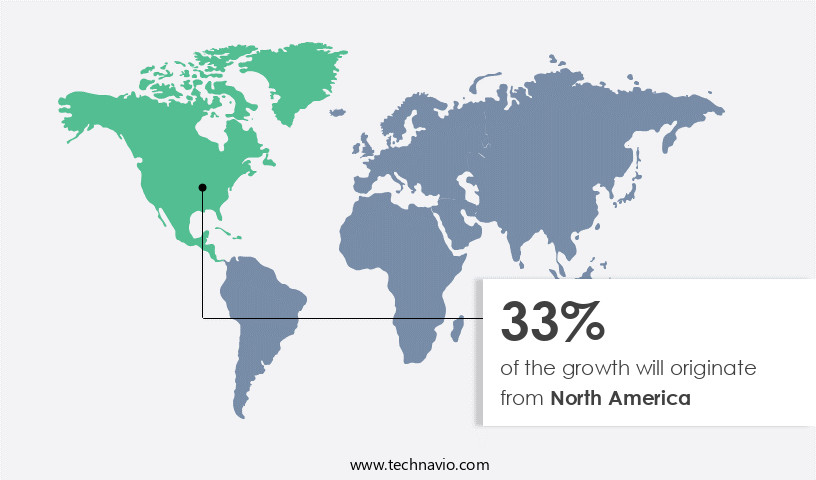
- North America is estimated to contribute 33% to the growth of the global market during the forecast period.
Technavio's analysts have elaborately explained the regional trends and drivers that shape the market during the forecast period.
For more insights on the market share of various regions, Request Free Sample
In North America, the market is experiencing notable expansion, with the United States and Canada being key contributors to the region's revenue growth. The region's market expansion is driven by escalating research and investments in the development of unmanned sea systems. Notable companies, such as Lockheed Martin, General Dynamics, L3Harris Technologies, Teledyne Technologies, and The Boeing Co., are based in North America and are actively investing in research and development to innovate and upgrade their products.
Furthermore, the US Department of Defense (DoD) is increasing its focus on modernizing naval combat capabilities, leading to a heightened demand for advanced unmanned sea systems for the US Navy. These systems are employed for various applications, including marine habitat monitoring, aquatic ecosystem monitoring, underwater infrastructure inspection, offshore energy exploration, underwater pipeline inspection, and subsea cable inspection.
Market Dynamics
Our researchers analyzed the data with 2023 as the base year, along with the key drivers, trends, and challenges. A holistic analysis of drivers will help companies refine their marketing strategies to gain a competitive advantage.
What are the key market drivers leading to the rise in adoption of Unmanned Sea Systems Market?
Growing demand for stealth platforms is the key driver of the market.
- Unmanned underwater systems, including marine wildlife tracking devices, fisheries monitoring drones, underwater archaeology tools, oceanographic survey equipment, and underwater communication systems, have gained significant importance in various industries and research fields. These systems enable the collection of valuable data and information from the ocean floor and marine environments, often in hard-to-reach areas. BAE Systems, a leading defense, technology, and security company, has developed the Talisman UUV, an autonomous underwater vehicle, featuring advanced stealth technology. This technology includes carbon fiber hulls, which ensure a low observability profile underwater, similar to that of stealth aircraft. This innovation enhances the effectiveness of the UUV in performing tasks such as marine wildlife tracking, fisheries monitoring, underwater archaeology, and oceanographic surveys, without disrupting the marine ecosystem or being detected by potential threats.
- Furthermore, underwater communication systems play a crucial role in enabling real-time data transmission between underwater vehicles and surface vessels or onshore facilities. These systems employ various technologies, such as acoustic modems, optical communication, and satellite communication, to ensure reliable and secure data transfer. Marine salvage operations also benefit from the use of unmanned underwater systems, as they can be used to locate and recover sunken vessels, cargo, or other valuable assets. These systems can operate in hazardous environments, reducing the risk to human lives and minimizing the environmental impact of salvage operations. In conclusion, the use of unmanned underwater systems has become essential for various industries and research fields, offering numerous advantages, including enhanced data collection capabilities, reduced operational risks, and environmental sustainability. The integration of stealth technology in these systems further enhances their effectiveness and versatility.
What are the market trends shaping the Unmanned Sea Systems Market?
Growing investments in undersea warfare capabilities are the upcoming trend in the market.
- Unmanned Underwater Vehicles (UUVs) have become an essential component of oceanographic research and military operations due to their stealth capabilities. The increasing importance of undersea warfare in defense strategies has led to significant investments in UUV technology. These vehicles offer advantages such as extended operational duration, reduced risk to personnel, and the ability to gather intelligence in hostile environments. Major countries are investing in UUVs to enhance their naval capabilities.
- For instance, China is expanding its fleet of advanced nuclear attack and ballistic missile submarines, as well as developing nuclear ballistic missiles, to strengthen its undersea presence. The transition from manned to unmanned sea systems is transforming naval warfare. Extensive research and development, coupled with the integration of advanced technology, have improved UUVs' stealth attributes. High-fidelity training further enhances their operational effectiveness.
What challenges does Unmanned Sea Systems Market face during the growth?
Design and operational challenges are key challenges affecting the market growth.
- Unmanned sea systems offer significant benefits to naval forces for oceanographic sampling, underwater photography, marine biology research, underwater acoustic monitoring, autonomous coastal surveillance, and maritime security. However, these systems encounter unique challenges when deployed underwater, including communication issues and payload limitations. The distortion of transmissions caused by water waves and ocean debris pose significant obstacles. Additionally, the presence of a substantial amount of debris on the ocean floor can damage these systems. As a result, the real-time communication capabilities of unmanned sea systems in submerged conditions are significantly reduced, negatively impacting mission effectiveness. To optimize the performance of unmanned sea systems, it is essential to address these challenges.
- However, advancements in underwater communication technologies, such as acoustic modems and optical communication systems, can improve communication reliability. Furthermore, advancements in materials science and engineering can increase the payload capacity and endurance of these systems. By addressing these challenges, unmanned sea systems can provide valuable data and insights for various applications, including environmental monitoring, resource exploration, and security surveillance. In conclusion, unmanned sea systems offer numerous benefits for various applications, but they also present unique challenges when deployed underwater. By investing in research and development in communication technologies and materials science, we can enhance the capabilities of these systems and improve mission effectiveness.
Exclusive Customer Landscape
The market forecasting report includes the adoption lifecycle of the market, covering from the innovator's stage to the laggard's stage. It focuses on adoption rates in different regions based on penetration. Furthermore, the market report also includes key purchase criteria and drivers of price sensitivity to help companies evaluate and develop their market growth analysis strategies.

Customer Landscape
Key Companies & Market Insights
Companies are implementing various strategies, such as strategic alliances, market forecast, partnerships, mergers and acquisitions, geographical expansion, and product/service launches, to enhance their presence in the market. The market research and growth report includes detailed analyses of the competitive landscape of the market and information about key companies, including:
- Advanced Ocean Systems
- BAE Systems Plc
- Boston Engineering
- Elbit Systems Ltd.
- Exail Technologies
- EyeROV
- General Dynamics Corp.
- Hanwha Corp.
- Huntington Ingalls Industries Inc.
- Kongsberg Gruppen ASA
- L3Harris Technologies Inc.
- Lockheed Martin Corp.
- Maritime Robotics
- Maritime Tactical Systems Inc.
- Ocean Aero
- Saab AB
- Teledyne Technologies Inc.
- Thales Group
- The Boeing Co.
- thyssenkrupp AG
Qualitative and quantitative analysis of companies has been conducted to help clients understand the wider business environment as well as the strengths and weaknesses of key market players. Data is qualitatively analyzed to categorize companies as pure play, category-focused, industry-focused, and diversified; it is quantitatively analyzed to categorize companies as dominant, leading, strong, tentative, and weak.
Research Analyst Overview
Unmanned maritime vehicles have gained significant attention in recent years due to their ability to operate in harsh marine environments with minimal human intervention. Autonomous maritime systems, including underwater drones and remote operated vehicles, have revolutionized ocean exploration and underwater inspections. These unmanned vehicles offer numerous benefits, such as increased efficiency, cost savings, and improved safety. Unmanned surface vessels and submarine drones are used for various applications, including oceanographic research, underwater pipeline inspection, and offshore energy exploration. Maritime robotics, including ocean drones and naval drones, are utilized for marine environmental monitoring, underwater infrastructure inspection, and marine wildlife tracking. Underwater exploration robots and autonomous underwater gliders are essential tools for underwater mapping, oceanographic data collection, and underwater photography.
Similarly, subsea drones and underwater communication systems enable real-time data transmission and support marine salvage operations. Marine autonomous systems have become indispensable for marine habitat monitoring, aquatic ecosystem monitoring, and underwater research. Oceanographic surveys and underwater acoustic monitoring are critical applications for these unmanned vehicles. Autonomous coastal surveillance and maritime security drones ensure effective monitoring of coastal areas and maritime borders. In summary, the unmanned maritime vehicles market encompasses a diverse range of applications, from underwater inspections and exploration to marine environmental monitoring and security. These autonomous systems offer numerous benefits and are transforming the way we explore, monitor, and protect our oceans.
|
Market Scope |
|
|
Report Coverage |
Details |
|
Page number |
176 |
|
Base year |
2023 |
|
Historic period |
2018-2022 |
|
Forecast period |
2024-2028 |
|
Growth momentum & CAGR |
Accelerate at a CAGR of 15.21% |
|
Market growth 2024-2028 |
USD 7.11 billion |
|
Market structure |
Fragmented |
|
YoY growth 2023-2024(%) |
14.41 |
|
Key countries |
US, China, Germany, France, and Japan |
|
Competitive landscape |
Leading Companies, Market Positioning of Companies, Competitive Strategies, and Industry Risks |
What are the Key Data Covered in this Market Research and Growth Report?
- CAGR of the market during the forecast period
- Detailed information on factors that will drive the market growth and forecasting between 2024 and 2028
- Precise estimation of the size of the market and its contribution of the market in focus to the parent market
- Accurate predictions about upcoming market growth and trends and changes in consumer behaviour
- Growth of the market across North America, APAC, Europe, South America, and Middle East and Africa
- Thorough analysis of the market's competitive landscape and detailed information about companies
- Comprehensive analysis of factors that will challenge the growth of market companies
We can help! Our analysts can customize this market research report to meet your requirements. Get in touch