


Wearable Health Sensors Market Size 2024-2028
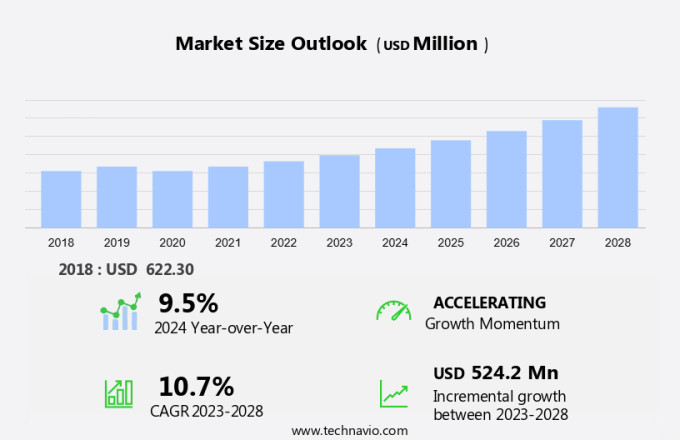
The wearable health sensors market size is forecast to increase by USD 524.2 million at a CAGR of 10.7% between 2023 and 2028.
- The market is experiencing significant growth due to increasing healthcare spending and the rising preference for remote monitoring services. Optical sensors and medical sensors are at the forefront of this trend, with applications in smart watches, fitness bands, smart glasses, smart fabric, bodywear, and footwear. These devices enable users to monitor their vital signs and health metrics in real-time, promoting proactive healthcare and disease management. However, concerns over data privacy remain a challenge, as the collection and sharing of sensitive health information raises ethical and security concerns. To address this, companies must prioritize data security and transparency, ensuring user data is protected and used only with consent. As awareness of the benefits of wearable health sensors continues to grow, the market is poised for continued expansion.
What will be the Size of the Market During the Forecast Period?
- The market is experiencing significant growth as consumers increasingly prioritize fitness awareness and health maintenance. This trend is driven by the digitalization of healthcare and the widespread adoption of consumer electronics, such as smartphones, tablets, and smart devices. Wearable sensors, including accelerometers, optical sensors, and medical sensors, are integral components of this market. These sensors enable the collection of real-time health data, facilitating remote patient monitoring and self-health monitoring. Cardiovascular diseases (CVDS) represent a major health concern, and wearable sensors offer a promising solution. By monitoring heart rate, blood pressure sensors, and other vital signs, these sensors enable early detection and prevention of CVDS. The Internet of Things (IoT) and Machine-to-Machine (M2M) communication play a crucial role in the wearable sensors market. Smart platforms facilitate the seamless exchange of data between sensors, smart devices, and healthcare providers, enhancing the overall effectiveness of remote patient monitoring.
- However, home healthcare is another sector benefiting from wearable sensors. These devices enable elderly individuals and those with chronic conditions to live independently while ensuring their health is closely monitored. Security is a critical concern in the wearable sensors market. Advanced encryption and authentication technologies ensure that sensitive health data remains protected. The integration of wearable sensors with smart technology, such as smartphones and smartwatches, offers unparalleled convenience and accessibility. Users can easily track their fitness and health metrics, receive real-time alerts, and access valuable insights to make informed decisions about their wellbeing. Next-generation sensors continue to emerge, offering enhanced capabilities and functionality. These advancements will further fuel the growth of the wearable sensors market, as consumers increasingly demand more sophisticated health monitoring solutions.
How is this market segmented and which is the largest segment?
The market research report provides comprehensive data (region-wise segment analysis), with forecasts and estimates in "USD million" for the period 2024-2028, as well as historical data from 2018-2022 for the following segments.
- Type
- Heart rate sensors
- Pedometers
- Pressure and temperature sensors
- Geography
- North America
- Canada
- US
- APAC
- China
- India
- Japan
- South Korea
- Europe
- Germany
- UK
- France
- South America
- Brazil
- Middle East and Africa
- North America
By Type Insights
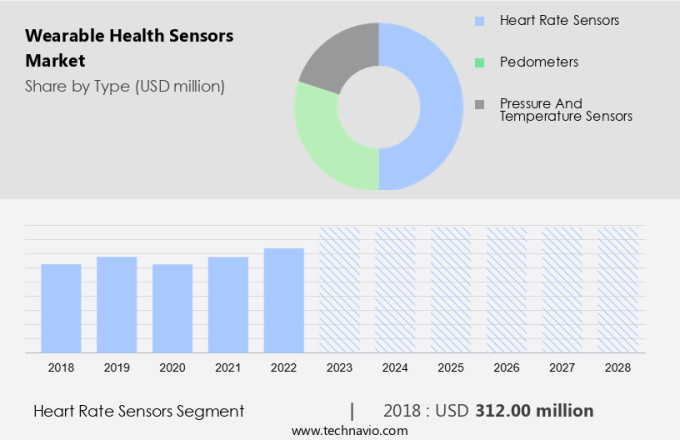
- The heart rate sensors segment is estimated to witness significant growth during the forecast period.
Wearable health sensors, including optical sensors and medical sensors, have gained significant traction in the US market with the increasing awareness of health and wellness. These sensors are integrated into various wearable devices such as smartwatches, fitness bands, smart glasses, smart fabric, bodywear, and footwear. Heart rate monitoring sensors, which utilize a methodology called photoplethysmography (PPG), are among the most common sensors used in wearables.
Furthermore, these sensors employ small light-emitting diodes (LEDs) on the underside of the device to measure blood flow in the user's wrist. The interaction of light with the blood is captured by another sensor, which then processes the data using other sensors and algorithms to generate pulse readings. Most wearables in the form of wristbands utilize these sensors to monitor fitness and health metrics. The inadequate awareness of these advanced health monitoring technologies and the rising healthcare spending are driving the demand for remote monitoring services. These services enable healthcare providers to monitor patients' health conditions in real-time, leading to improved patient outcomes and reduced healthcare costs.
Get a glance at the market report of share of various segments Request Free Sample
The heart rate sensors segment was valued at USD 312.00 million in 2018 and showed a gradual increase during the forecast period.
Regional Analysis
- North America is estimated to contribute 50% to the growth of the global market during the forecast period.
Technavio's analysts have elaborately explained the regional trends and drivers that shape the market during the forecast period.

For more insights on the market share of various regions Request Free Sample
In North America, the adoption of wearable health sensors is experiencing significant growth due to technological innovations and shifting consumer preferences toward health and fitness. The region is a hub for early adopters of new technologies, creating a favorable market for wearable sensors. The presence of major players such as Apple, Fitbit, and Pebble in the US further boosts the market's growth. Wearable sensors, including techno-fashion clothing and wristwear, are integrated into the wearable ecosystem of connected devices. Magnetometers, which detect magnetic fields for position detection, are among the essential sensors used in wearable health technology. Security is a crucial factor in the market, ensuring data privacy and protection. The US is the primary revenue contributor to the North American market, making it a significant market for industry players.
Market Dynamics
Our researchers analyzed the data with 2023 as the base year, along with the key drivers, trends, and challenges. A holistic analysis of drivers will help companies refine their marketing strategies to gain a competitive advantage.
What are the key market drivers leading to the rise in adoption of Wearable Health Sensors Market?
Growing awareness and preference for home healthcare is the key driver of the market.
- The market is experiencing significant growth between 2021 and 2028. This growth can be attributed to the increasing adoption of wearable technology in both the entertainment and healthcare industries. Self-health monitoring through motion-sensing activities, such as fitness and health tracking, has gained popularity among consumers. Fitness trackers and smartwatches, equipped with advanced function sensors, are leading this trend. Sensor manufacturers are capitalizing on this demand, producing innovative devices to meet consumer needs. Also, health awareness is a primary driver for this market's growth, as individuals seek to monitor their well-being and improve their overall fitness.
- The integration of wearable technology into daily life offers a cost-effective and convenient solution for self-health monitoring. Governments and healthcare organizations recognize the potential cost savings of home healthcare, which could lead to a decrease in expensive hospital visits. For instance, home healthcare programs, like hospital reception, enable patients to receive acute care at home, resulting in fewer complications and a 30% cost reduction. Overall, the market is poised for continued expansion, providing valuable insights into personal health and wellness. Thus, such factors are driving the growth of the market during the forecast period.
What are the market trends shaping the Wearable Health Sensors Market?
Increasing adoption of self-monitoring of vital organs is the upcoming trend in the market.
- Wearable sensors have gained significant traction in the market as they enable individuals to monitor their health and maintain fitness through digital means. These sensors, which include devices such as smartwatches and fitness bands, are equipped with features like accelerometers that track movement and collect data on vital signs such as heart rate, temperature, respiration, and blood pressure. This information is crucial for understanding one's overall health and can help prevent or manage conditions like cardiovascular diseases (CVDs). The adoption of smartphones and consumer electronics has further fueled the demand for wearable sensors, as they can seamlessly integrate with these devices for remote patient monitoring and home healthcare.
- This digitalization of health maintenance is increasingly popular, especially in the context of the ongoing pandemic, which has highlighted the importance of self-monitoring and reducing the need for in-person medical visits. Moreover, the rise in the prevalence of chronic diseases, such as CVDs, has necessitated the use of wearable sensors for continuous monitoring and early detection. The market for wearable sensors is expected to grow significantly in the coming years, as more people recognize the benefits of self-monitoring and the convenience of using smart devices for health management.
What challenges does Wearable Health Sensors Market face during its growth?
Data privacy issue is a key challenge affecting the market growth.
- Wearable health sensors, including smart wearables and wellness monitors, have gained significant traction in the digital healthcare industry due to their ability to monitor athletic performance and biometric markers. These sensor-based devices are compact and lightweight, making them ideal for daily use. However, their small size and reliance on batteries pose challenges in terms of battery efficiency. The integration of 5G connections into wearable health sensors is expected to address battery efficiency concerns, enabling faster data transfer and longer battery life. Smart wearables, such as fitness bands and smartwatches, are increasingly popular for sports and fitness enthusiasts, providing real-time data on heart rate, steps taken, and calories burned. Sensor miniaturization is another key trend driving the growth of the market. The development of advanced sensors and chip technology has made it possible to incorporate multiple sensors into a single device, providing comprehensive health monitoring capabilities.
- Moreover, biometric markers, such as heart rate variability, body temperature, and sleep patterns, are essential health indicators that wearable sensors can measure. These markers can help individuals identify potential health issues early and take preventative measures. Security is a critical concern in the market, given the sensitive nature of the data they collect. Ensuring data privacy and security is essential to prevent unauthorized access and data breaches. In conclusion, wearable health sensors offer numerous benefits for individuals seeking to improve their health and fitness. The integration of advanced technologies, such as 5G and sensor miniaturization, is driving innovation in this market. However, battery efficiency and data security remain key challenges that need to be addressed to ensure the widespread adoption of wearable health sensors. Hence, the above factors will impede the growth of the market during the forecast period.
Exclusive Customer Landscape
The market forecasting report includes the adoption lifecycle of the market, covering from the innovator's stage to the laggard's stage. It focuses on adoption rates in different regions based on penetration. Furthermore, the market report also includes key purchase criteria and drivers of price sensitivity to help companies evaluate and develop their market growth analysis strategies.

Customer Landscape
Key Companies & Market Insights
Companies are implementing various strategies, such as strategic alliances, market forecast, partnerships, mergers and acquisitions, geographical expansion, and product/service launches, to enhance their presence in the market.
The market research and growth report includes detailed analyses of the competitive landscape of the market and information about key companies, including:
- Alphabet Inc.
- Analog Devices Inc.
- Apple Inc.
- Arm Ltd.
- Cerca Magnetics Ltd.
- Garmin Ltd.
- greenTEG AG
- Infineon Technologies AG
- Intel Corp.
- Maxim Integrated Products Inc.
- NXP Semiconductors NV
- Omron Healthcare Inc.
- Panasonic Holdings Corp.
- Robert Bosch GmbH
- Sensirion AG
- STMicroelectronics International NV
- TDK Corp.
- TE Connectivity Ltd.
- Texas Instruments Inc.
- VivaLNK Inc.
Qualitative and quantitative analysis of companies has been conducted to help clients understand the wider business environment as well as the strengths and weaknesses of key market players. Data is qualitatively analyzed to categorize companies as pure play, category-focused, industry-focused, and diversified; it is quantitatively analyzed to categorize companies as dominant, leading, strong, tentative, and weak.
Research Analyst Overview
The market is experiencing significant growth due to the increasing focus on fitness awareness and health maintenance. With the digitalization of healthcare, wearable sensors have become an integral part of self-health monitoring and remote patient monitoring. The adoption of smartphones and consumer electronics has fueled the demand for wearable devices, including smartwatches, fitness bands, smart glasses, and bodywear. These devices incorporate advanced sensors such as accelerometers, optical sensors, and medical sensors to monitor various health parameters. Cardiovascular diseases (CVDS) are a major concern, and wearable sensors enable early detection and prevention.
Furthermore, remote monitoring services and smart platforms are driving the market, with the Internet of Things (IoT), machine-to-machine (M2M) communication, and 5G connections facilitating seamless data transfer. Wearable sensors offer position detection through magnetometers and magnetic fields, and the market for wearable technology is expanding into tech-fashion clothing and smart fabric. Security is a key concern, and connected devices require strong security measures to protect user data. The market for wearable sensors is diverse, catering to entertainment, healthcare, sports and fitness, and wellness monitors. The future of wearable sensors lies in next-generation sensors, advanced function sensors, and battery efficiency.
|
Market Scope |
|
|
Report Coverage |
Details |
|
Page number |
168 |
|
Base year |
2023 |
|
Historic period |
2018-2022 |
|
Forecast period |
2024-2028 |
|
Growth momentum & CAGR |
Accelerate at a CAGR of 10.7% |
|
Market Growth 2024-2028 |
USD 524.2 million |
|
Market structure |
Fragmented |
|
YoY growth 2023-2024(%) |
9.5 |
|
Key countries |
US, Canada, China, Germany, Japan, India, UK, South Korea, France, and Brazil |
|
Competitive landscape |
Leading Companies, Market Positioning of Companies, Competitive Strategies, and Industry Risks |
What are the Key Data Covered in this Market Research and Growth Report?
- CAGR of the market during the forecast period
- Detailed information on factors that will drive the market growth and forecasting between 2024 and 2028
- Precise estimation of the size of the market and its contribution of the market in focus to the parent market
- Accurate predictions about upcoming market growth and trends and changes in consumer behaviour
- Growth of the market across North America, APAC, Europe, South America, and Middle East and Africa
- Thorough analysis of the market's competitive landscape and detailed information about companies
- Comprehensive analysis of factors that will challenge the growth of market companies
We can help! Our analysts can customize this market research report to meet your requirements. Get in touch