
Xanthates Market Analysis, Size, and Forecast 2026-2030: APAC (China, Australia, and India), Europe (Poland, Finland, and Sweden), North America (US, Canada, and Mexico), South America (Chile, Peru, and Brazil), Middle East and Africa (South Africa, Saudi Arabia, and Morocco), and Rest of World (ROW)

Xanthates Market Analysis, Size, and Forecast 2026-2030:
APAC (China, Australia, and India), Europe (Poland, Finland, and Sweden), North America (US, Canada, and Mexico), South America (Chile, Peru, and Brazil), Middle East and Africa (South Africa, Saudi Arabia, and Morocco), and Rest of World (ROW)

Published: Oct 2026 323 Pages SKU: IRTNTR80039

Market Overview at a Glance

$150.1 Mn
Market Opportunity
4.8%
CAGR 2025 - 2030
46.6%
APAC Growth
$206.6 Mn
Sodium ethyl xanthate segment 2024

Xanthates Market Size 2026-2030

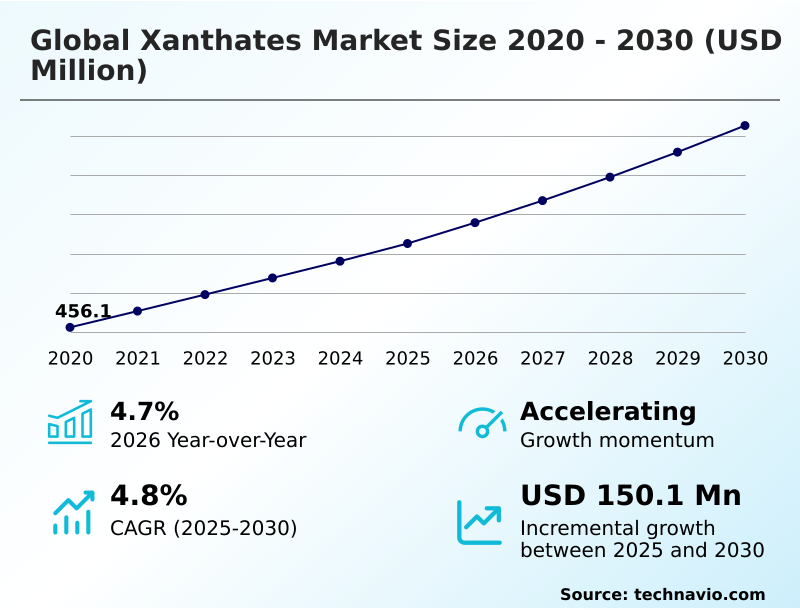
The xanthates market size is valued to increase by USD 150.1 million, at a CAGR of 4.8% from 2025 to 2030. Expansion of global mining operations for essential base metals will drive the xanthates market.

Major Market Trends & Insights

  • APAC dominated the market and accounted for a 46.6% growth during the forecast period.
  • By Type - Sodium ethyl xanthate segment was valued at USD 206.6 million in 2024
  • By Application - Mining segment accounted for the largest market revenue share in 2024

Market Size & Forecast

  • Market Opportunities: USD 256.8 million
  • Market Future Opportunities: USD 150.1 million
  • CAGR from 2025 to 2030 : 4.8%

Market Summary

  • The Xanthates Market functions as a critical enabler for base metal extraction and complex mineral processing. Industrial reliance on these reagents stems from their unique ability to execute hydrophobic surface modification, effectively separating valuable metals from gangue materials.
  • In a real-world operational scenario, mining conglomerates processing declining ore grades deploy automated slurry chemical conditioning networks, which can lower chemical waste by 18% compared to manual dosing methods. A primary driver of this demand is the rapid expansion of electrification infrastructure, which requires massive volumes of copper and nickel recovered via sulfide mineral beneficiation.
  • Conversely, the market faces structural challenges due to stringent environmental regulations governing the hazardous decomposition of the carbon disulfide precursor during storage and transport. Facilities must balance high mineral recovery kinetics with intense safety compliance, compelling a transition toward stable pelletized formats.
  • These shifting dynamics illustrate how metallurgical operations are optimizing resource efficiency while navigating the complex regulatory frameworks associated with hazardous flotation chemicals.

What will be the Size of the Xanthates Market during the forecast period?
Get Key Insights on Market Forecast (PDF) Get Free Sample

How is the Xanthates Market Segmented?

The xanthates industry research report provides comprehensive data (region-wise segment analysis), with forecasts and estimates in "USD million" for the period 2026-2030, as well as historical data from 2020-2024 for the following segments.

  • Type
    • Sodium ethyl xanthate
    • Potassium amyl xanthate
    • Sodium isopropyl xanthate
    • Sodium butyl xanthate
    • Sodium isobutyl xanthate
  • Application
    • Mining
    • Rubber processing
    • Agrochemicals
    • Others
  • Grade type
    • Technical grade
    • Commercial grade
  • Form factor
    • Solid
    • Liquid
  • Geography
    • APAC
      • China
      • Australia
      • India
      • Indonesia
      • Japan
      • South Korea
    • Europe
      • Poland
      • Finland
      • Sweden
      • Spain
      • Germany
    • North America
      • US
      • Canada
      • Mexico
    • South America
      • Chile
      • Peru
      • Brazil
    • Middle East and Africa
      • South Africa
      • Saudi Arabia
      • Morocco
      • UAE

By Type Insights

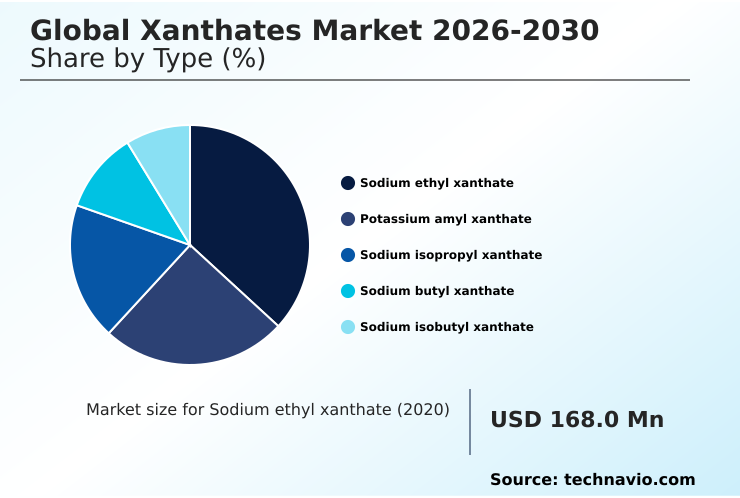
The sodium ethyl xanthate segment is estimated to witness significant growth during the forecast period.

The sodium ethyl xanthate segment relies on a short ethyl structure to enable precision within differential flotation circuits, driving efficient sulfide mineral beneficiation.

Because of its targeted nonpolar group, this chemical agent delivers superior collector selectivity, separating valuable copper and lead from barren iron sulfides. Metallurgical operations deploy this configuration to maximize selective mineral separation while maintaining froth phase stability.

Real-world implementations show that integrating this targeted collector into rougher cell extraction processes reduces inadvertent gangue activation by 15%, significantly elevating final concentrate grades.

This formulation remains integral to sulfhydryl flotation collectors, balancing lower collecting power with enhanced precision to treat increasingly complex mineralogy without inflating reagent consumption intensity across multi-stage cleaner circuits.
Get Free Sample

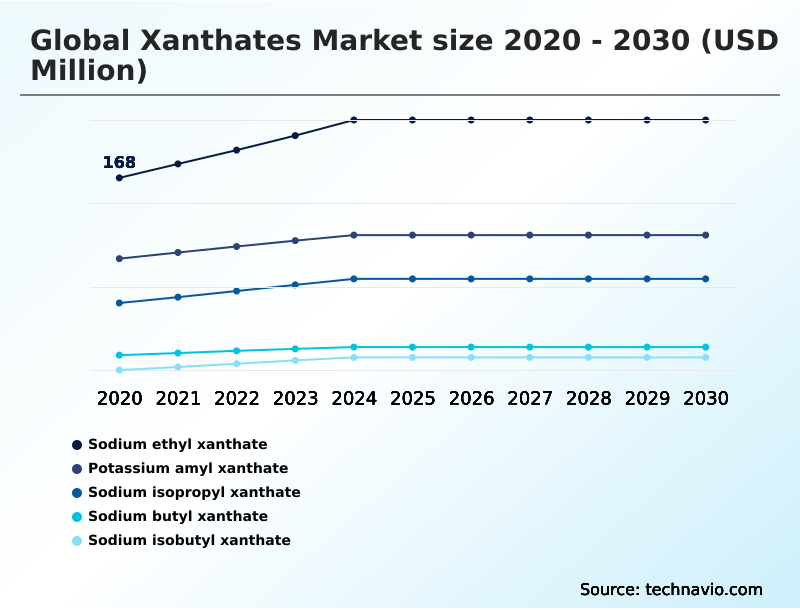
The Sodium ethyl xanthate segment was valued at USD 206.6 million in 2024 and showed a gradual increase during the forecast period.
Get Free Sample

Regional Analysis

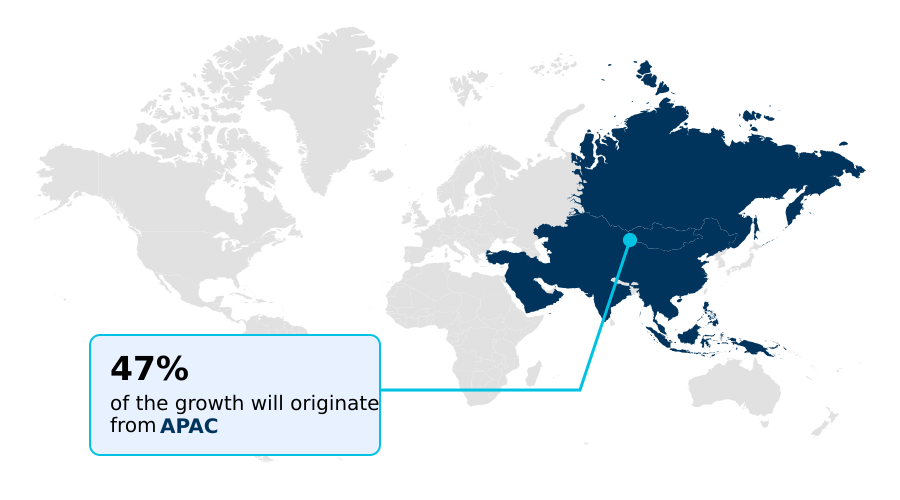
APAC is estimated to contribute 46.6% to the growth of the global market during the forecast period.Technavio’s analysts have elaborately explained the regional trends and drivers that shape the market during the forecast period.
See How Xanthates Market Demand is Rising in APAC Get Free Sample

The geographic landscape of the Xanthates demonstrates distinct operational disparities driven by local polymetallic ore processing demands and regulatory environments.

APAC commands the highest consumption volume due to immense base metal extraction activities, processing ores with significantly lower head grades than established European mines.

By implementing advanced flotation circuit optimization, operations in APAC have improved rougher cell extraction efficiency by 18%, countering the economic impact of declining ore quality.

Conversely, North America enforces rigorous tailings effluent management, compelling a shift toward liquid collector blends that reduce airborne particulate exposure.

This regulatory pivot in North America has lowered hazardous compliance violations by 25% compared to regions relying strictly on dry powders.

Ultimately, adapting pelletized reagent formulation standards allows regional hubs to safely navigate long-distance logistics while maintaining optimal collector selectivity during mineral recovery.

Market Dynamics

Our researchers analyzed the data with 2025 as the base year, along with the key drivers, trends, and challenges. A holistic analysis of drivers will help companies refine their marketing strategies to gain a competitive advantage.

  • The evolution of mineral processing demands an integrated approach to maximize resource recovery while adhering to stringent environmental benchmarks. Central to this objective is improving sulfide mineral beneficiation recovery rates, which directly dictates the profitability of large-scale copper and nickel extraction operations. To combat the inefficiencies of manual chemical handling, modern concentrators are prioritizing automated reagent dosing systems integration.
  • This transition allows metallurgical teams to adjust chemical inputs in real time, reducing excessive reagent waste by 15% relative to conventional static dosing protocols, thereby optimizing supply chain procurement cycles. Furthermore, as high-grade reserves become depleted, facilities encounter complex mineral structures that require precise chemical targeting.
  • Achieving optimal polymetallic ore processing collector selectivity ensures that valuable base metals are efficiently separated from barren gangue, stabilizing production output. Beyond the primary extraction phase, regulatory scrutiny necessitates comprehensive heavy metal precipitation effluent management to prevent toxic discharge into surrounding ecosystems.
  • Mining conglomerates that proactively adopt advanced wastewater remediation strategies experience significantly fewer compliance disruptions than those utilizing legacy treatment methods. To further enhance operational safety and logistical stability, manufacturers are advancing pelletized reagent formulation dust suppression techniques.
  • Converting highly flammable and volatile powders into durable solid pellets minimizes spontaneous decomposition risks during maritime transit, fortifying the reliability of the global chemical supply chain and ensuring uninterrupted deliveries to remote mining districts.
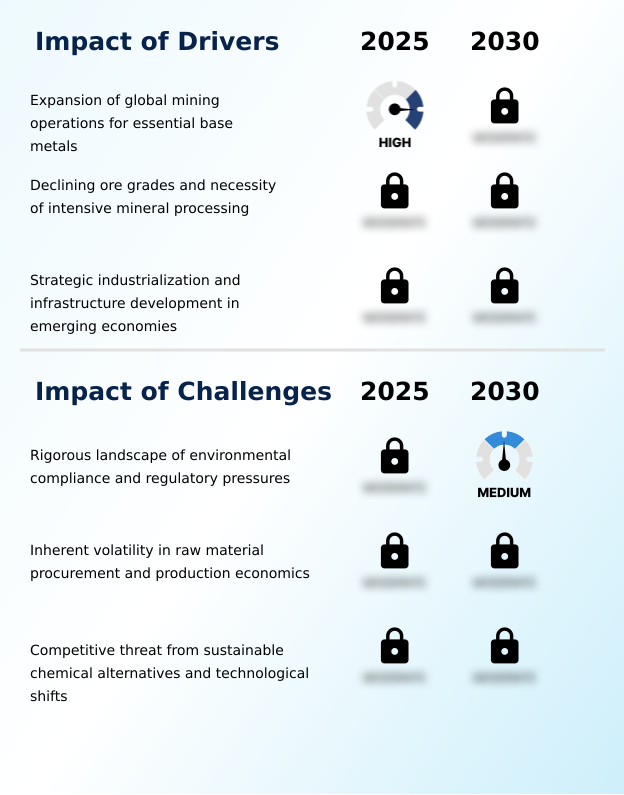
What are the key market drivers leading to the rise in the adoption of Xanthates Industry?

  • The relentless expansion of mining operations to secure essential base metals for industrial and energy transition applications serves as the primary catalyst propelling demand.

  • The relentless global demand for base metals essential to the energy transition serves as the primary catalyst for specialized chemical extraction technologies.
  • Because legacy high-grade deposits are rapidly depleting, mining operations must process complex ores requiring intense hydrophobic surface modification to isolate valuable minerals.
  • This fundamental shift necessitates prolonged scavenger residence time and higher concentrations of dithiocarbonate functional group derivatives to ensure profitable yields.
  • By employing advanced synergistic collector suites, metallurgical plants have enhanced rougher cell extraction efficiency by 20%, significantly mitigating the penalty of declining ore head grades.
  • This widespread adoption empowers operators to maintain high throughput and minimize the volume of unrecovered metals lost to tailings, optimizing overall resource utilization.

What are the market trends shaping the Xanthates Industry?

  • The industry is experiencing a strategic shift toward tailored and blended reagent formulations to address complex ore processing requirements. This transition enables metallurgical operations to optimize collector selectivity and improve overall recovery efficiencies.

  • The transition toward digitalized concentrator operations has triggered a rapid adoption of automated reagent dosing systems across the metallurgical sector. As ore bodies present increasing mineralogy complexity, traditional manual dosing fails to maintain the precise chemical balance required for efficient separation.
  • By utilizing real-time sensor data for slurry chemical conditioning, processing plants dynamically adjust the input of froth flotation reagents based on immediate pulp characteristics. This technological integration has improved overall mineral recovery kinetics by 14% while simultaneously reducing chemical consumption by 18% compared to static delivery methods.
  • Consequently, mining enterprises achieve superior froth phase stability and collector selectivity, directly translating into higher concentrate grades. This trend toward precision chemistry empowers facilities to lower operational expenditures and minimize the environmental impact associated with excess reagent discharge.

What challenges does the Xanthates Industry face during its growth?

  • The rigorous landscape of environmental compliance and intensifying regulatory pressures regarding hazardous chemical decomposition pose significant constraints on production and operational logistics.

  • The inherent chemical instability and hazardous nature of sulfhydryl compounds present severe logistical and operational constraints for the mineral processing sector. Because these reagents are prone to rapid hydrolytic breakdown mitigation issues, they frequently release volatile carbon disulfide precursor gases during transit and storage.
  • This toxicity risk forces facilities to invest heavily in specialized exothermic decomposition control and stringent safety infrastructure, driving up compliance expenditures by nearly 25% relative to non-hazardous chemical handling. Furthermore, the necessity for rigorous heavy metal precipitation and effluent toxicity reduction in wastewater streams complicates discharge protocols.
  • As environmental regulations tighten globally, plants face significant structural hurdles in balancing the required chemical strength for gangue mineral depression against the escalating costs of mandatory ecological stewardship and worker protection.

Exclusive Technavio Analysis on Customer Landscape

The xanthates market forecasting report includes the adoption lifecycle of the market, covering from the innovator’s stage to the laggard’s stage. It focuses on adoption rates in different regions based on penetration. Furthermore, the xanthates market report also includes key purchase criteria and drivers of price sensitivity to help companies evaluate and develop their market growth analysis strategies.
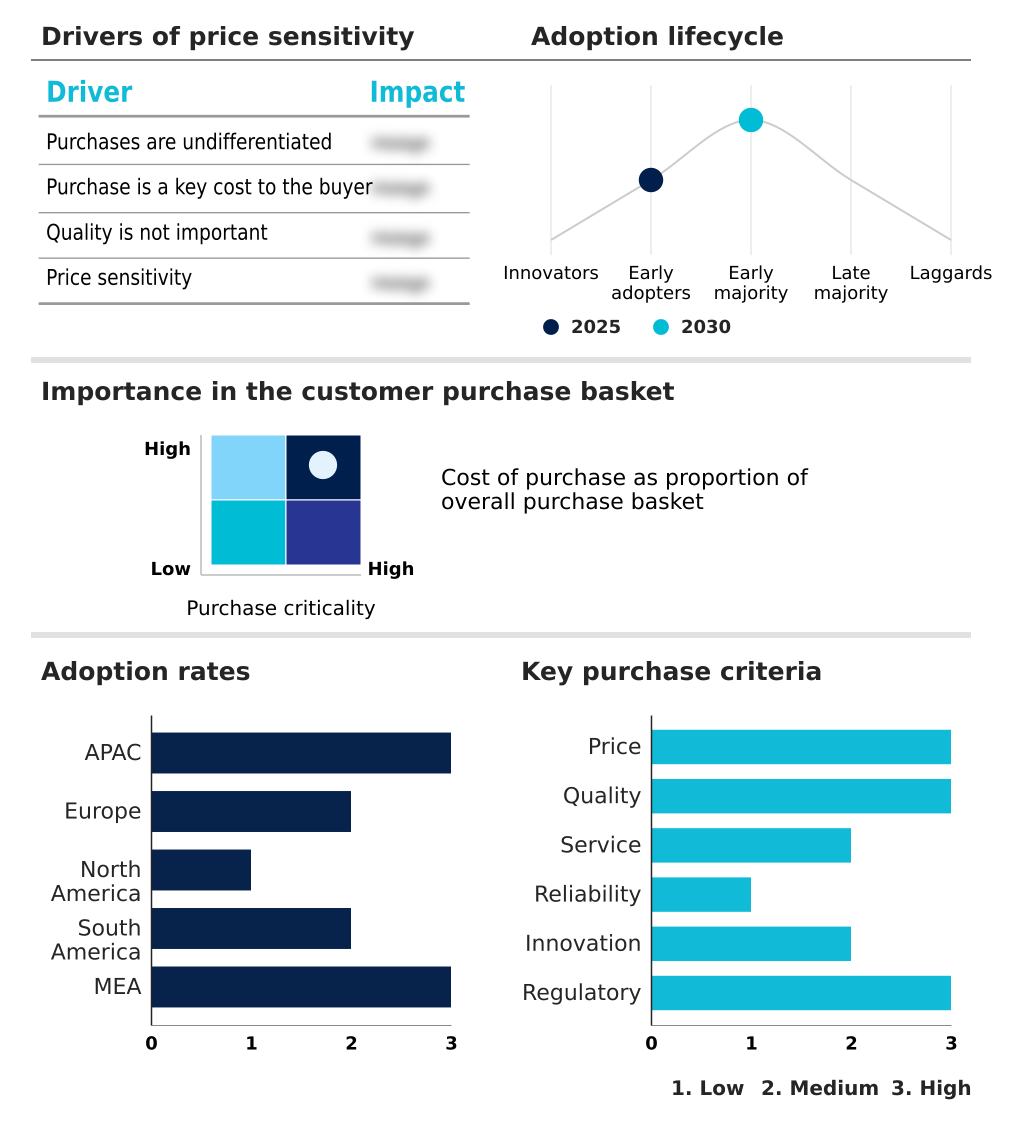
Customer Landscape of Xanthates Industry

Competitive Landscape

Companies are implementing various strategies, such as strategic alliances, xanthates market forecast, partnerships, mergers and acquisitions, geographical expansion, and product/service launches, to enhance their presence in the industry.

AECI Ltd. - The vendor provides specialized chemical collectors, including sodium ethyl, sodium isobutyl, and potassium amyl variants, optimized for efficient mineral separation and advanced froth flotation processes.

The industry research and growth report includes detailed analyses of the competitive landscape of the market and information about key companies, including:

  • AECI Ltd.
  • Arkema Group
  • Bin commerce
  • Canadian Tire Corp. Ltd.
  • Charles Tennant and Co
  • Coogee
  • Gansu Winshine Chemical
  • Hongjin Chemical Co. Ltd.
  • Hunan Fortune Chemical
  • Nasaco International Ltd
  • Orica Ltd.
  • Qingdao Ruchang Mining Industry
  • Rao A Group of Companies
  • Robinson Brothers Ltd.
  • Sellwell Group Flotation
  • Shandong Aotong Chemical Co
  • SNF Group
  • Suyog Inc
  • Syensqo SA
  • Tieling Flotation Reagents Co.

Qualitative and quantitative analysis of companies has been conducted to help clients understand the wider business environment as well as the strengths and weaknesses of key industry players. Data is qualitatively analyzed to categorize companies as pure play, category-focused, industry-focused, and diversified; it is quantitatively analyzed to categorize companies as dominant, leading, strong, tentative, and weak.

Recent Development and News in Xanthates market

  • In the Specialty Chemicals industry, the transition toward digitized process control frameworks has introduced closed-loop automated reagent dosing systems, directly impacting Xanthates demand by reducing chemical consumption intensity by up to 15%.
  • Stringent environmental mandates targeting volatile organic compounds and hazardous decomposition byproducts have accelerated the adoption of pelletized reagent formulation methods, significantly lowering carbon disulfide emission risks during maritime transit.
  • The rapid expansion of the electric vehicle battery manufacturing sector has intensified base metal extraction requirements, driving higher volume consumption of specialized sulfhydryl flotation collectors to process declining ore head grades.
  • Advancements in vulcanization accelerator chemistry have shifted rubber processing protocols toward ultra-fast, low-temperature curing agents, increasing the utilization of specialized dithiocarbonate functional group derivatives to replace traditional nitrosamine-generating compounds.

Dive into Technavio’s robust research methodology, blending expert interviews, extensive data synthesis, and validated models for unparalleled Xanthates Market insights. See full methodology.

Market Scope
Page number 323
Base year 2025
Historic period 2020-2024
Forecast period 2026-2030
Growth momentum & CAGR Accelerate at a CAGR of 4.8%
Market growth 2026-2030 USD 150.1 million
Market structure Fragmented
YoY growth 2025-2026(%) 4.7%
Key countries China, Australia, India, Indonesia, Japan, South Korea, Poland, Russia, Finland, Sweden, Spain, Germany, US, Canada, Mexico, Chile, Peru, Brazil, South Africa, Saudi Arabia, Morocco, Zambia and UAE
Competitive landscape Leading Companies, Market Positioning of Companies, Competitive Strategies, and Industry Risks

Request Free Sample

Research Analyst Overview

  • The operational framework governing the processing of complex mineral resources relies heavily on precision chemical engineering and advanced sulfhydryl flotation collectors. Metallurgical facilities are increasingly prioritizing froth flotation reagents that offer superior target affinity, ensuring highly efficient sulfide mineral beneficiation even as geological quality degrades.
  • This strategic shift toward automated slurry chemical conditioning directly impacts boardroom-level budgeting, as precision delivery systems prevent chemical overconsumption and streamline supply chain procurement. Mining enterprises transitioning to these automated frameworks achieve a 20% reduction in chemical waste compared to legacy manual addition methods.
  • Implementing customized chain transfer agents and highly specific collector formulations allows concentrators to maintain optimal froth phase stability during separation. Strategic formulation choices influence not only the mineral recovery kinetics but also the downstream environmental compliance footprint. By transitioning toward stabilized pelletized formats and liquid solutions, operations successfully manage the volatility of the carbon disulfide precursor, mitigating severe occupational hazards.
  • These adaptive chemical strategies enable heavy industries to balance ambitious production targets with rigorous safety and sustainability mandates.

What are the Key Data Covered in this Xanthates Market Research and Growth Report?

  • What is the expected growth of the Xanthates Market between 2026 and 2030?

    • USD 150.1 million, at a CAGR of 4.8%

  • What segmentation does the market report cover?

    • The report is segmented by Type (Sodium ethyl xanthate, Potassium amyl xanthate, Sodium isopropyl xanthate, Sodium butyl xanthate, and Sodium isobutyl xanthate), Application (Mining, Rubber processing, Agrochemicals, and Others), Grade Type (Technical grade, and Commercial grade), Form Factor (Solid, and Liquid) and Geography (APAC, Europe, North America, South America, Middle East and Africa)

  • Which regions are analyzed in the report?

    • APAC, Europe, North America, South America and Middle East and Africa

  • What are the key growth drivers and market challenges?

    • Expansion of global mining operations for essential base metals, Rigorous landscape of environmental compliance and regulatory pressures

  • Who are the major players in the Xanthates Market?

    • AECI Ltd., Arkema Group, Bin commerce, Canadian Tire Corp. Ltd., Charles Tennant and Co, Coogee, Gansu Winshine Chemical, Hongjin Chemical Co. Ltd., Hunan Fortune Chemical, Nasaco International Ltd, Orica Ltd., Qingdao Ruchang Mining Industry, Rao A Group of Companies, Robinson Brothers Ltd., Sellwell Group Flotation, Shandong Aotong Chemical Co, SNF Group, Suyog Inc, Syensqo SA and Tieling Flotation Reagents Co.

Market Research Insights

  • The Xanthates Market relies on advanced metallurgical technical service to navigate increasing mineralogy complexity across aging ore bodies. As flotation circuit optimization becomes paramount, facilities are shifting toward synergistic collector suites to maximize yield. Implementing closed loop dosing systems has improved reagent consumption intensity ratios by 22%, directly enhancing cost-efficiency in large-scale processing.
  • Furthermore, adopting low-dust pelletized formats has reduced hazardous dust suppression costs by 30%, aligning operations with strict occupational safety protocols. By refining pulp density control and managing the exothermic decomposition control mechanisms, mining enterprises achieve superior recovery rates while minimizing the severe compliance risks associated with toxic effluent discharge.

We can help! Our analysts can customize this xanthates market research report to meet your requirements.

Get in touch

1. Executive Summary

1.1 Market overview

Executive Summary - Chart on Market Overview
Executive Summary - Data Table on Market Overview
Executive Summary - Chart on Global Market Characteristics
Executive Summary - Chart on Market by Geography
Executive Summary - Chart on Market Segmentation by Type
Executive Summary - Chart on Market Segmentation by Application
Executive Summary - Chart on Market Segmentation by Grade Type
Executive Summary - Chart on Market Segmentation by Form Factor
Executive Summary - Chart on Incremental Growth
Executive Summary - Data Table on Incremental Growth
Executive Summary - Chart on Company Market Positioning

2. Technavio Analysis

2.1 Analysis of price sensitivity, lifecycle, customer purchase basket, adoption rates, and purchase criteria

2.2 Criticality of inputs and Factors of differentiation

Chart on Overview on criticality of inputs and factors of differentiation

2.3 Factors of disruption

Chart on Overview on factors of disruption

2.4 Impact of drivers and challenges

Chart on Impact of drivers and challenges in 2025 and 2030

3. Market Landscape

3.1 Market ecosystem

Chart on Parent Market
Data Table on - Parent Market

3.2 Market characteristics

Chart on Market characteristics analysis

3.3 Value chain analysis

Chart on Value chain analysis

4. Market Sizing

4.1 Market definition

Data Table on Offerings of companies included in the market definition

4.2 Market segment analysis

Market segments

4.3 Market size 2025

4.4 Market outlook: Forecast for 2025-2030

Chart on Global - Market size and forecast 2025-2030 ($ million)
Data Table on Global - Market size and forecast 2025-2030 ($ million)
Chart on Global Market: Year-over-year growth 2025-2030 (%)
Data Table on Global Market: Year-over-year growth 2025-2030 (%)

5. Historic Market Size

5.1 Global Xanthates Market 2020 - 2024

Historic Market Size - Data Table on Global Xanthates Market 2020 - 2024 ($ million)

5.2 Type segment analysis 2020 - 2024

Historic Market Size - Type Segment 2020 - 2024 ($ million)

5.3 Application segment analysis 2020 - 2024

Historic Market Size - Application Segment 2020 - 2024 ($ million)

5.4 Grade Type segment analysis 2020 - 2024

Historic Market Size - Grade Type Segment 2020 - 2024 ($ million)

5.5 Form Factor segment analysis 2020 - 2024

Historic Market Size - Form Factor Segment 2020 - 2024 ($ million)

5.6 Geography segment analysis 2020 - 2024

Historic Market Size - Geography Segment 2020 - 2024 ($ million)

5.7 Country segment analysis 2020 - 2024

Historic Market Size - Country Segment 2020 - 2024 ($ million)

6. Qualitative Analysis

6.1 Impact of AI on Global Xanthates Market

6.2 Impact of Geopolitical Conflicts on Global Xanthates Market

7. Five Forces Analysis

7.1 Five forces summary

Five forces analysis - Comparison between 2025 and 2030

7.2 Bargaining power of buyers

Bargaining power of buyers - Impact of key factors 2025 and 2030

7.3 Bargaining power of suppliers

Bargaining power of suppliers - Impact of key factors in 2025 and 2030

7.4 Threat of new entrants

Threat of new entrants - Impact of key factors in 2025 and 2030

7.5 Threat of substitutes

Threat of substitutes - Impact of key factors in 2025 and 2030

7.6 Threat of rivalry

Threat of rivalry - Impact of key factors in 2025 and 2030

7.7 Market condition

Chart on Market condition - Five forces 2025 and 2030

8. Market Segmentation by Type

8.1 Market segments

Chart on Type - Market share 2025-2030 (%)
Data Table on Type - Market share 2025-2030 (%)

8.2 Comparison by Type

Chart on Comparison by Type
Data Table on Comparison by Type

8.3 Sodium ethyl xanthate - Market size and forecast 2025-2030

Chart on Sodium ethyl xanthate - Market size and forecast 2025-2030 ($ million)
Data Table on Sodium ethyl xanthate - Market size and forecast 2025-2030 ($ million)
Chart on Sodium ethyl xanthate - Year-over-year growth 2025-2030 (%)
Data Table on Sodium ethyl xanthate - Year-over-year growth 2025-2030 (%)

8.4 Potassium amyl xanthate - Market size and forecast 2025-2030

Chart on Potassium amyl xanthate - Market size and forecast 2025-2030 ($ million)
Data Table on Potassium amyl xanthate - Market size and forecast 2025-2030 ($ million)
Chart on Potassium amyl xanthate - Year-over-year growth 2025-2030 (%)
Data Table on Potassium amyl xanthate - Year-over-year growth 2025-2030 (%)

8.5 Sodium isopropyl xanthate - Market size and forecast 2025-2030

Chart on Sodium isopropyl xanthate - Market size and forecast 2025-2030 ($ million)
Data Table on Sodium isopropyl xanthate - Market size and forecast 2025-2030 ($ million)
Chart on Sodium isopropyl xanthate - Year-over-year growth 2025-2030 (%)
Data Table on Sodium isopropyl xanthate - Year-over-year growth 2025-2030 (%)

8.6 Sodium butyl xanthate - Market size and forecast 2025-2030

Chart on Sodium butyl xanthate - Market size and forecast 2025-2030 ($ million)
Data Table on Sodium butyl xanthate - Market size and forecast 2025-2030 ($ million)
Chart on Sodium butyl xanthate - Year-over-year growth 2025-2030 (%)
Data Table on Sodium butyl xanthate - Year-over-year growth 2025-2030 (%)

8.7 Sodium isobutyl xanthate - Market size and forecast 2025-2030

Chart on Sodium isobutyl xanthate - Market size and forecast 2025-2030 ($ million)
Data Table on Sodium isobutyl xanthate - Market size and forecast 2025-2030 ($ million)
Chart on Sodium isobutyl xanthate - Year-over-year growth 2025-2030 (%)
Data Table on Sodium isobutyl xanthate - Year-over-year growth 2025-2030 (%)

8.8 Market opportunity by Type

Market opportunity by Type ($ million)
Data Table on Market opportunity by Type ($ million)

9. Market Segmentation by Application

9.1 Market segments

Chart on Application - Market share 2025-2030 (%)
Data Table on Application - Market share 2025-2030 (%)

9.2 Comparison by Application

Chart on Comparison by Application
Data Table on Comparison by Application

9.3 Mining - Market size and forecast 2025-2030

Chart on Mining - Market size and forecast 2025-2030 ($ million)
Data Table on Mining - Market size and forecast 2025-2030 ($ million)
Chart on Mining - Year-over-year growth 2025-2030 (%)
Data Table on Mining - Year-over-year growth 2025-2030 (%)

9.4 Rubber processing - Market size and forecast 2025-2030

Chart on Rubber processing - Market size and forecast 2025-2030 ($ million)
Data Table on Rubber processing - Market size and forecast 2025-2030 ($ million)
Chart on Rubber processing - Year-over-year growth 2025-2030 (%)
Data Table on Rubber processing - Year-over-year growth 2025-2030 (%)

9.5 Agrochemicals - Market size and forecast 2025-2030

Chart on Agrochemicals - Market size and forecast 2025-2030 ($ million)
Data Table on Agrochemicals - Market size and forecast 2025-2030 ($ million)
Chart on Agrochemicals - Year-over-year growth 2025-2030 (%)
Data Table on Agrochemicals - Year-over-year growth 2025-2030 (%)

9.6 Others - Market size and forecast 2025-2030

Chart on Others - Market size and forecast 2025-2030 ($ million)
Data Table on Others - Market size and forecast 2025-2030 ($ million)
Chart on Others - Year-over-year growth 2025-2030 (%)
Data Table on Others - Year-over-year growth 2025-2030 (%)

9.7 Market opportunity by Application

Market opportunity by Application ($ million)
Data Table on Market opportunity by Application ($ million)

10. Market Segmentation by Grade Type

10.1 Market segments

Chart on Grade Type - Market share 2025-2030 (%)
Data Table on Grade Type - Market share 2025-2030 (%)

10.2 Comparison by Grade Type

Chart on Comparison by Grade Type
Data Table on Comparison by Grade Type

10.3 Technical grade - Market size and forecast 2025-2030

Chart on Technical grade - Market size and forecast 2025-2030 ($ million)
Data Table on Technical grade - Market size and forecast 2025-2030 ($ million)
Chart on Technical grade - Year-over-year growth 2025-2030 (%)
Data Table on Technical grade - Year-over-year growth 2025-2030 (%)

10.4 Commercial grade - Market size and forecast 2025-2030

Chart on Commercial grade - Market size and forecast 2025-2030 ($ million)
Data Table on Commercial grade - Market size and forecast 2025-2030 ($ million)
Chart on Commercial grade - Year-over-year growth 2025-2030 (%)
Data Table on Commercial grade - Year-over-year growth 2025-2030 (%)

10.5 Market opportunity by Grade Type

Market opportunity by Grade Type ($ million)
Data Table on Market opportunity by Grade Type ($ million)

11. Market Segmentation by Form Factor

11.1 Market segments

Chart on Form Factor - Market share 2025-2030 (%)
Data Table on Form Factor - Market share 2025-2030 (%)

11.2 Comparison by Form Factor

Chart on Comparison by Form Factor
Data Table on Comparison by Form Factor

11.3 Solid - Market size and forecast 2025-2030

Chart on Solid - Market size and forecast 2025-2030 ($ million)
Data Table on Solid - Market size and forecast 2025-2030 ($ million)
Chart on Solid - Year-over-year growth 2025-2030 (%)
Data Table on Solid - Year-over-year growth 2025-2030 (%)

11.4 Liquid - Market size and forecast 2025-2030

Chart on Liquid - Market size and forecast 2025-2030 ($ million)
Data Table on Liquid - Market size and forecast 2025-2030 ($ million)
Chart on Liquid - Year-over-year growth 2025-2030 (%)
Data Table on Liquid - Year-over-year growth 2025-2030 (%)

11.5 Market opportunity by Form Factor

Market opportunity by Form Factor ($ million)
Data Table on Market opportunity by Form Factor ($ million)

12. Customer Landscape

12.1 Customer landscape overview

Analysis of price sensitivity, lifecycle, customer purchase basket, adoption rates, and purchase criteria

13. Geographic Landscape

13.1 Geographic segmentation

Chart on Market share by geography 2025-2030 (%)
Data Table on Market share by geography 2025-2030 (%)

13.2 Geographic comparison

Chart on Geographic comparison
Data Table on Geographic comparison

13.3 APAC - Market size and forecast 2025-2030

Chart on APAC - Market size and forecast 2025-2030 ($ million)
Data Table on APAC - Market size and forecast 2025-2030 ($ million)
Chart on APAC - Year-over-year growth 2025-2030 (%)
Data Table on APAC - Year-over-year growth 2025-2030 (%)
Chart on Regional Comparison - APAC
Data Table on Regional Comparison - APAC

13.3.1 China - Market size and forecast 2025-2030

Chart on China - Market size and forecast 2025-2030 ($ million)
Data Table on China - Market size and forecast 2025-2030 ($ million)
Chart on China - Year-over-year growth 2025-2030 (%)
Data Table on China - Year-over-year growth 2025-2030 (%)

13.3.2 Australia - Market size and forecast 2025-2030

Chart on Australia - Market size and forecast 2025-2030 ($ million)
Data Table on Australia - Market size and forecast 2025-2030 ($ million)
Chart on Australia - Year-over-year growth 2025-2030 (%)
Data Table on Australia - Year-over-year growth 2025-2030 (%)

13.3.3 India - Market size and forecast 2025-2030

Chart on India - Market size and forecast 2025-2030 ($ million)
Data Table on India - Market size and forecast 2025-2030 ($ million)
Chart on India - Year-over-year growth 2025-2030 (%)
Data Table on India - Year-over-year growth 2025-2030 (%)

13.3.4 Indonesia - Market size and forecast 2025-2030

Chart on Indonesia - Market size and forecast 2025-2030 ($ million)
Data Table on Indonesia - Market size and forecast 2025-2030 ($ million)
Chart on Indonesia - Year-over-year growth 2025-2030 (%)
Data Table on Indonesia - Year-over-year growth 2025-2030 (%)

13.3.5 Japan - Market size and forecast 2025-2030

Chart on Japan - Market size and forecast 2025-2030 ($ million)
Data Table on Japan - Market size and forecast 2025-2030 ($ million)
Chart on Japan - Year-over-year growth 2025-2030 (%)
Data Table on Japan - Year-over-year growth 2025-2030 (%)

13.3.6 South Korea - Market size and forecast 2025-2030

Chart on South Korea - Market size and forecast 2025-2030 ($ million)
Data Table on South Korea - Market size and forecast 2025-2030 ($ million)
Chart on South Korea - Year-over-year growth 2025-2030 (%)
Data Table on South Korea - Year-over-year growth 2025-2030 (%)

13.4 Europe - Market size and forecast 2025-2030

Chart on Europe - Market size and forecast 2025-2030 ($ million)
Data Table on Europe - Market size and forecast 2025-2030 ($ million)
Chart on Europe - Year-over-year growth 2025-2030 (%)
Data Table on Europe - Year-over-year growth 2025-2030 (%)
Chart on Regional Comparison - Europe
Data Table on Regional Comparison - Europe

13.4.1 Poland - Market size and forecast 2025-2030

Chart on Poland - Market size and forecast 2025-2030 ($ million)
Data Table on Poland - Market size and forecast 2025-2030 ($ million)
Chart on Poland - Year-over-year growth 2025-2030 (%)
Data Table on Poland - Year-over-year growth 2025-2030 (%)

13.4.2 Russia - Market size and forecast 2025-2030

Chart on Russia - Market size and forecast 2025-2030 ($ million)
Data Table on Russia - Market size and forecast 2025-2030 ($ million)
Chart on Russia - Year-over-year growth 2025-2030 (%)
Data Table on Russia - Year-over-year growth 2025-2030 (%)

13.4.3 Finland - Market size and forecast 2025-2030

Chart on Finland - Market size and forecast 2025-2030 ($ million)
Data Table on Finland - Market size and forecast 2025-2030 ($ million)
Chart on Finland - Year-over-year growth 2025-2030 (%)
Data Table on Finland - Year-over-year growth 2025-2030 (%)

13.4.4 Sweden - Market size and forecast 2025-2030

Chart on Sweden - Market size and forecast 2025-2030 ($ million)
Data Table on Sweden - Market size and forecast 2025-2030 ($ million)
Chart on Sweden - Year-over-year growth 2025-2030 (%)
Data Table on Sweden - Year-over-year growth 2025-2030 (%)

13.4.5 Spain - Market size and forecast 2025-2030

Chart on Spain - Market size and forecast 2025-2030 ($ million)
Data Table on Spain - Market size and forecast 2025-2030 ($ million)
Chart on Spain - Year-over-year growth 2025-2030 (%)
Data Table on Spain - Year-over-year growth 2025-2030 (%)

13.4.6 Germany - Market size and forecast 2025-2030

Chart on Germany - Market size and forecast 2025-2030 ($ million)
Data Table on Germany - Market size and forecast 2025-2030 ($ million)
Chart on Germany - Year-over-year growth 2025-2030 (%)
Data Table on Germany - Year-over-year growth 2025-2030 (%)

13.5 North America - Market size and forecast 2025-2030

Chart on North America - Market size and forecast 2025-2030 ($ million)
Data Table on North America - Market size and forecast 2025-2030 ($ million)
Chart on North America - Year-over-year growth 2025-2030 (%)
Data Table on North America - Year-over-year growth 2025-2030 (%)
Chart on Regional Comparison - North America
Data Table on Regional Comparison - North America

13.5.1 US - Market size and forecast 2025-2030

Chart on US - Market size and forecast 2025-2030 ($ million)
Data Table on US - Market size and forecast 2025-2030 ($ million)
Chart on US - Year-over-year growth 2025-2030 (%)
Data Table on US - Year-over-year growth 2025-2030 (%)

13.5.2 Canada - Market size and forecast 2025-2030

Chart on Canada - Market size and forecast 2025-2030 ($ million)
Data Table on Canada - Market size and forecast 2025-2030 ($ million)
Chart on Canada - Year-over-year growth 2025-2030 (%)
Data Table on Canada - Year-over-year growth 2025-2030 (%)

13.5.3 Mexico - Market size and forecast 2025-2030

Chart on Mexico - Market size and forecast 2025-2030 ($ million)
Data Table on Mexico - Market size and forecast 2025-2030 ($ million)
Chart on Mexico - Year-over-year growth 2025-2030 (%)
Data Table on Mexico - Year-over-year growth 2025-2030 (%)

13.6 South America - Market size and forecast 2025-2030

Chart on South America - Market size and forecast 2025-2030 ($ million)
Data Table on South America - Market size and forecast 2025-2030 ($ million)
Chart on South America - Year-over-year growth 2025-2030 (%)
Data Table on South America - Year-over-year growth 2025-2030 (%)
Chart on Regional Comparison - South America
Data Table on Regional Comparison - South America

13.6.1 Chile - Market size and forecast 2025-2030

Chart on Chile - Market size and forecast 2025-2030 ($ million)
Data Table on Chile - Market size and forecast 2025-2030 ($ million)
Chart on Chile - Year-over-year growth 2025-2030 (%)
Data Table on Chile - Year-over-year growth 2025-2030 (%)

13.6.2 Peru - Market size and forecast 2025-2030

Chart on Peru - Market size and forecast 2025-2030 ($ million)
Data Table on Peru - Market size and forecast 2025-2030 ($ million)
Chart on Peru - Year-over-year growth 2025-2030 (%)
Data Table on Peru - Year-over-year growth 2025-2030 (%)

13.6.3 Brazil - Market size and forecast 2025-2030

Chart on Brazil - Market size and forecast 2025-2030 ($ million)
Data Table on Brazil - Market size and forecast 2025-2030 ($ million)
Chart on Brazil - Year-over-year growth 2025-2030 (%)
Data Table on Brazil - Year-over-year growth 2025-2030 (%)

13.7 Middle East and Africa - Market size and forecast 2025-2030

Chart on Middle East and Africa - Market size and forecast 2025-2030 ($ million)
Data Table on Middle East and Africa - Market size and forecast 2025-2030 ($ million)
Chart on Middle East and Africa - Year-over-year growth 2025-2030 (%)
Data Table on Middle East and Africa - Year-over-year growth 2025-2030 (%)
Chart on Regional Comparison - Middle East and Africa
Data Table on Regional Comparison - Middle East and Africa

13.7.1 South Africa - Market size and forecast 2025-2030

Chart on South Africa - Market size and forecast 2025-2030 ($ million)
Data Table on South Africa - Market size and forecast 2025-2030 ($ million)
Chart on South Africa - Year-over-year growth 2025-2030 (%)
Data Table on South Africa - Year-over-year growth 2025-2030 (%)

13.7.2 Saudi Arabia - Market size and forecast 2025-2030

Chart on Saudi Arabia - Market size and forecast 2025-2030 ($ million)
Data Table on Saudi Arabia - Market size and forecast 2025-2030 ($ million)
Chart on Saudi Arabia - Year-over-year growth 2025-2030 (%)
Data Table on Saudi Arabia - Year-over-year growth 2025-2030 (%)

13.7.3 Morocco - Market size and forecast 2025-2030

Chart on Morocco - Market size and forecast 2025-2030 ($ million)
Data Table on Morocco - Market size and forecast 2025-2030 ($ million)
Chart on Morocco - Year-over-year growth 2025-2030 (%)
Data Table on Morocco - Year-over-year growth 2025-2030 (%)

13.7.4 Zambia - Market size and forecast 2025-2030

Chart on Zambia - Market size and forecast 2025-2030 ($ million)
Data Table on Zambia - Market size and forecast 2025-2030 ($ million)
Chart on Zambia - Year-over-year growth 2025-2030 (%)
Data Table on Zambia - Year-over-year growth 2025-2030 (%)

13.7.5 UAE - Market size and forecast 2025-2030

Chart on UAE - Market size and forecast 2025-2030 ($ million)
Data Table on UAE - Market size and forecast 2025-2030 ($ million)
Chart on UAE - Year-over-year growth 2025-2030 (%)
Data Table on UAE - Year-over-year growth 2025-2030 (%)

13.8 Market opportunity by geography

Market opportunity by geography ($ million)
Data Tables on Market opportunity by geography ($ million)

14. Drivers, Challenges, and Opportunity

14.1 Market drivers

Expansion of global mining operations for essential base metals
Declining ore grades and necessity of intensive mineral processing
Strategic industrialization and infrastructure development in emerging economies

14.2 Market challenges

Rigorous landscape of environmental compliance and regulatory pressures
Inherent volatility in raw material procurement and production economics
Competitive threat from sustainable chemical alternatives and technological shifts

14.3 Impact of drivers and challenges

Impact of drivers and challenges in 2025 and 2030

14.4 Market opportunities

Strategic shift toward tailored and blended reagent formulations
Integration of automated dosing and digital monitoring technologies
Transition to pelletized and low-dust product formats for enhanced safety

15. Competitive Landscape

15.1 Overview

15.2

Overview on criticality of inputs and factors of differentiation

15.3 Landscape disruption

Overview on factors of disruption

15.4 Industry risks

Impact of key risks on business

16. Competitive Analysis

16.1 Companies profiled

Companies covered

16.2 Company ranking index

16.3 Market positioning of companies

Matrix on companies position and classification

16.4 AECI Ltd.

AECI Ltd. - Overview
AECI Ltd. - Product / Service
AECI Ltd. - Key offerings
SWOT

16.5 Arkema Group

Arkema Group - Overview
Arkema Group - Business segments
Arkema Group - Key news
Arkema Group - Key offerings
Arkema Group - Segment focus
SWOT

16.6 Canadian Tire Corp. Ltd.

Canadian Tire Corp. Ltd. - Overview
Canadian Tire Corp. Ltd. - Product / Service
Canadian Tire Corp. Ltd. - Key offerings
SWOT

16.7 Charles Tennant and Co

Charles Tennant and Co - Overview
Charles Tennant and Co - Product / Service
Charles Tennant and Co - Key offerings
SWOT

16.8 Coogee

Coogee - Overview
Coogee - Product / Service
Coogee - Key offerings
SWOT

16.9 Gansu Winshine Chemical

Gansu Winshine Chemical - Overview
Gansu Winshine Chemical - Product / Service
Gansu Winshine Chemical - Key offerings
SWOT

16.10 Orica Ltd.

Orica Ltd. - Overview
Orica Ltd. - Business segments
Orica Ltd. - Key offerings
Orica Ltd. - Segment focus
SWOT

16.11 Qingdao Ruchang Mining Industry

Qingdao Ruchang Mining Industry - Overview
Qingdao Ruchang Mining Industry - Product / Service
Qingdao Ruchang Mining Industry - Key offerings
SWOT

16.12 Rao A Group of Companies

Rao A Group of Companies - Overview
Rao A Group of Companies - Product / Service
Rao A Group of Companies - Key offerings
SWOT

16.13 Robinson Brothers Ltd.

Robinson Brothers Ltd. - Overview
Robinson Brothers Ltd. - Product / Service
Robinson Brothers Ltd. - Key offerings
SWOT

16.14 Sellwell Group Flotation

Sellwell Group Flotation - Overview
Sellwell Group Flotation - Product / Service
Sellwell Group Flotation - Key offerings
SWOT

16.15 Shandong Aotong Chemical Co

Shandong Aotong Chemical Co - Overview
Shandong Aotong Chemical Co - Product / Service
Shandong Aotong Chemical Co - Key offerings
SWOT

16.16 SNF Group

SNF Group - Overview
SNF Group - Product / Service
SNF Group - Key offerings
SWOT

16.17 Syensqo SA

Syensqo SA - Overview
Syensqo SA - Business segments
Syensqo SA - Key news
Syensqo SA - Key offerings
Syensqo SA - Segment focus
SWOT

16.18 Tieling Flotation Reagents Co.

Tieling Flotation Reagents Co. - Overview
Tieling Flotation Reagents Co. - Product / Service
Tieling Flotation Reagents Co. - Key offerings
SWOT

17. Appendix

17.1 Scope of the report

Market definition
Objectives
Notes and caveats

17.2 Inclusions and exclusions checklist

Inclusions checklist
Exclusions checklist

17.3 Currency conversion rates for US$

17.4 Research methodology

17.5 Data procurement

Information sources

17.6 Data validation

17.7 Validation techniques employed for market sizing

17.8 Data synthesis

17.9 360 degree market analysis

17.10 List of abbreviations

Research Methodology

Technavio presents a detailed picture of the market by way of study, synthesis, and summation of data from multiple sources. The analysts have presented the various facets of the market with a particular focus on identifying the key industry influencers. The data thus presented is comprehensive, reliable, and the result of extensive research, both primary and secondary.

INFORMATION SOURCES

Primary sources

  • Manufacturers and suppliers
  • Channel partners
  • Industry experts
  • Strategic decision makers

Secondary sources

  • Industry journals and periodicals
  • Government data
  • Financial reports of key industry players
  • Historical data
  • Press releases

DATA ANALYSIS

Data Synthesis

  • Collation of data
  • Estimation of key figures
  • Analysis of derived insights

Data Validation

  • Triangulation with data models
  • Reference against proprietary databases
  • Corroboration with industry experts

REPORT WRITING

Qualitative

  • Market drivers
  • Market challenges
  • Market trends
  • Five forces analysis

Quantitative

  • Market size and forecast
  • Market segmentation
  • Geographical insights
  • Competitive landscape

Interested in this report?

Get your sample now to see our research methodology and insights!

Download Now

Frequently Asked Questions

Xanthates market growth will increase by USD 150.1 million during 2026-2030.

The Xanthates market is expected to grow at a CAGR of 4.8% during 2026-2030.

Xanthates market is segmented by Type (Sodium ethyl xanthate, Potassium amyl xanthate, Sodium isopropyl xanthate, Sodium butyl xanthate, Sodium isobutyl xanthate) Application (Mining, Rubber processing, Agrochemicals, Others) Grade type (Technical grade, Commercial grade) Form factor (Solid, Liquid)

AECI Ltd., Arkema Group, Bin commerce, Canadian Tire Corp. Ltd., Charles Tennant and Co, Coogee, Gansu Winshine Chemical, Hongjin Chemical Co. Ltd., Hunan Fortune Chemical, Nasaco International Ltd, Orica Ltd., Qingdao Ruchang Mining Industry, Rao A Group of Companies, Robinson Brothers Ltd., Sellwell Group Flotation, Shandong Aotong Chemical Co, SNF Group, Suyog Inc, Syensqo SA, Tieling Flotation Reagents Co. are a few of the key vendors in the Xanthates market.

APAC will register the highest growth rate of 46.6% among the other regions. Therefore, the Xanthates market in APAC is expected to garner significant business opportunities for the vendors during the forecast period.

China, Australia, India, Indonesia, Japan, South Korea, Poland, Russia, Finland, Sweden, Spain, Germany, US, Canada, Mexico, Chile, Peru, Brazil, South Africa, Saudi Arabia, Morocco, Zambia, UAE

  • Expansion of global mining operations for essential base metals is the driving factor this market.

The Xanthates market vendors should focus on grabbing business opportunities from the Type segment as it accounted for the largest market share in the base year.
RIA - Research AI Assistant
Ask RIA