

Yeast Market Size 2026-2030
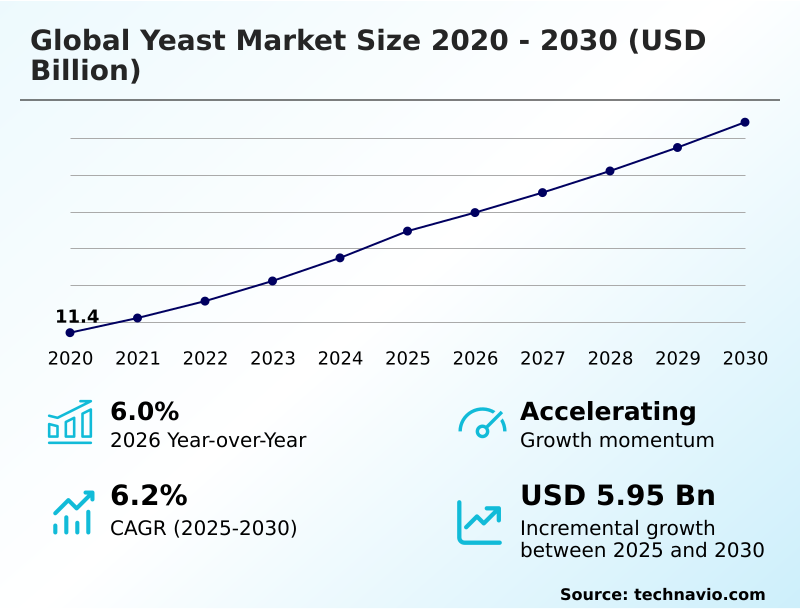
The yeast market size is valued to increase by USD 5.95 billion, at a CAGR of 6.2% from 2025 to 2030. Infrastructure constraints and logistical fragility in fresh yeast distribution will drive the yeast market.
Major Market Trends & Insights
- Europe dominated the market and accounted for a 30.7% growth during the forecast period.
- By Application - Food and beverage segment was valued at USD 7.07 billion in 2024
- By Type - Probiotic yeast segment accounted for the largest market revenue share in 2024
Market Size & Forecast
- Market Opportunities: USD 11.48 billion
- Market Future Opportunities: USD 5.95 billion
- CAGR from 2025 to 2030 : 6.2%
Market Summary
- The Yeast market is undergoing a significant transformation, moving beyond its traditional role as a commodity for baking and brewing toward a sophisticated biotechnological tool. This evolution is driven by the growing demand for natural and sustainable solutions across multiple industries.
- Key trends include the use of nutritional yeast and yeast protein as core components in the expanding plant-based food sector and the application of yeast extract as a clean-label alternative to synthetic flavor enhancers like MSG.
- For example, a food manufacturer seeking to meet consumer demand for healthier products might reformulate its savory snack line, replacing chemical additives with autolyzed yeast to achieve a rich umami flavor profile while simplifying its ingredient list. Concurrently, the bio-economy leverages bioethanol yeast and precision fermentation for creating renewable fuels and bio-based chemicals.
- However, the industry faces challenges from volatile raw material costs, particularly for fermentation substrates, and an increasingly stringent regulatory landscape that demands greater transparency and investment in quality control.
What will be the Size of the Yeast Market during the forecast period?
Get Key Insights on Market Forecast (PDF) Get Free Sample
How is the Yeast Market Segmented?
The yeast industry research report provides comprehensive data (region-wise segment analysis), with forecasts and estimates in "USD million" for the period 2026-2030, as well as historical data from 2020-2024 for the following segments.
- Application
- Food and beverage
- Feed
- Bioethanol
- Others
- Type
- Probiotic yeast
- Bakers yeast
- Brewers yeast
- Wine yeast
- Others
- Form factor
- Dry yeast
- Fresh yeast
- Instant yeast
- Geography
- Europe
- UK
- Germany
- France
- APAC
- China
- India
- Japan
- North America
- US
- Canada
- Mexico
- South America
- Brazil
- Argentina
- Colombia
- Middle East and Africa
- Turkey
- South Africa
- Saudi Arabia
- Rest of World (ROW)
- Europe
By Application Insights
The food and beverage segment is estimated to witness significant growth during the forecast period.
The food and beverage segment is a primary application area, where yeast functions as a crucial leavening agent and flavor enhancer.
The sector's reliance on stable raw materials makes it susceptible to supply chain volatility; for instance, recent drought conditions contributed to a sharp 18% surge in global molasses prices, directly impacting production costs for bakers yeast and brewers yeast.
This volatility underscores the need for innovations in fermentation substrates and genetic strain engineering to ensure consistent output.
As consumer demand for clean-label ingredients grows, the use of yeast extract as a natural flavor enhancer is expanding, moving beyond traditional baking to encompass a wider range of processed foods and leveraging advanced microbial fermentation and oenological yeast techniques for specialized products.
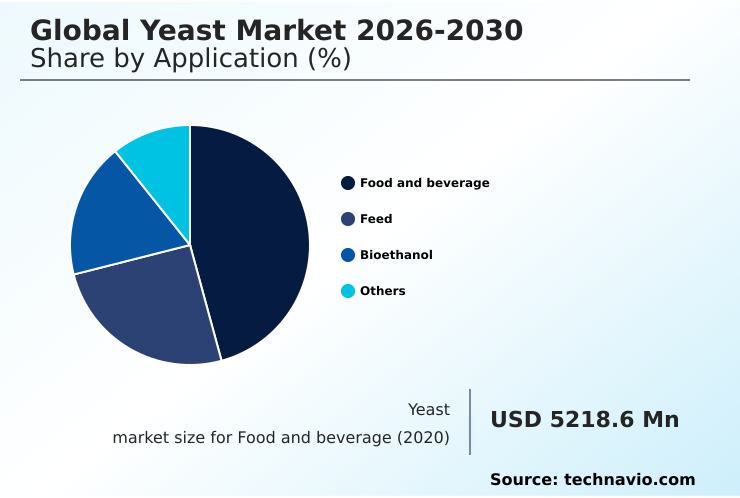
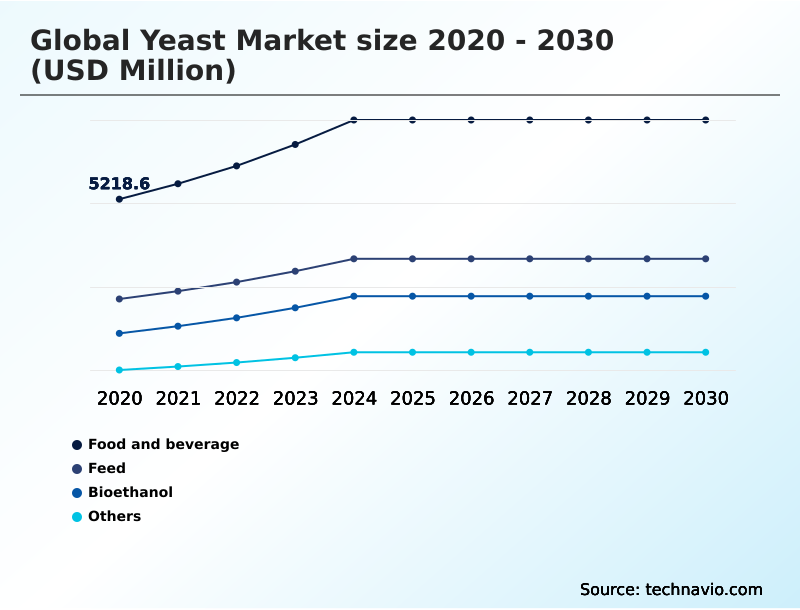
The Food and beverage segment was valued at USD 7.07 billion in 2024 and showed a gradual increase during the forecast period.
Regional Analysis
Europe is estimated to contribute 30.7% to the growth of the global market during the forecast period.Technavio’s analysts have elaborately explained the regional trends and drivers that shape the market during the forecast period.
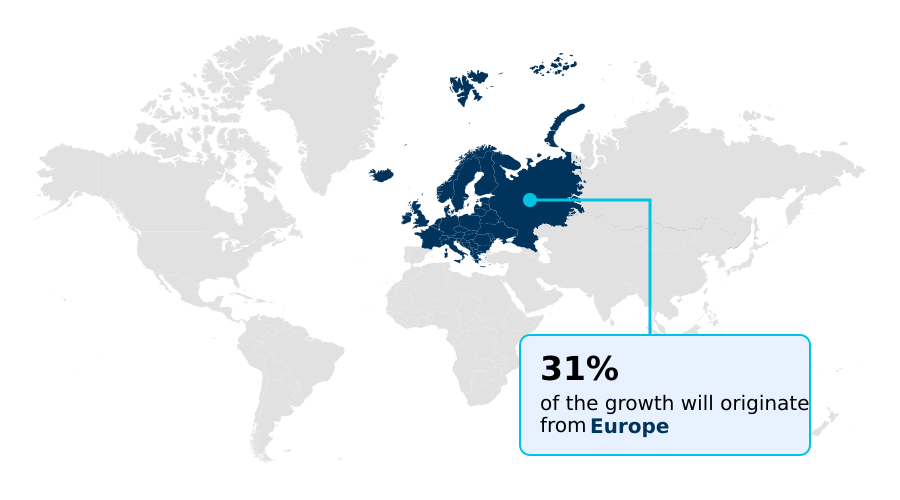
See How Yeast Market Demand is Rising in Europe Get Free Sample
The geographic landscape of the yeast market is characterized by a contrast between mature and high-growth regions.
Europe remains a dominant force, contributing over 30% of the market's incremental growth, driven by a sophisticated food and beverage sector and a strong focus on clean-label ingredients and circular economy principles.
This region's strength lies in high-value yeast derivatives and advanced fermentation technology.
In contrast, APAC is the fastest-growing region, with a projected market expansion rate of 7.0%, fueled by rapid urbanization, rising disposable incomes, and the modernization of dietary habits in countries like China and India.
The demand here is increasingly for instant dry yeast and yeast-based biosolutions that support the expanding bakery, biofuel production, and functional food ingredient sectors, highlighting a global market with diverse regional drivers.
Market Dynamics
Our researchers analyzed the data with 2025 as the base year, along with the key drivers, trends, and challenges. A holistic analysis of drivers will help companies refine their marketing strategies to gain a competitive advantage.
- The global yeast market is undergoing strategic diversification as companies move beyond commodity products to capture value in specialized, high-margin applications. This involves optimizing yeast for bioethanol yield, where producers are achieving significant efficiency gains through advanced fermentation techniques that directly improve supply chain economics.
- Simultaneously, a key focus is the role of yeast in gut health, with extensive research driving the development of targeted probiotic yeast for livestock feed and human supplements. In the food sector, the use of yeast extract as MSG replacement is a major trend, aligning with consumer demand for clean label food production.
- This requires innovations in yeast strain development to create yeast autolysates for flavor enhancement with specific sensory profiles. Winemakers are also leveraging yeast fermentation in winemaking to create unique bouquets, while the craft brewing industry demands specific yeast strains for craft beer brewing.
- This pivot toward specialization extends to animal nutrition, with customized yeast applications in animal nutrition improving feed conversion ratios. Addressing challenges in yeast substrate sourcing and reducing production costs of yeast remain critical operational goals.
- This multifaceted evolution underscores yeast's role in the bioeconomy, where it is increasingly positioned as a key enabler of sustainable and functional solutions across food, feed, and industrial sectors.
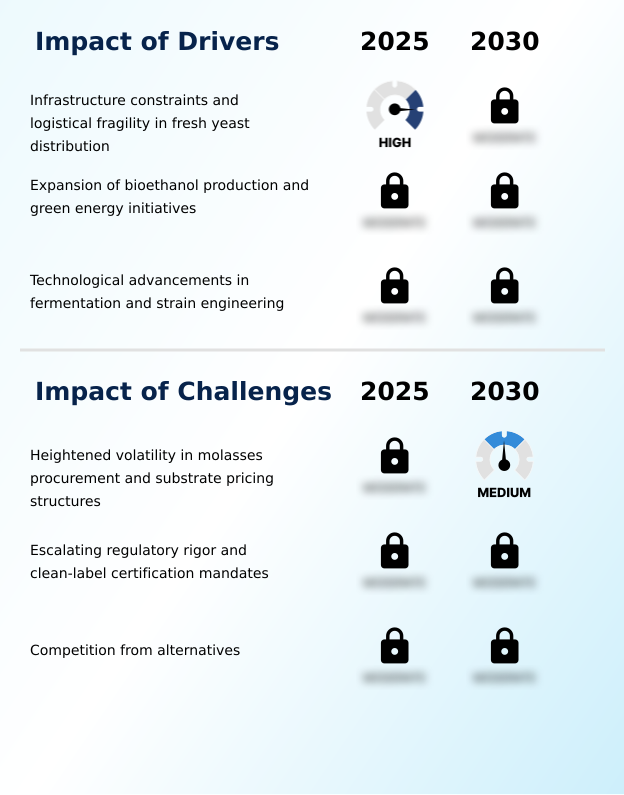
What are the key market drivers leading to the rise in the adoption of Yeast Industry?
- The expansion of bioethanol production, driven by global green energy initiatives and sustainability goals, is a primary driver for the yeast market's growth.
- The market's growth is strongly driven by the global expansion of the bio-economy, particularly in renewable energy and sustainable agriculture. The push for biofuel production has intensified the demand for specialized bioethanol yeast capable of high-gravity fermentation.
- In the UK, the bioethanol yeast market is projected to expand at a rate of 7.3%, reflecting national commitments to green energy.
- This demand creates competition for fermentation substrates, contributing to raw material price volatility, with molasses costs surging by as much as 18% due to competing uses.
- In response, companies are focusing on fermentation efficiency and developing yeast strains with high-temperature tolerance and ethanol concentration tolerance.
- This highlights a dual dynamic where the drive for sustainable energy both fuels the market and creates complex supply chain challenges that require advanced biotechnology applications to resolve.
What are the market trends shaping the Yeast Industry?
- The market is experiencing a significant strategic shift toward plant-based proteins. This is driven by a growing focus on nutritional fortification using advanced yeast-derived ingredients.
- Key trends in the market are centered on health, wellness, and sustainability, driving significant investment in production capacity and innovation. The expansion into bio-ingredients for clean-label applications is accelerating, with manufacturers developing yeast-based dough relaxants and natural flavor enhancers to replace synthetic additives.
- This is supported by tangible investments, such as a new 8,500-ton specialty yeast facility designed for sterile production lines, enhancing capabilities in high-value sectors. The push for sustainable protein solutions has also led to the construction of an 11,000-ton plant for yeast protein, a key ingredient for the alternative protein sector.
- These developments reflect a strategic pivot towards using spent brewers yeast and other byproducts within circular economy principles, creating functional food ingredients that meet modern consumer demands for nutritional fortification and transparency.
What challenges does the Yeast Industry face during its growth?
- Heightened volatility in molasses procurement and fluctuating substrate pricing structures present a significant challenge to the yeast industry's growth and margin stability.
- The market faces significant operational and regulatory challenges that impact profitability and innovation. Raw material volatility is a primary concern, as molasses procurement represents 35-40% of variable production costs, making manufacturers highly sensitive to price fluctuations in fermentation substrates. This is compounded by an increasingly stringent global regulatory environment.
- For example, China's comprehensive ban on specific medically important antibiotics in animal feed forced a rapid pivot to antibiotic-free production, escalating demand for yeast culture and other microbial solutions. This shift, while creating opportunity, placed immense technical and scaling pressure on producers.
- Such regulatory and sourcing pressures necessitate continuous innovation in areas like dough rising and flavor synthesis to maintain a competitive edge and ensure compliance across diverse international markets.
Exclusive Technavio Analysis on Customer Landscape
The yeast market forecasting report includes the adoption lifecycle of the market, covering from the innovator’s stage to the laggard’s stage. It focuses on adoption rates in different regions based on penetration. Furthermore, the yeast market report also includes key purchase criteria and drivers of price sensitivity to help companies evaluate and develop their market growth analysis strategies.
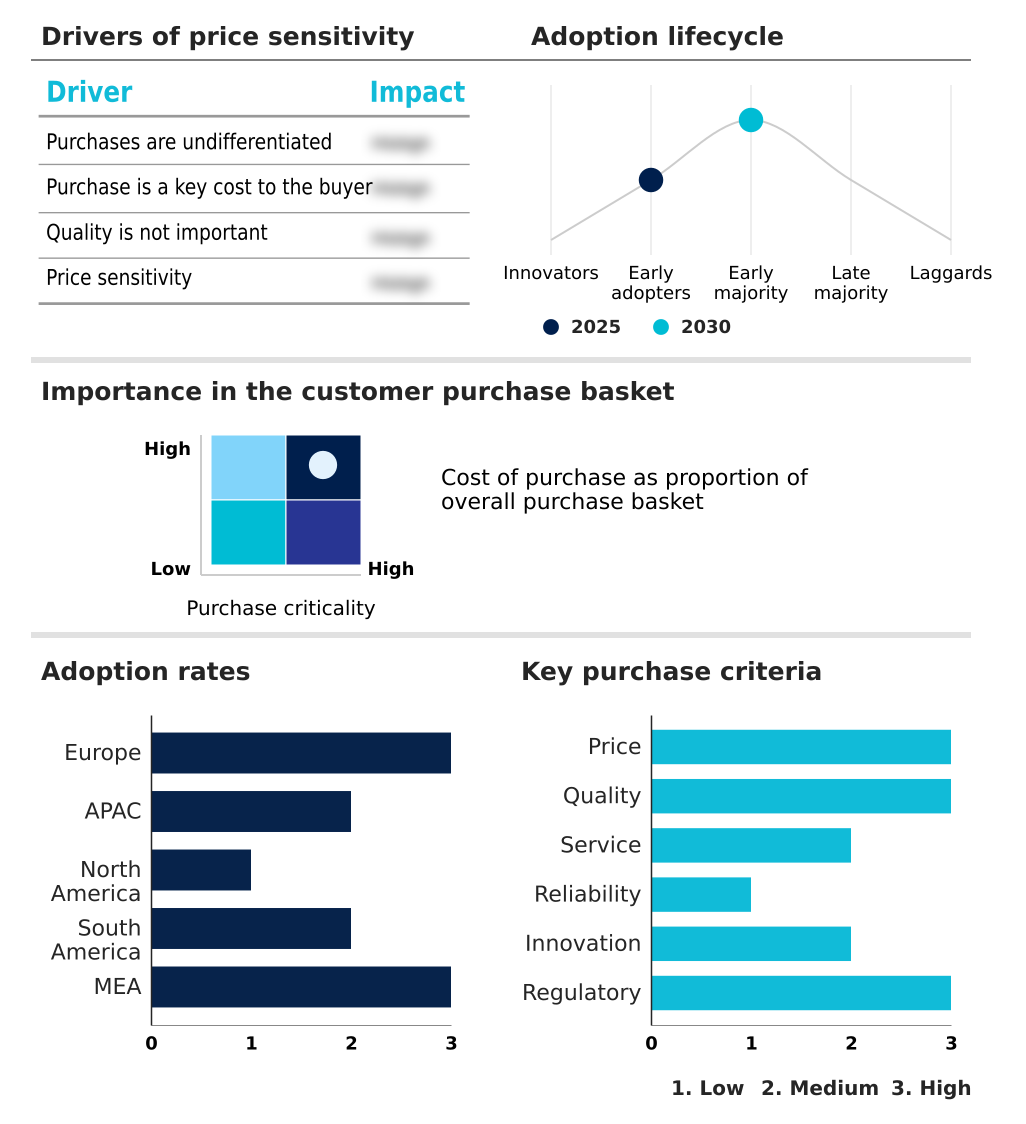
Customer Landscape of Yeast Industry
Competitive Landscape
Companies are implementing various strategies, such as strategic alliances, yeast market forecast, partnerships, mergers and acquisitions, geographical expansion, and product/service launches, to enhance their presence in the industry.
AB Agri Ltd. - Offerings encompass a range of feed-grade, nutritional, and derivative yeast products, engineered to meet diverse industrial and consumer application requirements.
The industry research and growth report includes detailed analyses of the competitive landscape of the market and information about key companies, including:
- AB Agri Ltd.
- AB Mauri UK Ltd.
- Alltech Inc.
- Angel Yeast Co. Ltd.
- Archer Daniels Midland Co.
- Cargill Inc.
- DSM Firmenich AG
- Imperial Yeast
- Kerry Group Plc
- LAFFORT
- Lallemand Inc.
- Leiber GmbH
- Lesaffre and Cie
- Nisshin Seifun Group Inc.
- Novonesis Group
- Novus International Inc.
- Ohly GmbH
- Renaissance BioScience Inc.
- UNIFERM GmbH and Co. KG
Qualitative and quantitative analysis of companies has been conducted to help clients understand the wider business environment as well as the strengths and weaknesses of key industry players. Data is qualitatively analyzed to categorize companies as pure play, category-focused, industry-focused, and diversified; it is quantitatively analyzed to categorize companies as dominant, leading, strong, tentative, and weak.
Recent Development and News in Yeast market
- In June 2025, Novonesis introduced the Innova Eclipse-L and Innova Total A6 yeast biosolutions, which were designed to enhance ethanol fermentation performance during prolonged fermentation cycles.
- In May 2025, Angel Yeast launched its innovative Feravor series at major international exhibitions, featuring floral and buttery yeast-based flavor variants to provide natural flavor enhancement.
- In June 2025, Lesaffre completed the acquisition of a 70% stake in Biorigin, a business unit of the Brazilian sugarcane company Zilor, to bolster its capacity in yeast-derived and savory ingredient solutions.
- In March 2025, Asahi Group Foods entered into a definitive agreement to acquire 100% of the shares of Leiber GmbH, a German manufacturer specializing in brewers yeast products, to expand its global presence.
Dive into Technavio’s robust research methodology, blending expert interviews, extensive data synthesis, and validated models for unparalleled Yeast Market insights. See full methodology.
| Market Scope | |
|---|---|
| Page number | 309 |
| Base year | 2025 |
| Historic period | 2020-2024 |
| Forecast period | 2026-2030 |
| Growth momentum & CAGR | Accelerate at a CAGR of 6.2% |
| Market growth 2026-2030 | USD 5949.6 million |
| Market structure | Fragmented |
| YoY growth 2025-2026(%) | 6.0% |
| Key countries | UK, Germany, France, Italy, Spain, The Netherlands, China, India, Japan, South Korea, Indonesia, Australia, US, Canada, Mexico, Brazil, Argentina, Colombia, Turkey, South Africa, Saudi Arabia, Egypt and UAE |
| Competitive landscape | Leading Companies, Market Positioning of Companies, Competitive Strategies, and Industry Risks |
Research Analyst Overview
- The Yeast market is evolving from a supplier of basic commodities into a pivotal enabler of high-value industrial biotechnology. A significant trend shaping boardroom strategy is the pivot toward functional ingredients and alternative proteins, driven by consumer demand for health and sustainability.
- This requires substantial R&D investment in genetic strain engineering and precision fermentation to develop products like yeast protein and beta-glucans. A clear example of market-shifting forces is the regulatory action in China that banned certain antibiotics in animal feed, compelling a rapid industry-wide adoption of probiotic yeast and mannan-oligosaccharides to maintain livestock health.
- This event highlights how compliance mandates can instantly create new market verticals and underscores the strategic importance of metabolic engineering. Companies are now focusing on creating high-performance saccharomyces cerevisiae, yeast derivatives, and non-saccharomyces strains for applications ranging from wine yeast to advanced dough conditioners, positioning yeast as a critical component in the future of food, feed, and pharmaceuticals.
What are the Key Data Covered in this Yeast Market Research and Growth Report?
-
What is the expected growth of the Yeast Market between 2026 and 2030?
-
USD 5.95 billion, at a CAGR of 6.2%
-
-
What segmentation does the market report cover?
-
The report is segmented by Application (Food and beverage, Feed, Bioethanol, and Others), Type (Probiotic yeast, Bakers yeast, Brewers yeast, Wine yeast, and Others), Form Factor (Dry yeast, Fresh yeast, and Instant yeast) and Geography (Europe, APAC, North America, South America, Middle East and Africa)
-
-
Which regions are analyzed in the report?
-
Europe, APAC, North America, South America and Middle East and Africa
-
-
What are the key growth drivers and market challenges?
-
Infrastructure constraints and logistical fragility in fresh yeast distribution, Heightened volatility in molasses procurement and substrate pricing structures
-
-
Who are the major players in the Yeast Market?
-
AB Agri Ltd., AB Mauri UK Ltd., Alltech Inc., Angel Yeast Co. Ltd., Archer Daniels Midland Co., Cargill Inc., DSM Firmenich AG, Imperial Yeast, Kerry Group Plc, LAFFORT, Lallemand Inc., Leiber GmbH, Lesaffre and Cie, Nisshin Seifun Group Inc., Novonesis Group, Novus International Inc., Ohly GmbH, Renaissance BioScience Inc. and UNIFERM GmbH and Co. KG
-
Market Research Insights
- Market dynamics are shaped by both opportunities and operational pressures. The strategic shift toward antibiotic-free production in livestock farming, exemplified by regulatory changes like China's comprehensive ban on certain antibiotics, has significantly boosted demand for probiotic yeast and feed additives. This pivot highlights the growing preference for natural gut microflora stabilization. Conversely, the industry grapples with significant cost volatility.
- For instance, molasses procurement can account for 35-40% of variable production costs, and recent agricultural and logistical disruptions have led to price surges of up to 18%. This pricing pressure forces manufacturers to innovate in fermentation kinetics and explore alternative substrates to maintain profitability, illustrating a complex interplay between regulatory-driven demand and supply-side economic challenges.
We can help! Our analysts can customize this yeast market research report to meet your requirements.
 RIA -
RIA -